
On 18 August, Simply Wall St flagged a pattern in Meta’s financing that had been building in plain sight for ten months: the company is pairing off-balance-sheet residual value guarantees with corporate bond issuance to fund its AI data-centre build-out, and that combination is now a meaningful driver of the broader rise in corporate bond supply. The framing was descriptive rather than alarmed. Investors, the piece suggested, should watch the footnotes for the size of the guarantees and the leverage ratios once the bonds settle.
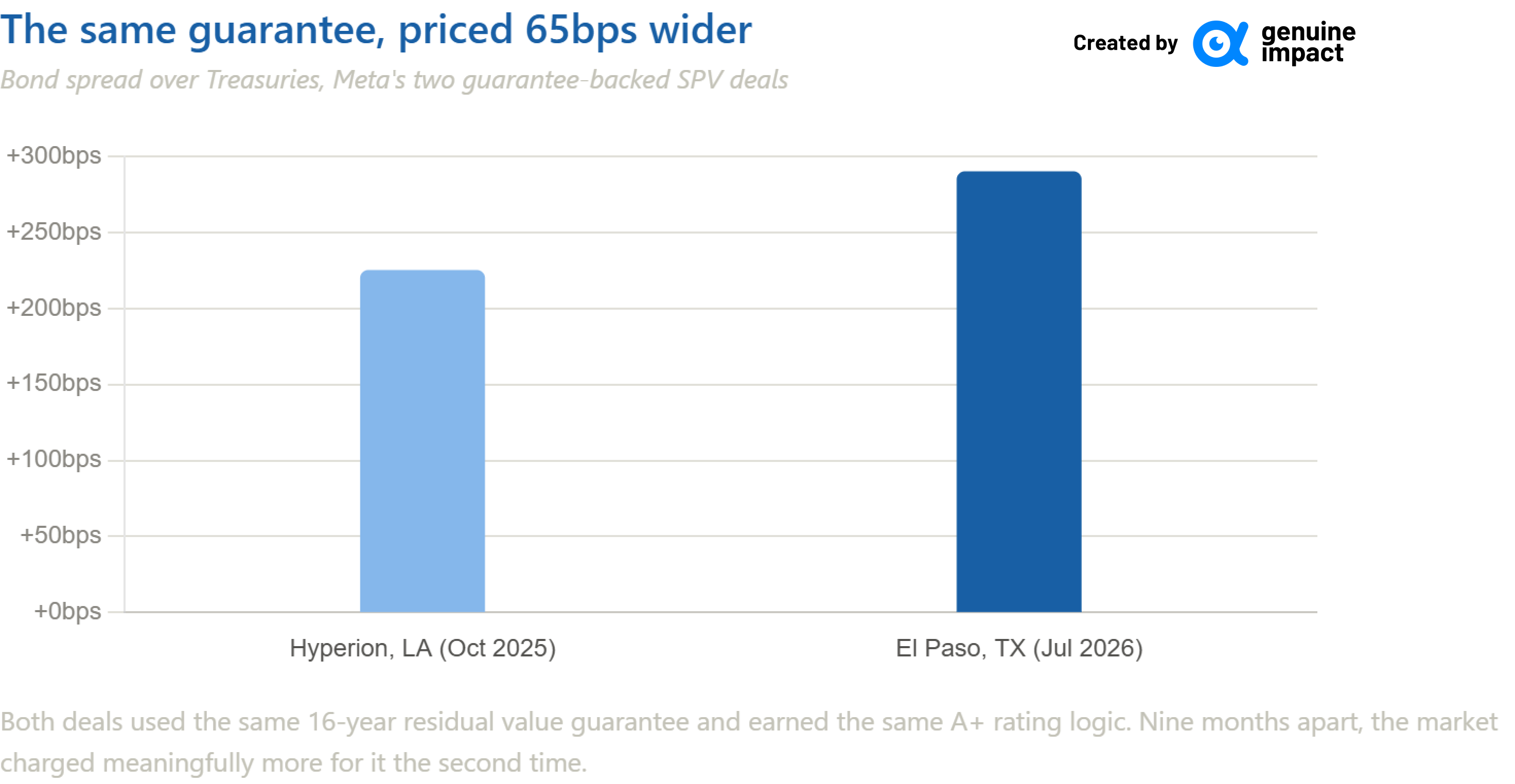
We think the more useful place to watch is not the footnotes. It’s the coupon. Nine months after Meta first used a residual value guarantee to move $27 billion of debt off its balance sheet, at a spread of 225 basis points over Treasuries, it went back to the same structure for a second, smaller project, and the market charged it roughly 65 basis points more, at a yield brushing against speculative-grade territory. The guarantee is designed to convince lenders that Meta, not the special-purpose vehicle, ultimately stands behind the asset’s value. The bond market’s own pricing is the clearest evidence available on whether lenders believe that, and on the second attempt, they priced it as though they believe it rather less than they did the first time.
Start with the mechanism, because “off-balance-sheet” undersells what is actually happening. In October 2025, Meta and funds managed by Blue Owl Capital formed a joint venture to build the Hyperion data centre in Richland Parish, Louisiana, a $27 billion project in which Blue Owl holds 80% and Meta 20%. Morgan Stanley arranged the debt, PIMCO anchored it alongside BlackRock, and S&P rated the resulting bonds A+. Meta is simultaneously the developer, the operator, and the eventual tenant, leasing back a campus it, on paper, does not own.
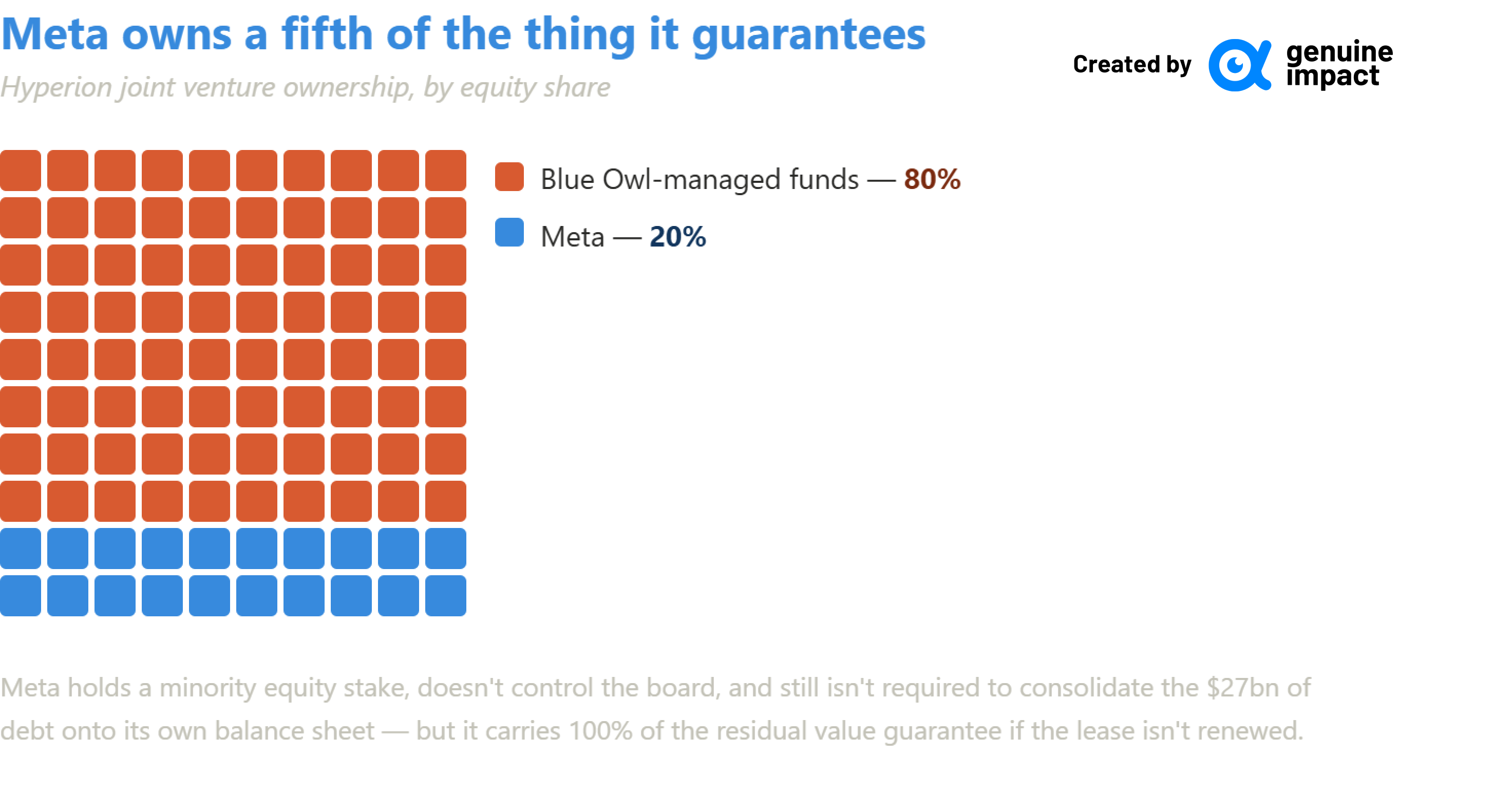
The piece that made the A+ rating possible was Meta’s residual value guarantee: a commitment, running the first 16 years of operation, that if Meta doesn’t renew its lease and the facility’s resale value falls short of an agreed threshold, Meta makes up the difference in a capped cash payment. S&P’s own analyst called the guarantee “the linchpin” of the rating. It is what lets an insurance company buy Louisiana data-centre debt as though it were buying Meta credit risk, without the correlation risk of actually owning Meta equity. Because the joint venture’s board is appointed by Blue Owl rather than Meta, the arrangement typically qualifies for equity-method accounting, Meta records its 20% stake as a financial investment rather than adding $27 billion to its own property, plant and equipment or its own debt.
What Meta gets from this is genuine: the $27 billion doesn’t show up as capex or as debt on its primary balance sheet, even though Meta retains operational control and, through the guarantee, the specific risk that a 2029-vintage AI data centre might be worth less than expected by the mid-2030s. That is a real transfer of financing burden. It is a much smaller transfer of the underlying risk, which is precisely the distinction the July repricing made visible.
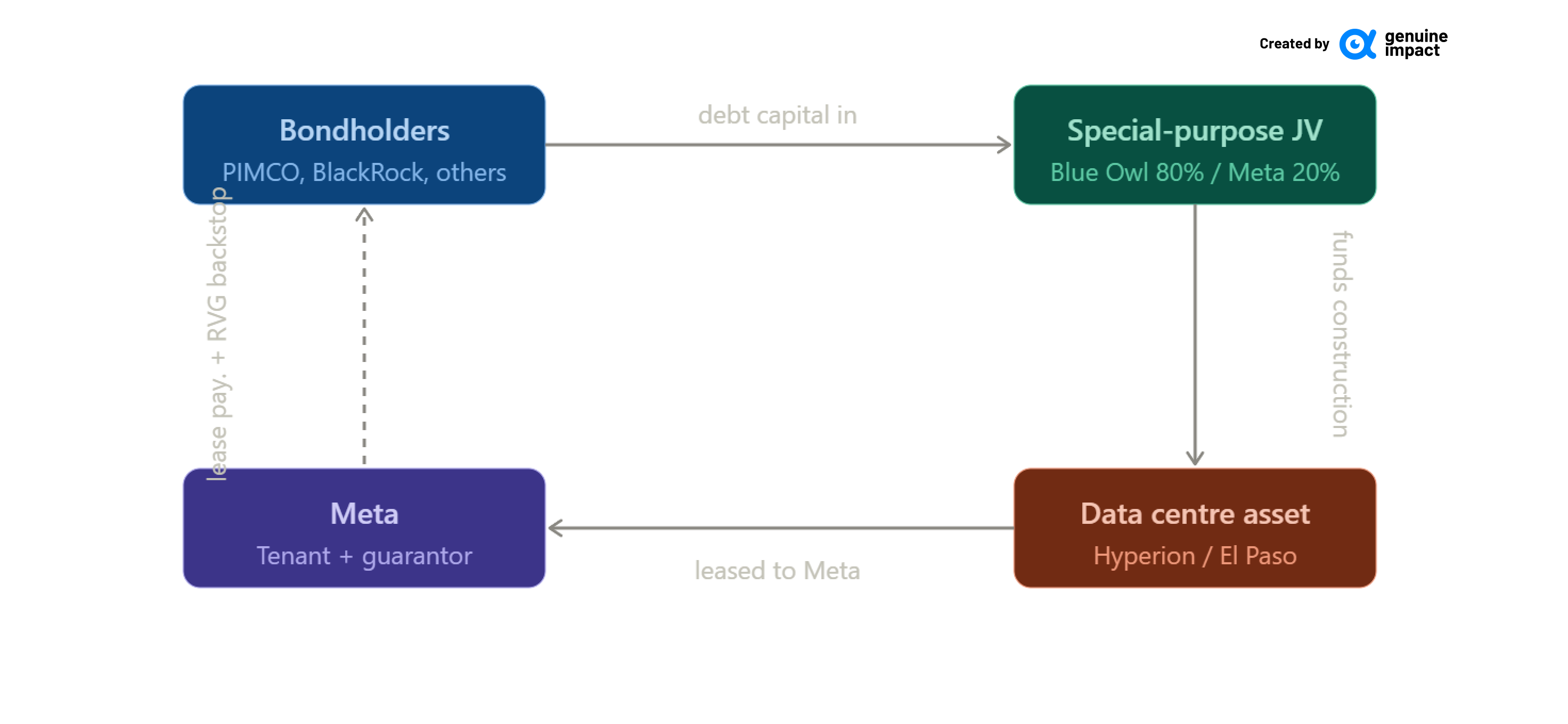
In July 2026, Meta went back to the same playbook for a smaller campus in El Paso, Texas, roughly 1 gigawatt against Hyperion’s targeted 5, and reported at $12 billion to $12.55 billion depending on the report. The vehicle this time is nicknamed Sopaipilla Investor, continuing Meta’s habit of naming these deals after fried dough. The structure is the same: an 80/20 joint venture, a residual value guarantee, a 20-year lease commitment starting in 2028 with four-year renewal windows and penalties for early exit.
The pricing was not the same. Investors reportedly pushed for yields exceeding 7%, as high as 7.5% by some reporting, roughly 290 basis points over Treasuries against Hyperion’s 225, a level more commonly associated with speculative-grade debt than with a company whose implied credit strength was meant to be the entire point of the guarantee. Applied to a $12 billion offering, that gap translates into tens of millions of dollars in additional annual interest expense on this deal alone, and it re-prices every AI infrastructure bond that follows it, because the market now has a second, harder data point on what lenders actually charge for this structure once the novelty has worn off.
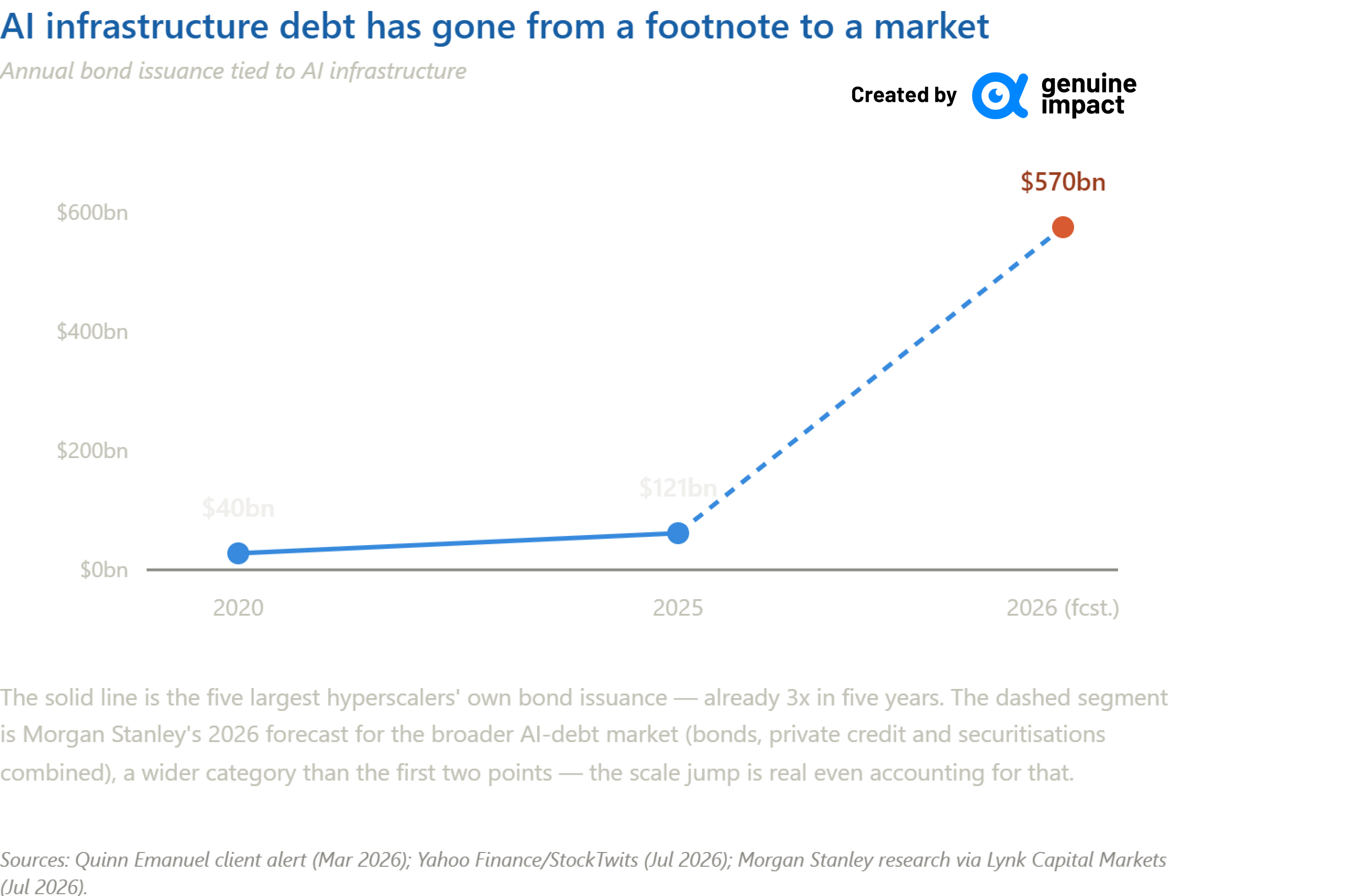
This did not happen to Meta in isolation. Oracle, which has leaned even more heavily on debt to fund its AI data-centre commitments, had its credit rating cut to BBB- by S&P in July, one notch above junk. Existing Microsoft and Amazon bonds, neither directly connected to the Meta deal, traded down as investors recalibrated how much more AI-infrastructure debt is still coming. The Wall Street Journal has described 2026 as a period of quarter-trillion-dollar AI bond issuance testing the market’s absorption capacity; Morgan Stanley puts total AI-related debt issuance for the year near $570 billion, against roughly $121 billion issued by the five largest hyperscalers combined in all of 2025, itself already four times the prior five-year average.
The residual value guarantee is a good tool for exactly one problem: it lets a lender treat project-level debt as though it carries parent-company credit quality, which lowers the coupon relative to a true project-finance deal with no backstop. What it cannot do is make the underlying question, will a data centre built for 2026-generation AI training still be economically useful in year 12 of a 16-year guarantee — any more knowable than it was before the guarantee existed. That question sits underneath every hyperscaler’s server depreciation schedule as well; here it has simply been repackaged as a capped contingent liability rather than an accelerating expense line.
The July repricing suggests the market is starting to treat the guarantee accordingly: useful for getting a rating, not sufficient to hold a spread flat once investors have a second project to compare against the first. If a third Meta vehicle prices wider still, that is the moment the guarantee stops functioning as intended, not because Meta’s promise becomes less real, but because the market decides the promise is worth less than an A+ rating implied it was.
This is not happening in a vacuum. J.P. Morgan estimates hyperscaler capex will reach roughly $697 billion in 2026 alone. Morgan Stanley’s own bridge for the sector puts total global data-centre capital expenditure at roughly $2.9 trillion through 2028, of which hyperscalers’ operating cash flow covers only about $1.4 trillion, leaving a $1.5 trillion gap that the industry expects private credit, corporate bonds and securitised products to fill, with private credit funds alone (Blackstone, Blue Owl, Apollo, PIMCO and BlackRock among them) already sitting on AI-related loan books that have gone from near zero to more than $200 billion in a few years. Meta’s guarantee-and-bond pairing is not a one-off financing trick; it is one visible instance of the mechanism the entire sector is now leaning on to keep the buildout off primary balance sheets while the depreciation question, whether these assets earn their keep before they’re obsolete, remains unresolved.
None of this touches China directly, Meta doesn’t operate there, but the structure is now doing real work in the US-China AI narrative, and it showed up explicitly in reporting the day before the Simply Wall St piece. CNBC’s China Connection newsletter, published 17 August, framed Nvidia’s separate $500 billion financing-platform announcement as “the U.S. advantage in capital,” citing Fitch’s BMI research that private-sector AI investment in the US runs roughly 23 times higher than in mainland China. The same analyst called that financing gap “one of the most durable structural explanations for US leadership”, unless Beijing makes it meaningfully easier for Chinese AI firms to raise capital outside the state system.
Meta’s residual-value-guarantee bonds are a specific instance of exactly the machinery that comparison is describing: a deep, willing, price-discovering private capital market that can absorb a $12 billion junk-adjacent-yield data-centre bond in the space of a week. China is not attempting to replicate that apparatus at the same scale, its widely reported roughly $295 billion, five-year public AI infrastructure plan is smaller than what Meta and Microsoft alone are expected to commit in 2026. Instead, China’s cost advantage runs through state-controlled power pricing and policy-directed capital rather than through a corporate bond market pricing AI risk in real time. The July repricing of Meta’s own debt is, in that light, a data point for both sides of the comparison: it is evidence the US system can still price and absorb enormous, genuinely uncertain infrastructure risk at scale, and evidence of exactly what that pricing costs, in a way the Chinese system, for now, simply doesn’t have to pay.
The spread on the next vehicle. If a third Meta-guaranteed SPV prices wider than El Paso’s roughly 290 basis points, that’s a trend rather than a one-off, and it would be the clearest signal yet that the market is discounting the guarantee’s ability to hold financing costs down.
The size of the contingent liability in Meta’s own filings. Meta’s 10-K will eventually need to disclose the aggregate residual value guarantee exposure across Hyperion, El Paso and any future vehicles. That cumulative number, not the per-deal headline, is what determines how much of the “off-balance-sheet” story is really off Meta’s risk as opposed to merely off its debt line.
Any rating action on Meta itself. Oracle’s move to BBB- is the precedent. A similar signal on Meta, even an outlook change rather than a downgrade, would confirm that rating agencies are starting to weigh the aggregate guarantee exposure across deals, not just the strength of any single A+-rated vehicle.
There is a version of this that resolves cleanly: AI-driven revenue growth outpaces the buildout fast enough that residual values hold, guarantees are never called, and the structure proves to be exactly the efficient capital-markets innovation its architects describe. But financing costs are usually the fastest-moving indicator in any credit story, faster than a ratings action and much faster than an actual default. On that measure, the market’s answer nine months into this experiment was to charge Meta more, not less, for asking it a second time.
Deal mechanics and quotations on Meta’s Hyperion and El Paso financing are compiled from Meta and Blue Owl Capital’s joint press release (21 October 2025), PitchBook, Forbes, Bisnow, Global Data Center Hub and Benzinga reporting on the Hyperion transaction, and Wall Street Journal reporting via MarketScale, GuruFocus, Yahoo Finance/StockTwits and Economy.ac on the El Paso transaction, published between July and August 2026. Sector-wide bond and private-credit figures are drawn from Morgan Stanley research as cited by Yahoo Finance and Lynk Capital Markets, J.P. Morgan’s AI infrastructure financing insights, and Quinn Emanuel’s March 2026 client alert on AI data-centre financing litigation risk. China-comparison figures and quotations are from CNBC’s China Connection newsletter (17 August 2026) and The AI Consulting Network’s analysis of China’s public AI infrastructure plan (June 2026). This information is for guidance purposes and may become out of date at any given time. It is not investment advice. Investments can rise and fall in value. If you are unsure of the suitability of any investment, investment service or strategy, you should seek independent financial advice. Past performance does not indicate future results. Your capital is at risk.
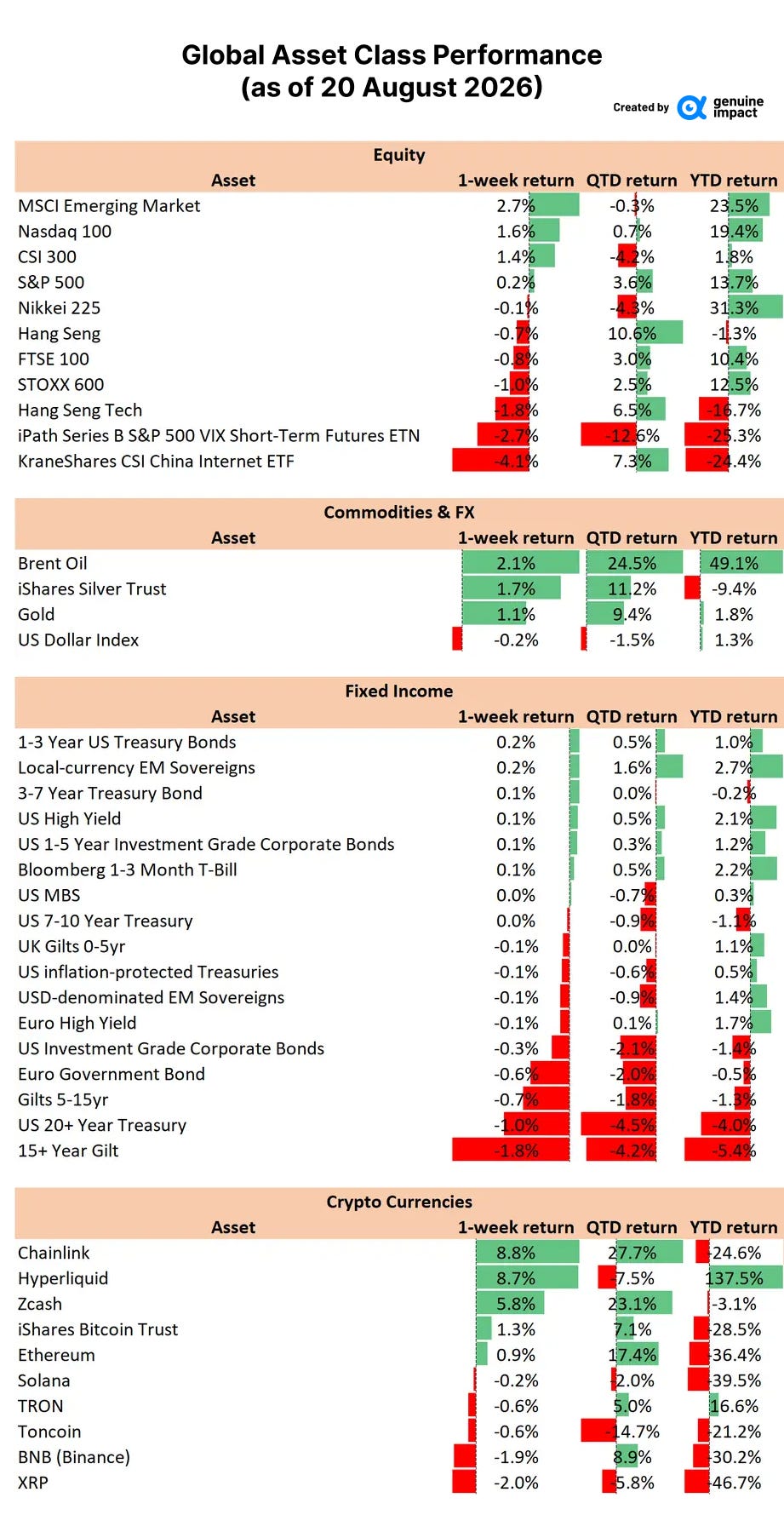
Equities: China led, volatility products got hit hardest. MSCi Emerging Market was the standout at +2.7% on the week, with Nasdaq 100 (+1.6%) and CSI 300 (+1.4%) also firm. The S&P 500 barely moved (+0.2%). On the losing side, the VIX Short-Term Futures ETN fell 2.7% — consistent with a week where risk assets grinded higher rather than sold off — and the KraneShares China Internet ETF dropped 4.1% even as MSCI EM and CSI 300 both rose, a split worth noting given they’re often correlated. Hang Seng Tech (-1.8%) also lagged its broader Hang Seng cousin.
Commodities: broad, quiet strength. Brent Oil (+2.1%), Silver (+1.7%) and Gold (+1.1%) all gained together, while the Dollar Index slipped slightly (-0.2%) — the classic pattern of a softer dollar lifting commodities across the board rather than one story doing the work.
Fixed income: a clean short-vs-long divergence. Short-duration bonds were flat-to-positive (1-3 Year Treasuries +0.2%, US High Yield +0.1%), while long duration sold off hard — the 15+ Year Gilt fell 1.8% and the US 20+ Year Treasury fell 1.0% on the week alone. That’s a bear-steepening signature: the front end held, the long end got hit, likely reflecting a rates or inflation repricing rather than a broad credit scare (US High Yield and Investment Grade Corporates were essentially flat to slightly negative, not stressed).
Crypto: a genuine rotation, not a uniform move. Chainlink (+8.8%) and Hyperliquid (+8.7%) had standout weeks, and Zcash added 5.8% — but XRP (-2.0%), BNB (-1.9%) and the majors (Solana -0.2%, TRON -0.6%, Toncoin -0.6%) were all red. Ethereum (+0.9%) and Bitcoin, via the iShares Trust (+1.3%), sat in between. This is a week where capital moved into specific names rather than the asset class moving together — worth flagging since the YTD numbers for several of this week’s winners (Hyperliquid +137.5% YTD, Chainlink +24.6% YTD) are wildly different from names like Solana (-39.5% YTD) or BNB (-30.2% YTD), so this week’s bounce is happening in names with very different starting points.
The takeaway: short-duration fixed income and broad commodities were the “boring but positive” corner of the sheet this week, long-duration bonds were the clearest loser, and both equities and crypto showed real dispersion underneath calm-looking headline moves — gains concentrated in specific names (China equities, Chainlink/Hyperliquid) rather than broad-based rallies.
‼️ The AI trade flipped roles this week. Last week it was pulling the tape higher — this week, it's where the damage sat. The Nasdaq 100 still eked out a small gain (+1.6%), but that headline number is doing a lot of hiding: Hang Seng Tech fell 1.8%, and the KraneShares China Internet ETF dropped 4.1% even as the broader CSI 300 rose 1.4% — a split that only shows up once you look past the index level. The real question is whether this is profit-taking in the portfolio's structural winners, or an early sign the theme itself is cracking.
🎉 Great news — three stocks in our portfolio gained more than 10% this week.
SanDisk (+43.9%)
The clearest standout of the week, and by a wide margin. On 12 August, SanDisk launched a new QLC flash product aimed squarely at AI inference and data-intensive storage — exactly the kind of demand investors are trying to get ahead of. That was quickly followed by an Investor Day where management laid out real numbers: mid-to-high-teens annual revenue growth, ~80% gross margin, and ~50% adjusted free-cash-flow margin targeted for FY2028–FY2030. JPMorgan upgraded the stock to Overweight on 14 August, and the rally kept building into 17 August as the market leaned further into the idea of an AI-memory bottleneck.
Micron (+17.1%)
Micron rode the wave created by SanDisk. The 12 August flash launch and SanDisk’s 13 August long-term guidance improved the read-through for memory demand sector-wide, and New Street upgraded Micron to Buy from Hold on 14 August, arguing the valuation looked compelling as gross margins normalise. The stock added another 4.1% on 17 August as the memory-bottleneck narrative broadened beyond SanDisk alone.
Lenovo (+13.5%)
Lenovo’s move came from its own numbers, not sector sentiment. First-quarter revenue for FY2026/27 grew 43% year-on-year to a record $26.94bn — more than double the ~19% growth the market was expecting — with adjusted attributable profit up 176% to $1.08bn. AI-related revenue grew 60%, and the AI-server pipeline reached $54bn, reinforcing the case that infrastructure growth can offset softness in mature device categories. The stock jumped 20.2% on the 13 August print, though about half that gain has since unwound, with the shares down 10.0% over the following three sessions as the initial re-rating cooled.
Want to see the rest of the portfolio’s holdings, weights, and what we’re watching next? Subscribe to unlock the full breakdown below ⬇️
Comments
Nothing yet. Say the first thing.
Sign in to join the conversation.