
The Alibaba group unveiled Qwen3.8-Max on August 3, this saw their Hong Kong shares rise 7% and the New York ADR 4.5%, taking the stock to $127.82. Qwen3.8-Max is a 2.4 trillion parameter model that topped the Chinese language leaderboard on Arena.AI. That session capped a run from $91.99 on 26 June, a 39% move over the course of five weeks, dramatically outperforming the Nasdaq 100 that has remained roughly flat over the same period. The stock is now overbought on every conventional measure, with a 14-day RSI above 80, sitting just below chart resistance at $128. Begging the question as to whether investors have been too optimistic.
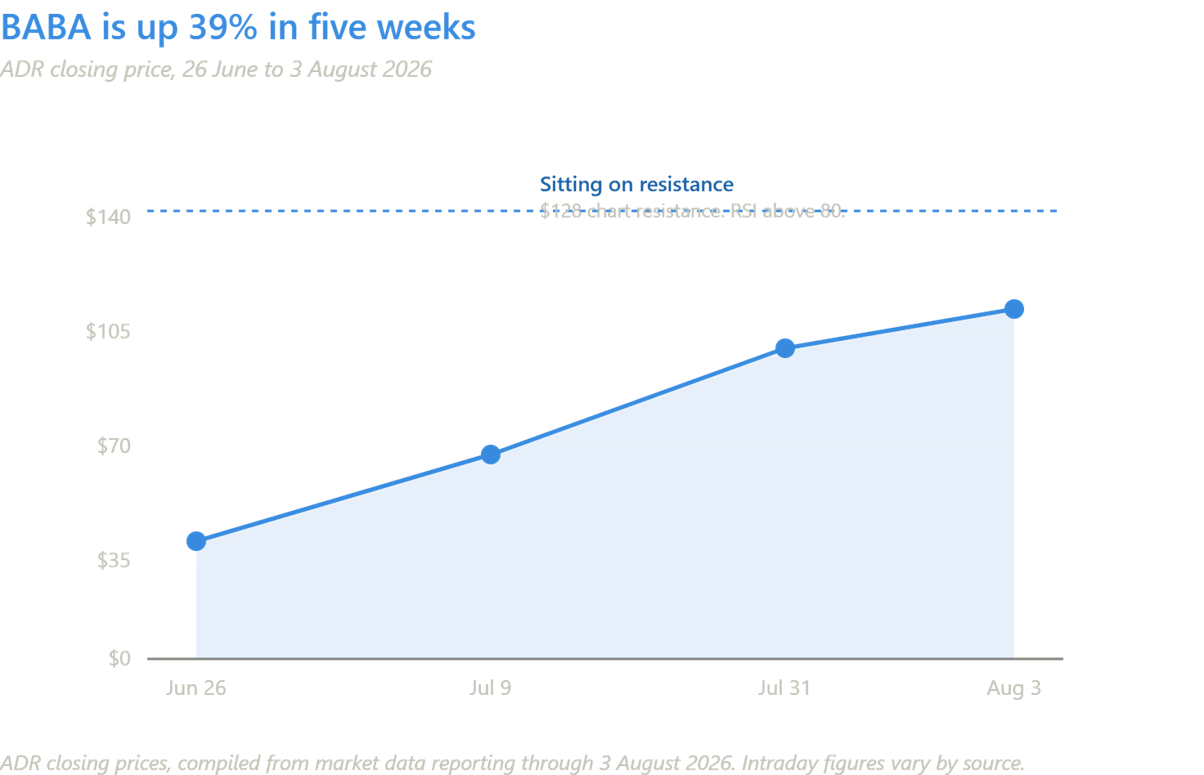
The market has filed this under the ‘AI story’. In the space of a month, Alibaba shipped a new frontier model, secured regulatory approval for Qwen to power Apple Intelligence and Siri in China, picked up reports of limited access to Nvidia H200 chips, and took part in a $1.2 billion Series A for Ant International. Any one of these moves would move a stock 3-5% on a quiet day, together, they have produced one of Alibaba’s strongest runs since 2020.
We think that filing is doing too much work. The rally is being priced as validation of a single AI thesis. When the numbers underneath it are actually two separate and only loosely related stories: an external one, posing the question of whether Qwen is a credible model franchise with real distribution (Apple, chip access, leaderboard position), and an internal one, about whether Alibaba’s core margins can absorb the capital expenditure that franchise requires. The first story has produced almost all of the news flow. The second story is the one that August 17’s earnings report will evaluate. It will tell us whether Alibaba have the finances to support their AI investment, and based on the most recent available numbers, it is far less settled than the share price suggests.
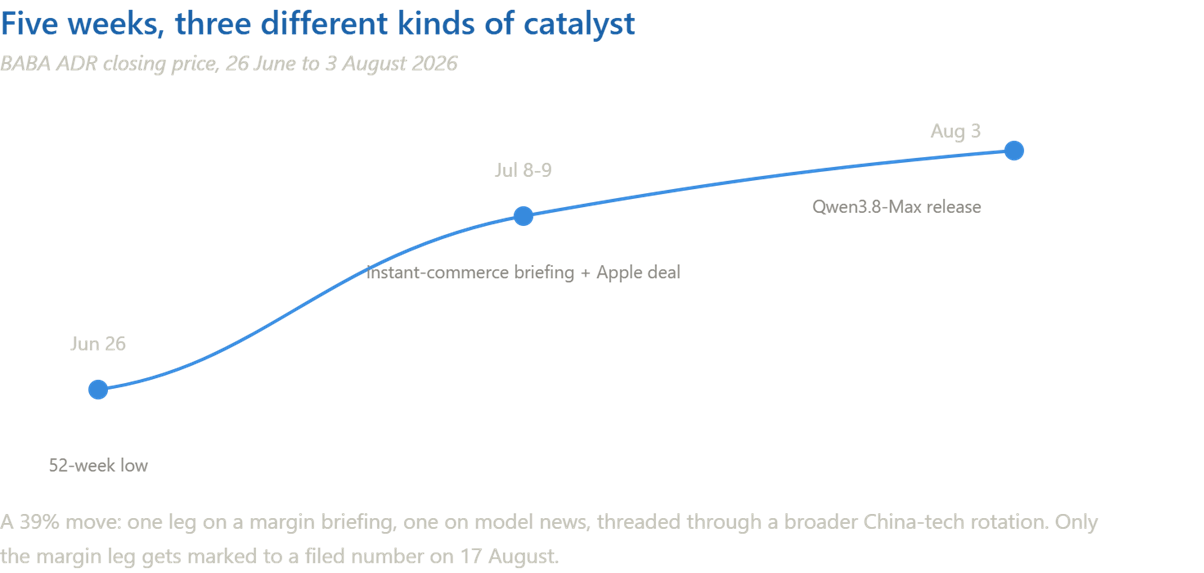
Strip the month down to its distinct catalysts rather than reading it as one continuous AI narrative, and three separate investor incentives are doing the work.
The first is model news, arriving roughly weekly: Qwen3.8-Max on 3 August, the Apple Intelligence approval reported in mid-July, and a steady cadence of smaller releases and startup investments (Zhipu AI, Moonshot AI, MiniMax) that keep Alibaba in the AI conversation independent of its own model cadence. This is the part of the rally that is genuinely new information, external parties (Apple, Arena.AI’s leaderboard, Beijing’s chip-allocation process) are validating Alibaba’s AI position in ways the company cannot manufacture through guidance alone.
The second is a margin narrative that predates the AI news by weeks. The initial leg of the rally, on 8-9 July, was triggered by a pre-earnings briefing rather than a model release. The briefing indicated that losses in Instant Commerce, Alibaba’s on-demand delivery business, competing directly with Meituan, had begun to narrow. That single data point did more to move the stock than most of the subsequent AI headlines; the 8 July session alone produced a 9.8-11% move.
The third is sector rotation. Chinese internet names had been unloved for most of 2026, and the Hang Seng Tech Index’s 5% move on 3 August, alongside gains of roughly 4% each in Tencent and JD.com, shows capital moving into the sector as a group, not just into Alibaba specifically. Some portion of Alibaba’s move is Alibaba being the largest, most liquid vehicle for a broader “China tech is cheap again” trade rather than a company-specific reassessment.
Three catalysts with three different effects. Model news can repeat indefinitely. Sector rotation reverses on any macro or regulatory surprise, the margin narrative is the only one of the three that gets marked to an actual financial statement in two weeks, and it is the one the market has spent the least time scrutinising.
As of Q4 2026, adjusted EBITA was seen falling 84% year-on-year to $740 million, with a $123 million operating loss, even as revenue grew to $35.3 billion. Adjusted for net profit, the company was close to breakeven. The stated cause was the combination of instant commerce losses and elevated AI capital expenditure landing in the same twelve months.
This is the same mechanical pattern that has shown up across every large-cap AI spender this reporting season: capital expenditure hits the cash flow statement immediately, chasing a revenue opportunity that is real but not yet large enough to offset the near-term margin drag. Separately, a structurally loss-making business, for Alibaba, instant commerce; for the US hyperscalers, nothing quite analogous, compounds the pressure rather than offsetting it. Where Microsoft, Alphabet and Meta are absorbing a pure capex-versus-depreciation timing gap, Alibaba is absorbing that gap on top of an already loss-making delivery business it chose to keep funding through the same period.
The market’s read since 8 July has essentially been, that narrowing delivery losses make the drag temporary, leaving AI spending as the dominant driver of the investment case. That is a reasonable hypothesis, however, as of this writing, also one that rests on one pre-earnings briefing rather than a filed number. Until August 17 we await whether this assumption will be confirmed or disproven.
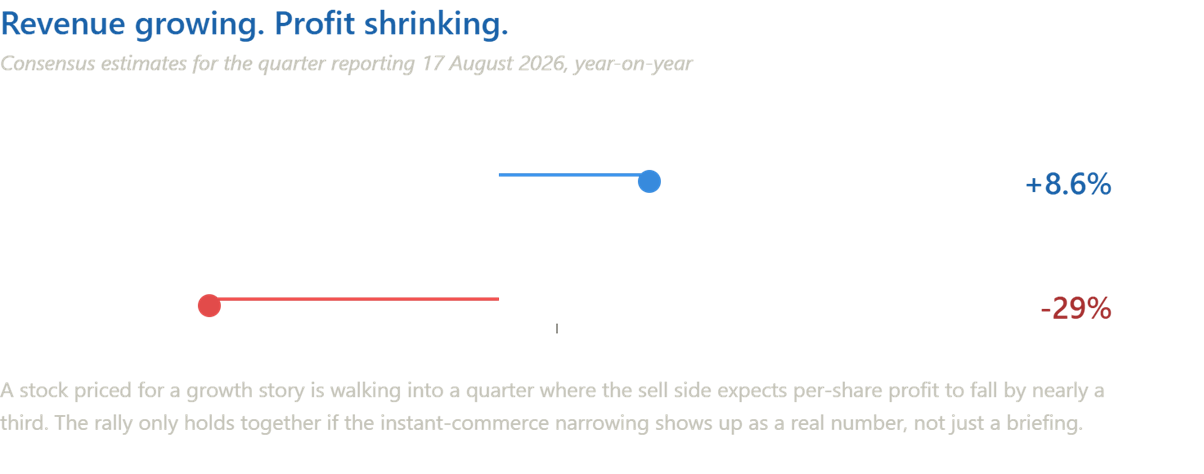
Consensus for the quarter due 17 August is RMB268.86 billion, up 8.6% year-on-year, against adjusted EPS of RMB10.46 per ADS, down 29% year-on-year. Put those two numbers next to each other and the earnings report is not being priced as a growth story so much as a margin-recovery story: the top line is expected to grow modestly while per-share profit is expected to fall by nearly a third, and the stock has still run 39% into the print. That combination only makes sense if investors believe the instant-commerce narrowing is real, sustained and about to show up in the numbers for the first time.
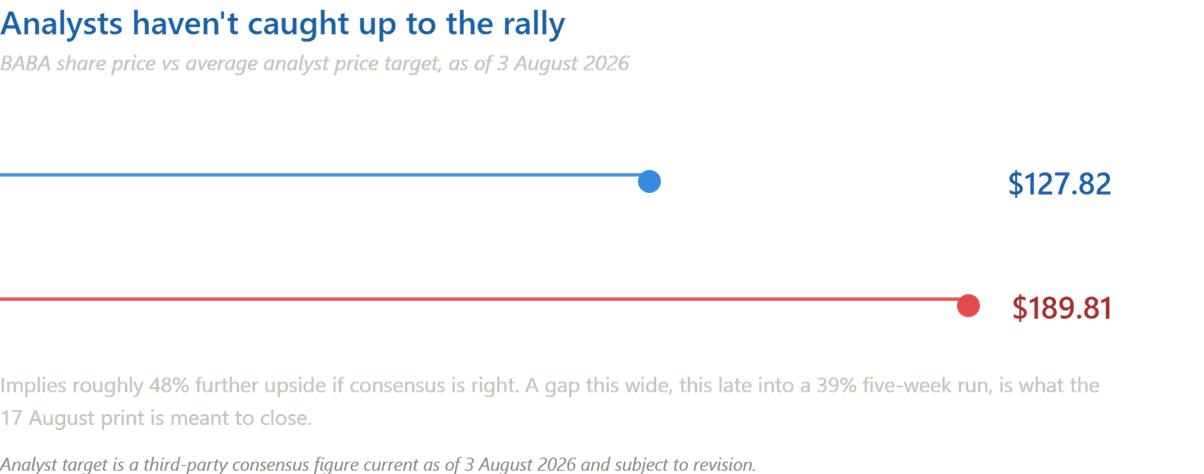
The analyst consensus price target, at $189.81, implies roughly 48% further upside from the current $127.82, a gap wide enough that either the sell side has not caught up to five weeks of AI news, or the market has run ahead of what the fundamentals currently support, or both are true in different proportions. We would not resolve that ambiguity from the outside; it is precisely what the 17 August filing is for.
The instant-commerce EBITA line, isolated from the Qwen story. The pre-earnings briefing that started this rally was directional, not a number. The filing will contain an actual figure for how much the losses narrowed, and whether ‘narrowed’ means materially smaller or merely less negative than a uniquely bad prior quarter.
Cloud and AI revenue growth against the capex it required to produce. Alibaba does not break out AI-specific capital expenditure any more precisely than the US hyperscalers do, but the ratio of Cloud segment growth to the capex line will show whether the AI business is approaching the scale needed to carry the group’s margins, or whether it remains a strategic investment still being subsidised by the rest of the company.
Any forward capex commentary for the next fiscal year. Given the pattern already visible at Microsoft, Alphabet and Meta, capex guided up mid-year, ahead of any matching depreciation disclosure, the question for Alibaba is whether management signals a similar acceleration, and whether they frame the instant commerce business as approaching breakeven or as a multi-year drag they are prepared to keep funding.
There is a version of this that resolves cleanly in Alibaba’s favour, instant commerce losses really have turned a corner, Cloud and Qwen-related revenue is compounding fast enough to absorb the capex, and the Apple and chip-access stories translate into disclosed commercial terms rather than remaining direction. On that path, the 39% run is early rather than overextended, and the analyst target is the more useful anchor than the current price.
But an RSI above 80 and a share price sitting on a chart resistance is not, by itself, evidence of anything about the business, it is evidence that a great deal of good news has already been priced in a short window, ahead of the one filing that will show whether the margin side of the story matches the AI side of it. The model releases have been real and independently verifiable. The margin recovery, so far, has been one briefing. The gap between those two kinds of evidence is what 17 August closes.
Global markets snapped back this week, and the reversal was almost a mirror image of the one before it. Equities rallied broadly, with the pain trade from the prior week becoming the relief rally in this one. The KraneShares CSI China Internet ETF led with a 5.2% gain, MSCI Emerging Markets rose 4.4%, and the Nasdaq 100 — last week’s worst major loser — bounced 3.7%. Hang Seng Tech added 3.3%, the Nikkei 225 climbed 2.6% even as its quarter stayed 9.2% underwater, and the S&P 500 rose 2.3%. Only the VIX short-term futures position moved against the tape, falling 4.3% as the hedges put on the week before were unwound.
Fixed income flipped from the quiet winner to the clear loser, and duration again did the damage — just in the opposite direction. The US 20+ Year Treasury fell 2.0% and is now down 3.5% on the quarter, while 15+ Year Gilts and US MBS each slipped 0.6%. The short end held up far better: Local-currency EM Sovereigns rose 0.6%, US High Yield 0.3%, and most short-duration credit and T-Bill lines stayed roughly flat.
Commodities and crypto also partially reversed course. Brent Oil rebounded 2.1% after last week’s rout, though it remains 27.5% lower on the quarter, and silver and gold both edged higher. The Dollar Index gave back 1.4% this time, having gained the week before. Crypto was split rather than uniform: Zcash rose 3.5% and BNB 3.2%, while Ethereum fell 3.2%, Chainlink 2.8%, and Toncoin 2.6% — a much more scattered picture than the across-the-board selloff seen previously.
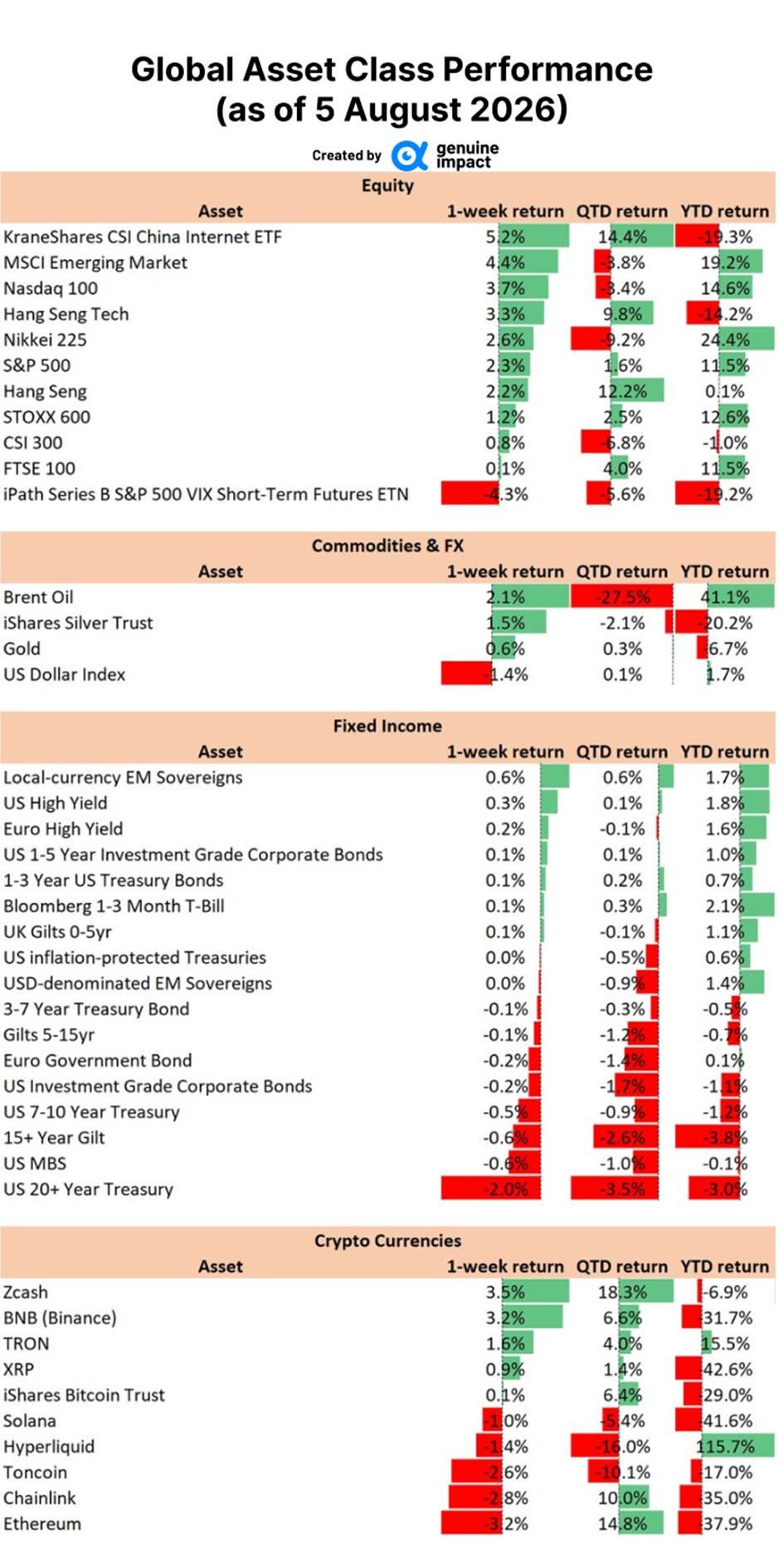
‼️ Last week the rotation punished US tech and rewarded China and duration. This week both trades unwound at once. The question is whether this is genuine mean reversion, or whether the portfolio just swapped one crowded trade for another.
Want to see which stocks, at what weights, and what we are watching next? Subscribe to unlock the full holdings and performance below ⬇️
Comments
Nothing yet. Say the first thing.
Sign in to join the conversation.