
Hello Geeks -
11 Tuesday sleeps til the election and we’re here to bring you the latest and greatest election updates, news of the week and a Geeky deep-dive into the funding cuts to science getting in the way of a little thing called human flourishing. Who needs it, ammirite? ::facepalm:: We’ve also included three simple steps you can take to help defend the future of American science.
Let’s get to it. Here’s your Geekly Digest for the week of August 17th:
CHOOSE YOUR FIGHTER
Welcome to your Election news of the week.
Overall takeaway: According to our friends at NPR, it was a good night for the Democratic establishment, the progressives, and Trump-endorsed Republicans alike — no single faction dominated. In a big score for democracy, Missouri voters rejected a GOP-backed measure that would have raised the threshold for future constitutional amendments. NPR
Wisconsin (Democratic governor): Milwaukee County Executive David Crowley narrowly defeated progressive state Rep. Francesca Hong, who had led in polls ahead of election day but lost by just 0.4 percent — a major upset for the progressive wing. He’ll face Trump-endorsed Rep. Tom Tiffany in November. Al Jazeera. (House): Republican Rep. Tom Tiffany won his party’s nomination for governor by a landslide with united GOP backing and Trump’s endorsement. NPR
Alabama: Trump-endorsed state Rep. Rhett Marques clinched the Republican nomination for the congressional district running from Mobile County through the southern Black Belt to the Georgia border. NPR
Minnesota (Senate): Republican — former TV sports reporter Michele Tafoya won the GOP Senate nomination. Democratic — Lt. Gov. Peggy Flanagan captured the Democratic nomination for U.S. Senate, defeating U.S. Rep. Angie Craig 58.8% to 39.7%, for the seat retiring Sen. Tina Smith is vacating. CBS News
Minnesota (Governor): House Speaker Lisa Demuth won the Republican gubernatorial primary, notably beating out Trump-endorsed Mike Lindell (MyPillow founder). CBS News NPR
South Carolina (special Senate primary): This was a race to fill the late Sen. Lindsey Graham’s seat — Trump-endorsed Sen. Darline Graham advanced to a special Republican primary runoff, set for Aug. 25. NPR
THIS JUST IN
Hot off the IG (give us a follow if you haven’t) this week:
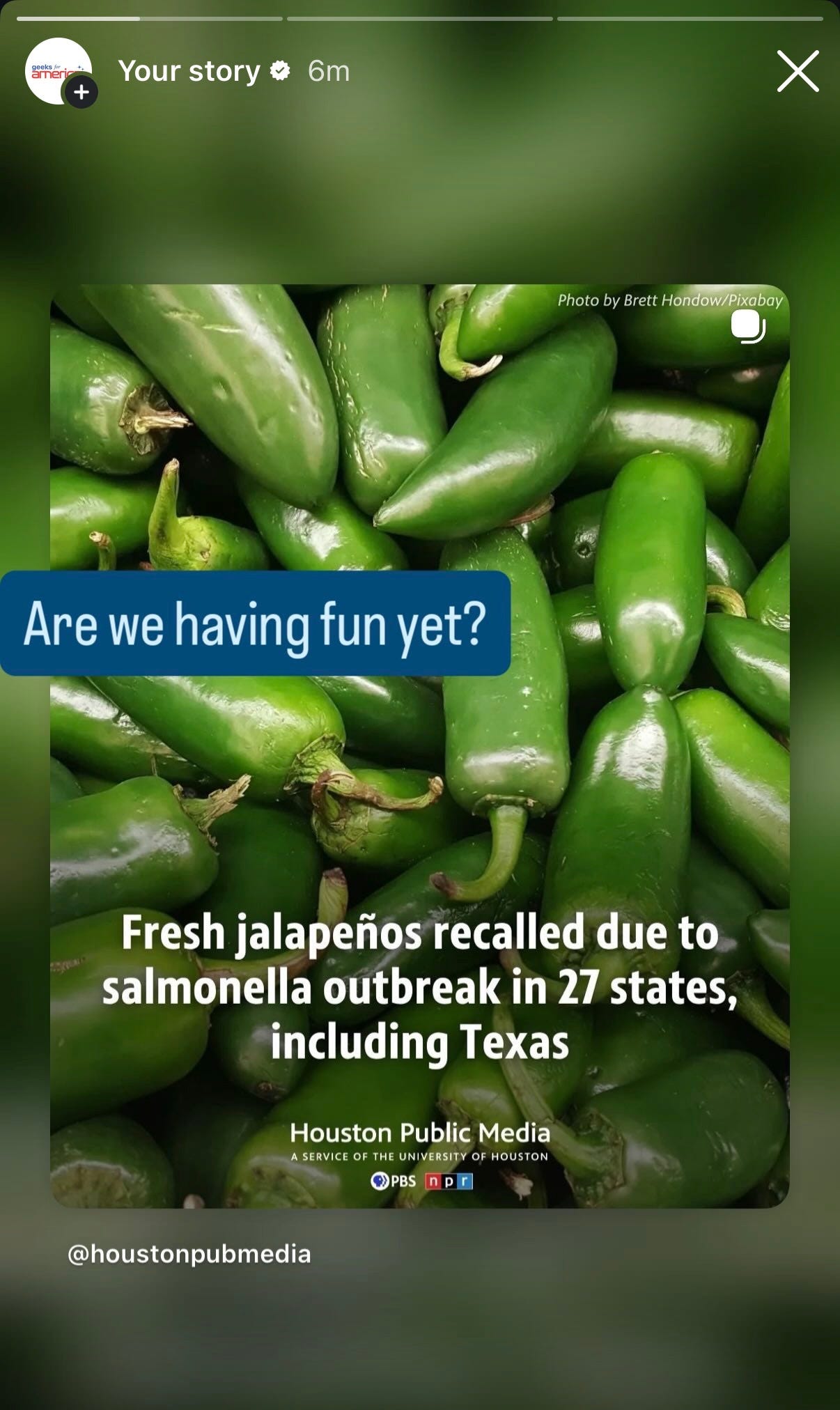
No lettuce, no eggs, no jalapeños. What’s next, air, water, hope? Get yourself up to speed on the latest here:
UNIVERSITY OF MINNESOTA CIDRAP

“Hackers targeted municipal water systems in 7 states this week, FBI says” - Totally nothing to worry about we're sure!!!! Read up:
And now it’s time for our
MAIN STORY
Once-bustling laboratories stand nearly empty. Cancer patients wait in limbo for the resumption of life-saving clinical trials. Environmental monitoring systems are dismantled or abandoned, leaving communities vulnerable to future disasters.
The second Trump administration has driven a bulldozer through the U.S. scientific research funding ecosystem, halting active research in its tracks and threatening the future of safety and prosperity in America.
Since World War II, federal research funding has been the primary engine of American innovation. Federal investment in science enabled monumental breakthroughs like the moon landing, the internet, and gene therapy, as well as now-commonplace technologies like GPS, touch screens, and wireless headsets. Economists estimate that federal non-defense research funding has been responsible for at least one fifth of postwar economic productivity growth.
The federal government can fund research and development on a scale far beyond what private companies or charitable organizations can match. The government invests in basic research that furthers our understanding of the world and advances the public interest, whereas the private sector is limited to R&D that generates near-term profits. Over the long term, federally funded research provides the foundation on which new technologies and industries can be built. Every taxpayer dollar invested in basic research can generate as much as $12.50 in economic growth over the following 30 years.
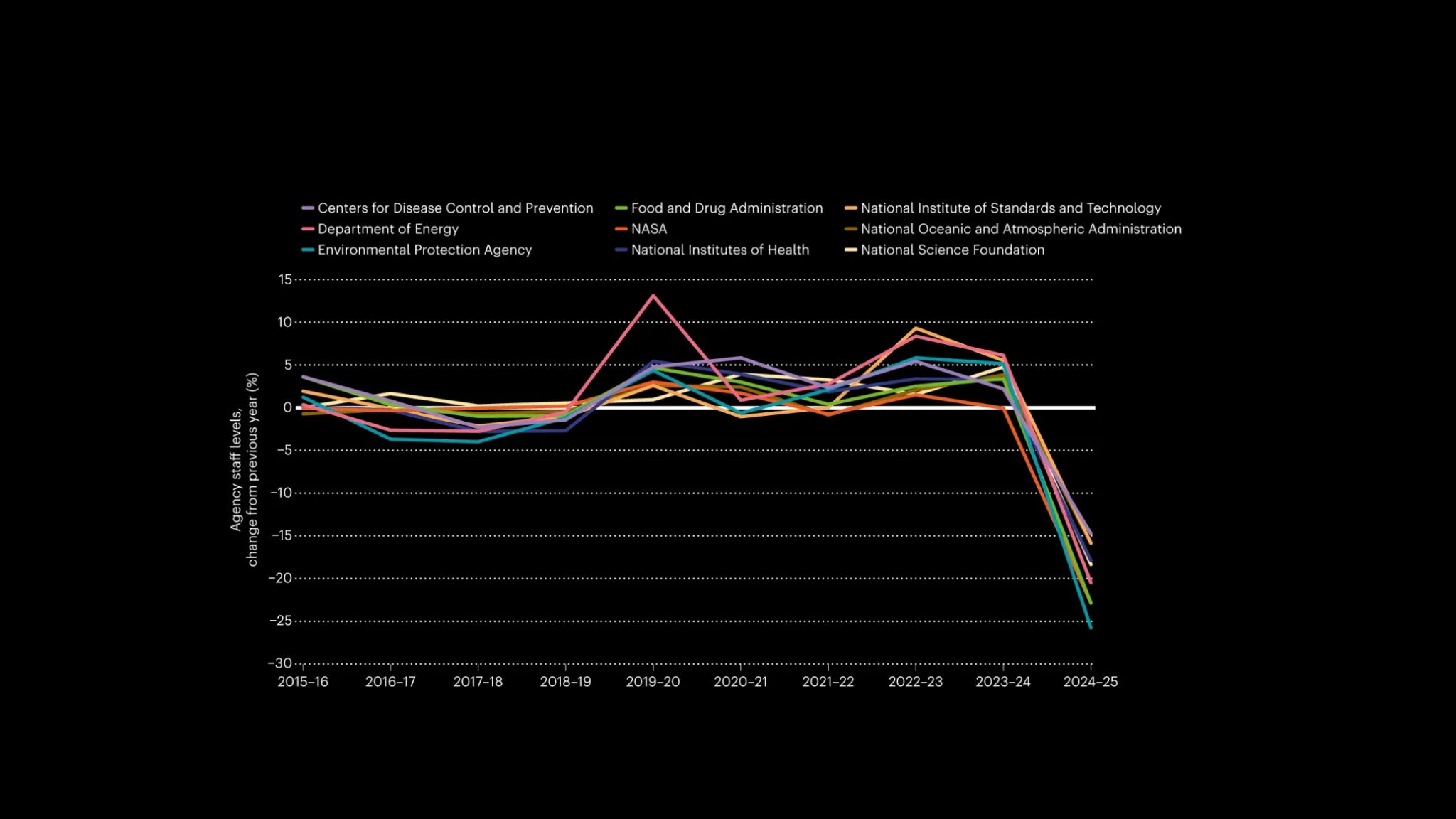
In 2025, the Trump administration made drastic cuts to the agencies charged with advancing scientific knowledge and innovation. Though the federal workforce as a whole shrunk by about 12% in 2025, federal agencies experienced staff reductions of over 20%. Overall, science agencies lost over 25,000 scientists and staff.
Source: Nature
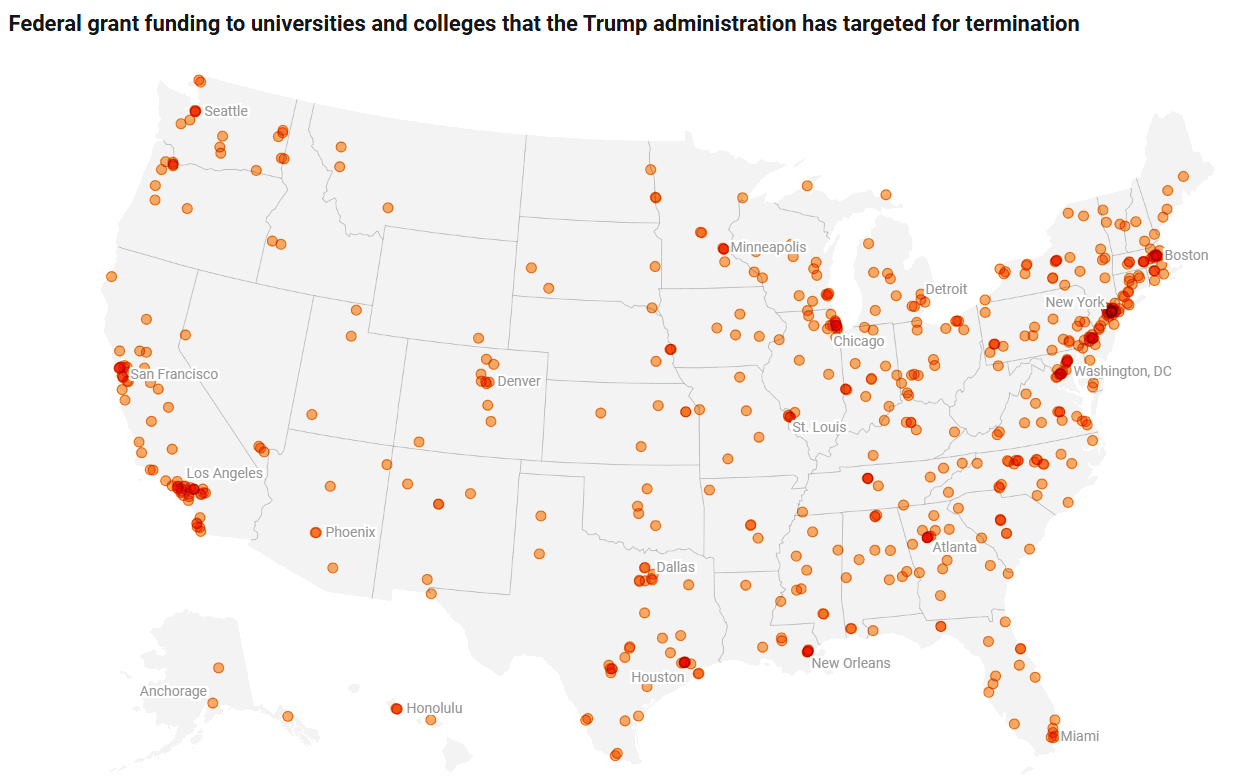
The administration also terminated or froze more than 7,800 previously approved research grants, representing over $3 billion in funding. The cuts targeted over 600 colleges and universities, disrupting research on topics ranging from cardiovascular health to conservation. It also slashed the number of new grants issued, with both the National Science Foundation and the National Institutes of Health, the nation’s largest public funders of science, awarding about 25% fewer grants compared to the average of the previous ten years. So far, the number of grants awarded in 2026 is on track to be even lower.
Source: Center for American Progress
Trump’s attacks on science are already having impacts across the scientific community:
Cancelled treatments and lowered health outcomes: The terminations disrupted hundreds of clinical trials treating diseases like cancer, dementia, and postpartum depression. More than 74,000 patients were impacted. Going forward, the cuts could slow the development of life-saving drugs and even reduce American life expectancy.
Economy-wide impacts: Cuts to scientific research will trickle through the economy, generating job losses across industry, academia, and government. Experts estimate that NIH and NSF funding losses alone will decrease annual U.S. economic output by as much as $16 billion.
Loss of U.S. scientific leadership: With fewer opportunities for funding and employment and increasing uncertainty about the future, many scientists are seeking to relocate to more supportive environments like Canada, Europe, or China. A Nature poll found that 75% of responding scientists are considering leaving the country, prompting fears of a brain drain that could threaten U.S. competitiveness.
Stifling the next generation of scientists: Without reliable funding sources, universities have been forced to reduce admissions and restrict hiring of graduate students, postdocs, and early-career researchers. These roadblocks could deter young people from pursuing careers in STEM and hamstring a whole generation of scientists, with implications for scientific advancement that could last decades.
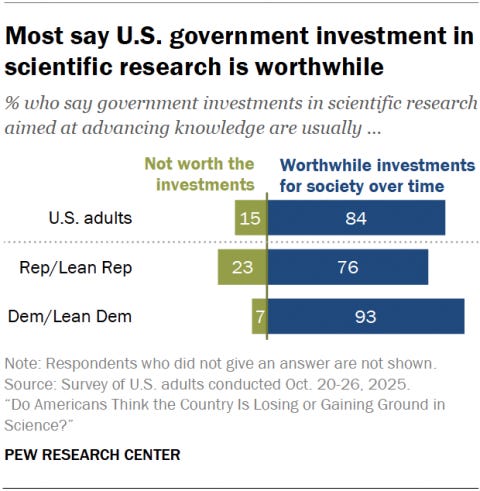
The broad majority of Americans understand that scientific innovation is key to our nation’s success. More than 80% of Americans support government investments in scientific research, including large majorities of both Democrats and Republicans. This support is reflected in Congress, which rejected Trump’s cuts to science funding in the FY2026 budget, and in the courts, which have ordered the restoration of thousands of grants.
Source: Pew Research Center
ARE YOU WITH US?
With 11 Tuesdays to go until Election Day, The Geekly Digest is a gathering ground to explore solutions that help carry America forward. This week the story helps us understand the implications from funding cuts that don’t seem to be stopping. The rollout of reinstated grants has stalled, and the administration’s FY2027 budget seeks even deeper cuts to research funding.
Scientists and science supporters can help defend the future of American science by:
Calling your representatives to oppose budget cuts to science agencies in 2027.
Donating to organizations fighting back against funding cuts, like the Center for Science in the Public Interest and Protect Democracy.
Supporting pro-science candidates in the midterm races by donating or canvassing.
And here’s how you can support the broader mission to bring back fact-based governance:
Donate to elect science champions.
Volunteer to canvas in your local community.
Subscribe to our Substack for more news for nerds and ways to get involved!
Whether you’re an expert or an enthusiast, an artist or an analyst, a Trekkie or a Tolkienite, we hope you’ll join us on our mission. America can do better than this, and we, the Geeks, are here to help.
No posts
Comments
Nothing yet. Say the first thing.
Sign in to join the conversation.