
Hello Geeks -
10 Tuesday sleeps til the election and it is getting SPICY out there. As ever, we’re here to bring you the latest and greatest election updates, news of the week and a Geeky conclusion to our deep-dive on funding cuts and the resulting erosion of research you can trust. We’ve also included a toolkit for effective steps you can take in these last days of the Congressional August Recess - read on to learn more!
Hot diggity. Here’s your Geekly Digest for the week of August 24th:
CHOOSE YOUR FIGHTER
Welcome to your Election news of the week.
Overall takeaway: Voters in half a dozen states went to the polls on August 11, with results highlighting ongoing conflicts within both parties ahead of the November midterms. Democratic primaries in Wisconsin, Minnesota and Connecticut signaled what the party's base may want from new leaders: a harder line against Trump's immigration crackdown and younger, more progressive nominees. On the Republican side, the night tested how far Trump's endorsement still carries — the answer was mixed, with his endorsements winning in some states and stumbling in others. NPR
Florida: Byron Donalds won the Republican primary for governor with 47.8% of the vote, and former Rep. David Jolly won the Democratic primary with 61%. Donalds, a Naples-area congressman, dominated after receiving Trump’s early endorsement; Jolly, a former Republican who registered as a Democrat in 2025, is running on an affordability platform. They’ll face off in November to succeed term-limited Gov. Ron DeSantis. Spectrum News CBS12
Alaska: Mary Peltola opened a five-point lead over incumbent Sen. Dan Sullivan (48% to 43%) in the top-four nonpartisan primary, outperforming a state Trump won by 13 points in 2024. Peltola, Sullivan, and a second candidate also named Dan Sullivan are advancing to the ranked-choice general election in November. The race is now rated a toss-up by multiple forecasters. Electiontracker
Wyoming: On the Senate side of things, Rep. Harriet Hageman won the Republican nomination with 63% of the vote, defeating four other candidates including former Kirby Mayor Sam Mead. Hageman had President Trump's endorsement — he'd backed her 2022 primary campaign that ousted Trump critic Liz Cheney. On the Democratic side, James Byrd won the nomination with 79.3% of the vote.Hageman is heavily favored in the deep-red state come November. In an upset on the Congress side, state Sen. Eric Barlow won the Republican nomination over Trump-endorsed Superintendent of Public Instruction Megan Degenfelder — Barlow took 58,820 votes to Degenfelder's 38,739, with retired Marine Col. Brent Bien in third at 30,843. Barlow will face Democrat Kenneth Casner in November. Washington Post
THIS JUST IN
Hot off the IG (give us a follow if you haven’t) this week:

News Flash: Hot Dogs grow on trees according to US officials 👀
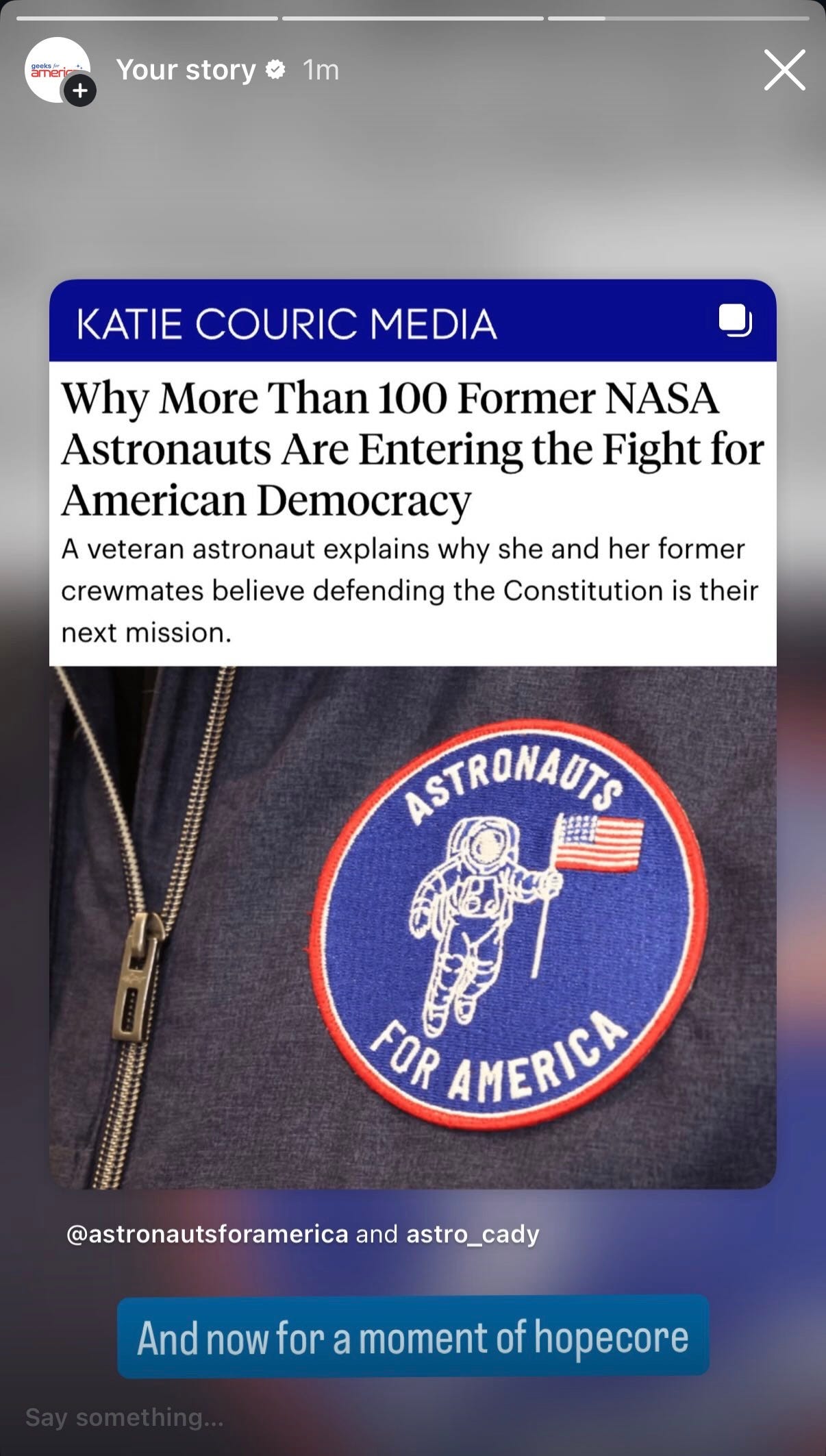
Send in the Astronauts LFG!

Storm’s a’brewing with Trump’s nomination to the FDA. If you care about women’s reproductive health rights, vaccines and pediatricians (who hates pediatricians?!) , we recommend briefing yourself on Dr. Heidi Overton right now.
CENTER FOR REPRODUCTIVE RIGHTS
And now it’s time for our
MAIN STORY
For nearly a century, the American scientific community has relied on independent peer review to evaluate studies and direct funds towards promising research. This system seeks to ensure that research remains unbiased, merit-based, and committed to the truth and the public good, independent of the political whims of whichever party is in power.
When the second Trump administration took office, it sent that system into a tailspin by firing scientists, cancelling grants, and targeting universities. If you missed it, we covered this in detail in our Part 1 Substack on Funding Cuts.
Now, it’s attempting to permanently codify the chaos with foundational changes to the way science gets funded.
Since taking office, the Trump administration has terminated more than 150 federal science advisory committees. Dozens more have been suspended or prevented from meeting.
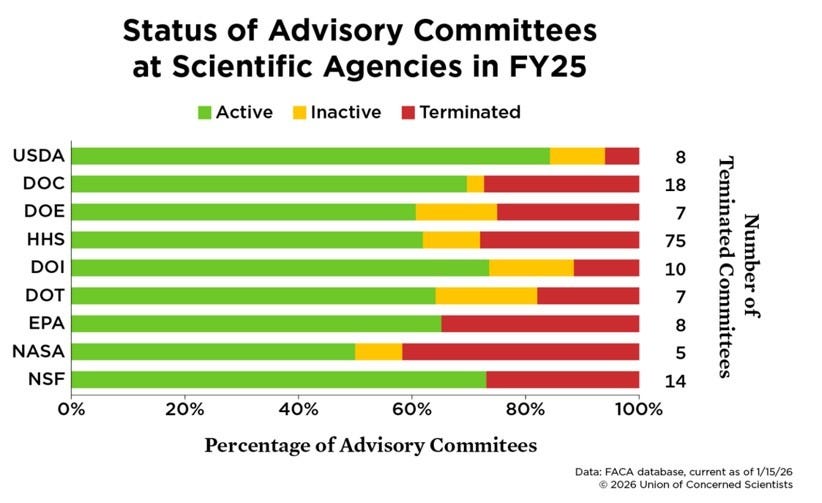
Source: Union of Concerned Scientists
In April 2026, the administration dismissed all 22 members of the board overseeing the National Science Foundation, one of the country’s foremost funders of basic science, math, and engineering research. Scientists and lawmakers blasted the decision as an attempt to exert partisan control over what should be an unbiased and independent advisory body.
Federal advisory committees bring together experts from academia, industry, nonprofits, and state and local government to inform policy and funding decisions. These independent bodies provide the insight and expertise needed to ensure responses to complex challenges, like pandemics and climate change, are based on the best available science. By purging these committees and replacing their members with Trump allies or industry representatives, the administration aims to make it so these decisions are driven not by expertise, but by its own political priorities.
In May, Trump’s Office of Management and Budget, under the direction of Project 2025 architect Russell Vought, unveiled a new rule that would politicize grantmaking across the whole of the federal government. The proposal would hand control of nearly $1 trillion in research grants over to political appointees.
The new rule would upend science in the United States by:
Circumventing traditional peer review and giving political appointees final say over grantmaking decisions. Peer review would be downgraded to an advisory role only, allowing decisions to be based solely on the interests of the administration.
Allowing the federal government to cancel awards at any time. This would interrupt multi-year studies and clinical trials, jeopardize careers, waste time and resources, and deter scientists from engaging in long-term research.
Prohibiting research on “DEI,” gender, and topics that espouse so-called “woke” ideas or “anti-American values.” Some scientific organizations have likened this to McCarthy-era censorship which would erase critical research on real challenges like health disparities.
Restricting international scientific collaboration, and
Limiting whether and how scientists communicate their findings.
ARE YOU WITH US?
With 10 Tuesdays to go until Election Day, The Geekly Digest is a gathering ground to explore solutions that help carry America forward.
The public comment period for the proposed OMB rule is now closed, after receiving an outpouring of almost half a million comments in opposition. But fear not: there are still actions you can take to help save American science!
Talk to your representatives. Lawmakers have the power to trigger Congressional review of a rule or to include language to block implementation of the rule in an appropriations bill. So seriously, talk to them! Engage with your Congressperson during the August recess. Attend town halls, write letters, or make a call to voice your concerns about how the rule will affect your research or your community. Here’s some examples of messages to use as well as a list of other ways to connect with your reps.
Join a network like the UCS Science Network or the Science Rising Action Corps, or donate to support organizations like Stand Up for Science.
Support pro-science candidates in the midterm races by donating or canvassing.
And here’s how you can support the broader mission to bring back fact-based governance:
Donate to elect science champions.
Volunteer to canvas in your local community.
Subscribe to our Substack for more news for nerds and ways to get involved!
We are stronger together! Let us know which of these you chose to do to help save American Science.
No posts
Comments
Nothing yet. Say the first thing.
Sign in to join the conversation.