
Hello Geeks -
12 Tuesday sleeps til the election and a lot happened this past week - so much so, we held the issue til today, so we could properly report on election results. Here’s your Geekly Digest, rounding it all up:
CHOOSE YOUR FIGHTER
Welcome to your Election news of the week.
Big stories coming out of Connecticut: Former Hartford Mayor Luke Bronin defeated longtime incumbent Rep. John Larson (D) in the 1st District primary — Larson had been unopposed since first winning the seat in 1998, so this is a real upset of an entrenched incumbent. NBC Connecticut
Gov. Ned Lamont won the Democratic gubernatorial primary over Josh Elliott, with 99 percent of precincts reporting showing Lamont at 68 percent (125,577 votes) to Elliott's 32 percent (59,447 votes). His victory ended a historic race that marked the first time in 50 years a sitting Connecticut governor faced a primary challenge from within his own party. Lamont will face Republican Ryan Fazio in the general election on Nov. 3. WFSB
In Minnesota, the Senate race is open because Sen. Tina Smith decided not to seek re-election. Gov. Tim Walz's unexpected decision not to seek re-election also left the governor's race wide open. Results: Flanagan won the Democratic Senate primary (59% to Craig's 39.4%); Tafoya won the Republican Senate primary (52.1% to Schwarze's 24%); Klobuchar won the Democratic governor's primary in a landslide (89.7% to Layne's 5.8%); Demuth won the Republican governor's primary (43.4% to Lindell's 32.5%). And if you didn’t know: any registered Minnesota voter may participate in any party's primary — it's an open primary system. NBC News
Wisconsin saw more incumbents stepping down, leaving three executive offices ready to change hands. The incumbent governor, state Senate majority leader, and state assembly speaker all announced they will not run for re-election in 2026 — meaning this is the first time since 2010 that all three top executive and legislative offices in Wisconsin change hands simultaneously. On top of that, Gov. Tony Evers retiring left a crowded, unsettled primary to choose his successor, with progressive momentum shaking up the race. Result: David Crowley won the Democratic gubernatorial primary, per NBC News projection. Wikipedia
Alabama’s Primaries were originally scheduled for May but rescheduled to August 11 to allow implementation of a new congressional map, following a June 2026 Supreme Court decision permitting Alabama to adopt a 2023 map despite a lower court finding that it intentionally discriminates against Black voters. The new map heavily favors Republicans and could help the party pick up House seats in November. Republicans took all but one district, with District 7 seemingly still incomplete as of last reporting. One race to flag: under the new map, District 2 shifted roughly 22 points to the right, with Republicans winning by 54% per unofficial results. They’ll be targeting freshman Democratic Rep. Shomari Figures for a pickup in November. PJ Media + 3
The Vermont races were a teensy bit more quiet: Incumbent Republican Lt. Gov. John Rodgers ran unopposed after no one chose to challenge him in the primary, and Republican Gov. Phil Scott is seeking a sixth two-year term in a state rated "Solid R"/"Safe R" by every major forecaster. The one contested race of note: Amanda Janoo faced off against Aly Richards for the Democratic nomination and won, and Molly Gray, Ryan McLaren, and Esther Charlestin ran for lieutenant governor, wiht Molly Gray taking the win according to Vermont Public. Wikipedia + 2
THIS JUST IN
A lot going on in the news (when is there not), so here’s a few things we highlighted on our Instagram (give us a follow if you haven’t) this week:

Oh goody, we can finally stop waiting for this shoe to drop. Get yourself up to speed on the latest here:

The Arctic is the fastest warming region on Earth, so this should probably work out great for everyone. Read up:
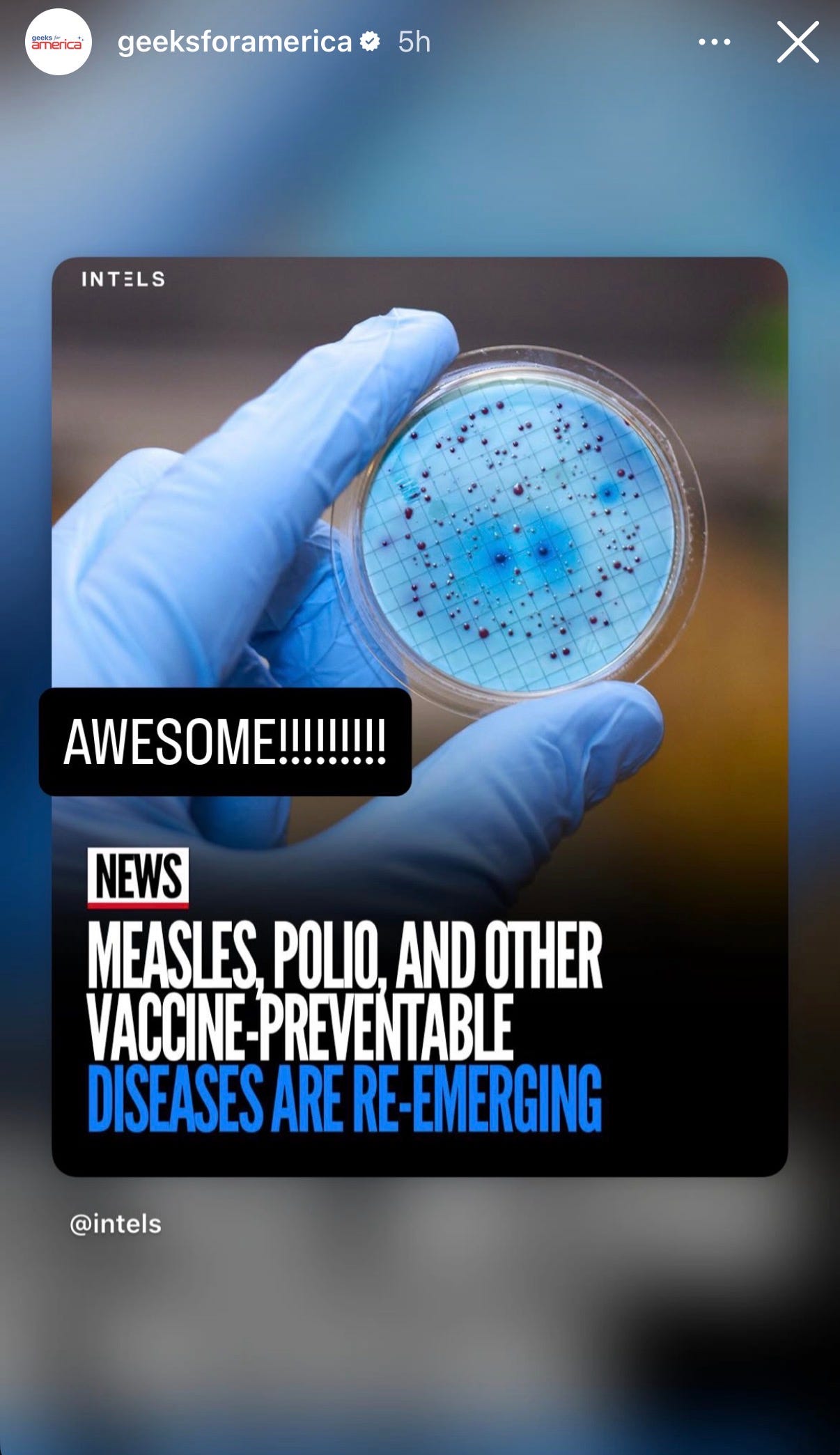
And for our main story today, measles. The disease turning budget math into body counts even though it WAS ELIMINATED decades ago.
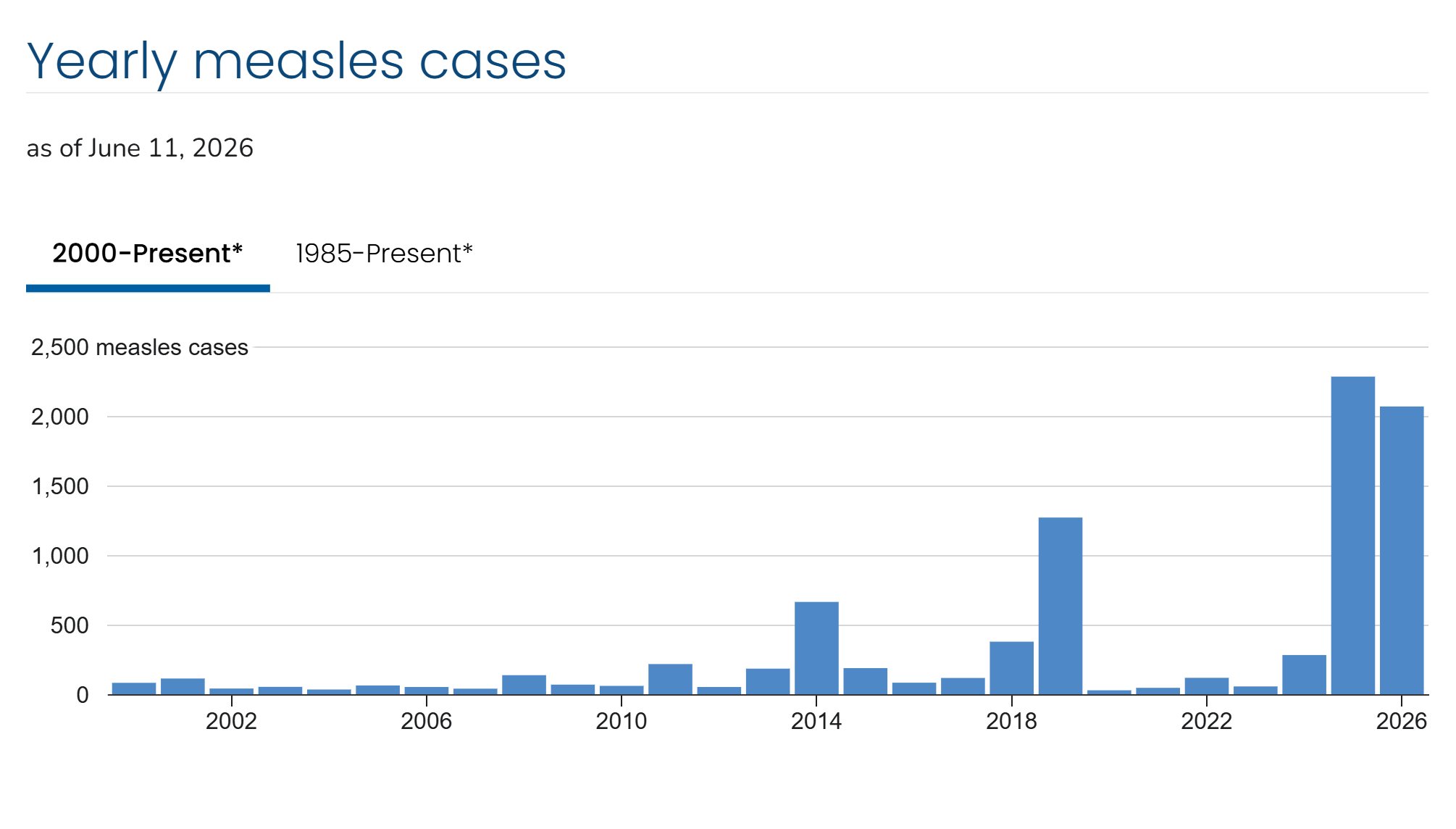
This month, the United States surpassed 2,400 confirmed measles cases for 2026, outstripping last year’s record highs (and…it’s only August). When the Trump administration took office, measles cases skyrocketed from 285 in 2024 to 2,288 in 2025, the highest levels seen since 1991. Two children and one adult died from measles infection — the first U.S. measles deaths this century. This year, the U.S. is all but certain to lose its measles elimination status.
How did this happen in a country that declared victory over measles in 2000? Historic disinvestments in public health programs and rampant misinformation from government officials have created a perfect storm for measles and other infectious diseases to come roaring back.
Source: Centers for Disease Control and Prevention.
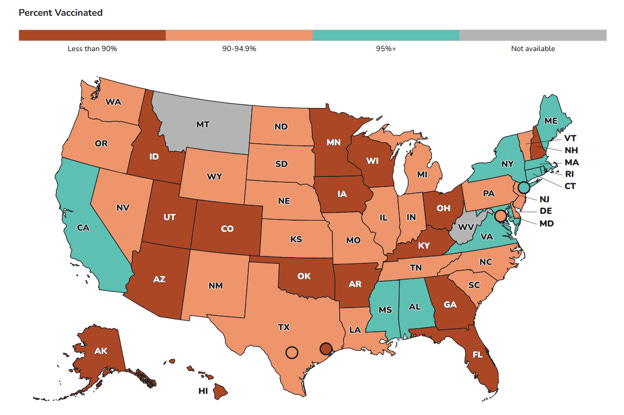
Misinformation driving a decline in vaccinations: Measles is one of the most contagious diseases on Earth. About 95% of the population must be vaccinated to effectively prevent measles from spreading. But for the past decade or so, disinformation campaigns casting doubt on vaccine safety have driven MMR vaccination rates down below 93% in U.S. kindergarteners. In some communities, coverage levels have dipped under 60%, creating “pockets of susceptibility” where infection can spread like wildfire.
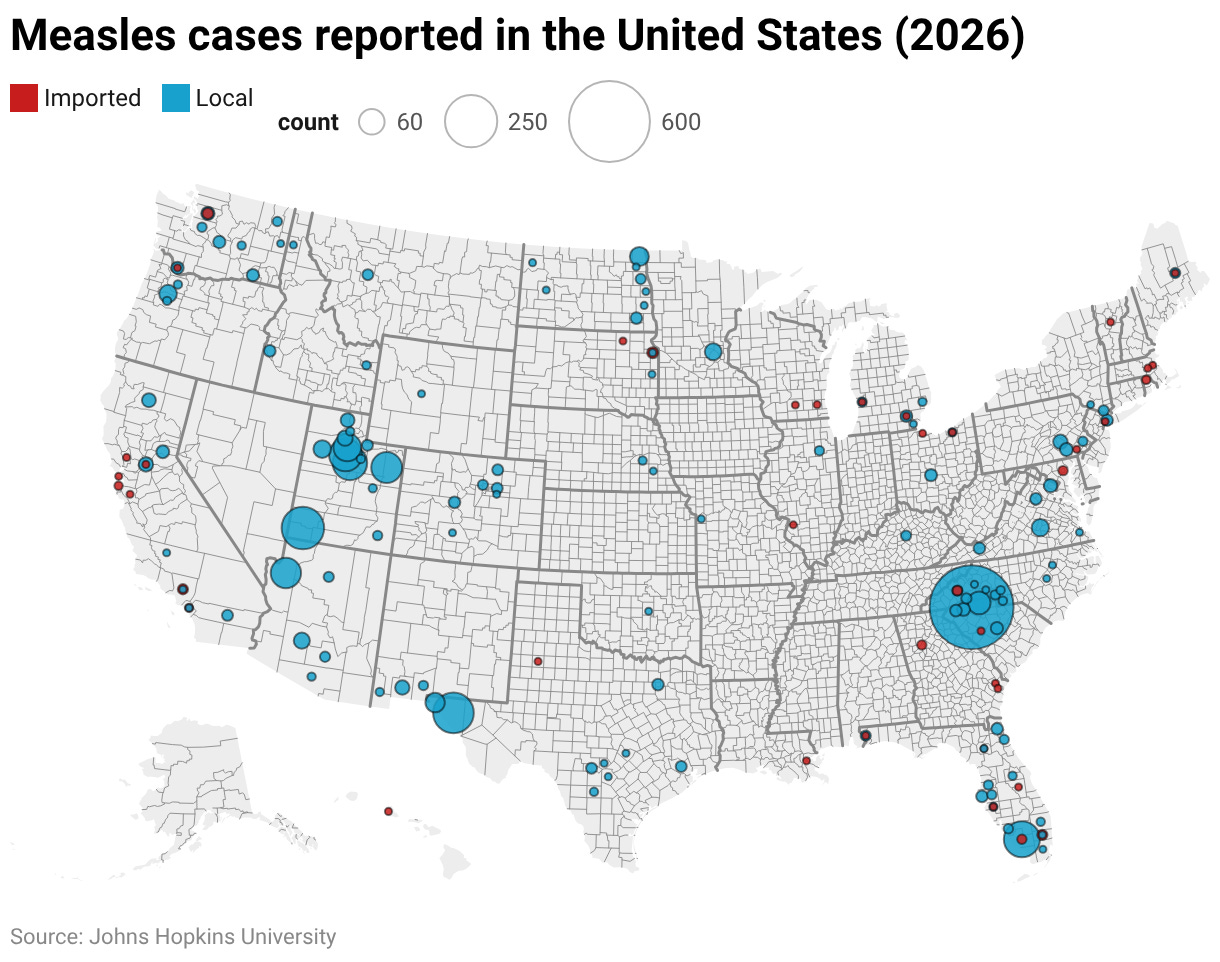
Under the Trump administration, longtime anti-vaxxer Robert F. Kennedy Jr. has used his position as Secretary of Health and Human Services to amplify debunked claims about vaccines. Even as measles outbreaks accelerate in states like Texas, Utah, and South Carolina, RFK Jr. has sowed confusion by downplaying vaccine effectiveness and promoting unproven treatments.
Source: Centers for Disease Control and Prevention.
Funding cuts crippling public health efforts at home: Mass firings, dramatic funding cuts, and agency restructuring across the Department of Health and Human Services have hamstrung measles response efforts right when they’re needed most. With federal funding slashed, local and state health departments have been forced to lay off staff and cancel vaccination clinics. Public health workers are left scrambling to control outbreaks without the resources and personnel they need for testing, contact tracing, and vaccine education.
Source: Johns Hopkins University.
“America first” policies increasing disease cases abroad: As the U.S. retreats from the world stage, it creates gaps allowing infectious diseases to spread around the globe. Trump withdrew the U.S. from the World Health Organization and dismantled USAID, creating massive vaccine funding shortfalls in countries that were already falling behind due to COVID-19 lockdowns and supply chain issues. Now, measles is proliferating in countries like Bangladesh, increasing the risk that cases from abroad will be transmitted back home.
To protect children and families from preventable diseases like measles, the U.S. needs pro-science leaders willing to fight for the health and safety of all Americans. It needs science champions like Dr. Annie Andrews, a pediatrician running for U.S. Senate in South Carolina. “There’s never been a more urgent need for scientifically literate, data-driven lawmakers to be in the rooms where these conversations are happening,” said Andrews to The Guardian.
As the midterms roll around, it’s time to elect leaders who will hold the current administration accountable, bolster public health resources and research funding, and restore public trust in science.
ARE YOU WITH US?
With 12 Tuesdays to go until Election Day, The Geekly Digest is a gathering ground to explore solutions that help carry America forward. This week the story is measles: a preventable disease roaring back because leaders chose misinformation over medicine and cuts over public health. But outbreaks are stoppable, and so is the politics that fuels them.
Here’s what you can do about measles:
Check your MMR status and make sure your family is up to date. It takes a 95% vaccination rate to stop measles from spreading. You in that number is how community immunity gets built.
Push back on the misinformation. When you see debunked vaccine claims in your feed, counter them with the CDC’s data. Facts should inform opinions, not the other way around.
Elect science champions who will refund public health and restore trust in expertise, like Dr. Annie Andrews, a pediatrician running for U.S. Senate in South Carolina.
And here’s how you can support the broader mission to bring back fact-based governance:
Donating to elect science champions.
Volunteering to canvas in your local community.
Subscribing to our Substack for more science news and ways to get involved!
Whether you’re an expert or an enthusiast, an artist or an analyst, a Trekkie or a Tolkienite, we hope you’ll join us on our mission. America can do better than this, and we, the Geeks, are here to help.
No posts
Comments
Nothing yet. Say the first thing.
Sign in to join the conversation.