
This is a scenario, not a forecast. It is built from open-source evidence available in August 2026: the 1951 US-Danish defence framework and the current status of Pituffik Space Base, Denmark's 2025 Arctic investment programme, European and Canadian force structures, published exercise participation, NATO and EU treaty text, and verified statements by serving leaders. Four assumptions drive everything that follows and are stated openly. First, the crisis begins in late 2026, when Canada's F-35 transition is barely under way and Denmark's Arctic build-out is funded but not delivered. Second, Canada joins Denmark rather than staying neutral; the alternative branch is set out below, because it changes the war completely. Third, the scenario follows roughly the first month. Where questions of escalation arise, they are worked through at the point the scenario reaches them rather than settled in advance.
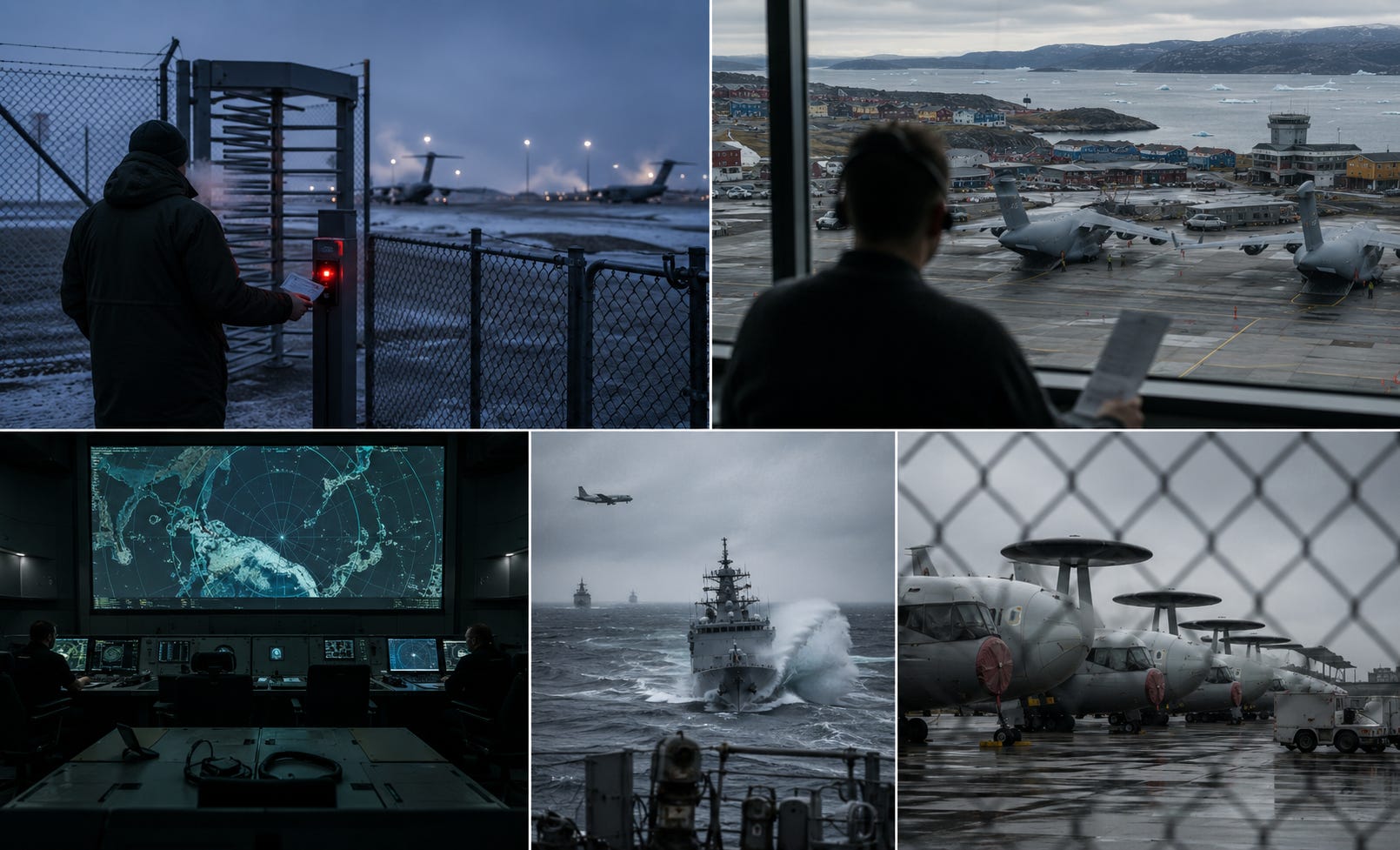
At 04:40 local time, a Danish liaison officer at Pituffik Space Base holds his identity card against a reader that has worked every morning for three years. The light stays red.
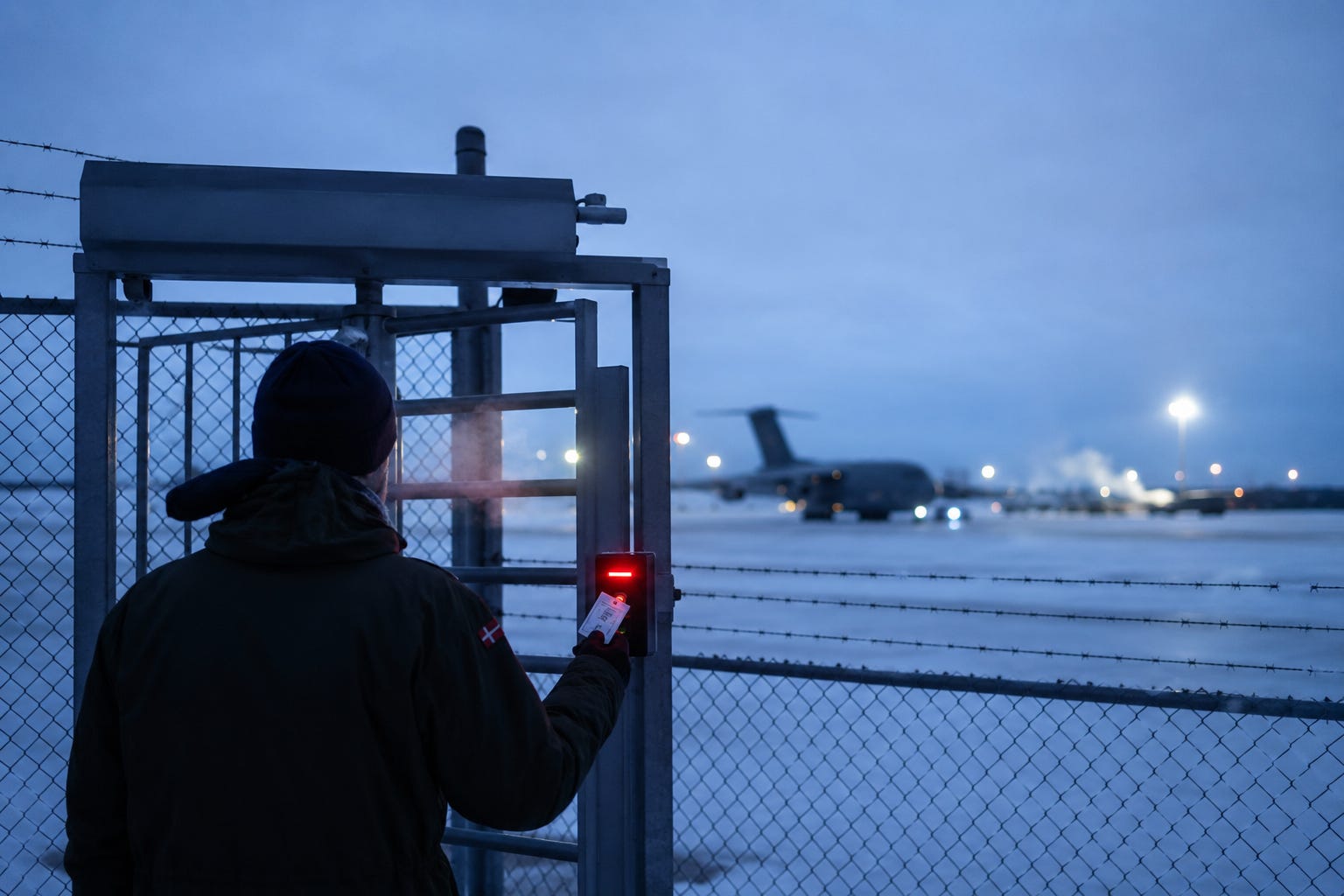
Nothing else happens for eleven minutes. He is not arrested. Nobody points a weapon at him. A young American security airman, visibly embarrassed, tells him there is an access review and offers to call someone. The officer stands in the cold and looks past the fence at the flight line, where there are considerably more aircraft than there were at midnight, and none of them are on the schedule he was shown yesterday.
That is the opening move of the war: a card that no longer works.
The reason it can happen this way is the strangest fact in the whole scenario. The United States does not have to invade Greenland to be inside Greenland. It is already there, lawfully, by agreement with Denmark, and has been since 1951.
Pituffik gives it a year-round airfield in the far north-west, the world’s northernmost deep-water port, missile-warning and missile-defence installations, space surveillance and satellite command-and-control, plus its own armed security personnel.
No landing craft are required. No beach has to be taken. The garrison changes character rather than arriving.
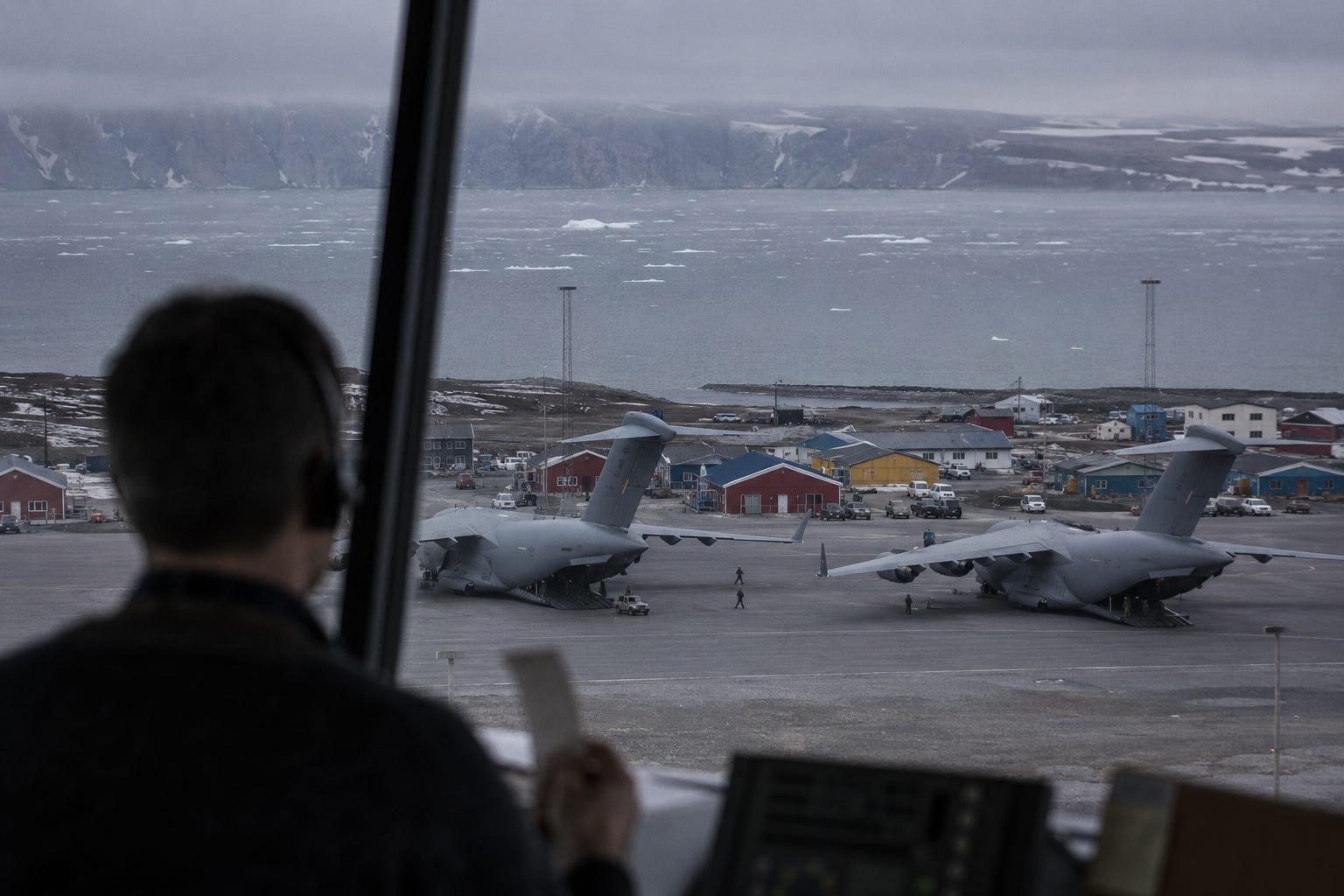
By 07:00, American transport aircraft are on the ground at Kangerlussuaq and Nuuk. The Greenlandic air-traffic controller who logs the first arrival has no procedure for what she is looking at, because the aircraft type is one she clears routinely and the flight plan is one she has never seen.
By 09:00 in Copenhagen, the Danish prime minister has been awake for two hours, and the military situation is already secondary to a legal one.
Greenland is roughly 2.1 million square kilometres. It holds about 56,600 people. There is no road network connecting the settlements to each other.
This makes it the opposite of a conventional occupation problem. You cannot drive across it. You do not need to. Nobody sane would try to control the interior, and controlling the interior would achieve nothing if you did.
What matters is a short list:
a handful of airfields with runways long enough for heavy aircraft
a smaller number of usable ports
the communications infrastructure
the government buildings in Nuuk
Perhaps a dozen points in total. Everything else is ice, coastline and distance.
That list is the entire military problem, and it is why the American opening is so favourable.
Denmark’s presence in Greenland has grown substantially since 2025: soldiers training out of Nuuk and Kangerlussuaq, patrol and inspection vessels reinforced by a frigate, F-35 activity, Arctic specialist units, a strengthened Joint Arctic Command. Copenhagen committed DKK 88 billion, roughly 13.7 billion dollars, to Arctic and North Atlantic capability: long-range drones, Arctic ships, maritime patrol capacity, air-surveillance radar, icebreakers, tanker aircraft, a larger F-35 fleet of 43 aircraft.
All of that is real. Very little of it exists yet in the form that would matter on the first morning.
It is a programme, and programmes deliver on a schedule that a fait accompli is specifically designed to outrun.
Here is the question that should be asked before any discussion of who can sink whose ships.
What does the United States gain that it did not have at 04:39?
Not missile warning. It had that. Not missile defence, or space surveillance, or the deep-water port, or the runway. Not an Arctic foothold. All of it was already provided under a defence agreement with an ally, and had been for seventy-five years.
What the seizure buys is title. The right to expand without asking, to develop without a partner, to say that the northern approaches to North America belong to the country defending them rather than being borrowed from a small kingdom in northern Europe with opinions of its own.
Which means the objective of the war is, in the end, a signature.
And force is famously poor at producing signatures.
This is not a rhetorical point. It determines the shape of everything that follows, because it tells you what the United States needs the other side to do. Washington does not need Europe defeated. It needs Europe to stop objecting. That is a political condition, not a military one, and there is no target that produces it.
In Copenhagen, the immediate military question is whether Danish forces in Greenland engage.
The honest answer is that they can inflict cost and cannot alter the outcome. A small, professional, well-trained Arctic force is not going to expel American units from an airfield the Americans have reinforced overnight. Fighting produces Danish casualties and an American consolidation.
But not fighting has its own price, and it is not a matter of honour.
If nobody shoots, the seizure can be described in Washington as an expansion of an existing basing arrangement between allies.
If Danish soldiers die, it becomes an armed attack on the territory of a NATO member, and every legal and political mechanism in Europe acquires a fact to attach itself to.
Both sides understand this. The Americans have every reason to want the first day to be bloodless. Copenhagen has every reason to want the world to see exactly what is happening.
What settles it, in this scenario, is not a decision by either government. It is a checkpoint.
Somewhere near Nuuk, a Danish patrol and an American security element meet on a road that goes nowhere in particular, and a vehicle does not stop when it is told to. There is a brief exchange. Two men are wounded, one seriously.
Neither capital ordered it. Both capitals now have to describe it.
By evening, Denmark has invoked NATO’s Article 4 for consultations and asked its European partners for assistance. Seven months earlier, on 6 January 2026, the leaders of Denmark, Britain, France, Germany, Italy, Poland and Spain had issued a joint statement containing four words:
“Greenland belongs to its people.”
It was written as a warning. It is now a commitment with a date on it, and the governments that signed it are discovering that the difference between those two things is measured in aircraft.
The most important conversation of the night is not happening in any of those capitals.
It is happening in Ottawa.
Comments
Nothing yet. Say the first thing.
Sign in to join the conversation.