
In her first year of training as a cancer doctor, Urvi Shah was told she had Hodgkin lymphoma. She was about eleven months into a haematology and oncology fellowship, surrounded by more expertise in this disease than almost anyone on earth gets to be surrounded by. And she did what every patient does within roughly ninety seconds of the news. She asked what she should eat.
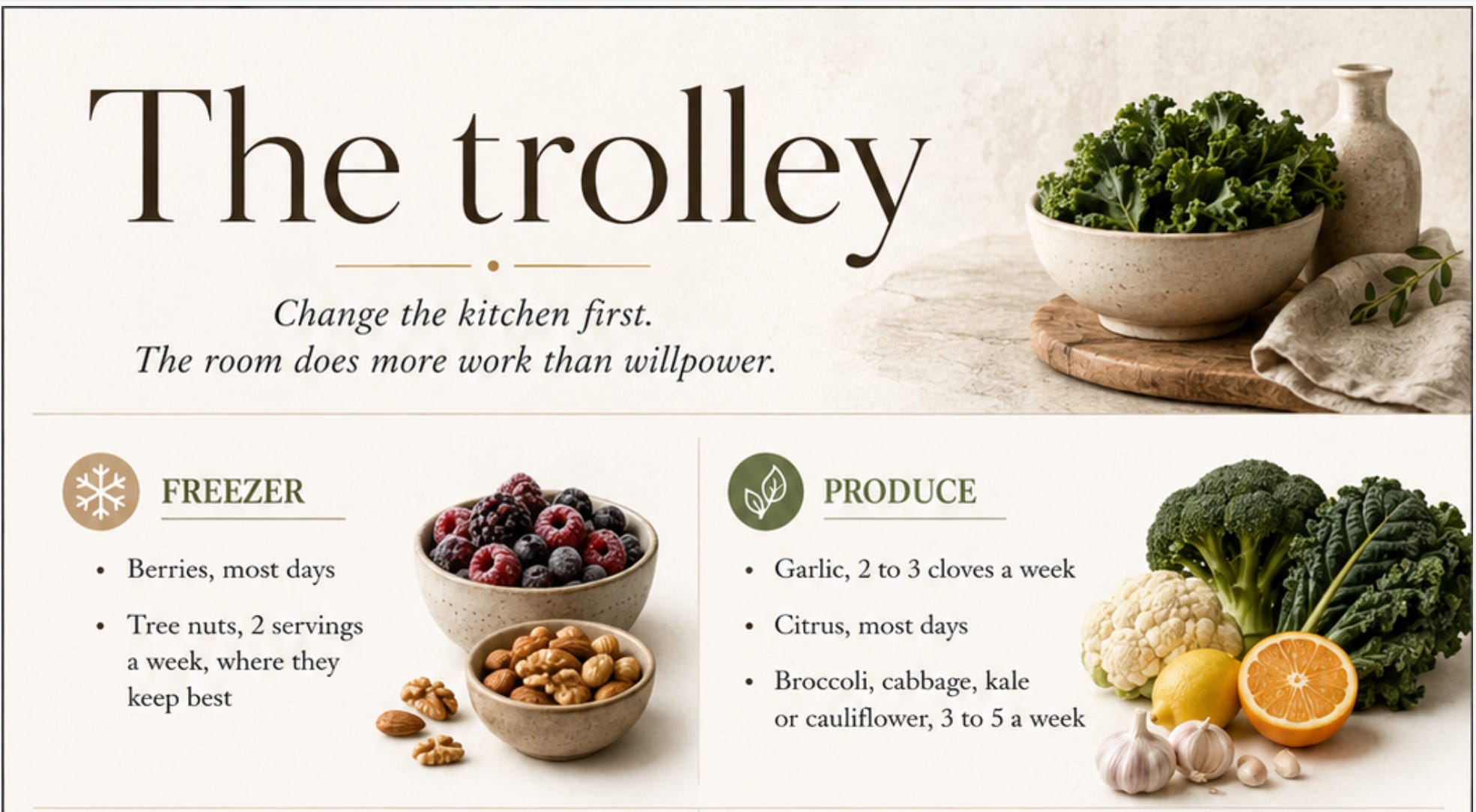
She found a gap where the answer should have been. Medical training, as she has said publicly since, gives doctors very little on nutrition and almost nothing on what to eat after a diagnosis. Years of biochemistry, the Krebs cycle drawn on a whiteboard at half past seven in the morning by a man in a fleece, and then somebody asks about breakfast and the whole magnificent apparatus goes quiet.
The rest of us live in that gap permanently, except our version has more noise in it. Over the past decade you have been told that coffee causes cancer, that coffee prevents cancer, that seed oils are poison, that antioxidants are the answer, that antioxidants were never the answer, and that somewhere in this shop is a superfood, a word invented by people selling things and never used in earnest by a scientist.
The problem is not ignorance. It is that there is now so much information about food and cancer that the net effect is indistinguishable from having none, and what it leaves behind is a low permanent hum that never gets loud enough to act on.
So here is the useful sentence, from a man who treats breast cancer for a living. Neil Iyengar, a medical oncologist at Memorial Sloan Kettering and one of the more prominent researchers on diet and cancer working today, puts it close to a shrug: if you read that a food prevents cancer, the claim is probably not evidence-based. What matters, he says, is that “the most important thing is what your overall dietary pattern looks like.”
No food prevents cancer. What exists instead is a set of foods where very large populations were followed for decades, where the people eating more of them turned out to have less cancer, and where the finding kept surviving as statisticians ground it against every other explanation they could think of. A smaller claim than the supplement aisle makes, and true, which the supplement aisle is not.
Twelve made this list, ordered by me from the ones where the research is thin and argumentative to the ones where the argument is effectively over. No official body ranks foods this way, though the grading at the far end is not mine: that is the World Cancer Research Fund calling the evidence strong.
The order is the point. Anyone can hand you twelve foods. The useful thing is knowing which three deserve a rearranged trolley and which one is mostly a very good story.
One convention, so I do not have to keep saying it: every amount below is what was observed or tested in the research, not a dose anybody is prescribing. There are almost no real doses in this subject.
Thirty seconds on it, because it sets up everything else.
Two things in the modern diet have evidence against them solid enough that the argument is finished. In 2015 the International Agency for Research on Cancer put twenty-two experts in a room with more than eight hundred studies and classified processed meat as carcinogenic to humans, each fifty grams a day, one hot dog or a few rashers of bacon, calculated to raise colorectal cancer risk by eighteen per cent. It sits in tobacco’s evidence category, which sounds alarming until you understand the category describes how certain we are rather than how dangerous the thing is.
And in January 2025 the US Surgeon General named alcohol the third leading preventable cause of cancer in America, linked to at least seven cancers and contributing to roughly 100,000 cases a year there. His complaint was not that people drink, but that “the majority of Americans are unaware of this risk.”
Ultra-processed food is the newer case, and the one still being argued about. It now supplies more than half the daily calories of the average Briton. Pooled across cohorts, each ten percentage point increase in the share of a diet made up of ultra-processed food has been associated with roughly thirteen per cent higher overall cancer risk, and the association keeps reappearing: in the French NutriNet-Santé cohort, in UK Biobank, across the EPIC study. It is observational, and people who eat differently live differently in a thousand unmeasured ways, so nobody can yet tell you which part of the packet is responsible. The formulation, the additives, the displacement of everything else, or all three at once.
But you do not need that answer to act on it. Ultra-processed food is a category defined by industrial formulation rather than by cooking, engineered to be cheap, shelf-stable and difficult to stop eating. Every one of those design goals belongs to somebody’s balance sheet, and none of them is yours. And whatever the mechanism turns out to be, the practical conclusion is already settled, because the main thing ultra-processed food does to a diet is take the place of the twelve items below.
Notice what all three have in common, because it explains why people read exactly that list and change nothing. Every item is something to give up, and giving things up has a poor record, because the vow must be renewed every morning, indefinitely, inside a shop built by people who are extremely good at their jobs and whose job is you losing.
The twelve below are additions. A plate is a finite object. Fill most of it with the things on this list and the rest is not forbidden, it is crowded out, in the way a car park fills up without anyone banning a single car.
We start on the soft ground.
The weakest evidence on the list, and it points two ways at once.
Garlic has been credited with curing more or less everything since the pyramids, whose labourers were reportedly issued it, and it remains the only vegetable with a documented career in vampire suppression.
In the laboratory it behaves beautifully. Crush a clove and you set off a small chemical demolition, releasing sulphur compounds that do genuinely interesting things to cancer cells in a dish. The trouble with cancer cells in a dish is that they will also die if you pour vodka on them, and nobody is recommending that.
In humans the evidence splits, and the split is instructive. For stomach cancer it looks real: researchers followed more than three thousand people in Shandong province, a region of China with famously high gastric cancer rates, for over twenty-two years, and higher garlic intake was associated with roughly seventeen per cent lower odds per additional kilogram eaten a year. A kilogram a year is about two cloves a week.
For bowel cancer it collapses. A meta-analysis pooling eight prospective studies across seven million person-years found no protective association at all, with a pooled relative risk of 1.06, statistically indistinguishable from a shrug. And in that same analysis, garlic supplements were associated with an eighteen per cent increase in colorectal cancer risk. The authors said the finding needs confirming and you should hold it that lightly, but look at the direction. The pills did not merely fail to help.
Remember this, because you will need it perhaps nine more times. A clove is a chemically busy organism delivering hundreds of compounds in the ratios evolution and your chopping board produced. A capsule is one or two of them, concentrated beyond anything a human has ever eaten and sold at a markup because concentration sounds like potency. It is not potency. It is a guess about which part mattered, taken at scale.
Eat the bulb, skip the tub.
Two or three cloves a week is roughly the Shandong intake, and not the pre-minced grey stuff in a jar, which has been sitting in acidified water since the last general election. Chop it and leave it on the board for ten minutes before it meets heat, because the compound you want is not waiting inside the clove. It is manufactured on contact between two things the plant keeps deliberately apart, precisely so that being chewed is unpleasant, and immediate high heat interrupts the reaction before it finishes. Ten minutes of standing about while you do the onions costs nothing.
Almost no direct cancer evidence. Here on the strength of what is in the bowl.
Berries are on this list because of laboratory work and of what they are physically made of, which is a weaker claim than you have been led to expect.
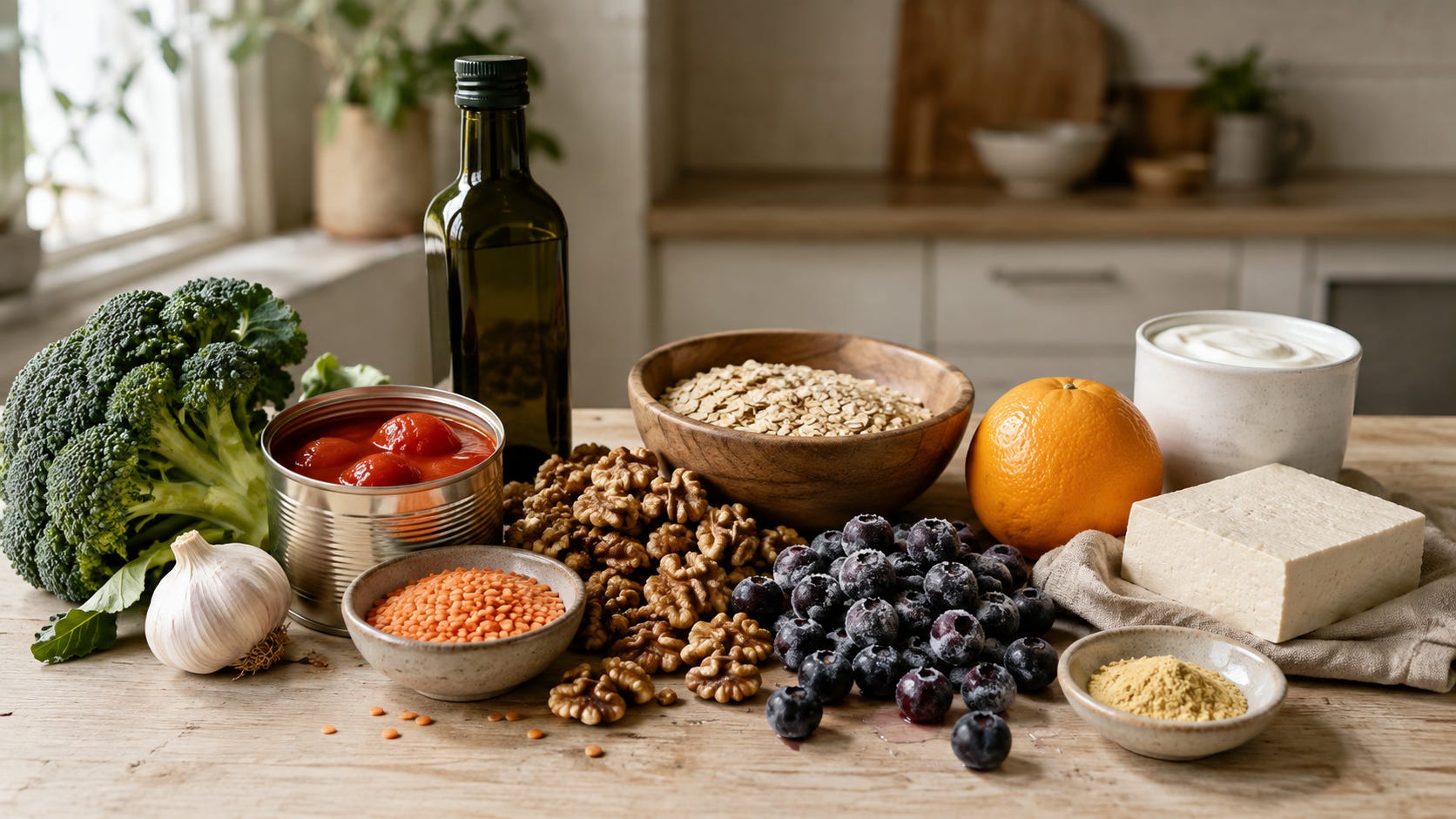
Go looking for a large prospective cohort showing that blueberry eaters get meaningfully less cancer and you will be looking for a while. That is not because berries were tested and failed. Eating a punnet of raspberries has been rare enough in the populations we have studied that it is statistically hard to see at all. What we have is interesting cellular work on the compounds behind the colour: anthocyanins, the pigments that make a blueberry that improbable purple, and ellagic acid, part of the chemical armoury a raspberry uses to defend itself. Both behave well in a dish, which you now know is not the same as behaving well in a person. What is not in doubt is what sits in the bowl: about eight grams of fibre in a cup of raspberries, which beats most people’s entire breakfast, for very little sugar.
So put them in your week, mostly for the fibre, and refuse the bilberry extract.
Say “berries in yoghurt” to a hundred people and half will reach for a pot of strawberry yoghurt, which is a small trifle wearing a health food’s clothing. Buy plain yoghurt, buy frozen berries, put the second into the first.
And buy them frozen without guilt. Frozen and fresh are nutritionally broadly comparable, varying by nutrient and crop. Frozen wins on price, on shelf life, and on the probability that you will actually eat them, which is more than can be said for the liquefying clamshell.
Promising and unresolved on cancer. Much firmer on how to eat them.
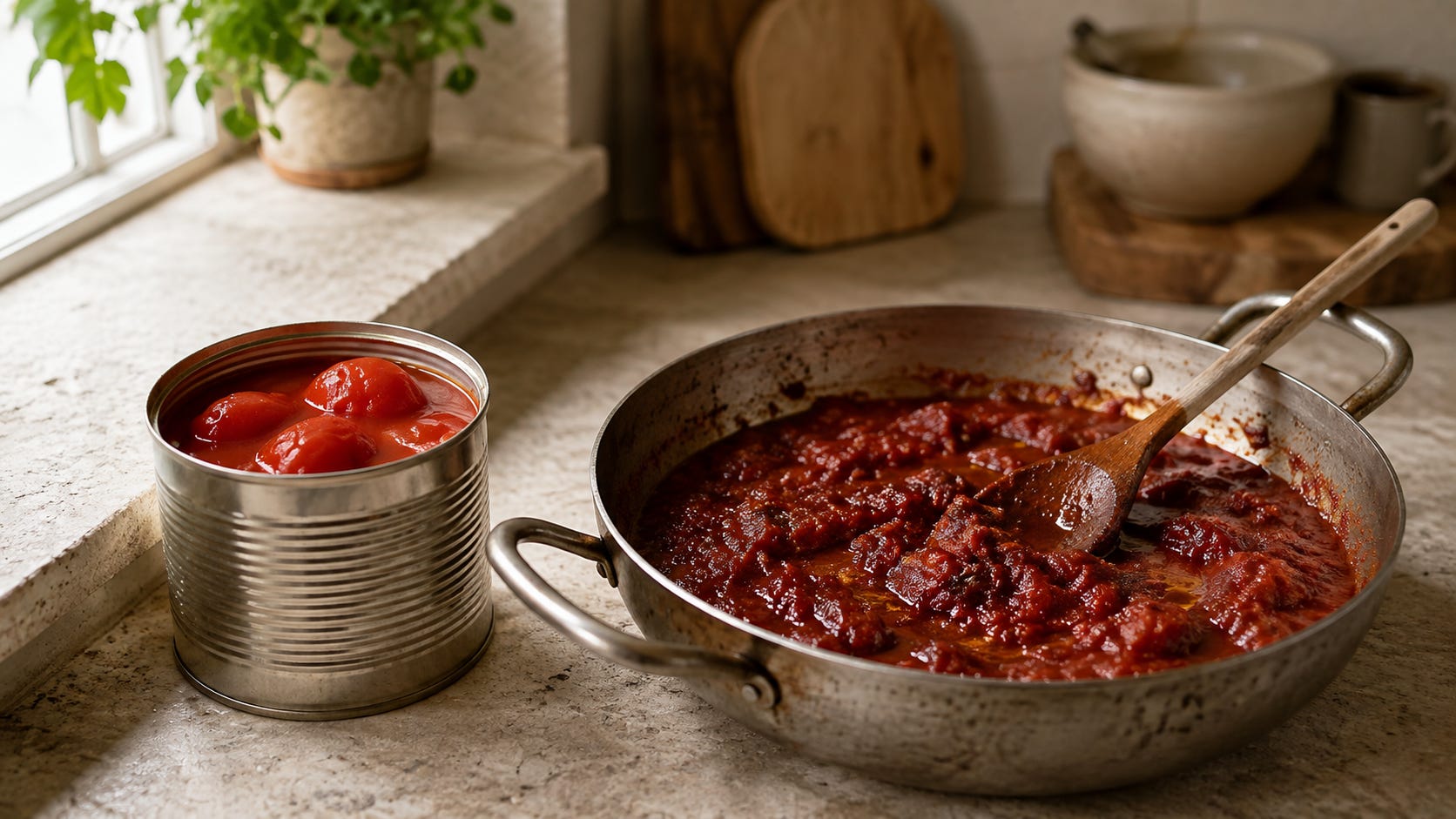
Here is where it gets strange, because almost everyone in Northern Europe eats tomatoes in the way that extracts the least of the thing worth having, and the version that works better costs about forty pence.
Comments
Nothing yet. Say the first thing.
Sign in to join the conversation.