
The best insomnia science offers a surprisingly different way through the night.
At 3:04 in the morning, you are doing sums.
You did not choose to. You woke, decided quite sensibly not to look at the clock, looked anyway, and immediately regretted obtaining the information. Now the calculation is running: the alarm rings at 6:45, which leaves three hours and forty-one minutes, which would be almost enough if you fell asleep right now, which you can already tell you will not. You check again at 3:17 and feel a small, unreasonable sting of loss. Thirteen minutes, gone, spent on nothing. By 3:42 the numbers have company. Tomorrow’s meeting has arrived uninvited and appears to believe it can be improved at this hour. Your heart is going slightly faster than a resting heart should. The pillow is warm on both sides. Beside you, a person you otherwise love is breathing with an evenness that feels, just now, like showing off.
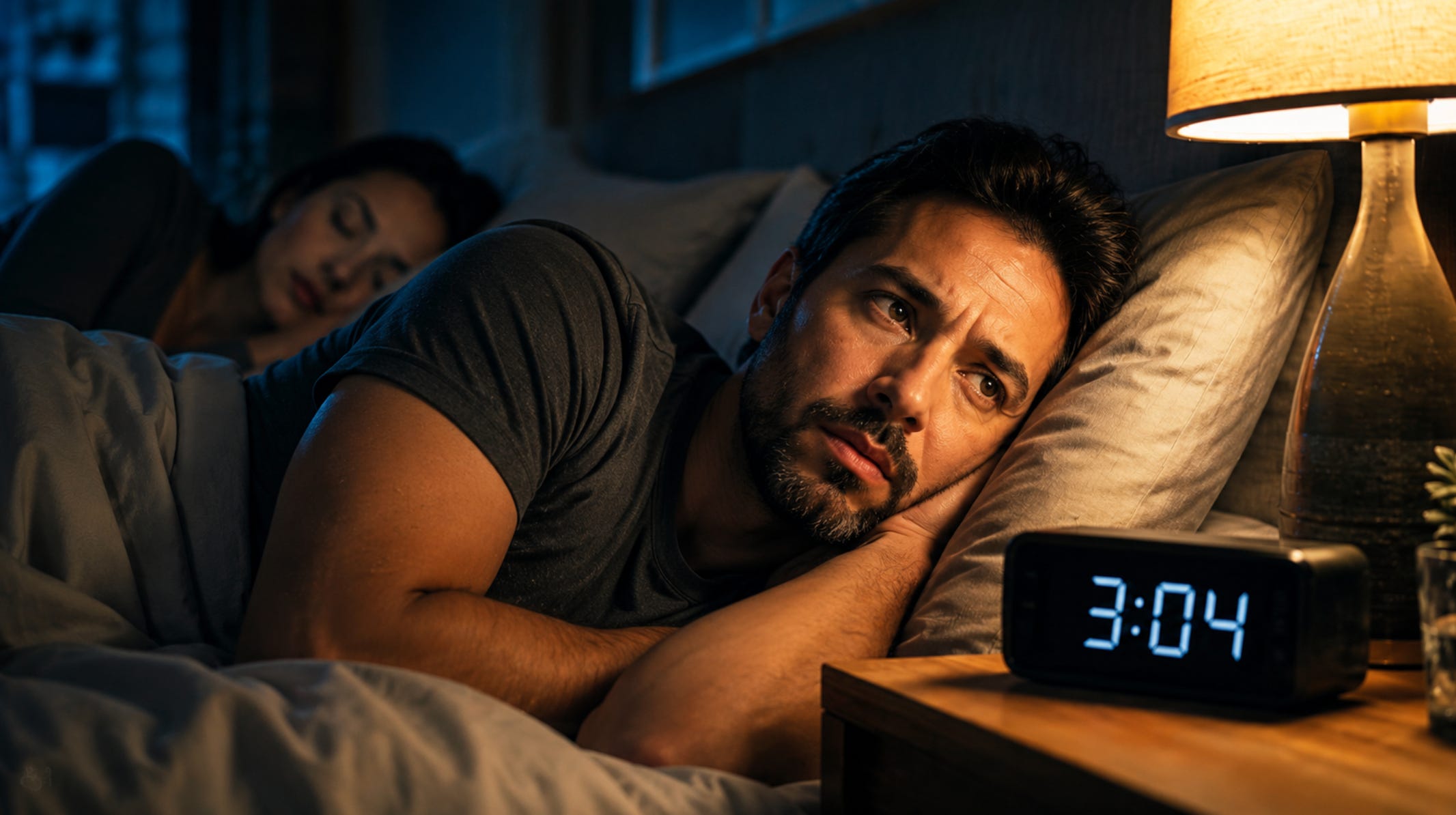
You tell yourself to stop thinking. You begin, instantly, to think, because that is what the instruction does. You wonder whether you need the toilet or merely want a change of scene. You remember an email that was unimportant at lunchtime and has apparently matured overnight into a crisis. You change position with the care of someone defusing something. You check the time once more, for no reason you could defend, and quietly begin writing off tomorrow: I am going to be useless.
Nobody teaches these sums. Every bad sleeper invents them independently, in the dark, with the same grim fluency.
And they invent them in remarkable numbers. Waking during the night is the most common sleep complaint there is: when Maurice Ohayon’s sleep epidemiology group at Stanford surveyed nearly nine thousand American adults, 35.5 per cent reported waking at least three nights a week, almost a quarter every single night, and among the regular wakers more than four in ten struggled to get back to sleep. That last group is who this article is mostly written for. Only mostly, because the 3 a.m. scene is just the most vivid member of a family: waking too early and giving up, sleeping thinly, surfacing over and over, coming to unrefreshed after a full eight hours in bed, dreading bedtime because of what the night might do, and compensating for one bad night in ways that quietly manufacture the next. If your sleep keeps breaking, in whichever pattern, this is for you.
One reassurance before anything else. A night is not one continuous block of unconsciousness; it runs in cycles of roughly ninety minutes, and at the boundaries between cycles the brain routinely rises close to the surface, sometimes briefly through it. Good sleepers have these moments too. They drift straight back under and keep no record, which is why they will tell you, sincerely and wrongly, that they slept straight through. The eight seamless hours you are measuring yourself against do not exist in nature. Which splits your 3:04 in two: the waking itself was ordinary machinery doing what it always does, and the misery arrived with what came next. Biology woke you. The rest was habit.
So here is what this article is going to do, and what it is not. It is not going to spend two thousand words explaining your awakening and then wish you luck. There is no shortage of sleep advice; the internet would like you to buy magnesium, block blue light, cool the bedroom, warm the feet, breathe differently and perhaps acquire a more expensive mattress. What is in short supply is filtering. So I went looking, not for another bedtime routine, but for everything researchers have actually tested on people who sleep like this: the clinical insomnia guidelines, the randomised trials, the sleep-laboratory experiments, the caffeine and alcohol research, the light studies, and the interviews with patients who have been through the treatment that demonstrably works. The question was deliberately practical. If you have five minutes in the evening and want the best possible chance of a night that holds together, what deserves those five minutes?
The answer was not the list I expected. A good deal of famous advice did not survive the filtering. The magnesium evidence is thinner than its reputation. Melatonin is not the answer for chronic insomnia. Evening exercise, long accused of wrecking sleep, generally does not, when finished a couple of hours before bed. Blue-light glasses address a fraction of the problem. Generic sleep hygiene, the tips-poster version of all this, performs poorly on its own in clinical studies. What survived came overwhelmingly from one place, the behavioural treatment sleep medicine itself uses for chronic insomnia, and its strongest components say something strange: several of the things bad sleepers instinctively do are keeping the problem alive.
You slept badly, so tonight you go to bed earlier, to bank a few hours. The treatment says do not.
You wake at three, so you lie perfectly still and try harder. The treatment says get out of bed.
You need to know how bad it is, so you check the clock. The treatment says remove the clock.
You are frightened of another ruined week, so the ritual grows. The research suggests the effort itself has quietly joined the disorder.
It has a clinical name, cognitive behavioural therapy for insomnia, CBT-I, and an unusual status: the major American and European guidelines now list it as the first thing to try for chronic insomnia, ahead of sleeping pills. What earned it that position is relevant to you specifically. When Trauer and colleagues pooled 20 randomised trials, 1,162 adults with chronic insomnia, the headline was not that people slept dramatically longer. Total sleep time barely moved. What moved was the middle of the night: about 26 minutes less time lying awake after first falling asleep, and nearly ten percentage points more of the night actually spent sleeping. Twenty-six minutes is most of the episode this article opened with.The treatment does not manufacture sleep. It removes wakefulness from the bed and concentrates the sleep you were going to get anyway, which is precisely the trade a person doing sums in the dark would sign for.
Two things it is not. It is not a bedtime ritual; it is a programme run over weeks, and no single evening trick produces those 26 minutes. And it is aimed at chronic insomnia, roughly three broken nights a week for three months with real daytime cost. One wrecked night after a late flight needs no protocol.
Why would sensible compensations backfire? The shortest answer comes from Michael Perlis, who directs the Behavioral Sleep Medicine Program at the University of Pennsylvania:
“The intention to fall asleep triggers sleep effort.”
Poor sleep attracts attention. Attention hardens into the felt command that I must sleep now. And the command produces effort, which raises arousal, the precise opposite of what unconsciousness requires. The harder you push, the more awake you become: a person lying rigid at 3.30, willing themselves unconscious, is trying to slam a revolving door. There is real relief in this view. Your 3 a.m. brain is not broken. It is trained, innocently, one reasonable compensation at a time, and anything trained can be retrained.
That is what the five-minute evening protocol is for. Eleven decisions, made while you are still the calm daytime version of yourself, working on five ordinary fronts: anchoring the body’s inner clock, building enough pressure for sleep to hold, clearing away the chemistry and light that fragment the second half of the night, emptying tomorrow out of working memory, and refusing to teach your brain that bed is where the worrying happens. Most of them subtract rather than add, and what they aim at is concrete: falling asleep when you actually go to bed, fewer and shorter interruptions, an easier route back under when you do wake, and less dread on the stairs at eleven. They are not equally supported by evidence, and I will grade them honestly; they work as a set, and none is a cure alone. We will also come back to why it is so often three o’clock, because the biology matters most at the exact moment you wake. The first two decisions can be given straight away, because they concern the two most popular sleep aids in the world, and both of them are drugs.
Comments
Nothing yet. Say the first thing.
Sign in to join the conversation.