
On 16 March, just over two weeks into the war he had started, President Trump was asked about the Iranian missile attacks on Saudi Arabia, Qatar, the United Arab Emirates, Bahrain and Kuwait.
Nobody expected that. We were shocked.
Donald Trump, 16 March 2026
Somebody had expected it.
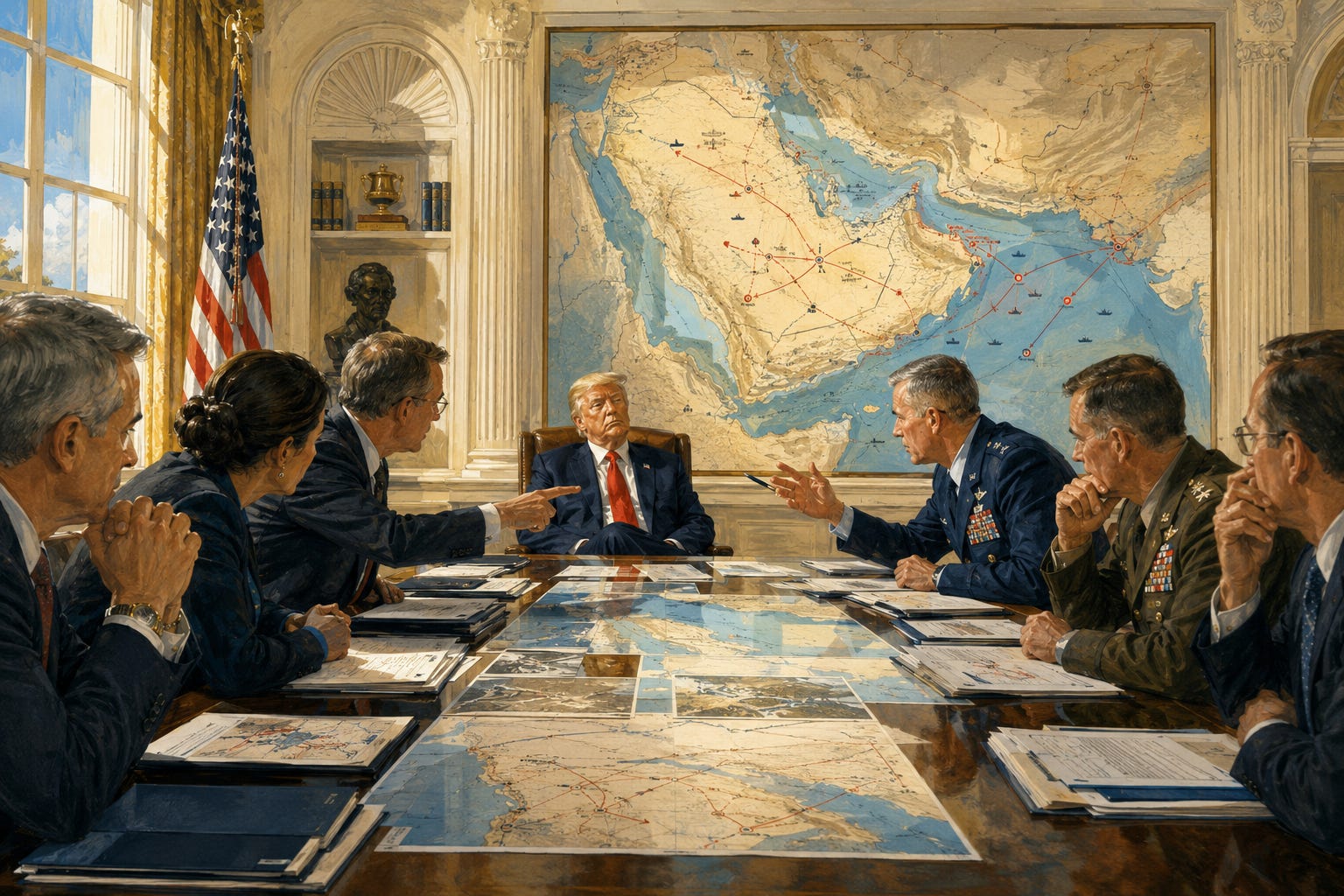
Six months on, the Strait of Hormuz is closed to most traffic and Americans are being told to accept the petrol prices that follow. Air-defence stockpiles have fallen far enough that the Pentagon is demanding faster production from industry. The regime that was supposed to crumble has a new Khamenei and a tighter grip on power. Carrier crews are at sea on record-length deployments, short of supplies, and the Gulf partners the war was supposed to reassure are warning Washington against escalation. There is no end date.
Here is the mystery. The most sophisticated national-security apparatus on Earth predicted much of this correctly, in writing, in advance. Several warnings were delivered to the president in person. And the disaster arrived anyway, almost on schedule. The conventional explanation for a war that goes this wrong is intelligence failure, the explanation reached for after Pearl Harbor, after 9/11 and after Iraq, and it does not fit here. What fits is something less familiar and more unsettling: a government losing its ability to correct the president’s reality. This investigation runs through the White House, the intelligence agencies, a Pentagon podium, and, briefly, an unemployment report.
To find the beginning, you have to start with an old problem that America once solved.
Every leader is wrong about something important. Serious institutions are therefore designed not around the fantasy of infallible leadership but around error correction, and error correction has been one of the hidden sources of American power. The United States built institutions whose purpose, reduced to its essence, was to tell powerful people no. The assumption is wrong. The inventory cannot sustain that. The enemy will probably do this instead. The evacuation plan does not exist. The president may hate every one of those sentences. That is why the machinery exists.
Senator Jon Ossoff recently reached for a very old story about the alternative. In the First Book of Kings, King Ahab weighs a war. Four hundred prophets tell him to go; victory is assured. One, Micaiah, says the campaign will end in disaster. Ahab has him imprisoned, goes to war, and dies. The point is not that Ahab lacked information. Someone knew, and someone told him. The court had simply made truth the most expensive answer in the room.
Leaders can always find people to tell them what they want to hear. Sophisticated states build institutions to protect the person who says the opposite. Ahab had prophets. America built the National Intelligence Council.
Julia Curlee spent twenty-five years inside that machinery, about twenty of them as a CIA analyst, delivered the President’s Daily Brief to Vice President Mike Pence, and served as the NSC’s acting senior director for intelligence programmes during the 2025 transition. Her most consequential idea is contained in a single sentence.
Candor at that level is a structural achievement.
Julia Curlee, Lawfare
It sounds like a bureaucrat’s sentence until you sit with it. Truth does not rise through a hierarchy on its own; bad news has gravity working against it, because everyone between an analyst and a president has a quiet incentive to soften the message for the person above. After 9/11 and Iraq, the United States treated an ancient problem as an engineering problem: analytic standards, formal dissent channels, an ombudsman outside the chain of command, career protections, all so that telling a president an unwelcome truth requires no personal heroism.
Which produces the question this article set out to answer: what happens when protecting the leader from unwelcome reality begins to outrank protecting the country from its consequences. Iran is the test case.
On 22 January 2025, the third day of the new administration, roughly 160 career staff of the National Security Council were summoned to an all-hands call and told to leave the building while their positions were reviewed. They were not Biden loyalists but career detailees on loan from the CIA, State, the Pentagon and the Treasury, people who serve whichever president is in office. Curlee survived that round. By 2 April she was gone too, and she has since written the most detailed insider account of what happened.
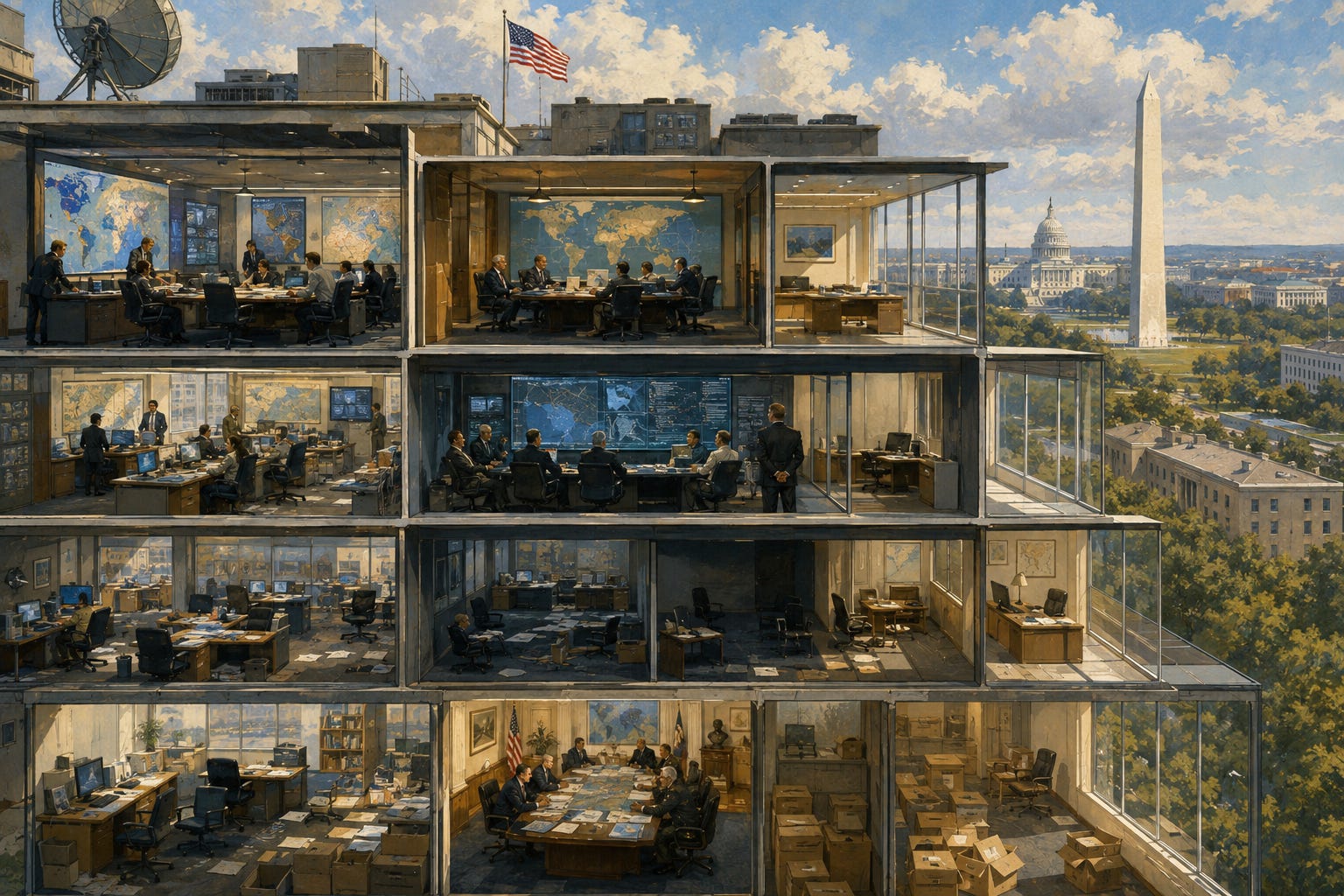
The NSC is worth a moment, because almost nobody outside Washington knows what it does. It collects no intelligence, commands no troops and has no budget worth mentioning. It is the room where the government’s parts are forced to confront one another’s assumptions before the president acts: the CIA asks whether the assumption is true, State asks what the allies will do, the military asks whether the objective is achievable, and the logisticians ask what happens when the port disappears.
Its product is not information. Its product is preparedness.
It has a second product, less obvious still: friction. A functioning process deliberately slows the journey from presidential impulse to national action. Sometimes the irritation is the safety system. A government stripped down into a fast implementation machine becomes excellent at executing presidential intent, and worse at discovering whether the intent corresponds to reality.
January was the beginning. In April 2025, senior NSC officials were fired or reassigned. In May, a restructuring took the NSC from more than 300 staff to roughly 50. That spring the CIA planned to eliminate about 1,200 positions. In August, Director of National Intelligence Tulsi Gabbard announced that ODNI, the office created after 9/11 to force America’s intelligence agencies to coordinate, would shrink by more than 40 per cent. At the State Department, more than 3,800 personnel left, and more than 100 ambassadorial posts stood vacant, including in several of the countries that border Iran.
Each move was defended individually, as the elimination of bloat, duplication and politicisation. Taken together they touched something larger. Carriers and stealth bombers are the visible form of American power. The less visible form was institutional: accumulated expertise, protected dissent, and machinery that forced second-order consequences into the room before a president did something irreversible. America’s strength was never just the hardware. It was the hardware attached to an enormous apparatus for judging how and when to use it.
Trump inherited that apparatus. In one year, his administration removed substantial parts of it.
Then came Iran.
One qualification should be stated once. We cannot know that retaining these people would have prevented the war or any failure within it. Bureaucracies do not run counterfactual experiments.
But Iran offers something unusually close to a stress test. We know what was weakened, because the cuts were announced policy. We know what the surviving system predicted, because the assessments have leaked in unusual detail. We know what the administration said in public. What follows is the comparison: the process by which one man’s version of reality began shaping the operating assumptions of a superpower, and what happened to the people positioned to stop it.
Comments
Nothing yet. Say the first thing.
Sign in to join the conversation.