
The West is trying to learn the same lessons without paying the same price. We followed Ukrainian drone teams through NATO exercises across Europe to measure the gap, and the first result, in Estonia, was only the beginning.
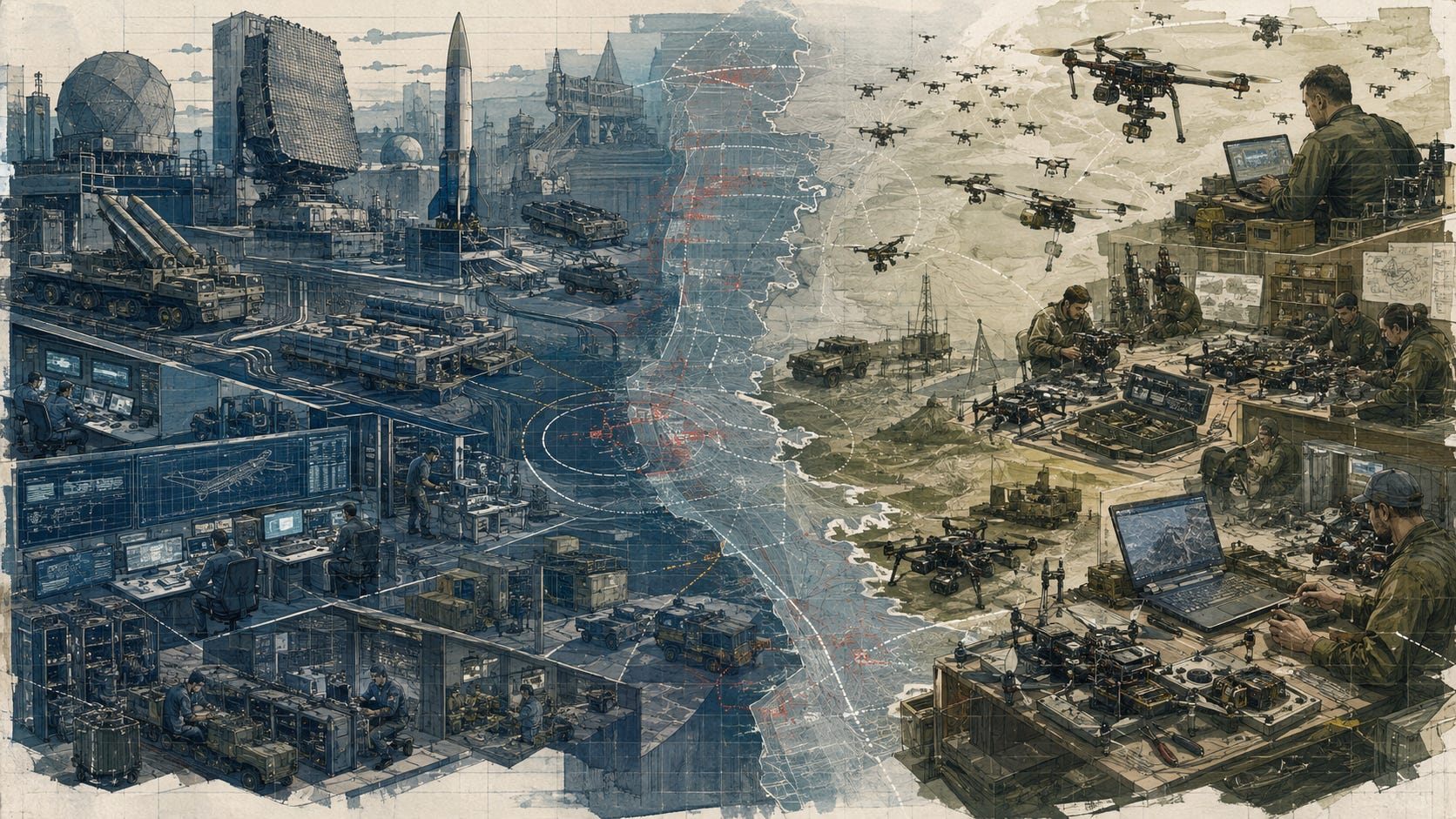
Western military superiority is not a myth.
For three decades, NATO militaries have demonstrated an ability to find and destroy conventional targets with extraordinary precision and reach. Satellites, stealth, networked command, long-range strike, air power capable of dismantling a state’s war machine in weeks. These capabilities are real, they are formidable, and nothing in this investigation argues otherwise.
But precision is one measurement of military power, and the war in Ukraine has spent four years quietly insisting on another.
What happens when the enemy changes faster than the weapon system?
Since 2022, Ukraine and Russia have been forcing each other to change, continuously. Ukraine solves a problem. Russia counters it. Ukraine changes. Russia changes again. A drone that works in March is jammed by June. A tactic that kept crews alive last year gets them killed this year. And because the feedback arrives as losses, not as findings in a review, the answer has to change immediately.
Russia’s side of this deserves attention, because the comfortable version of the war, plucky Ukraine against a lumbering relic, expired years ago.
One number shows the scale of it. RUSI analysts found that Ukrainian surveillance spotted only around 23 Russian tanks within 70 kilometres of the front between 1 and 24 August 2025. In May 2023, there were roughly 470 on the southern axis alone.
The tanks have not disappeared, and they have not fled a thousand kilometres to safety. Parking armour near a transparent front simply became too dangerous, so the tank changed how it exists: hidden, dispersed, committed briefly and pulled back. Russian artillery has gone the same way, still essential, but firing short sequences from cover and moving before it can be found and hit.
On this battlefield, a weapon that fails to evolve stops being a weapon.
NATO has fought real wars in the same period, against real and dangerous enemies, in the Gulf, the Balkans, Iraq and Afghanistan. What no NATO military has fought is a prolonged high-intensity conventional war against a technologically sophisticated opponent that continuously adapted its drones, jamming, sensors, fires and factories in response. Western weapons have been developed inside programmes: requirements, testing, contracts, upgrades, timelines measured in years. Ukrainian and Russian weapons are being developed inside a war.
Industry has names for what happens to products shielded from real competitive pressure. The Japanese called it Galapagos syndrome, after their mobile phones: marvels of engineering that evolved in isolation and could not survive contact with the global market. Business theorists call it the innovator’s dilemma, where an incumbent keeps perfecting the performance its best customers reward until a cruder, cheaper, faster-iterating product redefines what the market wants. Evolutionary biologists trace both back to the same root, relaxed selection: when the pressure that shaped you disappears, traits stop being tested, complexity accumulates without cost, and nothing looks wrong until the pressure returns.
Those are two different laboratories, and the difference raises a question that defence budgets do not answer. Did decades without sustained peer attrition allow the West to optimise its weapons for extraordinary individual performance, without ever fully testing how quickly those weapons, the systems that support them and the institutions that buy them could survive continuous enemy adaptation and mass expenditure?
We did not want to answer that with theory. We went looking for the places where the two laboratories have met: not doctrine papers, not procurement presentations, but Ukrainian combat veterans operating against NATO formations, with umpires keeping score.
Estonia appeared first.
The NATO force had one job. Find the Ukrainians.
There were roughly ten of them, hidden somewhere inside a small patch of terrain during Exercise Hedgehog in May 2025. They were not special forces. They were drone operators temporarily rotated out of actual frontline units and assigned to play the enemy.
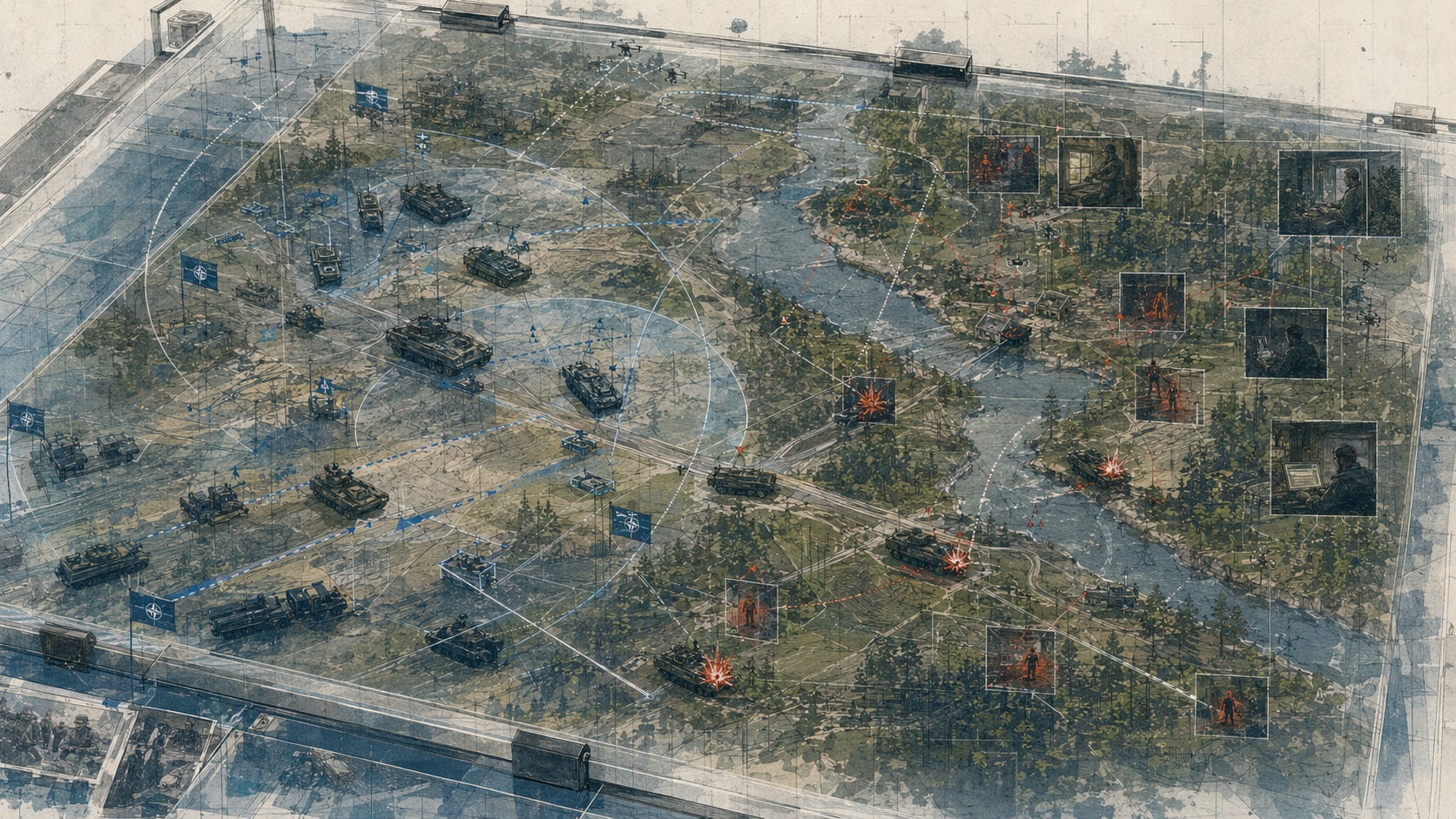
A NATO armoured formation went looking for them.
It never reached them.
Before half a day had passed, exercise umpires had declared 17 armoured vehicles destroyed and recorded roughly 30 additional strikes, all of it inside a patch of terrain smaller than ten square kilometres. Dozens of simulated attacks in less than half a day, and the people delivering them were still out there when it ended.
The figures come from an analysis published in War Room, the professional journal of the U.S. Army War College. The views are the author’s rather than an official Army finding, but this is a serious professional military source, not a victorious account posted by the winning side.
The wider Hedgehog exercise involved more than 16,000 troops from twelve countries. The ten Ukrainians were facing only one part of that force, not all sixteen thousand, and simulated kills are not battlefield kills. Exercises contain artificial rules, deliberately constructed weaknesses and umpires deciding who lives and dies.
But that was precisely why the result interested us. The NATO formation knew drones were hunting it. It tried to reach the operators. It could not, before the simulated losses became extraordinary.
There were several reassuring explanations. Perhaps the scenario had been stacked in Ukraine’s favour. Perhaps NATO had deliberately exposed an inadequately protected formation to discover what would happen. Perhaps ten exceptionally experienced operators had simply enjoyed one remarkable morning. Perhaps the whole thing would collapse the moment Ukrainian pilots encountered an American unit carrying the same technology.
There was a simple way to test that last possibility.
Find another exercise.
We did.
Eleven months later, Ukrainian drone operators met the U.S. Army in Germany. This time nobody could argue that the Americans had forgotten drones existed. They knew the threat. They had trained specifically for it. They had created an opposing-force unit whose job was to reproduce Ukraine-style drone and electronic-warfare tactics.
And the American brigade arrived carrying more than 400 drones of its own.
If Estonia had merely exposed an equipment problem, Germany should have ended the story. Instead, it made the story considerably bigger.
Combined Resolve 26-07 was held at Hohenfels in April and May 2026, with more than 3,600 personnel from seven countries and the U.S. Army’s 3rd Armored Brigade Combat Team, 1st Cavalry Division, at its centre.
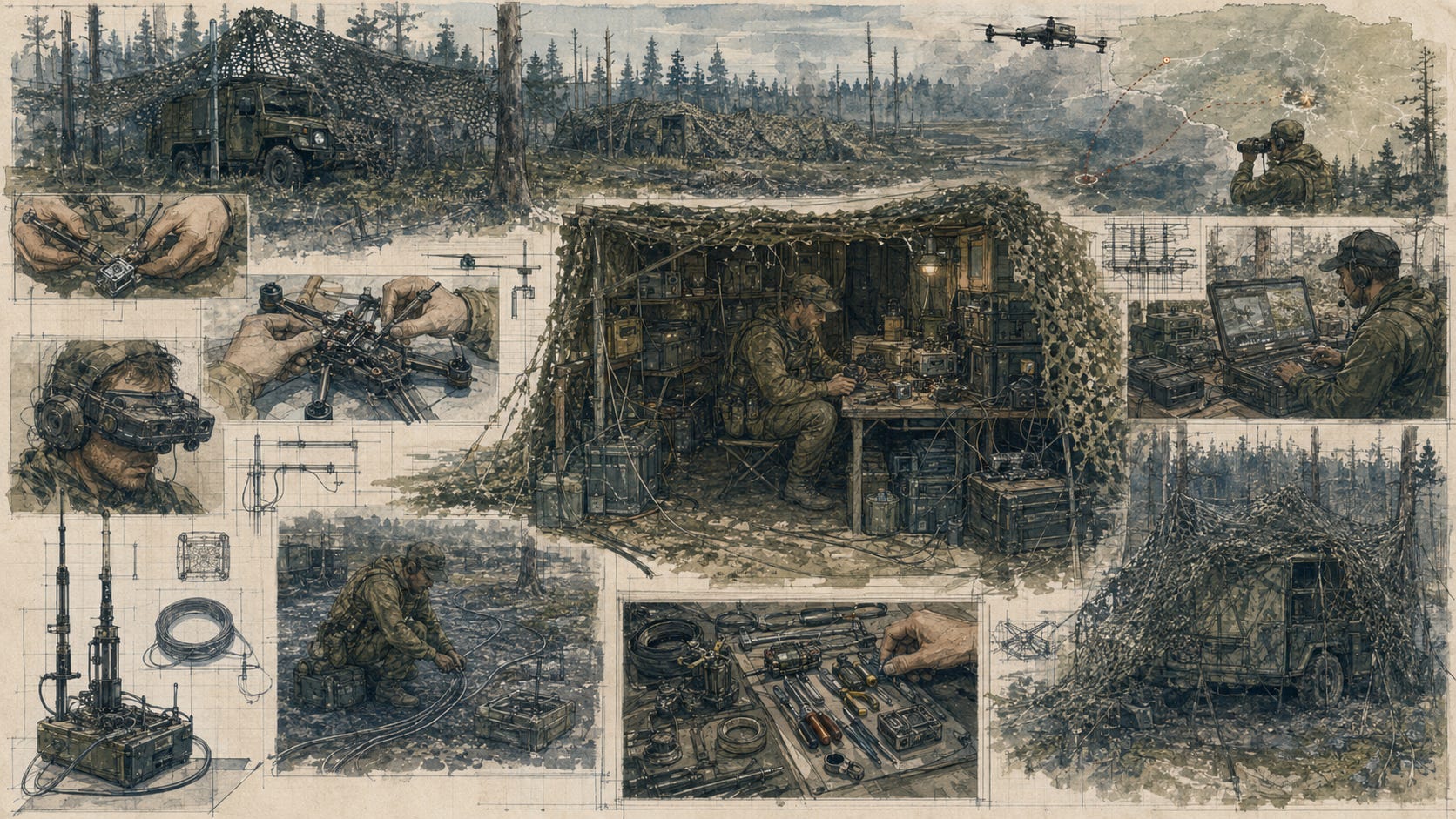
This was not an analogue army accidentally wandering into the drone age. The Greywolf Brigade itself operated more than 400 unmanned aircraft systems across six commands. Hohenfels maintains Eerie Company, a dedicated opposing-force unit built around FPV drones, reconnaissance and electronic warfare, so that American troops encounter this kind of battlefield before somebody introduces them to it with explosives. The Army describes the site as the one place where lessons from ongoing wars feed directly into its scenarios.
Then actual Ukrainians arrived. Combat veterans joined the opposing force, and according to the Wall Street Journal, American troops and armoured vehicles were detected and adjudicated killed so quickly that some had to be brought back into the exercise simply so the training could continue.
That creates a much more interesting problem than “America needs more drones.” America had drones, hundreds of them. It had studied the threat and built a unit to imitate the threat, and something was still missing. Military procurement is remarkably good at counting objects: ten drones, four hundred drones, three hundred thousand drones. What Germany suggested is that an inventory of drones and the ability to fight inside a battlefield transformed by drones are not the same capability, and only one of them appears neatly on a spreadsheet.
Whatever the Ukrainians had brought with them to Hohenfels, it was not listed on the equipment manifest.
To find it, we had to go to Sweden.
Aurora 26 was enormous: more than 18,000 personnel exercising across Sweden. Ukraine sent fifteen operators from its 1st Azov Corps to join the opposing force, and in one of the key mechanised scenarios only six Ukrainians were in the field at a time, one reconnaissance team and one FPV strike team. Coming towards them were Swedish Leopard 2 tanks and CV90 infantry fighting vehicles.
The Ukrainians found them first. Two participating operators later told the Kyiv Independent that the attackers never reached their objective, that they stopped counting adjudicated equipment kills after passing 30, and that one scenario had effectively ceased to be useful once roughly half the vehicles had been declared destroyed.
There is an important qualification. Some Swedish troops were deliberately sent into the exercise without anti-drone technology, because NATO wanted to see what drones would do to armour that lacked those protections. So this was not six Ukrainians defeating a fully defended NATO armoured force in a fair contest. That version makes for a better social-media post. It is also less interesting than what the Ukrainians noticed afterwards.
They complained about antennas. Where operators sat. How vehicles tried to hide. How drone pilots were protected. Engineering, camouflage, flying under pressure. Almost disappointingly ordinary things.
And that was the revelation. There was no secret Ukrainian super-drone, no extraordinary software Sweden could simply order, no artefact NATO had forgotten to purchase. The difference was made partly from hundreds of small decisions that had been tested somewhere very different from Sweden. Place an antenna badly during an exercise and somebody points it out afterwards. Place one badly enough in Ukraine and the lesson may arrive as a Russian strike. Hide a vehicle badly in Sweden and an umpire raises a flag. Hide it badly in Ukraine and another crew learns from the wreck. For years, Russian electronic warfare, reconnaissance and firepower have subjected Ukrainian units to continuous selection. Procedures that work survive. Procedures that fail are changed, sometimes within days. The Ukrainians arriving at NATO exercises carry the accumulated result, which points to something the equipment manifest could never show. The most advanced technology on that Swedish exercise field was not a drone. It was a habit.
That helps explain why six experienced operators can make a conventional formation look surprisingly vulnerable. But it does not explain the strangest things we found. Individual experience should remain individual. A brilliant operator can teach another operator; a veteran unit can outperform a greener one. That does not explain why Finland is now bringing Ukrainians in to teach its soldiers. It does not explain why Sweden formally asks Ukraine to transfer drone-warfare expertise. And it certainly does not explain why, at a multinational NATO experiment in Portugal, the opposing force ended up running part of its operation through Ukrainian battlefield software.
At that point the question changes. It is no longer why Ukrainian drone pilots are so good. It becomes: how did a country with a fraction of NATO’s money build a military system capable of learning from combat faster than some of the richest armed forces on Earth? And once we followed that question beyond the pilots, the exercises started pointing towards something much larger. Not merely a gap in training. Not merely a gap in procurement. A possible gap in the way the West has spent decades thinking about military power itself.
Comments
Nothing yet. Say the first thing.
Sign in to join the conversation.