
Check out the rest of the Mega Retrospective here!
When the NES hit the scene it 1985, it began a gradual shift in the video game market away from arcades and into the home. Like most other third-party developers of the time, Capcom approached this by adapting their arcade hits like 1942 and Ghosts ‘n Goblins straight to the NES. This worked well enough, but it quickly became clear that designing games for home systems presented a lot of new design potential. To this end, Capcom decided to bring on some fresh talent and whip up something brand-new for the NES: Mega Man. Building on their early forays into the action platformer genre with Ghosts ‘n Goblins, Mega Man would stand alongside titles like Super Mario Bros. and Castlevania as the building blocks of one of gaming’s most prolific genres - but it wouldn’t get there overnight.
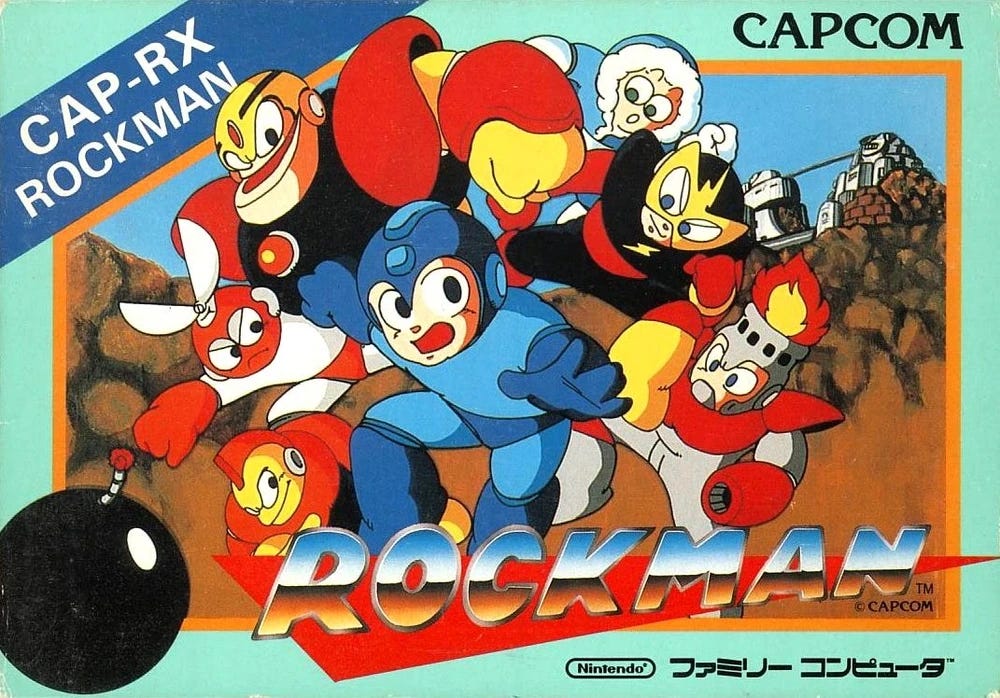
Mega Man was designed in large part by a team of amateurs, overseen by select Capcom vets like director Akira Kitamura. Keiji Inafune, the main artist, claims he “knew absolutely nothing about what it takes to create a game” when he was “thrust into” the team, unexpectedly taking on the duty of not only designing almost every single character and enemy but also drawing their in-game graphics. This method of game design might sound like a recipe for disaster, but back then, nobody had written the book on this stuff yet. Kitamura designed Mega Man as spritework first, choosing to make him blue since the NES could render more shades of blue than most colors. Mega Man’s timeless original sprites were so good that they would stay exactly the same throughout the series’ long run on NES, and Inafune was able to translate the design to physical art in a simple and appealing way.
Pulling in quick inspiration from things like Astro Boy’s art and rock paper scissors’ game dynamic, the team managed to design a simple, fundamentally competent game in spite of their hectic working environment and inexperience. Rock and his sister Roll were the robot assistants of Doctor Light, very much mirroring Astro Boy’s relationship with his creator, Doctor Tenma. Visually, Doctor Light’s thick white beard was inspired by Santa (for some reason) and his nefarious foil Doctor Wily was made to look like Albert Einstein. In Mega Man, Wily has stolen and reprogrammed six of Doctor Light’s revolutionary civil service robots into destructive Robot Masters, forcing the good doctor to convert Rock into the battle-ready Rockman!
Of course, if you were American, you didn’t get any of that stuff. There may not have been any group of people in gaming who were winging it harder than localization teams back in these days, especially at Capcom. Capcom USA’s people thought things like the Astro Boy-inspired art and Rockman’s name were too cute or uncool. In the interest of sales, the whole game was drenched in something of an American idea of “cool.” They were onto something with the catchy name “Mega Man,” but that’s about where the good ideas end. The back of the US box bizarrely sets the game in “Monsteropolis” and positions the Robot Masters as “robot-like Humanoids created by the wrongly-performed experiments with human beings by Dr. Wright.” It’s like they mashed Light and Wily into the same guy and introduced this weird body horror theme which doesn’t match the visuals at all! Most infamously of all, there’s this box “““art”””:
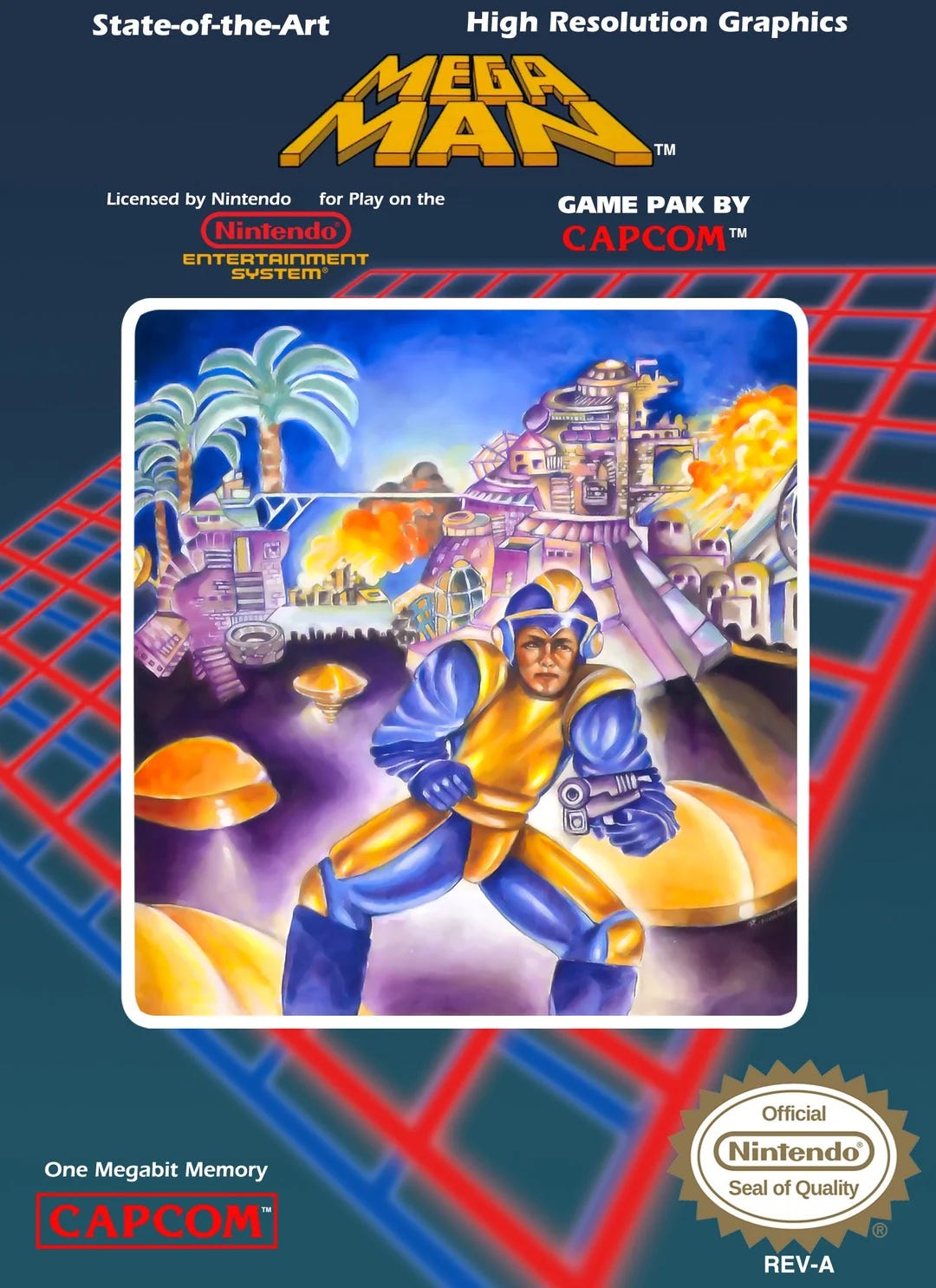
Unfortunately, this kind of overseas mangling was commonplace in the NES days, especially in the US. Capcom USA’s president reportedly told a marketing representative to design Mega Man’s box cover by the next day! Said marketing rep offloaded the work to a friend of his, who made it in just six hours and, unsurprisingly, seems to have sought no credit for his work. Inafune has gone on record saying that this box art is the reason Mega Man performed poorly in the US. It doesn’t get much worse than that. Weirdly, Europe got something way cooler:
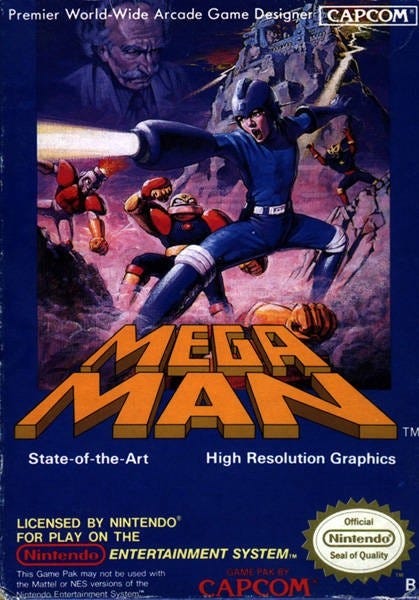
Not only is it significantly more on-model with the actual game, but the artistry is more technically impressive to an obvious degree. I wish we knew who drew this one, but no such luck. Wily’s faded, pensive image in the back always stands out to me; it makes the game look like it’s going to be WAY more dramatic than it is.
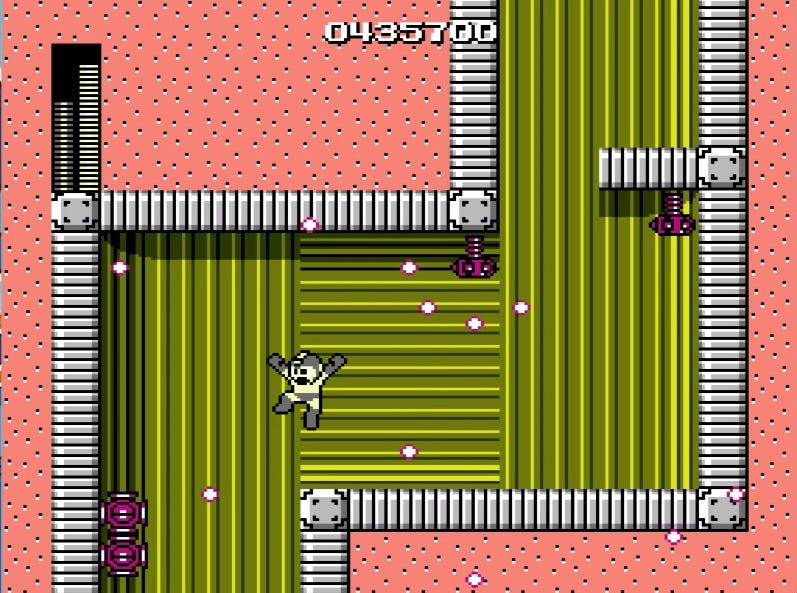
For a game made by a bunch of fresh-faced industry newcomers, Mega Man is pretty solid. All the series hallmarks are here, from cool music to annoying disappearing block puzzles. Players can choose to play any of the six Robot Masters’ stages right from the start, equipped with only the trusty but basic Mega Buster. Jumping and shooting are quick, and enemies force players to pay attention and react quickly. Even when you do get hit, random health and ammo drops from the enemies you defeat encourage you to keep moving forward. Mega Man runs at a steady pace and steers in the air on a dime, such that weaving your way around enemy attacks as you progress feels nimble and skillful. He’s a little more slippery than he would be in later games, though, making this first outing feel noticeably less tight to control than its successors. Level designs are generally solid and more fair than most games were at the time, but the wealth of copy-pasted rooms and some poorly-telegraphed challenges definitely feel weak compared to modern platformers. Though it’s never anywhere near as bullshit as stuff like Ninja Gaiden was, I don’t feel bad using save states in some of these older Mega Man games.
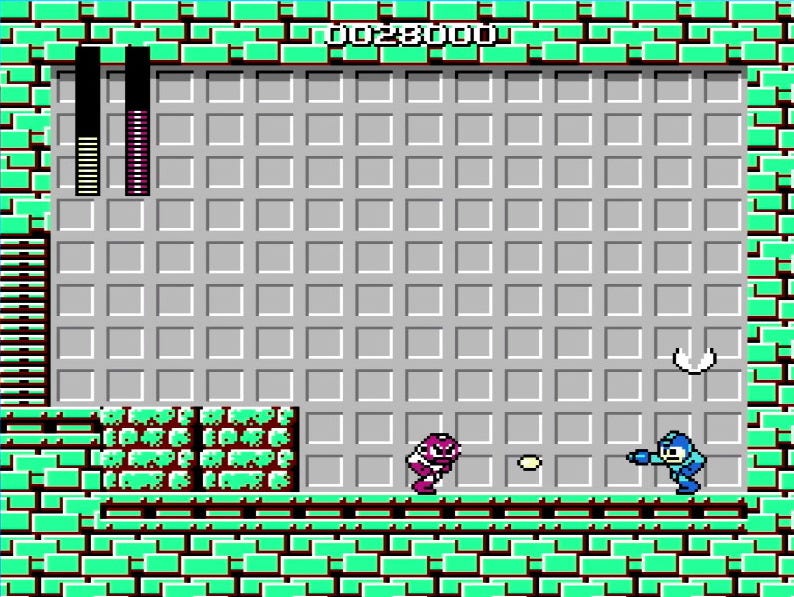
Of course, the franchise’s most iconic gimmick makes its debut here: the ability to use the defeated Robot Masters’ weapons against other bosses to exploit their vulnerabilities. There’s always a certain logic to the weaknesses, and with only six basic bosses as opposed to the later standard of eight, it makes more sense here than it usually does. Guts Man’s rock-throwing Super Arm beats Cut Man’s Boomerang Cutters; rock literally beats scissors. There’s no Paper Man, so the Boomerang Cutter instead beats Elec Man because metal doesn’t play nice with electrical systems. Naturally, the Thunder Beam beats Ice Man because water conducts, then the Ice Slasher cools down Fire Man, then the Fire Storm prematurely detonates Bomb Man, and the Hyper Bomb beats Guts Man because bombs are known to be very effective at killing people. Oh, and breaking rocks. Players are encouraged to find out which boss is easiest to beat first, then follow the weaknesses to form a nice, satisfying order. Many of the bosses die in just two or three hits from their weakness, which is fortunate since many of them move and shoot too fast in their cramped arenas to easily deal with otherwise.
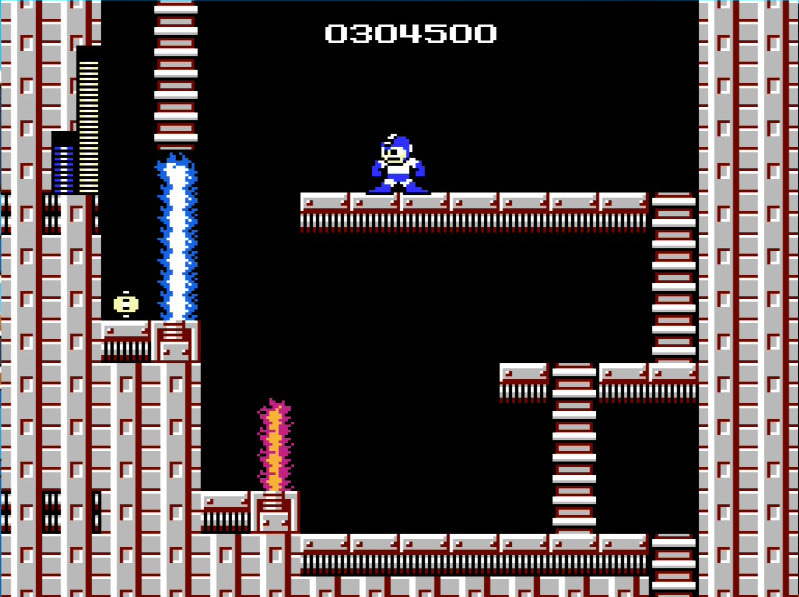
The small arsenal is fairly simple, but most weapons are solid and I appreciate the ways they can interact with Mega Man’s normal stages. In fact, Mega Man’s weapons beat out a lot of the later games in their ability to directly affect your environment. The Super Arm is completely unique across the series for only being used to pick up and throw specific blocks found in the stages; you can’t do anything with it if they’re not around. While this makes it useless most of the time, it is neat. The Ice Slasher can freeze pillars of fire in Fire Man’s stage, too. Though some of the later Mega Man games are known for having one weapon that really stands above the rest (more on that next article), Mega Man’s arsenal is actually pretty well-balanced. Things like the Boomerang Cutter’s curving arc and the Ice Slasher’s freezing capabilities keep every weapon feeling like it has some kind of niche. The variety of enemies who attack from all sorts of angles also encourage you to use everything at your disposal. If there is a superior weapon in this game, it’s probably the Thunder Beam; it fires a wide and powerful shot straight ahead along with two other bolts that go up and down, making it a great option for clearing foes out throughout the game. It can even destroy the blocks you use the super arm on, for some reason.
All in all, Mega Man is a pretty solid first outing by 1987 standards, and it’s not half bad today either if you’ve got the mindset for older games. However, most fans know that the Mega Man series didn’t really take off until the sequel, and it’s not too hard to see why. For all of its best efforts, games in the early NES days were working under a lot of limitations. Developers - especially the amateurs designing Mega Man - were still learning how to jam as much as they could onto the kilobytes an NES cartridge provided and keep their games running smoothly in the middle of the action. The result for the early days of the Mega Man series is none other than…
That’s right, folks; despite being one of the most iconic NES franchises, those old Mega Man games can get JANKY. There are few jankier than the original, and it’s in all the ways you can never quite predict. So, welcome to the first of many segments of MegaJank, where we go over all the weirdness that came with these pioneering, quickly-made Mega Man games. From funny quirks to tremendous pains in the ass, jank is always fun to talk about, even if I try not to give these games a hard time for being what they are. Nobody really knew any better!
The principal example of MegaJank, not only in Mega Man but perhaps the whole series, is the pause screen glitch. In Mega Man games, pressing start pauses the game and opens up a menu where you can select your weapon. However, one of the more archaic design elements of the first game (like your completely pointless score) is that there is a separate pause button that just pauses the game without opening up the menu. Why this was deemed necessary is beyond me, and it was promptly cut in the sequels to no one’s surprise or despair. However, this alternate pausing method accidentally opened up a crazy exploit for boss battles. For some reason, pausing like this paused everything in the game except for the limited invincibility bosses get to avoid taking damage from the same shot of a weapon more times than intended. In combination with the thunder beam’s huge projectile, what ensues is some glorious MegaJank. It’s best demonstrated against the Yellow Devil, the infamous first boss of the final stages in Dr. Wily’s castle. I’d be lying to you if I said I could beat this bastard without the glitch, as seen here:
WARNING: annoying, high-pitched computer sounds ahead!
It’s cheesy and it kind of messes up the display, but it sure gets the job done. I’d much rather this boss simply be fun to defeat without it. I’d certainly get my chance in other games, as Capcom decided he was so iconic that they would put new versions of him in many of the sequels which are only marginally less annoying. Yippee.
Anyways, the rest of Mega Man’s MegaJank is more tame by comparison. Some of it is even intentional! Notably, the first stage in Dr. Wily’s castle eventually leads to a room of two vertical tunnels with no platforms to jump through them. It seems unbeatable, but you can actually make it through if you collect the Magnet Beam in Elec Man’s stage. It’s not hidden, but you have to throw some blocks out of the way with the super arm or thunder beam to reach it, making it easy to forget about if you didn’t do it on your first trip through the stage. It draws a platform out in front of you when fired, which is really helpful, but it’s the sort of thing that seems optional right up until the game surprises you with a room you can’t clear without it. That’s kind of a dick move, especially since the only way to go back to stage select without straight-up resetting the game and losing all of your progress was to game over.
As for the unintentional MegaJank, a lot of it has to do with physics or loading data. If the ground ever slips from beneath Mega Man’s feet, such as when you’re standing on a disappearing platform when it disappears, he’ll slam to the bottom of the screen almost instantly. Falling from a jump doesn’t do this, but the game doesn’t really know how to handle becoming airborne from a standing position the same way. This is a quirk I’ve also noticed with the NES Castlevania games.
Like many NES games, Mega Man is prone to lag and flickering when many assets are on screen at once, and developers knew even less about how to smooth that out this early in the system’s life. It’s really easy to slow Mega Man down and flicker its assets all over just with a few of your own shots, especially with how many projectiles your enemies can put on screen. While this game includes underwater sections, water doesn’t change the physics like in later Mega Man games, so it just slows the game down arbitrarily. On Ice Man’s stage, the flying platforms are weirdly hard to land on. Touching the edge might cause you to slip off or fall through them, which is a real pain to deal with when you’re expected to cross gaps by jumping between them while being shot at. Overall, stuff like moving platforms and collision were tough nuts to crack back then.
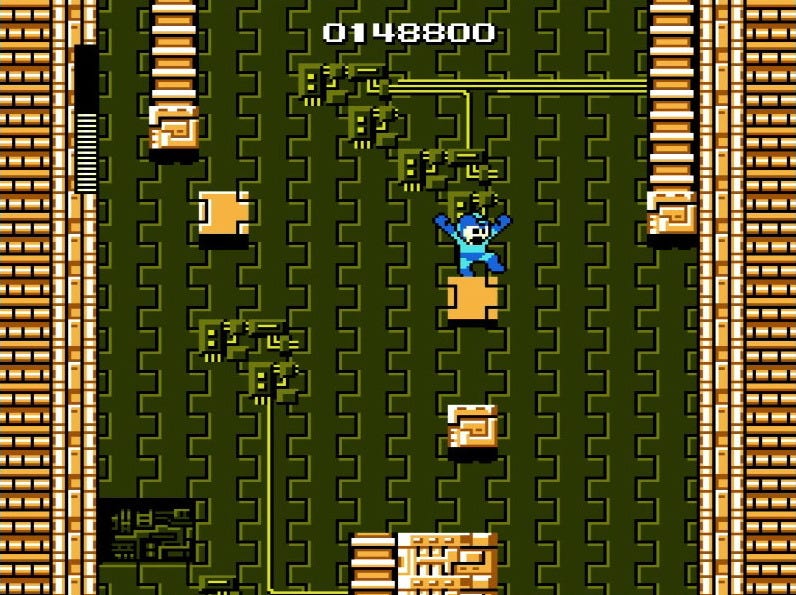
So, what’s the verdict on the original Mega Man title? I think it’s a pretty solid first outing, especially considering how little experience many of its creators had, but it’s undeniably a little rough around the edges. Though it laid down a lot of the strong design fundamentals the series would rely on and even executed on some of its ideas better than later entries, there’s a feeling throughout that this game is not all Mega Man could be. Everything’s a little shorter and simpler than you expect, but a first entry could be a lot worse than this - especially in such early times. Even though it’s handily eclipsed by most of its successors, I have a real soft spot for Mega Man. In some ways, it’s the little game that could. Besides, it doesn’t matter how much you like Mega Man 2; it never happens without Mega Man.
No posts
Comments
Nothing yet. Say the first thing.
Sign in to join the conversation.