
“Why can’t you just __?”
Over the years, I’ve had different versions of the same argument in different countries. When it happens, we usually hit the same impasse:
I’m thinking: Why can’t he just do this one thing to fix things between us?
Annoyed and triggered, he’s probably wondering: Why can’t she just move on, or look the other way?
For both of us, the word “just” is doing a lot of heavy lifting. Because everything that needs excavating lives under that four-letter word.
We’re both asking each other the same question:
Why can’t you just love me, exactly as I am? Is that too much to ask?
Technically, I mean, yeah, sure, I guess it is “too much to ask.” 😂
Because neither of us ever actually asks that question to the other person, out loud and unafraid. Instead, it’s as if we’re both very smart, logical people who can’t understand why the other person is refusing a simple request.
I decide: He avoids accountability. I’m so glad I saw that clearly, and I left!
He decides: She doesn’t know how to let things go & move on. That’s not going to work!
For both of us, it’s a comfortable way of rationalizing everything. Perhaps, too comfortable? Because, in my version of us, I’m right. In his? He is. Neither actually asks the other, “What does it cost me to give this person what they’re actually asking for, and why am I unwilling to give it?”
Regardless of the answer, it’s not either of our jobs to make anyone want to show up for us. After all, I could literally hand a man a playbook that explains how to love me, and he might still choose not to open it.
Everyone deserves to be loved correctly. Not perfectly (because I don’t believe in impossible standards), but correctly (because I do, indeed, believe in standards). So, we each decide if we want to do that for someone, and whether the other person’s behaviors demonstrate that they’re willing to do that for us in return.
Throughout my life, I’ve loved and been loved, even if imperfectly. When I felt truly known and understood, even if the person wasn’t standing next to me, knowing their love was in my presence, literally and figuratively, felt so good. Safe, soothing, calming, comforting, and supportive. I felt like, no matter what happened to me, I’d be okay. My life was sweeter because they were in it.
That’s once we’re in it. For me, the hardest part is getting started.
When I start to feel butterflies, it scares me.
Because if I’m honest with myself, intimacy with a stranger can feel like exposure. To my nervous system, exposure can feel like danger. It’s the opposite of the safety I’d likely feel once the guy and I were further down the road. Because, early on, there are a million reasons why someone might leave (ahem, abandon) me, or vice versa.
But, what if I really like someone?
Well, when I was in my 20s, that used to put me on my guard. Because: men.
Back then, I didn’t want to miss signs that the guy wasn’t a good person. So, I’d vigilantly hunt for trouble when there was none. Beneath the surface, it made me resent them because I was looking out for them and us, but it didn’t feel like they were looking out for me.
But, I didn’t leave them. No, I’d just become what I perceived to be a more palatable, agreeable, and soothing version of myself. I’d coast along with as little friction as possible. Because I wasn’t comfortable being on my own, and arguing with them was draining anyway.
When I met someone who I thought might be a better match, that’s when I’d break up with my partner and move on to the next one. I should have showed myself more fully & given him a fair chance to love me better.
Back then, I didn’t want to. Because I was scared. I worried, if I truly showed him who I was, maybe he wouldn’t love me.
Maybe he’d think I was too intense?
What if he turned out to be someone different than I thought he was?
What if he was unable, unwilling, or uninterested in caring about me in the way that I need?
What if I opened myself to getting hurt? That would mean that I’d done a bad job at protecting myself. I didn’t want to do that!
I wasn’t stupid, I was just inexperienced in love and managing a lot of anxiety and C-PTSD. I should’ve been gentler on myself. Thinking back, so many of my fears led to unnecessary energy spent and wasted time.
I have so much more compassion for myself now.
Almost thirty years later, given the beauty of both hindsight and age, I can recognize many of my earlier actions in relationships were trauma responses.
I’ve since learned:
The same skills that helped keep me safe when I was a little girl can actually push healthy people away from me as an adult.
I know now love requires an open heart the same way that plants need sunshine and water to grow.
So, what do I do now? I tend to go really deep really really fast. Turn up the heat. Accelerate the pace. Dowse the thing in self-trust, transparency, authenticity and every wonderful emotion (and expect my partners to do the same) fairly early on.
It feels comfortable to jump into the emotional deep end, feet first, screaming as I descend: Get to the truth faster, when it’s less likely to hurt.
If he’s going to run, or I need to, I’d rather know that right up front.
But, I’m learning it’s okay to stay present and uncertain, just a little bit longer. Because it’s easy to get along with, and fall for, someone who’s showing a bunch of charm, warmth, kindness, attentiveness, curiosity, intelligence, affection, and emotional generosity when it costs them nothing.
Wait for the times when things aren’t as smooth. Pay attention when someone’s done something that hurt someone’s feelings, fallen short of how either of us would like to show up, or a misunderstanding has surfaced. How do we behave toward each other then? Are we still kind? Loving? Supportive?
These days, I’m learning to ease my way into the pool more gently. Healthy relationships can actually feel kind of “boring” and “normal” and “easy.” That’s just my nervous system re-tuning itself away from interpreting “intensity” as care.
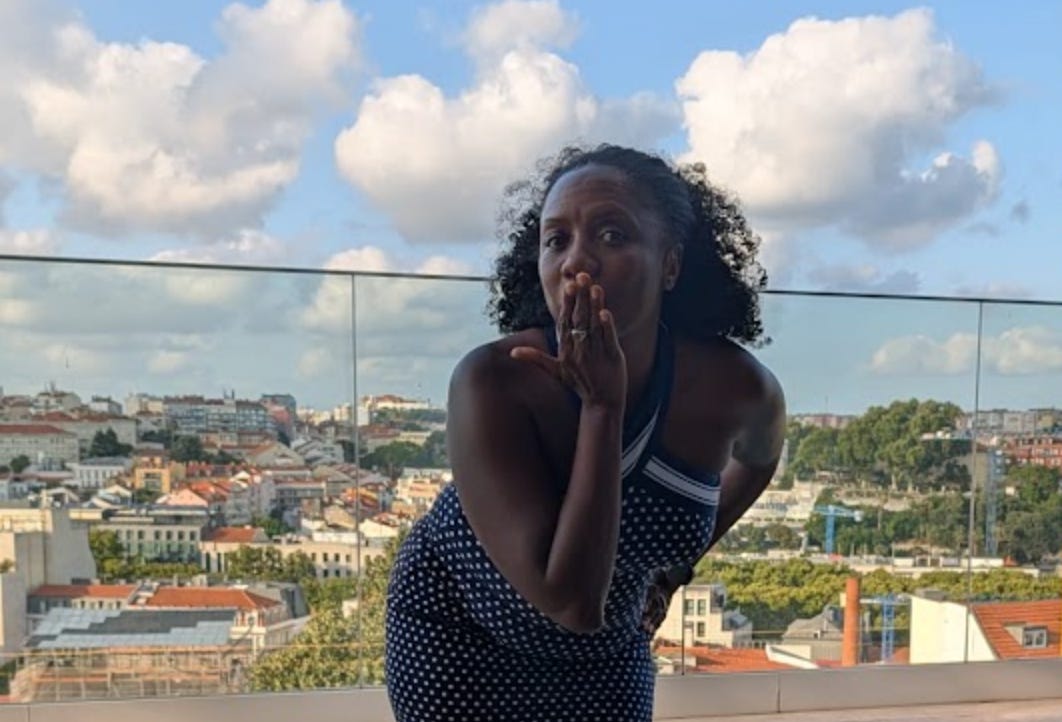
Sipping Aperol spritzes with a friend at a Portuguese quiosque outside one of Lisbon’s hidden botanical gardens, a friend recently asked me:
“So, have you fully healed?”
I didn’t know how to answer her. I mean, just the day before, I’d cried through my Portuguese language lesson. It’s nothing to get into it in this letter. Maybe the next one. For now, I’ll say: Life. Love. Work. Friends. Health. Lately, it had kind of been feeling like a lot of things hadn’t been working out as smoothly as I’d like them to, and I’ve craved a bit more ease. So, I sat there in front of my friend wondering:
Does anyone ever fully heal?
Even when we think we do, scar tissue persists. My uncertainty and confusion must’ve shown because she clarified:
“I mean with everything down there? After surgery. Are you all healed?”
Ah, got it. Wow, that’s a much easier question.
The answer: Yes.
As of August 7th, all internal wounds should be healed. After that, doc says I can swim pools and in the ocean again.
If only hearts could heal that easily and quickly, or not get wounded in the first place. Until then, yes, of course I still have tender spots. When a man brushes up against them, I immediately think: I’m beginning to trust this person, and now they’re hurting me, so I need to leave.
In those instances, my reflex can be like a tiny, spicy kitty. When scared, kittens usually do one of two things.
Swatty kitty: They’ll arch their backs, hiss, and pretend-swat at anyone who gets too close to them.
Missing kitty: Or, they run and hide, refusing to show themselves until they’re sure whatever danger has gone away.
I’m not actually ever going to hurt anyone. I’m just scared.
Usually, when I’m triggered, the kitty behavior I show depends on the situation.
Swatty Twanny: I’d say something that, while true, could get delivered in a tone that could come across more acerbic than it needs to be.
Missing Twanny: I’d shut down, greyrock, and remove every ounce of warmth from my communication. Because I don’t want to be unkind, so I’d rather say nothing.
But, reflexes are just that: something hard wired in the bodies that we call home. But, people can rewire their homes, especially when they actually want to put in the work to do so and when they realize the old wiring is out of date and no longer serves them well.
So, now, I’m choosing options that require me to sit in the uncomfortable middle where I don’t yet know if someone is emotionally safe.
Keeping cards close to my chest can feel good. Yet, avoiding risks isn’t the same thing as avoiding pain. If anything, being super cautious can actually choke off love.
🎶
Say after me:
It’s no better to be safe than sorry.
— A-ha, Take On Me
🎶
Always a Midwesterner at heart, oh how I love a monarch butterfly! Wearing stained glass as wings, they have beautiful burnt sienna colors of the sunset, framed in velvet black, and dotted with twinkling little stars. It doesn’t “fly” as much as it poetically drifts through the sky, dancing on the wind as if it’s stringing notes through the air. 🎼
But, it only lives for about three weeks. That’s an adult butterfly’s lifespan.
That’s the part nobody talks about when they say “butterflies.” When I feel them, the ones where I can’t stop thinking about the guy, reading his texts, hearing his voice, seeing his face (or his name on my phone), it makes me smile so big that my cheeks hurt. But, early on, I don’t know which kind of butterflies they are yet.
The literal kind? Equally beautiful as ill-fated, they die off in a few weeks because somebody’s fear, mine or his, choked it before it had a chance.
Or, the figurative kind? Fluttering in my cheeks, stomach, brain, heart, and everywhere else in my body, they eventually settle in, mature, and turn into something that can live inside a person forever.
I know what I deserve.
It takes a while to figure out who’s actually capable of providing that to me.
Tiny, Private Love Letter is written by Twanna A. Hines, an obsessed observer of how we love, learn, leave, and find our way through this world. When you subscribe or upgrade, you’re supporting independent writing and helping offset the cost to produce the work you’re currently reading.
Thanks for reading Tiny, Private Love Letter! This post is public so feel free to share it.
Twanna A. Hines, M.S. is an American entrepreneur and award-winning sexual health educator. She is founder of FUNKY BROWN CHICK, Inc., a social impact consultancy serving nonprofits, foundations, B-Corps, and international organizations. She has appeared in The Guardian, NBC News, Al Jazeera, Fast Company, and 25+ other outlets; she has been covered by The New York Times, CNN, Cosmopolitan, Essence, Vox, and 50+ additional media outlets. She has been called “a gifted storyteller” by The Washington Post. See more at: twannahines.com.
Comments
Nothing yet. Say the first thing.
Sign in to join the conversation.