
Last night I saw the total solar eclipse, at a miradouro in Lisbon.
So of course Total Eclipse of the Heart got stuck in my head on repeat. If you know the song, or even if you don’t: it’s about craving a past love so badly that not having them back feels like every drop of warmth has left you. Like you’ve been abandoned in the cold. With darkness.
In next week’s letter, I’ll do a roundup of every ex I’ve ever had, including which ones I want back.
Spoiler alert: none. 😂
But it’s still worth reading. It’s got other self-knowledge nuggets in it. (Ha, it’s almost like I go to therapy, so you don’t have to.) Anyway, now that I’ve actually seen an eclipse, I finally understand the song. Turns out I’ve had the “eclipse” metaphor wrong this whole time.
So, that’s what I’m sharing with you in this letter: what I learned about love from spending an hour in the dark, on a hill with several hundred strangers in Portugal.
Until yesterday I didn’t understand much about eclipses: what one actually is, how often they happen, or why everyone was so worked up about this particular one. But here’s what I know now.
What: The moon passes almost exactly between the earth and the sun.
When: Happens somewhere on earth roughly every year and a half.
Why people cared: To see a total solar eclipse happen at one particular spot takes more than 100 years. The last time Portugal had a total solar eclipse was in 1912. After last night, it’s possible the next one won’t happen here again until 2144. Definitely a once-in-a-lifetime experience.
Portugal aside, last night’s eclipse was the first of its kind anywhere in Europe since 1999.
Where I wanted to watch: Olho de Boi (“ox eye” in English). A hill above a pier called Cais do Ginjal, it’s a short walk from my apartment on the Cacilhas side of the river. That didn’t happen.
Where I actually watched: Miradouro do Monte Agudo, in Lisbon proper.
Miradouros, “viewpoints” in English, are like natural balcony cliffs built into Lisbon’s many hillsides. There’s something so beautiful about a city so stunningly gorgeous that the place makes space to just take it all in.
Monte Agudo isn’t even that popular. For starters, you’d actually have to find it. No public transport goes there. You walk up a steep hill, into a residential neighborhood full of locals, and tuck yourself in behind a school.
Most tourists either don’t know it exists, or skip it for the easier, more Instagrammable miradouros da Graça and São Pedro de Alcântara.
Outvoted on Olho de Boi, I could’ve said no and done my own thing, but I chose friendship over solitude.
I’m going to slip into a New York story for a second, but stay with me.
The vote itself reminded me of my New York days. Because the East River sits between Manhattan and Brooklyn, with bridges and short subway rides connecting the two. For years, Manhattanites (including me!) refused to go to Brooklyn because it was too far. Now, Brooklyn is the less plastic, more expensive version of what Manhattan used to be, with so many people wishing they’d bought something there ages ago.
O Rio Tejo sits between Lisbon proper and the city’s Margem Sul (south bank), where I choose to live. It feels like the same river story, different city. Only, this time, I got ahead of the curve.
My place has river and Lisbon skyline views.
In fact, one of the last texts the German ever sent me was about the river and the sun. We were dating. So, I’d slept at his place and I knew it had a river view. The first and last time he slept at mine, of course we had sex.
The next morning, he made his way back to his place in Lisbon. Once he got there, he sent me a text and a photo with “his” view of the river:
Hello from the other side. There was a beautiful sunrise this morning. 😊
I thought it was beautiful. Like a kiss, flying over mobile networks and across the river, landing on my phone, and then on my lips.
Prior to the eclipse, I’d been to Monte Agudo before. The German actually lives around the way, and we used to make out there. Yesterday, once I realized where I was, I thought about it (and him) the same way you’d think about a favorite restaurant that’s since closed, with something else taking its spot:
“Ah, I remember this place. It used to be something different!”
Then the thought passes, the way thoughts, places, and people often do.
I arrived around 6:20pm. Or, as the locals say: 18h20 WEST.
Perfect spot. Monte Agudo’s westward orientation literally frames the entire city with an unobstructed view of where the sun would sink into the ocean (only, you can’t see the water because houses are in the way).
Right around 7:30pm, it happened.
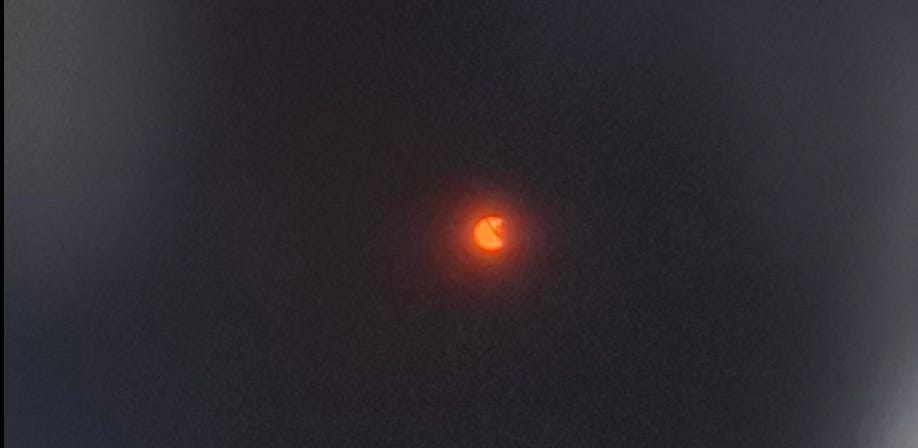
In Greenland and Iceland, people saw a full total eclipse. Here in Portugal, the moon covered 94.5% of the sun. For two minutes and eighteen seconds, daylight shifted to twilight. Shadows sharpened on faces, and it got colder because temperatures dropped. I hadn’t brought glasses. Thankfully, strangers shared theirs. Here’s a view from inside mine, as it started. You can see more on my Instagram.
There were supposed to be four of us there. One dropped out. She didn’t have glasses, or any way to know in advance that strangers would give them to her. Another came and left because the crowd was overwhelming.
And, then there were two: me, and a friend I call the Dutch Ambassador, who’s shown up in these letters before.
Honestly, I wondered if I should’ve left, too. Or, perhaps not come at all. Neither the eclipse nor my friend was the problem, both were fine. It’s what I didn’t get.
I wanted to be surrounded by water. Not three hundred strangers’ faces and backs of heads.
It’s kind of like the ball dropping in Times Square.
The first time, it’s mesmerizing. You feel like you’re part of something bigger than yourself. I’ve watched that ball drop from inside the crowd more than once because I lived in Hell’s Kitchen for years.
But, native New Yorkers don’t really do that. They’ve usually got a been-there-done-that relationship with the city, or they’ve never done “that” because they consider such things amateur hour. I’ve done the I’m-new-here crowd thing for a long time, because I was a happily childfree, city-dwelling, single woman in Manhattan, and Amsterdam, London, Los Angeles, DC, The Hague, and elsewhere. I’m starting to wonder if my city-crowd years might just be over.
Even at the miradouro, a cluster of people near us kept shushing everybody. Relatedly, on the walk up, I’d passed a banner:
“Menos turistas, mais bairros”
“Fewer Tourists, More Neighborhoods” is a protest slogan demanding the city actually belongs to the people who live in it. So, I don’t think the shushing was about silence. I think it was mostly locals, tired of a few hundred foreigners taking over “their” hillside, not even speaking “their” language, and blocking “their” view.
I can’t blame them for that.
Different people, all watching the same twenty minutes of sky, walked away with completely different nights.
Throughout the eclipse, Monte Agudo kept getting more and more crowded. So much so that, had something gone wrong, it would have been impossible to exit quickly.
I’m from a country with a particular relationship to crowds, and to how quickly things can take a turn and become dangerous.
That kind of thing doesn’t leave you, even once you leave the country. It stays with you like a permanent vigilance, the same way that anyone who’s ever served in the military is unlikely to sit in a restaurant’s chair with their back facing the door. I ran a quick background calculation on where and how fast I could get out if I needed to. I wasn’t being paranoid. I was being American.
I left around a quarter till eight. It didn’t escape my notice that the couple sitting next to me, also American, left even earlier than I did: immediately after the peak had passed.
Maybe I would’ve enjoyed the eclipse more from Cacilhas or Belém. It would’ve been more comfortable and more spread out, plus an actual view of the river. Then again, maybe the heart wants what it doesn’t have. Had I gone there alone, in the solitude that I thought I wanted, I might have spent the whole thing wondering why I hadn’t just joined friends.
I made the choice that felt right at the time, and I still feel good about it.
What I know now is that different people needed different things from those twenty minutes. The shushers wanted silence on “their” hillside. The Americans wanted an exit. The Dutch Ambassador wanted, and got, a sense of belonging. I wanted water, open space, and room to breath and leave.
I don’t know if my crowded-city season is over for good. Some seasons come back every year, the way summer always does. Others get packed away for good, the way high school did.
But back to the actual eclipse, since that’s what I came here to tell you about.
Now that I’ve seen 94.5% of one, here’s what I got wrong about that song for so many years. A real eclipse isn’t about darkness. It’s about something bright getting covered, slowly, until the whole atmosphere around you changes without asking you for permission first. You’re left in the shadows, with an eerie chill arriving from nowhere in particular.
Then, almost as fast as it came, it leaves. The brightness returns, and you’re left holding the memory of what was there.
See you next week, when we get into every single one of my exes.
Tiny, Private Love Letter is written by Twanna A. Hines, an obsessed observer of how we love, learn, leave, and find our way through this world. When you subscribe or upgrade, you’re supporting independent writing and helping offset the cost to produce the work you’re currently reading.
Twanna A. Hines, M.S. is an American entrepreneur and award-winning sexual health educator. She is founder of FUNKY BROWN CHICK, Inc., a social impact consultancy serving nonprofits, foundations, B-Corps, and international organizations. She has appeared in The Guardian, NBC News, Al Jazeera, Fast Company, and 25+ other outlets; she has been covered by The New York Times, CNN, Cosmopolitan, Essence, Vox, and 50+ additional media outlets. She has been called “a gifted storyteller” by The Washington Post. See more at: twannahines.com.
Comments
Nothing yet. Say the first thing.
Sign in to join the conversation.