
This is The Great Books Project in Anthropology. I am on a quest to rediscover the classics and their insights into the human condition as a salve to the contemporary technological, social, and political threats to our humanity. Lest we forget.
Email me your recommendations: frontalobe.substack@gmail.com
Phantom Africa by Michel Leiris
Leiris, Michel. 1968. L’Afrique fantôme. Paris: Gallimard
Leiris, Michel. 2017. Phantom Africa (trans. Brent Hayes Edwards). India: Seagull Books
Tristes Tropiques by Claude Lévi-Strauss
Lévi-Strauss, Claude. (1949) 1993. Tristes Tropiques Paris: Plon
Lévi-Strauss, Claude. (1949) 1969. World on a Wane (Tristes Tropiques) (Trans. J. Russell). Boston: Beacon Press
================
The Book Review Guideposts: The Rhetorical Sandwich
While reading early modern ethnographies or monographs, I shall use these tropes to evaluate and appreciate the literary and scientific work of the forefathers of anthropology.
The Opening Trope
Writing using referentiality (realist) or evocative (literary)
The chapters are written as parts of the whole (holism)
The Closing Trope
Whether you are off in some exotic locale or in your exotic garden outside your home this summer, what better way to spend these hot days than accompanying our ethnographers, Michel Leiris (1901-1990) and Claude Lévi-Strauss (1908-2009), as they travel across Africa and the Amazon jungle?
In an earlier post, we met these two French anthropology figures as they began their fieldwork. The former, Leiris, was untrained in the science of anthropology, but was recruited anyway as a writer, while the latter, Lévi-Strauss, was about to hold a position at the University of São Paulo, with the alluring promise of a new field site in Amazonia. Though separated by time, both were engaged in a kind of salvage ethnography—a record of the loss, the attempt at preserving a record of practices and beliefs before societies fully transition to late modernity and capitalism. The encroachment of Western-style civilisation threatens to flatten cultures into T-shirts, jeans, and Coca-Cola (or the internet as this generation understands it now). Though we all know that contact with the West had occurred for hundreds of years, there is something different in the urgency during the pre-and post-World War II periods that makes these two books valuable records of human diversity and choices in how to live.
It is this shared nostalgia of a unique past and the terrible loss or looming destruction of cultures that bind these two ethnographers. The result cannot be a scientific document but one that straddles the literary art of the pen. Leiris calls the ethnographic record he writes a ‘phantom’ of Africa while Levi-Strauss expresses it as Tristes Tropiques or translated as World on a Wane. Both are on a mission to document a rapidly changing world but also a reconstruction of themselves in the past.
…the voyage, as I conceived of it (a solitary distancing), far from being a way of making oneself other than what one is by changing ones setting, is only the pure and simple displacement of a person who is always identical to himself,…
Leiris (from Edwards), p. 7
The adage that you cannot escape from oneself means that writing ethnography is just as much a memoir as documenting another culture. The art of writing about the self with the Other in science remains in French anthropology.
As Chateaubriand wrote in his Voyage en Italie: ‘Every man carries within himself a world made up of all that he has seen and loved; and it is to this world that he returns incessantly, though he may pass through, and seem to inhabit, a world quite foreign to it.’ Henceforth I can pass from one of these worlds to the other. Between life and myself, Time has laid its isthmus; and it is a longer one than I had expected. Twenty years’ forgetfulness has enabled me to elucidate an old experience: one that I had pursued to the ends of the earth without managing either to decipher its meaning or to remain on intimate terms with it.
Lévi-Strauss, p. 17
Concluding Part I: Destinations: Chapter 4 |
We begin with how he ends his initial sea voyage—with a caution of what kind of truth his book will contain. None of them is the present but from a reconstructed past.
I may well be the only white traveller to have brought back nothing but ashes from my journeys. Perhaps my voice alone will be heard to say that travel no longer offers an escape? Like the Indian in the legend, I have been to the world’s end and there asked questions of people, and of things; and like him I was disappointed with what I heard.
Lévi-Strauss, p. 43
Claude Lévi-Strauss narrates in horror at the beginning of Chapter 4 of the tentacles of Western civilisation across the world—even in what we think of as the ends of the world—the atom and the military have touched them. “…The notion of travel has become corrupted by the notion of power.” (39) His realisation stems from what he observed aboard his ship as he sailed towards his field site. In his disgust, the French officers and their wives, on their way to a military mission in Paraguay, have transformed the deck into barracks—something everyone became immediately wary of. It was his distaste of their posture acting as colonialists more than anything else.
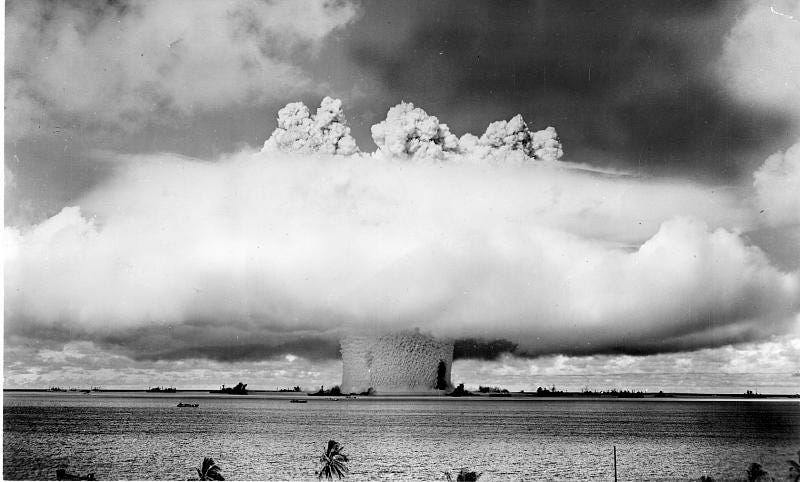
Everything and everywhere has been touched by outsiders or the West. Nothing is pristine as we imagine it to be—“however honest the traveller may be, he cannot, or can no longer, present them to us in their authentic form.” (40) And so, Lévi-Strauss asks himself, in what time frame could he have visited Brazil to see what a pristine culture looks like.
His answer: never.
It is the case of Schrödinger’s cat in the box conundrum in which the moment you peek inside, the culture shifts. Therefore, any observation renders any culture impure. Hence, his concluding paradox serves a warning to the readers but also speaks to the sense of his frustration to any researcher of human societies.
And so, with no hurry to open the box and observe, we never arrive yet at the port.
Instead, Lévi-Strauss reconstructs his memory from 1934 of his first encounter with the idea of Indians in the august halls of Paris. First, via a telephone call through the Director of the École Normale Supérieure, Célestin Bouglé, who informed him that a position for a Professorship in Sociology was open at the São Paulo University. As a further enticement, Bouglé told him that he could simply proceed to do fieldwork with Indians living next door to the university. Lévi-Strauss
Even George Dumas, a Sorbonne professor who was one of the academic patrons of the Trocadero, the main contact for the position, knew nothing of Indians or of Brazil, Lévi-Strauss concluded. How could Indians be living next door to the university as a carrot dangled by Bouglé to him?
Lévi-Strauss later learned during a luncheon party that even the ambassador of Brazil attested that they were all exterminated in the sixteenth century by overzealous Portuguese.
They used to grab hold of the Indians, tie them to the cannons’ mouth, and blow them to pieces. That’s how they went, every man Jack of them. There’ll be plenty to interest you, as a sociologist, in Brazil—but as for the Indians, you’d better forget about them, because you’ll never find a single one. . . .’
This tall tale overlooked what Lévi-Strauss described as the modern decimation of the Indian population in the city of São Paulo (the size of the entire country of France) by fellow Brazilians as recent as their and their parent’s generation using smallpox-infected clothing. This is in part what he learned as the cultural divide and rejection by the upper classes of their Indian roots. Hence, by the time he arrived in 1935, no Indian communities remained in São Paulo.
Lévi-Strauss would have to travel thousands of miles in the Amazonian interior to meet them.
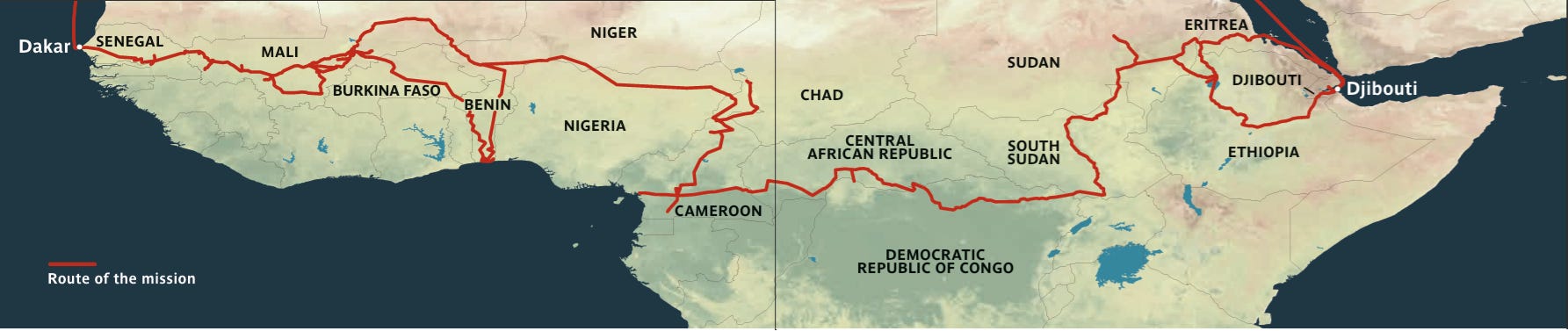
1931 | 19 - 31 May
Unlike the solo travel of Lévi-Strauss, Leiris embarks on a sea voyage similarly packed with people headed back to Africa and manned by mixed crews, Africans ejected from their jobs in the city and headed back to Africa, and by domestic animals. Leiris finds himself making the goat his temporary pet along the seas. From the Bay of Biscay, through Portugal and Tenerife, Spain, cockroaches mark the transition into the tropics. Somehow, the French terms cancrelats, blattes, and ravets in the French Antilles sounded more appealing.
In the afternoon, a lengthy session of oiling boots and shoes on the bridge, all of us roasting in the sun. We are now off the coast of Morocco. A few signs of the tropics: cockroaches appear on the walls; at breakfast, some tiny ants marched across the tablecloth and climbed up the bread. In the afternoon, saw jellyfish with purple crests trailing the ships hull. Spent the evening with Griaule, on the forecastle, chatting, him lying extended, me sitting, looking at the stem, the sky, the sea froth.
Leiris on May 24, Pentecost, p. 71
Though sounding idyllic, the days pass with work commencing on board. Leiris describes receiving anti-typhoid shots, doing linguistic research on board with the Kru or Krummen from Liberia or Ivory Coast, and taking care of equipment. He was particularly observant of the wildlife, such as the dolphins and flying fish astride the bow. Despite all the descriptions we read, we mistake the term journal to reveal the innermost thoughts of Leiris. This is not his diary, at least in the beginning. We do not get a sense of what he is thinking and feeling. This is in part what he despises about ethnography as merely a bureaucratic exercise. A tedium of description without getting into the heart of things or understanding.
So his letter to his wife, Louise “Zette”, that accompanies the margins of his journal entries here tells us what this journey meant to him. Leiris refused to disclose any sign of weakness to his wife, yet he wrote how he was frightened by the trip and of leaving her and what he knew.
May 25. 1931:
I spent the first two or three days in a sort of stupor: due to the shock of departure, first of all; and for physical reasons too, as I struggled against seasickness (because the boat was dancing violently); and trying to get settled in this new life. Little by little I am starting to get used to it but I was pretty depressed at the beginning, and my decision to leave seemed absurd, almost to the point that I wanted to quit…
Yet, he also expressed hope to her that his writing would turn out to be different, away from literature. A sense of purpose engulfs him as he hopes to cement a longer-lasting legacy from the upcoming mission. Leiris senses the present, the nowness, the reality of his being on the boat, rocking to and fro, the emergence of who he is sans performance.
…Now and then I look out the window to see if the Tenerife peak (Canary Islands), which we were told we would see soon, is finally visible. When I do this. I know that I am not an actor in a play and the character of "voyager" is not merely a role for me, but the only character I can be in all sincerity. I am no longer ashamed before you. the way I was ashamed by my "literary" character, which I am realizing more and more was hideous.
The specific demands of ethnographic writing, or positivist ethnographic writing, are ones he hopes present a truth unmasked from his literary world.
I am having a better time with my present companions because, making an abstraction naturally out of any goal that it seems “scientific," our existence is more sincere and, would even go so far as to say, ‘’cleaner," just as the existence—to take a literary example—of Conrad’s characters is more sincere and "cleaner" than that of Proust’s characters, for instance. [... ]
The bifurcation process in writing is what Leiris hoped would be his salvation, but it also turned out to be a cross. Tedium would set in as Leiris removed himself from his early text. It is interesting to see how his style would evolve during the trip.
And so they pass Cap Blanc (Ras Nouadhibou), the peninsula now a Natural Reserve, to Port Etienne (Nouadhibou) in Mauritania. Here, they re-supply for dried fish and bring a fisherman riddled with cancer to a hospital in Dakar. The “leader” also offloads wicker chairs and potted geraniums destined for what Leiris characterises as a hopeless, dreary place.
It is a sinister yellow dump with hardly any structures aside from the most essential buildings. A small fort. Radio antennae. Pitiful shacks on the j beach and up on the dunes.
Once everything was loaded, there was a promise of access to the mainland by the “trader.” It seems like a shady leader or warlord granting them access. However, in a hullaballoo of retrieving their raincoats to prevent getting wet, the launch leaves without him, Lutten and Mouffle. It was only Griaule and Mouchet who were on the launch, leaving them at their wake. By 10.15, the launch returns successfully with carved flints and knowledge that severe water rationing was happening at Port Etienne. It was the first ethnological collection and Leiris missed it.
Did Griaule know that the only reason I wanted to go ashore was to overcome the nervous apprehension I had of passing from the gangway to the launch over the slightly restless sea, which to my eyes made the operation seem somewhat delicate?
Nevertheless, the next day, the 31st of May, they reach Dakar, the capital of Senegal. It is a deluge of people resembling, as Leiris remembers, the beaches of Frejus in the Cote d’Azur region of southeastern France. Much of the hustle and bustle are familiar. Therefore, this is not yet the site of the Other.
All in all, very little difference between the life of a bureaucrat in Paris and his life in the colony (I mean: in the large urban centers); its hot and he spends his time out in the sun instead of cooped up indoors; beyond that, it s the same stingy existence, the same vulgarity, the same monotony, and the same systematic destruction of beauty. I cant wait to get to the bush. Depressed.
And so the adventure begins or is waylaid by bureaucratic colonial administration.
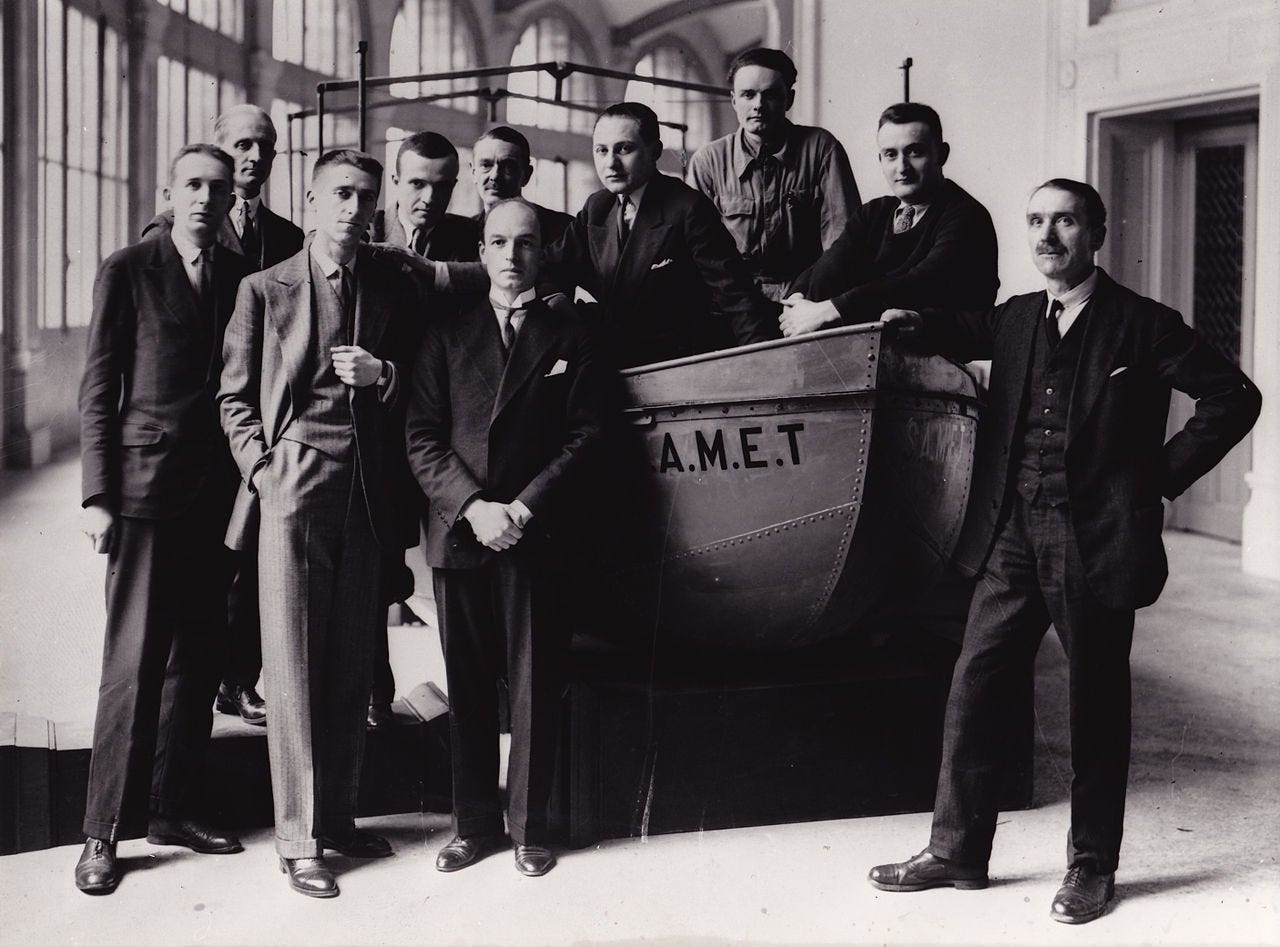
We encounter not just arrivals to the site but a preparation for the reader. The nature of truth involves three aspects:
the growth of the writer/person
the process of time
the devolution of the literary to scientific writing and back
To even start the work requires that one struggles with several realities. Lévi-Strauss present the context in which encounters with Brazil are not separated from the looming nuclear age. Leiris writes of the tedium of boat travel and the harsh realities on board and while on dock. The palpable contrasts between Blacks and Whites are prominent here as well as the extent of the French empire.
More important for our project, we begin to see the different forms of writing demanded from ethnographers. Leiris demonstrates the struggle to move away from his literary training as a writer as he acclimitises in the impersonal realist ethnographic writing he is called to do. In a lot of ways, the journal is a logbook but his letters act as his diary as we read about his fears and insecurities to his wife Louise. In Lévi-Strauss we adjust to his manipulation and time jumps which I myself got a bit confused as he set his recollection of his younger years. The memoir genre or the second book as what we read here convey the attempt (and the sadness) to record a slowly disappearing time in human history and knowledge.
Further Reading:
Leiris, Michel. 1992 [1939, 1946]. Manhood: A Journey from Childhood into the Fierce Order of Virility. Chicago: The University of Chicago Press
The ongoing draft and outline of our project are available on our main page.
If you got this far, I appreciate it! If you find reading this worthwhile, it greatly helps my cause if you can share. My tip jar is open, but this newsletter will always remain free.
Contribute to my library access!
If you are new here, we have just concluded reading David Graeber’s Debt: The First 5,000 Years. My first slow read here on Substack in 2023 was David Graeber’s The Dawn of Humanity. Unique among his peers, Graeber asked the big questions in anthropology—how did people organise themselves and what were the values and choices they made. Sadly, except for a few scholars, we have stopped boldly asking who we are, why we are different, and where we are headed. We are changing this now.
Re-read the previous post:
Comments
Nothing yet. Say the first thing.
Sign in to join the conversation.