
My study journey:
Anthropology Reconsidered (Present) | Debt: The First 5,000 Years (2025) | The Dawn of Everything (2023).
The path towards The Great Books in Anthropology
Say hi, frontalobe.substack@gmail.com
Hi Folks,
It’s been more than a month since I posted. Now that my family and friends have gone home, I can return to my old routine. More news at the end. Meanwhile, I am sharing with you what I have learned reading David Graeber and writing here on Substack. You can find Part One here.
It’s been helpful to articulate my why and I hope it resounds with you as well.
Melanie

David Graeber is an important turn in my intellectual growth in more ways than one. He was the primary mover of my Catholic reversion, as well as providing the impetus to integrate a multitude of issues that unsettled me. One of which was the prevalence of reductive keyword research frameworks in anthropology.
Though it may appear disconnected, my Catholic reversion is the return to something True (that we all have access to a debt-free relationship with God) and the primary lens by which all social upheavals are judged against. This single piece of insight opened my diagnosis of seemingly disconnected social ills.
We have forgotten who we are and where we came from.
All we know are guilt, penance, and propaganda. It sounds like the accusations laid against religion are also now at the doorstep of secular Western ideals and concepts. Much of our self- and cultural sabotage is misplaced. Secularism, with its hubris that it can exist in a vacuum, has veered so far away from its own wellspring—Christianity— that Western culture and its adherents are currently suffering from the malaise of disenchantment.
Do you feel hopeless? Apathy or indifference? Distrustful of the state? Institutions? These are some of the symptoms of disenchantment. I myself have feelings of collapse that have become a fixture of our everyday life in the twenty-first century. I am left with the realisation that, at this juncture, this is incomparable to the nuclear extinction threat while growing up in the eighties. The threat today is internal rather than external. Thus, the existential threat is a chronic and persistent condition that lies beyond our purview. But it is there because you can feel it.
My hypothesis is that this internal stress we feel can be attributed to the simultaneous destruction of the four pillars of secular society:
Science
Social institutions (especially the family)
The primacy of the nation-state concept
Capitalism and the free market
The secular domain focuses on man alone, though there has been a conceptual movement towards decentering man. In anthropology at least, some scholars have sought to mark the end of the Anthropocene and move to an even wider interspecies and planetary lens. That is, to equate man with the other living organisms is to return once again to the proverbial Garden of Wonders sans the Creator or even Adam and Eve. This attempt feels niche (though it has been at least two decades and counting) because we have no other language than a human-centred one. Secularism and its adherents have no recourse to alternatives. This has been persistently magnified by the social media tools that have birthed even more influencers.
Nevertheless, new categories have been formulated to move on and rely on the four pillars of secularism. The categories of gender, race, and ideology have entered the mainstream from academia to supplant some of these weakened domains. For instance, the nuclear family consisting of a man and a woman is no longer the only form legally to constitute a family unit or even biological sex to reproduce children. The concept of having children itself has moved from their nature as gifts to a social justice and debt perspective in which withholding birthing them from this world is considered humane.1

The other pillars are not immune to further attacks. Science, once its bulwark and mast, is in tatters. The social mistrust towards expertise escalated during the COVID-19 pandemic. Once a beacon of trust, leading institutions like the Centres for Disease Control in the United States and a somewhat reliable global institution such as the United Nations utterly lost their credibility and authority. The consequence of a lack of clear communication, leadership, and information transparency led to a drop in trust in vaccination in the West.
Among all four domains, capitalism has weathered its fiercest criticism: the turn to socialism. The election of Zohran Mamdani as New York City mayor shows a deep attraction to the idea of socialism. Whether this tenure works in the most capitalist city in the United States or not remains to be seen. The important part here is that some of the germane ideas written by his father (whose work is part of anthropology reading lists), Mahmoud Mamdani, found their way into contemporary political practice, supplanting the memory of 9/11 in New York City. His analysis on the binary of African colonialism/colonised, good Muslim/bad Muslim found traction in contemporary and populist propaganda about communism/socialism among Zohran’s voters. Combined with the domain replacement search for capitalism, this has resulted in political electoral practice.
You would think that this is a victory. Yet, capitalism continues to rear its ugly head with its variant of hypercapitalism built on top of Artificial Intelligence (AI). We know that capitalism thrives on the perpetual cycles of collapse. However, hypercapitalism in the era of AI makes no distinction between the we/other but profits from flattening all territories and bodies—not unlike what happened in the Spanish extraction of South America. To accelerate and profit from this new order, an AI capitalism terrorises vast swathes of terrain for its data and computing centres but also consumes earth resources (water, electricity, and more rare earth minerals) and free labour of human beings across borders. The transformation of human beings is imminent because we have come to rely on LLMs due to the deliberate degradation of our traditional digital tools for internet information search and creation, which were initially created for democratic access. The destruction of trust has dangerously eroded the primal objective of science and human institutions, that is, to serve humanity.
The constant pummelling of these three domains is nothing new (even from the stresses of AI capitalism). By their very nature, these pillars have always faced criticism from the very social sciences we practice today since the inception of these disciplines—to little existential threat. None of this should have mattered. Criticism is at the heart of our (secular) way of life.
Something else is afoot.
What is new is an undercurrent of self-destruction that undermines the reproduction of a structure that can withstand present and future blows. The internal threat to secular society will tip it to its final moment of weakness. The secular system is depleted. Where does it get an infusion of energy, strength, and stability to weather the upcoming generation of storms? It used to rely on a heavy infusion of mythmaking and storytelling from a deep well drawing from the Great Works of Western Civilisation, the university, and Christianity. All three forms face extinction: the Classics are now largely unstudied, defunded or worse, unread in schools; the university is currently facing a knowledge, expertise, and enrollment crisis; and Christianity as a practice and culture-building force has become timid and tepid. In other words, the well of resources of secularity has gone completely bone dry.
Secularity alone would have chugged along if not for the destruction of its other components. The quick arrival of the crisis in the last few decades highlights the missing key attribute at its root: the loss of enchantment, a sense of wonder, purpose, and an acknowledgement of a supernatural component of human life.
Without this critical factor, our prolonged feeling of malaise within a secular society remains superfluous, porous, and empty, and subject to internal and external forces at whim.

The call to a return to full humanity—a person who can think (without the help of AI); a person who deserves a life of enchantment and a supernatural communion (and not be slaves to consumerism or merely a mirror to ourselves); or having failed those, maintain a shared heritage of their Western historical roots and values—has become louder from different fields, especially on Substack.
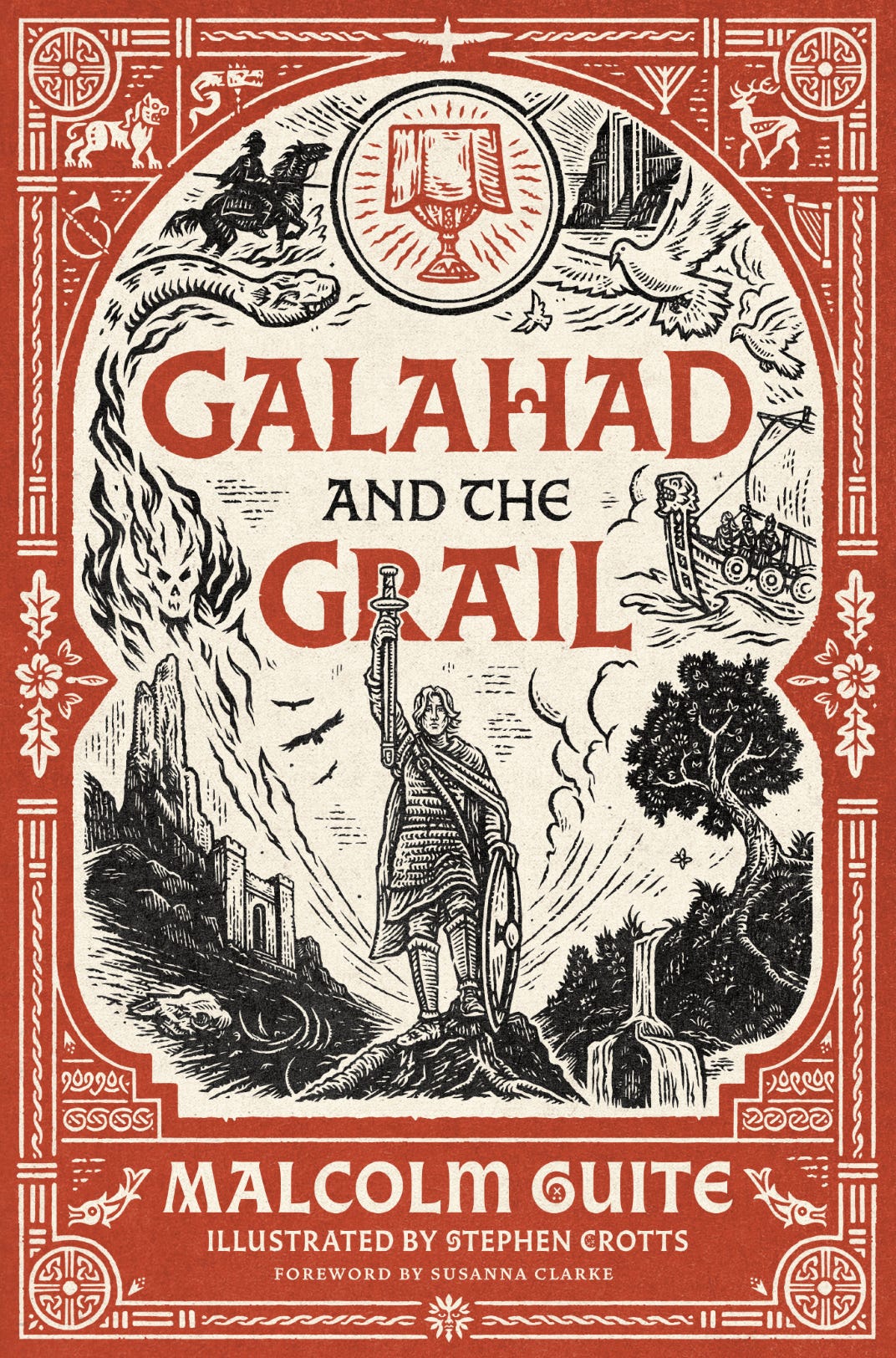
Numerous experts and individuals, such as myself, came to the common diagnosis of enchantment as the missing piece independently along specific fields of specialisation. I came to discover that the dialogic relationship between Christianity and secular society is standard knowledge among scholars of different stripes—Hilary White, in her sacred art project, and Amelia McKee highlights the importance of church art to human emotion and worship; Malcolm Guite, poet and Anglican priest, explicitly makes this connection between mythmaking and its significance on enchantment in everyday life in Galahad’s search for the Holy Grail. With the withering of the rigor in university, the opposite has been happening in the lower and middle schools. The explosion of classical learning schools in the United States is a deliberate reaction to the dehumanising emptiness (deliberate erasure) of the current curriculum emphasising identity, ideology or misplaced equality.
Once I came by this conclusion independently, just by reading disparate works, including Graeber’s study of Debt, a cascade of other scholarly works came into my purview—Tom Holland’s Dominion (2019), which piqued my interest in the narrative historical reading right around the death of Christ and its aftermath in the Roman Empire—a book I am continuing to read slowly (the author is now an agnostic). Further scholarly research that has come to my attention includes the works of Charles Taylor on The Secular Age (2018), Brad Gregory on The Unintended Reformation (2015), and Alasdair MacIntyre on After Virtue (1981 [2007]). With a universal Catholic point of view, I was able to unite these disparate works from people of different backgrounds to form my conclusion. This exercise was once unnecessary at the height of secular dominance in the culture—until recently, at secular culture’s depletion.
While the link between enchantment and secularism has been established, what is generally unarticulated is how both fields (Christianity and secularism) are invigorated.
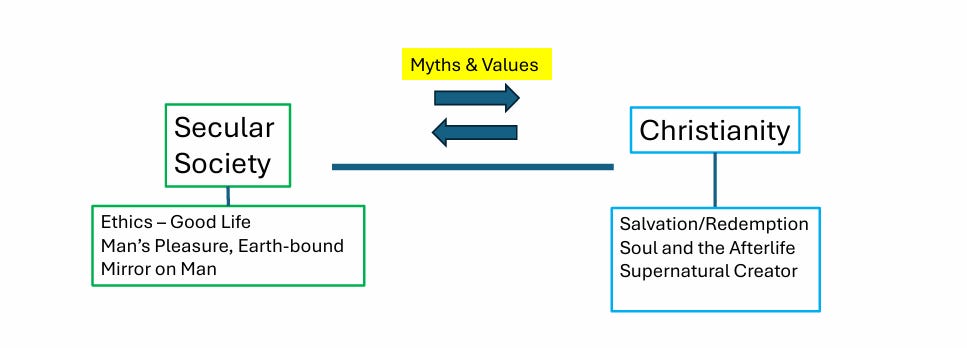
Academic scholarship is not enough, but art is at the core of this traffic. Ethnography, as I have come to understand more recently, is both art and science. The French school understands this more and has retained it compared to its Anglo counterparts. The Disenchantment Crisis has posed a looming existential threat in anthropology. The interrelated causes include the deterioration of critical reading, writing, and, thereby, thinking at all levels brought about by the ubiquitous use of (1) digital tools in the classroom and homes owned by a (2) handful of multinational tech firms and the (3) use of Large Language Models (LLMs) indiscriminately.2
Can the anthropological monograph survive?

This question has a direct impact on long-form and long-term research essential to doing anthropology. To reach the final product of ethnography requires reflection, writing, rewriting and more writing. If someone told me this when I was doing my undergraduate in anthropology, I may not have chosen it as a path. Though I am typing this out digitally, my initial notes and ideas require long-form reading and handwritten notes using a pen on notepaper. The resulting drop in long-form reading (and everything associated with it such as focus and deep learning) is a serious cross-cultural existential question that I have not seen written about in our discipline.3 Perhaps, in exasperated whispers and a shrug.
This sense of dejection has very little to do with borders or culture. It is already palpable when children fail at writing short essays, or any writing, at the grade school level here in the Netherlands. I spoke to a Chinese engineering Master’s student this year, studying at a prestigious tech university, at a cafe, and he admitted that in his cohort in China, they cannot write without an LLM prompt. Last year, I had a great conversation with a nephew who is in his early twenties who also similarly observed this phenomenon among his technical school classmates. We can debate the spiralling negative effects on education, but one dire result of not being able to read books and handwrite is the level of indifference to learning or having any interest at all in anything. It is a form of malaise that infects all forms of social life. This is the killing of enchantment. I came across this humorous take on what the death of curiousity looks like.
It sums up what destruction looks like, not with a bang but with an indifferent whimper. Even that generation attests that the discovery of aliens would merit merely a second headline after the Super Bowl, if any. We are that disinterested or bereft of wonder today, especially with the decline of attention and an all-access to the world. It is as if the world is so obvious, so flat, compressed into digital pixels, that nothing is mysterious or sacred anymore.
Our generation would not say this, having grown up with the E.T. the Extra-Terrestrial movie and a shared culture that becomes a huge part of our individual selves. The best description of enchantment in popular culture is the way we talk about mainstream popular art in cinema and television. Watch Joshua Horowitz cry as Spielberg explains to him that Elliot still remains connected with E.T.; also, Roy will come back, presumably transformed from his alien encounter, too, just like all the rest who were “abducted” by aliens in Close Encounters of the Third Kind.
Compare the reaction of the two generations here. One is checked out from any form of wonder, and the latter is steeped in the shared experience of cinema storytelling. Which one are you? The term “we do not make movies like this anymore” speaks to a kind of loss that those of my generation have experienced, but also a sense of an unknown nostalgic loss by a new generation who know nothing of the shared culture we experienced. Therefore, popular storytelling is a good gauge to see where it all dropped off. (Bonus: watch Josh O’Connor gush over his E.T. lunchbox. I wouldn’t mind having one of those, too, with a Thermos).
It is unsurprising that only twenty years ago, we were celebrating some of pop culture’s great hold on our imaginations, such as Buffy the Vampire Slayer, Supernatural, Friday the 13th: The Series, Fringe, and my personal favourite, X-Files and its iconic lines of The Truth is Out There and I Want to Believe.4 These phrases are the tagline of a generation still enamoured of the time when science tangled directly with the unknown and the unexplainable.
Aliens, among other conspiracy theories of the Deep State, are the last in the era of enchantment and urban mythmaking among a generation.5 If you examine all the television series beyond the niche nerd communities, these stories proliferated in the mainstream and continued weaving stories combining the occult, folktales, science fiction, monsters, classic good/evil hero journeys and the possibility of the unexplained. Life cannot simply be explained by science, and it is this pop culture conversation that is necessary to ignite infusion between secular culture and Christianity.
Of course, today we still have a smattering of superhero and occult/horror films that remain the only sources of supernatural storytelling.6 Since Iron Man of the Marvel Universe debuted in 2008, this was the pinnacle of mainstream supernatural storytelling that also resuscitated the dead career of Robert Downey, Jr. This wonder would end by 2019 with the release of Avengers: Endgame. None of the succeeding series, though financially profitable, would sustain wonder (not even the disappointing Star Wars genre of films that seems to have earned money but not cultivated any culture of wonder). The Game of Thrones fantasy series also debuted in 2011 and ended disappointingly in 2019 (some argued even much earlier than this; I wholeheartedly agree that the showrunners trashed the writing). Those that remained in the social imagination include the Harry Potter films that began in 2001 and ended in 2011 (books were published from 1997 to 2016); The Lord of the Rings, the Peter Jackson trilogy, was also produced in the sweet spot of the years 2001-2003.
Can you see a pattern?
It seemed the last enchantment in public media culture had a twenty-year run. Nothing succeeded the cultural influence of these stories until the surprising debut of Stranger Things in 2016, a horror thriller series not ironically echoing the eighties. This show not only had a backdrop of aliens and supernatural power but also headlines real-life adventure, friendships and supernatural encounters by a generation with little real-life experience of the storyline. The mainstream appeal had to do with several distinct features—the absence of mobile phones and social media apps. The popularisation of Facebook by 2007 changed the landscape of our imagination and interaction. Unsurprisingly, Stranger Things is a big hit because it encapsulates both the old (nostalgia) and the present generation that wished and aspired to have that digitally disconnected, free lives—the promise of that life. By the time you read this, another phenomenon rising is Widow’s Bay from Apple TV, which is an interesting comedy horror that also borrows a lot from the late 70’s and 80’s mystery sans any reference to digital connection. This has captured the imagination of a mainstream audience beyond the niche platform and genre. The lack of technology and the focus on human emotion and relationships is already a glaring indication of what effective storytelling is.
The consequence of the digital streaming medium impacts how we build a social imagination. It is not just about the stories per se that have changed but also how we consume these stories. This was similar to the print environment, as discussed by serial fiction writers Simon K Jones and Ms. Reid as they look back to the sixteenth-century serial fiction and penny fiction that kept the general public glued and in conversation with each other week after week. This was in contrast to the preference for publishing a completed work called The Novel in the nineteenth century. It used to be that the Novel was the compilation of all the serials. This partly explains the enormous book volumes that we see today. Though they argue that short-form writing has little impact on a sense of wonderment (in fact, they argue that the Novel and perhaps long-form reading is a recent urban development), we can agree that the medium of weekly newspaper publication built a shared public culture.
The argument for how we consume and what type of medium is difficult to parse to assess the impact on public culture. Are you a binge or weekly serial viewer? Does it build prolonged and sustained interest for a series? I prefer binging all the episodes as opposed to a weekly episode release. Otherwise, I lose momentum, interest, and forget the storyline. The counterargument is that a weekly drop allows a shared culture to develop: it gives people time to catch up once the fire of interest grows for a title. (This also allows podcasts to catch up! This is an important phenomenon.) Therefore, those that subscribe to a weekly episode model argue that this enables a shared environment to form.
However, this is only for shows that are bold enough to put everything on the line in the first episode. No excuses. The danger here is that once the first few episodes are poorly made, the audience falls off the cliff and forgets you. Very few cross the mainstream and niche demographics and explode into the common psyche. Ted Lasso (TV) and Everything Everywhere At Once (cinema) offered comfort and hope during the pandemic. The gas of positivity has since extinguished. Most fall off and die in the digital archive and in the attention economy.
Any argument we have on media consumption becomes nil when the public is fragmented. This is a significant effect of digital streaming on personal portable digital appliances. The digital, on-demand, streaming entertainment environment, alongside the social media landscape, provides unlimited consumer pleasures with a detrimental side effect—it only gratifies the individual. It has circumscribed wonder at the individual level (the precursor is the beloved Sony Walkman). If only such projects often move to the mainstream, then it becomes a balm against general indifference or the pervasiveness of dread and insecurity. Those days of multiple movies that are sources of building a shared common culture are at a precipitous decline.
Combined with the on-demand environment, the digital streaming world gives an impression as if the world is known and mapped. Nothing is a mystery when a life of little friction and all-speed is offered by big tech. Soon, even speed will mean nothing and, unsurprisingly, result in nothing. This gaping maw will result in even more alienation within and between us until we replenish it.
This is the task.
This is the vocation.
What does it mean to play a role in building public culture—one that relies not just on ethics but on a morality built from Christian virtues and the salvation of the human soul? I say this not just because it is compatible, but an essential fit to the values of secular culture.
It is only by sketching out the shared realities between these two domains that we can see how enchantment, or the sense of wonder that allows us to create, imagine, and inhabit other worlds, is a critical component of human life. How is this enacted in an academic field such as anthropology? Anthropologist Yana Stainova best expresses this idea in her fieldwork studying the impact of classical music training in impoverished neighbourhoods in Venezuela.
Rather than being crippled by the impossibility of the dreams, as I initially was, Ivan and Ana saw dreaming as a playful act that brought them joy. The richer we made the dream, as each of us built on one another’s ideas, the less relevant was its unfeasibility. Our joy, the boldness of our thoughts and words to go to places where structural constraints would not allow us, was a defeat of the capacity of systemic forces to foreclose the reach of our imaginations. It created an opening in the future that cast its light on the present. This dreaming did not have the purpose of escaping from or repairing a broken world. It was an attempt to find meaning, connection, and joy within it (cf. Halberstam 2013). Ivan and Ana had chosen to approach structural violence, and to claim their place within it, by dreaming and imagining themselves otherwise.
p. 217, Enchantment as Method
We become impoverished by remaining earth-bound and solely focused on the rational, the empirical, and the intellectual—just as I was when I left my Catholic upbringing to explore the secular world and anthropological training in my younger years. I had the same realisation as Stainova. She realised that one story, one framework, that of power and dominance, is debilitating even to her own psyche and role as a storyteller. It was not enough to simply highlight the structures of dominance, especially in a country such as Venezuela, part of the Global South. It was time to listen to your interlocutors. It is time to stop imposing the theoretical discourse of dejection.
She traces her own mental poverty because of the totalising effect of critical theory, an “iron cage”, she attributes to the observation made by Max Weber when modernity is defined by “the world knowable and calculable.” Briefly, she tracked the development of critical theory in anthropology from the 1960s. It first emerged from the Goethe University’s Frankfurt School. The focus of the theory was to reveal the underlying structures of dominance to renew society. Well, Stainova says, social reality has become overly defined by a totalitarian analysis of power and domination. As a result, she argues that this imbalance has left off the impetus of imagining a new social order. This feeling of bleakness, the same impasse we feel today, is what Graeber himself also describes as the flaw in critical theory. Arising alongside semiotics and Marxism, Graeber describes critical theory’s totalitarian aspect as its weakness.
Certainly such things are there to be found. But if this is all one is looking for, one soon ends up with a rather jaundiced picture of social reality. The overall effect of reading through this literature is remarkably bleak; one is left with the almost Gnostic feeling of a fallen world, in which every aspect of human life is threaded with violence and domination. Critical theory thus ended up sabotaging his own best intentions, making power and domination so fundamental to the very nature of social reality that it became impossible to imagine a world without it. Because if one can’t, then criticism rather loses its point. Before long, one had figures like Foucault or Baudrillard arguing that resistance is futile (or at least, that organized political resistance is futile), that power is simply the basic constituent of everything, and often enough, that there is no way out of a totalizing system, and that we should just learn to accept it with a certain ironic detachment. And if everything is equally corrupt, then pretty much anything could be open for redemption.
Graeber, an avowed Marxist activist, implicates himself within critical theory’s viewpoint but with an important escape hatch. He opens himself to a sense of change or redemption—a promise of cancellation. However, his self-awareness can be read in his successive works following his Theory of Value published in 2001. He constantly takes himself out of the straitjacket of his own principles and fierce ideas. This self-mirroring and critique is a hallmark of good practice. By the time he wrote his book on Debt in 2011, he explored the premise of a life free of any self-interest and the possibility of a debt-free life.
If we want to think about enchantment as a specific method in anthropological practice, Stainova pointed to some difficulties for anthropologists. As a framework, she points out that we usually associate the concept with irrationality. The consequence is that we can be misled by it, with a tendency to designate the Other as exotic. To avoid this, anthropologists, who commonly studied topics such as magic, sorcery, or witchcraft, rapidly sidestep them. Or, in the words that Bruce Kapferer (2002: 20) uses, the domestication of the themes by anthropologists. He argues that this is done to assuage the researcher’s sensibilities and also to align the subject with modernity (not an exotic Other). We can think of it as creating a kind of equality between the subject and the observer. An example of this is that he points to the common and simplified analyses, such as “witchcraft as resistance” or “witchcraft as explanation of misfortune” or similar types of social diagnoses found in a lot of work. Both Stainova and Kapferer describe a difficult situation for anthropologists who have to restrict themselves to statements of reason. It is unsurprising that what was once a common topic in anthropology has slid from the norm. Kapferer solves this by saying that these practices are already inherently modern. The question is to avoid over-rationalising and investigate the hidden dynamics.
The culprit here falls on the observer. I know because they describe the pathway of generations of anthropologists such as myself who fell under the sway of power and domination as social diagnoses. I still remember reading about Aihwa Ong’s work on Malaysian women who were periodically possessed in the workplace. Her analysis relied on Foucault’s notion of power/knowledge relations to explain spirit possession as a result of the capitalist disciplining of Malay land, money, and female bodies under the regiment of factory work. One of the finest ethnographies I have read. Her findings rationalised the supernatural possession of her subjects as a reaction and political action against capitalism, violence and factory disciplining.
This is an example of dis-enchantment in anthropology. Kapferer did not use this exactly, but he described the process perfectly.
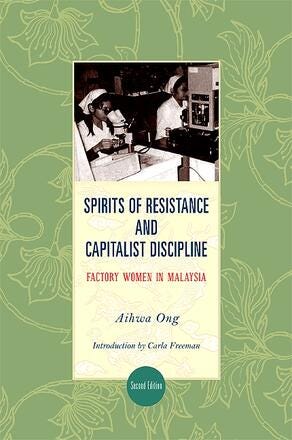
Much of religion becomes increasingly subsumed within the anti-capitalist/capitalist framework with little alternative re-reading of spirit possession. I do not disagree with the analysis of Ong here. My question is what have we missed in going this pathway? Manila, the capital city of the Philippines, was similarly undergoing numerous spirit possessions among its students. I remember the idea of contagion but no anthropologist stepped in to explain. It remains in my psyche, and I wonder if there was female child abuse (it was mostly females) among those who were affected.
This domestication process parallels the stamping down of much of the supernatural emphasis in the teachings of the Roman Catholic Church. At its core, we are in a spiritual warfare with the Devil. It comes in many forms (the seven deadly sins and temptations are but one of several), but the Devil also exists as a spirit incarnate. The Church is the only one I know who can do battle with them and send them back to Hell. It feels a little absurd as I write this paragraph as an anthropologist. Nevertheless, it is only by taking stock of this set of unexplainable beliefs that I can improve my future apprehension of social reality. As absurd as it sounds, the Devil is real.
Astonishingly, Kapferer shared a parallel observation of the Reverend Archbishop Fulton J. Sheen, separated by at least 25 years—disenchantment is a dangerous precedent in one’s spirituality: “today we are beginning either to domesticate the devil or else to deny him…He is most powerful when he is denied.”
Just like magic in anthropology, the devil or sin in our contemporary period is merely a relativist concept. At its extreme, nothing is sin. Either things are rationalised or medicalised, so to offer a counter position is untenable. Without enchantment, the unvirtuous and bad become palatable. Disenchantment seals the diabolic’s final acceptance into everyday life as a benign force.
What do we lose by relativising everything?
Nothing is significant, even humanity.
My thesis is that the new revolution is religion. Having skipped the millennials, a new generation is ready to turn to what everyone has turned their backs on: the long legacy of Christianity, its lessons, and, of course, the supernatural in human life.
Re-enchantment is difficult under a totalitarian critical theory/secular regime. I understood the dilemma of Stainova and Graeber. Following Bourdieu, I myself was enamoured by Bourdieu’s post-structuralist approach to analysis. At its simplest form, practice theory highlights individual agency within the rubrics of inescapable structural power—but in the end, it is as if we have no free will and will always succumb to institutional power beyond us. It is like living in a hamster wheel and it led me to nothing. The inescapable torture of totalitarian pressure. Having lived in China for research, this vision and feeling led to nothing but bleakness at a personal level.
Something had to change, and if it takes me three decades to de-program myself, I would like to live in the light. God’s light is better than a nihilist’s emptiness. And so without hesitation, I took up the mantle of my inheritance and proceeded to continue the rites of passage available to my personal growth. After baptism and confirmation, most of us are called to human partnership (the other pathways are the Holy Orders), and so I consecrated a long union in the most sacred way possible. And what do you know, the graces just flowed.

There is more to say, but let me reflect on this new domain more.
Thank you to all the subscribers and the new ones who helped me reach an elusive milestone of 102 since I started on this platform. Unbelievable. I have a hundred and two reasons to continue the work.
If you have read this far, I appreciate it. It would be a tremendous help to spread the word if you find any insights here valuable.
Sources:
Kapferer, B. (2002). Introduction: Outside All Reason—Magic, Sorcery and Epistemology in Anthropology. Social Analysis, 46(3), 1-30. Retrieved May 1, 2026, from https://doi.org/10.3167/015597702782409310
Graeber, David. 2001. Toward an Anthropological Theory of Value: The False Coin of Our Own Dreams. New York: Palgrave
Stainova, Y. (2019). Enchantment as Method. Anthropology and Humanism, 44(2), 214-230. Retrieved May 1, 2026, from https://doi.org/10.1111/anhu.12251
I once held this view when I was younger, and it is still dominant among the Millennials and Generation Z. Of course, the main concern is entirely economic, with the costs of a middle-class life becoming unreachable. The reason is that if you cannot provide your children with a middle-class life, you have no right to give birth to them. To a certain extent, I do agree with this. However, what is different is that the children themselves see no debt towards the parents. Thus cancelling your parents for every slight is just. Listen to how the language of secular psychology led to this.
We do not even need to measure the effects long-term, as there are so many consequences today with the process of learning and mastery and the exodus of a lot of teachers who have given up the teaching profession due to indifference, but also the advance of poorly trained students. Never mind the persistent adjunctification of academics. Most of these academics and teachers, such as myself, are happily now on Substack.
I read an undergraduate student project blog in anthropology (likely no longer live) from a former instructor at the Vrije Universiteit Amsterdam that mentioned this problem and why he was leaving teaching. I suspect that since that instructor was applying for jobs, this was not an ideal situation. The students (and instructors themselves) stopped reading ethnographies. It is a chicken and egg problem and students were finding it hard to read. Instead, they just made short-form films as their projects. Terrifying.
I fell off Lost after two seasons, but I remember the big party I attended celebrating the last episode watch party. The audience was disappointed with the ending. I didn’t understand it, but I know the hype. I was waiting for answers as well. This rocketed J.J. Abrams’ career.
Again, the release of the papers did not necessarily ignite the mainstream. The prophecy of the younger generation is fulfilled because the mainstream all shrugged. It has ignited the niche groups though.
The last full release of an actual breakdown of Netflix streaming views occurred in the 2023 Engagement Report. The list is dominated by older titles but also crime fiction, with few fantasy or sci-fi themes.
Comments
Nothing yet. Say the first thing.
Sign in to join the conversation.