
Imagine you hire a new salesperson. She is experienced and professional, with a great track record of success. On her first day, you send her straight into 10 client meetings. No onboarding. No product training. No context about who the clients are or what they need. She is smart and experienced, but she has no context. So she improvises. As a result, she pitches to problems your clients do not actually have. She makes generic claims any of your competitors could make. She sounds confident and plausible, but she can’t clearly articulate your value proposition, explain your differentiators, or define who is a good fit. By the tenth meeting, she has not just failed to sell. She has eroded trust in your name.
Nobody would do this to a human being.
And yet this is exactly what most companies do to their AI every single day.
Every AI tool in your business knows exactly what you explicitly give it about your business (plus what’s on the internet), and nothing else. It gets no shadowing your best people, no hallway conversations, no six months of quietly absorbing how things are done around here.
But AI is like an overconfident, eager-to-please intern. When it doesn't know something specific about your business, it doesn’t stop to ask you. It fills the gap with generic training data and the internet's statistical average, including what your competitors say.
That is exactly where AI slop comes from. Generative AI literally generates output by statistically predicting the next likely word. So, if we just give it a prompt like “You are an experienced blog writer. I want you to write me a blog post of 1200 words on the topic XYZ,” it will go and do exactly that. But everyone can do this. And almost everyone does this. So, the value creation equals ZERO.
So, what would you give your new salesperson? After 25 years of extracting, codifying, and structuring organizational knowledge to write GTM content, I know what it takes to give AI the context it needs to not only sound like you but also know your background, your values, and your experience. This enables your AI not only to create better content that requires less rework, but also to act correctly on your behalf.
This always boils down to five buckets. I call them the Foundation Five. That’s what this article is about.
The Foundation Five are the five pillars of codified knowledge and judgment that every GTM workflow stands on: your customer, your offer, your proof, your character, and your guardrails. They are built once, referenced by everything, and owned at the leadership level.
Three properties make them different from every other document in your company.
They are built once and improved forever. Not once per tool. Not once per team. Once. Every workflow, automation, and AI agent you will ever build references the same five pillars. When a pillar improves, everything built on it improves with it.
They are referenced, never redefined. A workflow narrows what it uses: this segment of the ICP, this pain point, these claims, this voice register. It never re-decides the foundations. Without this rule, every workflow team quietly answers the foundational questions in isolation. Marketing AI describes the company one way, sales AI another, customer service a third. Twenty AI workflows end up sounding like twenty different companies. I call this Standards Fragmentation, and it is the default state of AI adoption right now.
They encode judgment, not just information. Here is the thing most companies miss: a knowledge base can be assembled, but the Foundation Five must be decided. Each pillar holds two kinds of content: what you know, and what you hold by. Which claims you stake the brand on. Who you walk away from. The opinions you are willing to lose prospects over. Those are leadership decisions, and no intern with a folder of Google Docs can make them for you.
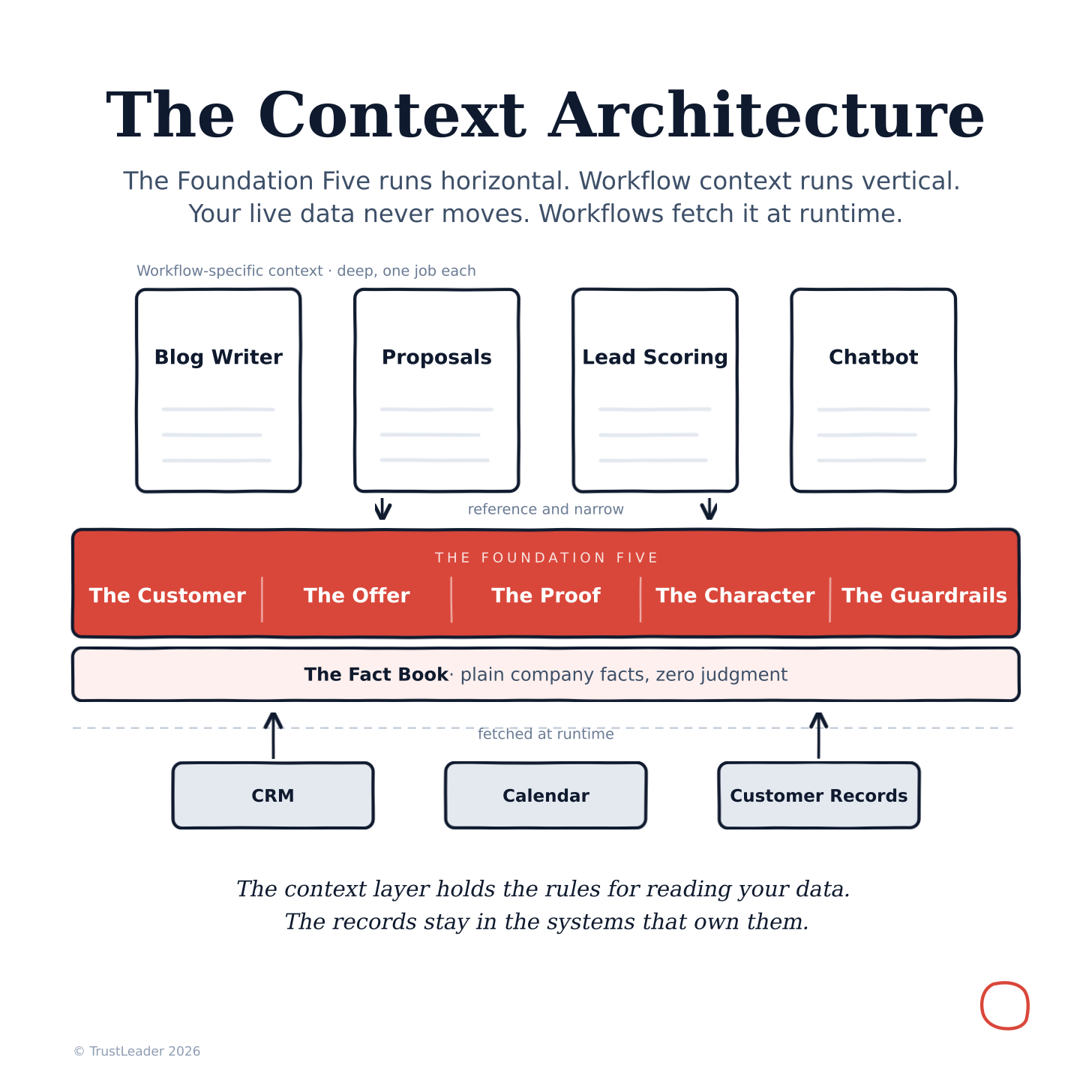
Now that we know what the Foundation Five are, let’s have a closer look at what is in those context buckets:
1. The Customer. Deep context around exactly who you serve (and who you don’t), what fears, worries, and concerns they have, what payoffs they wish to see, what transformation for them looks like, and the events that put them in market.
This includes the language they would use themselves, the questions and objections they usually raise, and the deeper fear underneath that they will not say in a first meeting.
The judgment at the core: Who do you walk away from, and why? What problems are you able to solve better than anyone else, and why?
Without this pillar, AI doesn’t know your exact audience, so the output is generic (it addresses everyone, and therefore no one in particular).
2. The Offer. All the context around what you sell, how you uniquely deliver it, and where you send people next. Your offerings are defined sharply enough that they cannot be confused with a competitor’s same-named offering, your method, your pricing logic, or the specific next steps you ask people to take.
Most companies cannot clearly describe their value proposition or how they differ from their competitors. Before anyone trusts you, they need proof of three things: that you have the capability to do what you say (competence), that you will do it exactly as promised, every time (reliability), and that you will treat them ethically throughout (integrity). This pillar establishes the context around it.
This includes what you refuse to sell or scope (even when a competitor does and a prospect asks) and a living register of the exact next step for each offer, so no article or proposal ever ends with nowhere to go.
The judgment at the core: What will you never promise, no matter how much the deal wants to hear it?
Without this pillar, AI cannot articulate what makes your offer different. Proposals read as accurate and articles educate your buyers and end without a next step.
3. The Proof. Deep context around why anyone should believe you: every claim you make, sorted by whether it’s safe to ship, requires sign-off, or never leaves the building, each one paired with the evidence that backs it, and where you stand against the alternatives your buyer is actually weighing.
This includes proof of competence (you have the capability to do what you say), proof of reliability (you’ll deliver exactly as promised, every time), and proof of integrity (you’ll treat them ethically throughout) — the three things a buyer must believe before they trust anyone at all.
The judgment at the core: Which claims do you stake the brand on, and which do you soften?
Without this pillar, AI invents statistics or hedges into mush, because nothing was ever staked in the first place.
4. The Character. Deep context around what makes you unmistakably you: your values as they show up in hard decisions, the positions you’ve decided to take out loud, and how all of it sounds on the page — your vocabulary, your sentence patterns, your proprietary terms used exactly as written.
This includes the practices in your industry you refuse to play along with, and a voice document, which is useful, but only one artifact inside this pillar, not the pillar itself.
The judgment at the core: What are the opinions you’re willing to lose prospects over?
Without this pillar, output is polished, correct, and instantly recognizable as machine-made. All manners, no character.
5. The Guardrails. Deep context around where the lines are: what never ships regardless of context, where your expertise genuinely ends, what “safe-to-ship” actually means, and the named situations where AI stops and a human decides.
This includes the words, claims, and topics prohibited outright, decided once at the top rather than argued over per output.
The judgment at the core: Where does the line sit when speed and safety pull in opposite directions?
Without this pillar, the public screw-up isn’t a risk. It’s a schedule.
In addition to the Foundation Five, I always recommend you create a compilation of company facts (I call it the “Fact Book”). This can be a Sharepoint site or anything that can be maintained and updated without having to roll out a version document (think: Masterprompt PDF document) in your organization.
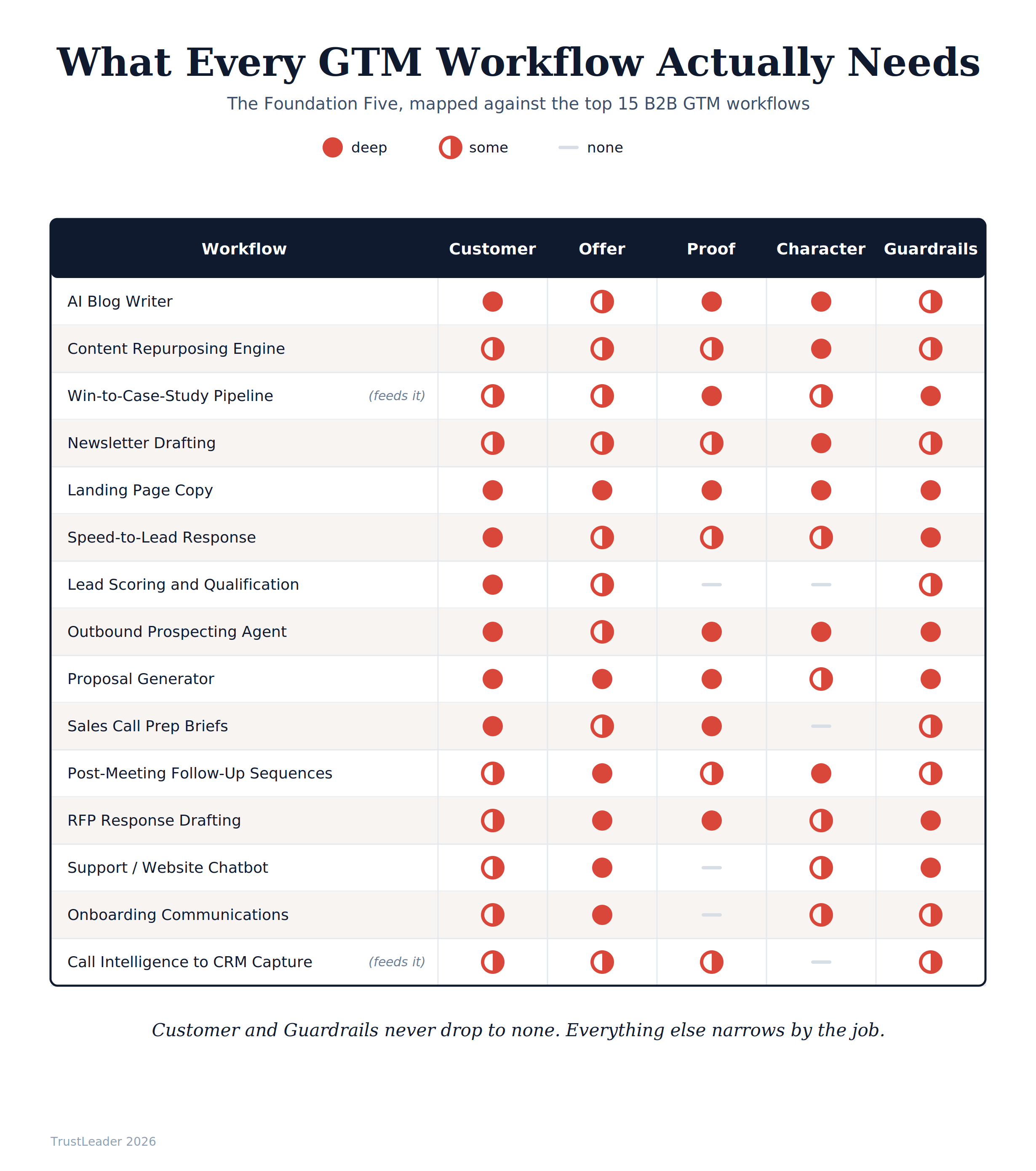
To pressure-test the Foundation Five, I mapped it against the top 15 GTM workflows for B2B companies with $5M to $25M in revenue: the blog writers, proposal generators, lead scorers, and chatbots that most of you are building or considering right now. For each one, I asked a simple question: how deep does it actually need to draw from each pillar? The pattern that emerged is the best illustration I have found yet for why the Foundation Five works the way it does.
You may be thinking: we have most of this. A voice guide, brand book, an ICP slide, a messaging doc from the last agency engagement.
That’s great and that put’s you ahead of many B2B companies out there that are winging it without those elements properly documented. But those documents were written for humans. And that’s a problem for AI. For example: A tone-of-voice guide tells a human writer to sound confident, approachable, and authoritative, and the human fills the enormous gaps between those adjectives with judgment. AI cannot. It needs rules, not aspirations: vocabulary in and vocabulary out, sentence patterns, before-and-after examples, claims paired with evidence. This is a higher documentation standard than your business has ever needed, because for the first time, your reader has no intuition.
The good news: the Foundation Five is finite work. Five pillars, one home for every decision, built once. The alternative is to answer the same five questions in every workflow you ever build, forever, slightly differently each time. The Foundation Five is not the heavy option. It is the only option that ever ends.
Start with an honest audit, one pillar at a time. For each of the five, ask two questions.
Where does this live today, in a document or in someone’s head?
Has this actually been decided, or just assumed?
Most leadership teams discover that their customer definition lives in three conflicting versions, their claims have never been sorted, and their guardrails exist only as instincts in the founder’s gut.
That discovery is not a setback. It is your baseline. The extraction and the decisions are leadership work, and they are exactly the work that turns AI from a generic tool into something unmistakably and defensibly yours.
If you want to know which of your five pillars is strongest and which one is quietly undermining everything you build, take the AI Foundation Scorecard. It takes a few minutes, and it will show you precisely where to start.
Take the AI Foundation Scorecard →
Then come back in three months and take it again. The score should move because foundations always show.
No posts
Comments
Nothing yet. Say the first thing.
Sign in to join the conversation.