
Yesterday, Yamini Rangan, the CEO of HubSpot, published a post on LinkedIn about context — “the specific knowledge about your customer, your business, and your team that AI needs to take the right action.” I was so thrilled because she not only brought up the topic (and validated the importance of context), but she also made the point that most companies don’t have adequate context defined, but those that have the highest quality of context achieve 2x, 3x, and sometimes even close to 4x better Go-To-Market outcomes.
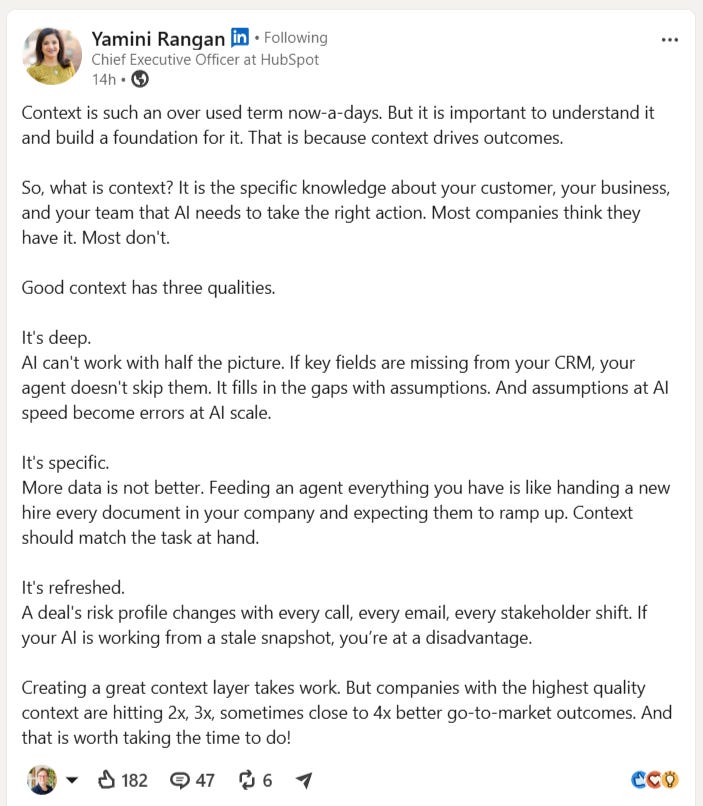
I commented and asked her if she had a source for the outcome numbers. She answered me, “Yes, for the data come to UNBOUND. We will share it.” Given previous HubSpot conferences, this leads me to believe (pure speculation, I have no insider knowledge here) that HubSpot will announce a Context Layer baked into the platform that Breeze agents will run on, and those numbers come from early alpha client success stories.
So the question is: If the highest-quality context produces two to four times the go-to-market outcomes, what does the highest-quality context actually look like — and how do you build it?
That is what this article is about. By the end of the article, you will have a precise and usable definition of the term Context Layer, know what high-quality looks like, and, maybe most importantly, how you can create yours within your organization. Because (spoiler alert): you can’t buy it.
Yamini’s definition of high-quality context is through a CRM/tooling lens. She uses three criteria to define it: depth (completeness of CRM data), specificity (task-specific serving of context), and freshness (data reflecting the latest situation).
But I would argue it still misses critical elements that prevent a company from scaling with AI even if they had all three. And that’s the point most people miss. Entirely.
Point in case: Ask most business leaders how to scale AI in a business, and you will hear the same three requirements everywhere: a unified data foundation, so AI has high-quality information to draw from; operational alignment, so humans and machines work together without friction; and governance, so teams can use AI with confidence. All three are genuinely necessary. But even if you have all three fully in place, your AI could still produce generic slop that needs rework and doesn’t result in compounding business impact.
What the standard answer leaves out is a fourth layer: context. Yes, that includes the knowledge about your customer, your business, and your team. But it also must include the judgment that sits on top of that knowledge. The discernment. The taste. The thousands of micro-decisions your company (or most likely your founder and a few people) makes every day that make it truly yours.
So here is my definition of a context layer:
A context layer is the explicit, deliberate representation of what makes your company uniquely recognizable —what it knows, stands for, and holds by—extracted, codified, and structured so that both your people and your AI can act on it.
Let me take this apart.
Uniquely recognizable. This is the whole point of a context layer. You are trying to give your AI an accurate representation of how you would write something, answer a difficult question, and behave in a tricky situation. Context gives the AI everything it needs to know about you to create, act, and behave like you, and only you.
Deliberate. This is important. Tacit and implicit knowledge is made explicit, and definitions, standards, guardrails, process maps, and judgment rules have been deliberately decided. A context layer is a dump of documents that have accumulated in your Drive over eight years; it is what you decided, on purpose, to hold as true.
What your company knows. Who you serve and what actually drives them. What you sell, what it costs, and what it is worth. What you claim and what evidence you got to back those claims up. How you sound in a proposal, in a cold email, and in a support reply.
What your company stands for. Your position, your beliefs, and your stance. What you believe about your market, what you are not willing to do (even if it’s standard practice), what you are for, why you exist (beyond the transaction), and the value proposition that follows from all of it.
And what your company holds by. Your commitments (expressed most often in the form of refusals): Which customers you turn down. Which claims never ship without proof attached. What never leaves the building without a human reading it first. Where you stay silent while competitors shout. These almost never appear in any document, because nobody writes down what they refuse. They are also the most valuable content in the entire layer.
Extracted. Most of this is not written anywhere. Most mid-market companies don’t even have agreed-upon value propositions and messaging. Context lives in the heads and habits of your best people, and it surfaces in how they work and how they decide. This first needs to be carefully extracted.
Codified. Codifying serves two purposes. The first is resolving contradictions: after you extracted all the raw material, you are left with contradictions and half-truths. Someone with the authority has to decide which of the three currently used ICP definitions is the right one (if any). The second job is explicitly capturing the context—the value proposition, the messaging hierarchy, the refusals that nobody ever wrote down. Codifying is part judgment, part authorship.
Structured. Structuring now turns the extracted and codified knowledge into canonical, retrievable, machine-readable assets, organized for using rather than only for finding. So, don’t think of a context layer as a filing cabinet AI needs to make sense of first or a database that only contains data records. It includes all types of knowledge made explicit and accessible.
Now that we know what a Context Layer is, let’s talk about how you can test whether your context is high-quality or not.
Thanks for reading From Scattered To Scaled AI! This post is public so feel free to share it.
Most companies I talk to have some context: a brand guide, a few positioning documents, an ICP definition somewhere, a shared drive full of proposals. So the question isn’t whether you have context. It’s whether what you have is high-quality enough for AI to run on. These four tests will tell you.
Accessible. Can the knowledge be retrieved and used by an AI without first untangling, reinterpreting, or reformatting it? Technically, your filing cabinet contains the answers too. But it makes everyone assemble those answers from parts, every single time. And everyone assembles them slightly differently, which is exactly the problem you were trying to solve. Also, documents written for humans are different than context created for AI. (One great example is a voice guide. The voice guide for humans includes aspirational adjectives an AI cannot accurately interpret. It needs rules, good and bad examples, and guardrails.)
Canonical. Is there a single agreed-upon version that governs all others, and does everyone know which one it is? Copies and overlap are normal and often even necessary. What matters is that when two documents disagree, the answer is already decided and it is clear which wins. If this isn’t the case. AI will just pick one when it encounters the contradiction. Without asking you but with complete confidence in whichever version it happened to land on.
Adopted. Does the context live where your team already works, in a form that fits how they actually do their jobs? In other words: is everyone using it? If this fails, people use whatever is closest to hand (e.g., documents they have to fill in the blanks or often just prompts they write up in the moment), and the version in circulation becomes the real one regardless of what you decided. You can imagine how messy this gets very quickly.
Maintainable. Can the people who own it update it without breaking everything downstream that depends on it? Building your context is one thing. Maintaining it is another. Companies who figure out how to maintain and iteratively improve their context over time will have a massive competitive advantage. Without being able to maintain it, the knowledge goes stale, and you find out when a customer points out the error or discrepancies. Ouch.
It is important to understand that these four tests are not a scorecard you average out the answers. Instead, think of them as toll gates you have to pass through. A foundation that fails one of them isn’t eighty percent of a foundation. It’s a well-organized filing system, which is a genuinely useful thing to have but not a thing your AI can scale on.
What passing all four produces is simple to state: one truth, one home, one owner.
Now that you know what high-quality context looks like and how to test for it, let’s look at why the fast ways of getting there don’t work.
Once leaders accept that context is the constraint, the instinct is to close the gap as fast as possible, and there are three shortcuts I see business leaders try to take. None of them survives the four tests, and it’s worth understanding exactly why, because each one is genuinely appealing.
The first shortcut is data. Connect every system, clean up the CRM, and let AI figure out the rest. The problem is that records tell AI what happened. They don’t tell it what you hold by. Your CRM knows a deal closed. It doesn’t know why you would refuse the same deal today or what your team worked around to get it over the line. Data quality is real and necessary work, which is a critical element for your agents to execute, but it is not the full story because it still lacks the full context.
The second shortcut is documents. Export everything into a single folder, point the AI at it, and call it a knowledge base. But your documents are artifacts of past decisions. They were written by different people, in different times, for different audiences, and they disagree with each other in ways nobody has ever deliberately reconciled. They also skew heavily toward wins, because nobody writes up the deals they walked away from or the customer they should never have taken on.
The third shortcut is the tool. Yes, I know. It is very tempting to just buy a platform that promises to become your company brain. I understand the appeal completely — buying is fast, building is not, and the demo always looks like it solves the problem. Also, once you really think about it, creating a context layer can feel overwhelming and exhausting (there is a reason you avoided this work before). But think of those tools as containers. They are necessary, often excellent, and still empty when you buy them. You will still need to fill them.
Underneath all three sits the same missing step. Decisions. Nobody decided which of the three ICP definitions governs. Nobody decided which claims are safe to ship without proof attached. Nobody decided how the company sounds when it says no. Nobody decided what never goes out without a human reading it first.
Your organization has the knowledge. You just never explicitly decided what it holds by. In my upcoming book, From Scattered to Scaled AI, I call this the Decision Gap: the distance between having knowledge and having decided knowledge. And when you point AI at an undecided pile, it does what AI is built to do with ambiguity: It picks the most plausible version and states it as fact.
This is also, by the way, why you are still reading every AI draft before it goes out. Not because AI isn’t mature enough. But because you are giving it ambiguity. In other words: If you didn’t do the deciding before you give it to AI, you will have to keep making decisions later; now there are exponentially more decisions to make.
From Scattered to Scaled will launch October 1st, 2026. Become part of the movement and join my book lunch team.
None of this is new. Playbooks, brand guidelines, positioning documents, documented sales processes — capturing what a company knows and holds by has been around for decades. But companies often skipped most of it and got away with it. Because the founder knew how to pivot the pitch mid-conversation in response to an objection. Because Sandra knew how to write aspirational thought leadership articles that were always on-brand. Humans learn by absorbing what they are exposed to. A new hire ramps slowly, asks questions in the hallway, watches how your senior rep handles the pricing objection, and six months later carries the context in her head like everyone else.
AI does not absorb. It makes assumptions. It fills gaps. And sometimes it hallucinates. Give it half the picture, and it fills the other half with the most plausible guess, delivered confidently, at a pace no human team can match. A salesperson who gets ten meetings wrong can be coached and retrained. An AI workflow running on a wrong foundation produces slightly off, slightly generic output every time it runs. An AI agent operating with inadequate context can cause hard-to-reverse, sometimes irreparable, damage.
And the stakes are about to rise. Gartner expects that 15% of day-to-day business decisions will be made autonomously by AI agents by 2028. Decisions. Not drafts. If you have never told an agent what you hold by, on what basis is it supposed to decide anything on your behalf?
One caveat worth stating: build context as a company asset, not inside a single platform. Whatever you codify should be portable enough that your CRM’s agents, your team’s daily AI tools, and whatever ships in eighteen months can all read from it. A context layer that lives only inside one vendor’s product isn’t an asset but merely a configuration.
So how do you actually build one? You don’t install it, and you can’t buy it. You go through a process, and the sequence matters more than most people expect. I developed a process I call the TrustLeader Method which consists of 5 steps: Extract, Codify, Structure, Implement, and Amplify.
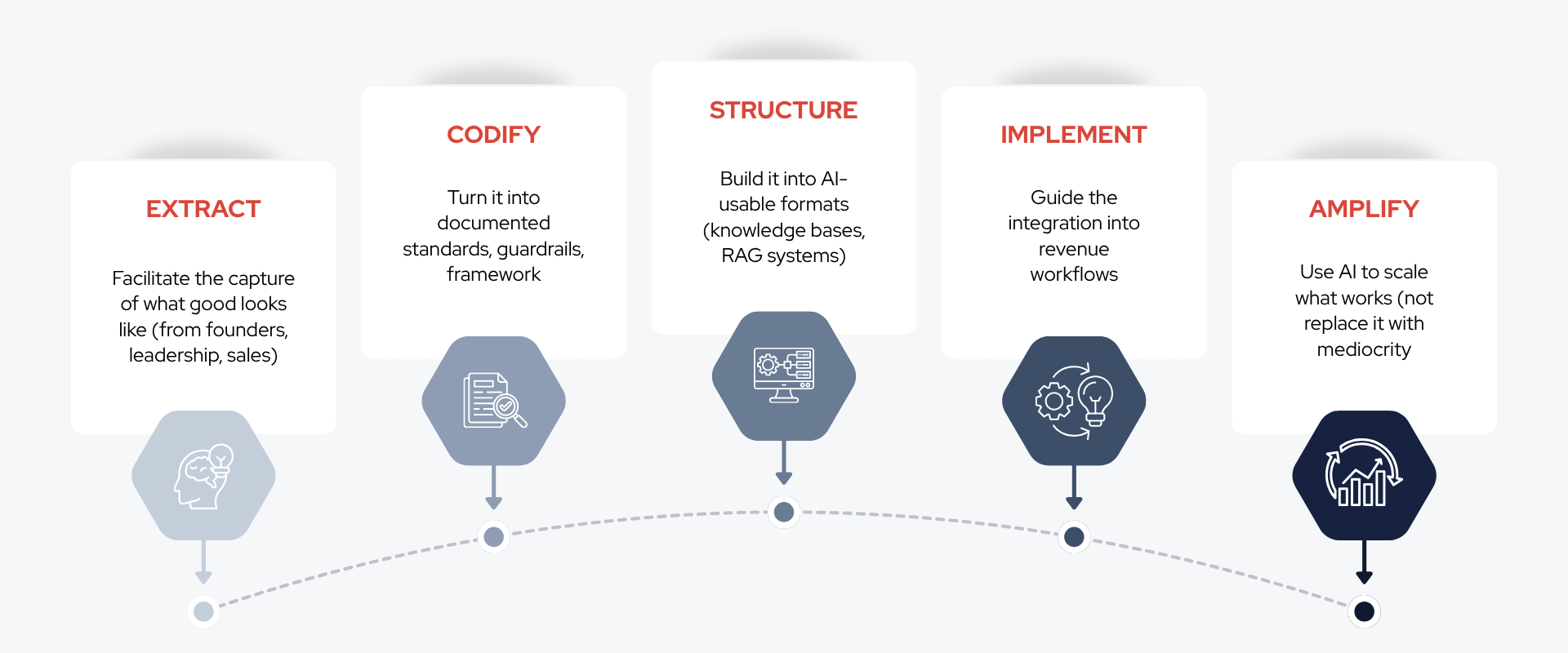
Extract. Pull knowledge out of heads, habits, and recordings — the explicit, the implicit, and the tacit. The richest and most valuable material here is spoken and unstructured. Internal pipeline reviews, sales calls, the way your best people answer a hard question when nobody is polishing the answer for publication.
Codify. This is where you close the Decision Gap. Two jobs happen here. The first is resolving contradictions and committing to positions: definitions, standards, guardrails, process maps, judgment rules. The second is authoring what was never written down in the first place — the value proposition, the messaging hierarchy, the refusals. It is CEO-level work, and no platform will ever do it for you.
Structure. Give every truth one home. Turn the codified decisions into canonical, retrievable assets organized for using rather than only for finding, held in portable forms your systems can actually reach.
Implement. Embed the foundation into the workflows where the work actually happens, and train your team to use it and to QA against it. This is the Adopted test in practice. If it doesn’t reach the daily work, it might as well not exist.
Amplify. Scale what works. Speed becomes safe at this point, because every output is drawing from the same decided foundation, and every win compounds instead of evaporating.
Notice which two moves carry the weight: Extract and Codify are the ones everyone tries to skip, and they are the two no product will ever ship for you, because they are made entirely of your judgment.
This is the work I do at TrustLeader. The Foundation Five engagement exists to build exactly this layer: extracted from your people, decided by you, and structured so that every workflow and every agent you deploy from here on runs on a foundation that is authentically yours and genuinely hard to copy.
Remember: The platforms will continue to ship better containers, and you should use them. What goes inside is the part nobody can sell you.
Does your business have the foundations to scale AI? Find out where you stand and uncover your AI strengths and gaps with The AI Foundation Scorecard. Take the quiz now https://scorecard.trustleader.co/ai-foundation-scorecard.
No posts
Comments
Nothing yet. Say the first thing.
Sign in to join the conversation.