
For the last year, I have been telling growth-stage CEOs the same thing: AI does not need better prompts. It needs your business context. It needs to know who you serve, what you say, what you would never say, and the thousands of small decisions that make your company recognizably yours. Without that, AI fills the gaps with the statistical average of the internet, and you end up with, well, AI slop (output that sounds like everybody and nobody).
So when the biggest CRM company in the market starts building exactly that, it is worth taking notice (and celebrating).
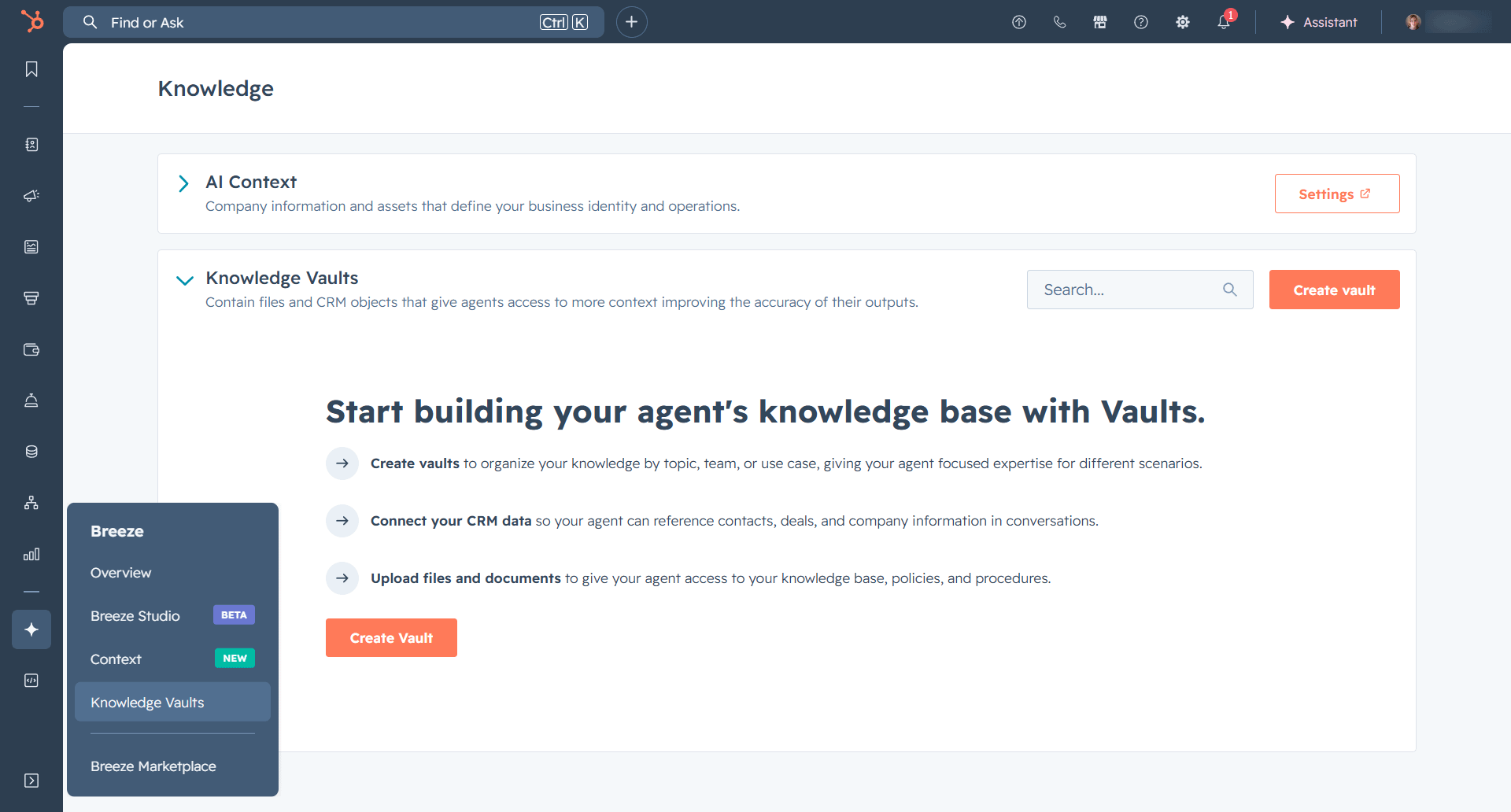
Here is what happened: HubSpot has now added two tabs into its Breeze menu: Context and Knowledge Vaults. Both exist to do one thing: give HubSpot’s AI more information about your business so its outputs are less generic and more accurate. That is the right idea. It is the idea I have been arguing for. And the fact that HubSpot is building it into the CRM tells you the platforms themselves now agree that context is what makes AI trustworthy at scale.
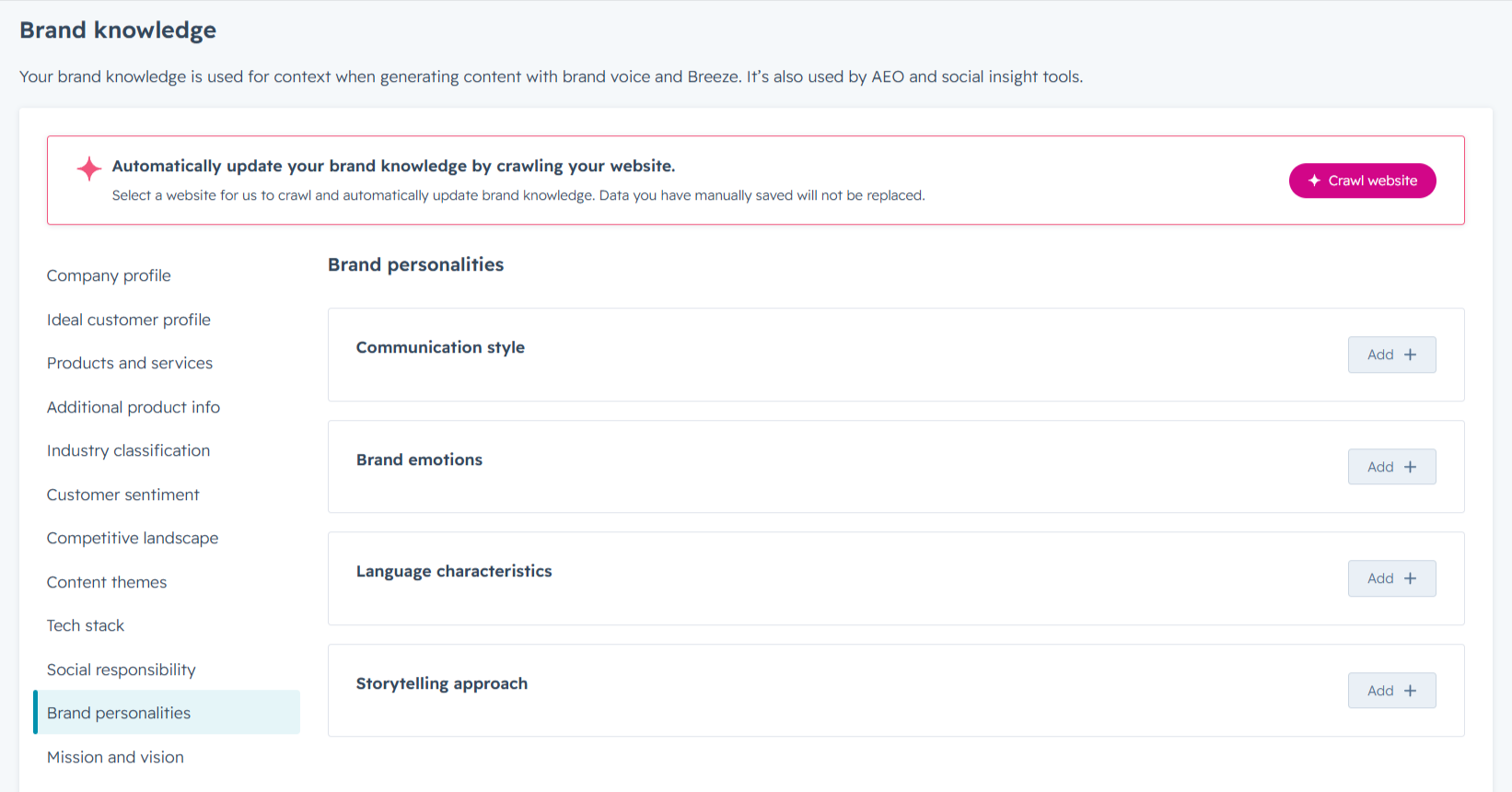
HubSpot has had a marketing capability called “Brand” for a while now. This is where you will find your brand kit (logos, colors, etc.), your brand voice (don’t get me started on the HubSpot Brand Voice… that deserves its own article), and Brand Knowledge. Brand Knowledge has its own set of fields: company profile, ideal customer profile, products and services, additional product info, industry classification, customer sentiment, competitive landscape, content themes, tech stack, social responsibility, brand personality, mission and vision. This has been around for at least six months if I remember correctly, but I haven’t seen many companies fill this out yet. Some of it gets actually filled automatically by HubSpot. In addition, HubSpot now even offers to update the brand knowledge sections automatically if you ask it to crawl your website (more on that below).
However, this is different (for now) from the newly added Breeze AI Context and the Breeze AI Knowledge Vaults, even though they are almost one-for-one and are asking the same things. So, I assume (and I don’t have any insider knowledge here) that these will be consolidated soon.
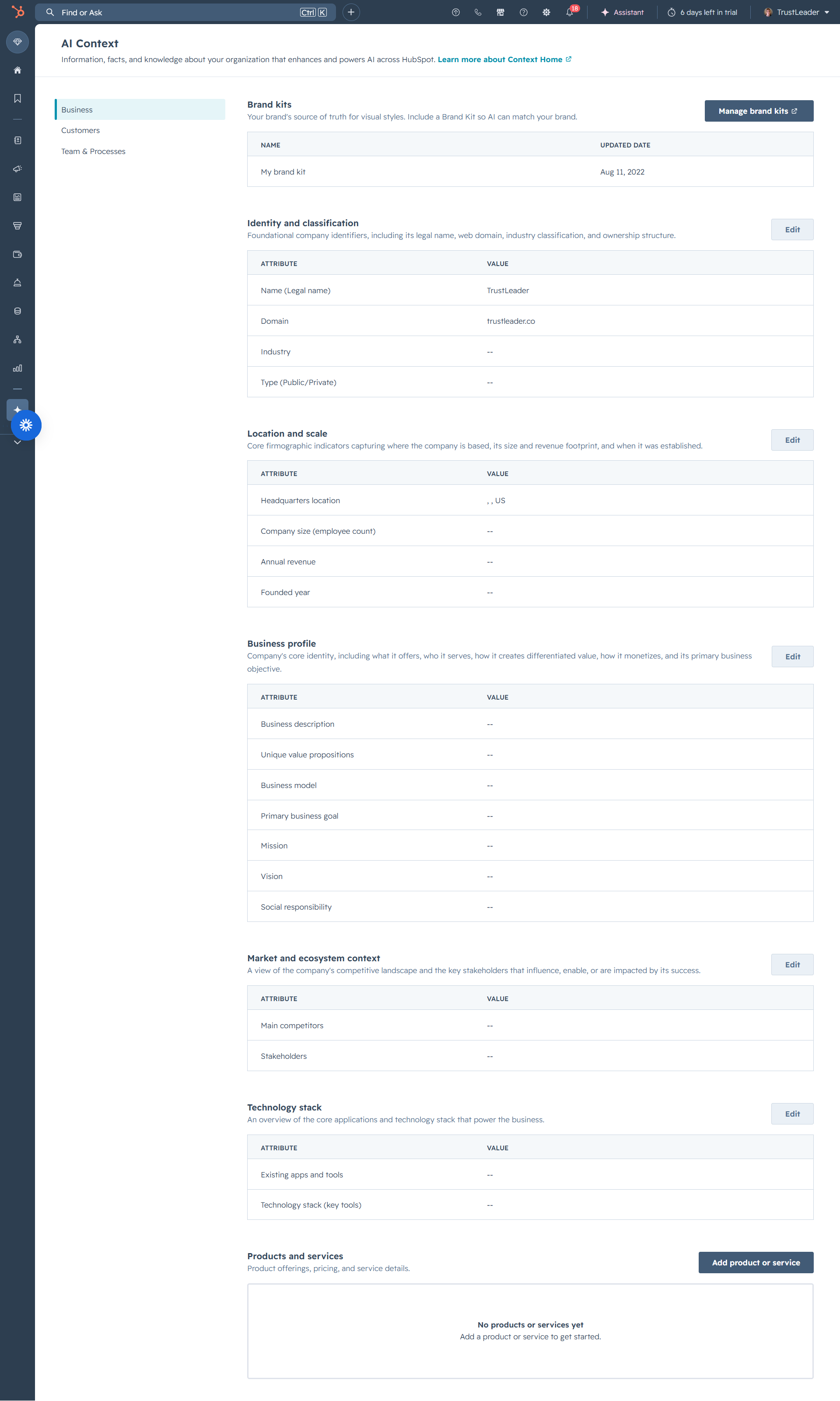
Let’s look at the recently added Breeze AI Context and Knowledge Vaults in more detail. The first is Breeze AI Context. HubSpot describes it as the “information, facts, and knowledge about your organization that empowers AI across the platform.”
The new layer sits under Breeze > Context and is organized into three areas.
Business covers your identity and the shape of your company. There is a brand kit (voice, tone, and brand guidelines, though notice this one actually pulls from Marketing > Brand, more on that in a moment). There is identity and classification: name, domain, industry, business type. There is location and scale: headquarters, size, annual revenue, year founded. There is a business profile meant to capture your mission, positioning, and key differentiators. There is a market and ecosystem section for your main competitors and stakeholders, a technology stack overview, and a products and services section.
Customer is where you add ideal customer profiles, the characteristics of the companies and buyers that best fit what you offer, and personas, the detailed profiles of your typical customers with their roles, goals, and challenges.
Team and Processes is essentially about the individual user. Your name, email, job title, phone number, and an email personality, where you set the tone, style, formality, greeting and sign-off patterns, whether you use bullet points, your common phrases, and so on. I would assume this will be built out in the future.
The second part is the Knowledge Vault. HubSpot draws a clear line between the two: Context is the default, foundational information applied automatically across AI features (at TrustLeader, we have a similar concept called the Foundation Fives), while Knowledge Vaults are additional, use-case-driven context you add manually and assign to specific assistants or agents.
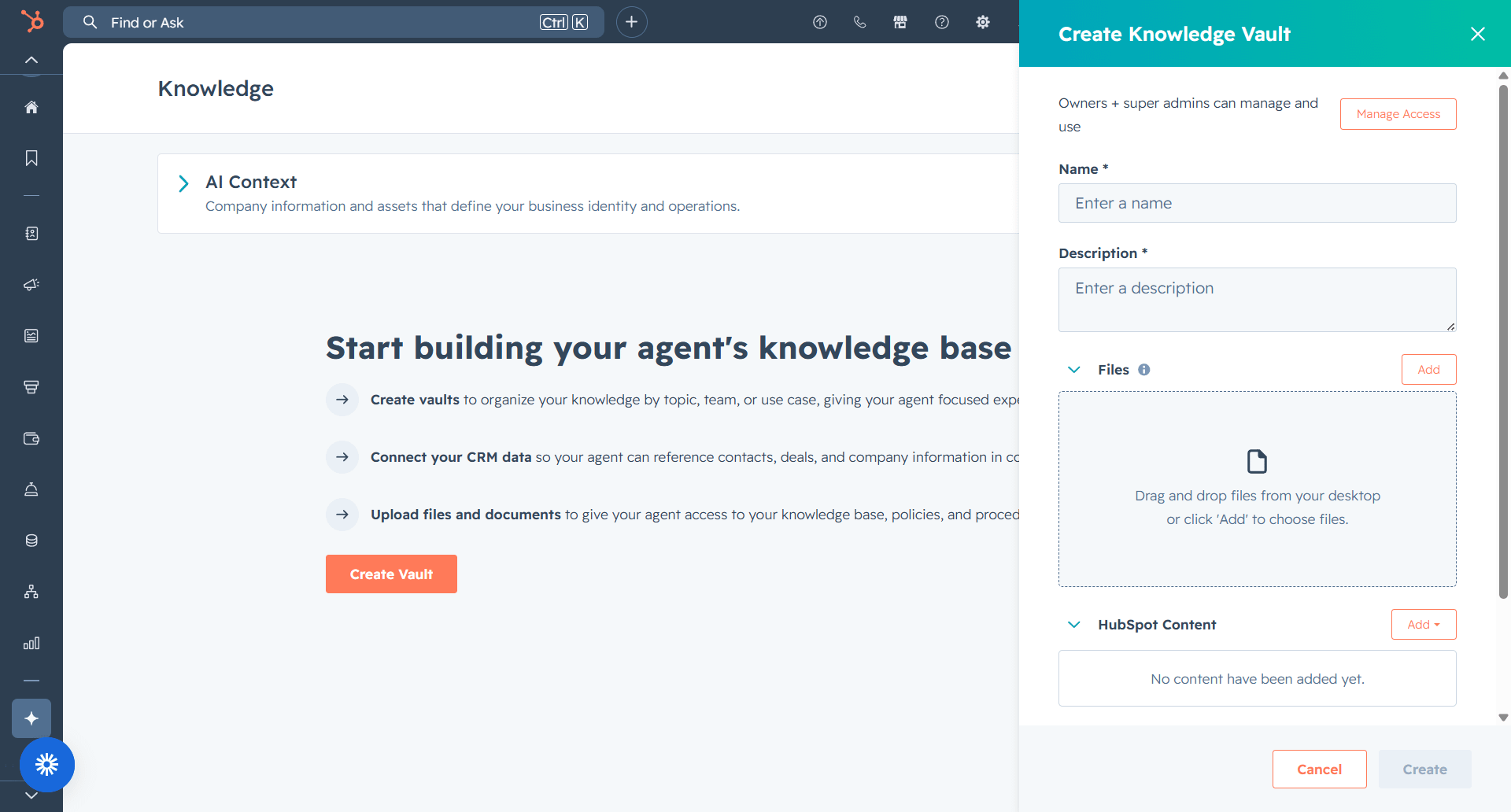
To create a Knowledge Vault, you click “Create Vault”, give it a name, add a description, and add files, HubSpot CRM objects, and lists. Only owners and super admins can manage and use vaults.
Now that you know what was added, let me tell you what I think about it.
Thanks for reading From Scattered To Scaled AI! This post is public, so feel free to share it.
Let’s start with what the move itself signals. HubSpot is telling you that AI needs a context layer and that it is critical. When a software company this large invests real engineering in that idea, it is strong evidence the idea matters. You do not build this unless you have concluded it is essential.
And you can see the recognition underneath it. HubSpot’s agents and AI are genuinely capable, but technology is not the constraint here. The AI is only ever as good as the data and context it runs on. A clean, well-maintained HubSpot database is necessary, and it is still not enough, because your records tell the AI what happened, not who you are, what you stand for, or what good looks like. HubSpot building a place for that second thing is an admission that the technology alone was never going to close the gap. That admission is the step forward.
There is a business logic to it too, and it is worth naming. The better your context, the better your AI and agents perform, and the better they perform, the more reason you have to keep your work inside HubSpot. Context is what makes the platform stickier. So I would expect serious investment in this part of the product over the next six months. I have no insider knowledge, but the incentives point in one direction.
In a previous article, I talked about the AI Context Gap, which is the space between what your AI knows about your business and what it actually needs to know to represent you accurately. Everything HubSpot has built here is an attempt to narrow that gap. That is the right target. The only question left is whether filling out form fields within a single platform actually closes it, and that is where the good news runs out.
The trouble begins the moment you actually try to fill it in.
Look at how HubSpot asks you to express your value proposition. You have to create phases consisting of a few words that are created like blog tags. And I want you to sit with how strange that is. How do you write a value proposition as a bundle of tiny phrases? You cannot. A value proposition is a piece of reasoning. It connects a specific buyer to a specific problem to a specific reason you, and not your competitor, are the one to solve it. Reduce it to tags, and you have kept the words and thrown away the logic.
But the value proposition is just an example. For some fields, you can enter a small paragraph. For others, you can choose from a list of preset choices. That is it.
I am currently writing the manuscript for my second book, From Scattered to Scaled AI. There, I draw a line between two kinds of documents. A human-readable document uses aspirational language: be bold, be trustworthy, be authoritative. It is too vague for AI to act on, because AI cannot interpret “authoritative” the way a person can. (BTW: that is exactly how you are supposed to define your brand voice in HubSpot…) An AI-accessible standard uses concrete, bounded, verifiable rules: documented examples, prohibited phrases, approved claims paired with the evidence that backs them, sentence patterns you actually use.
HubSpot’s tagged phrases are neither. They are a third thing, and it is the worst of the three. They are too thin for a human to reason from and too fragmented for an AI to reason from. There is no connective tissue, no before and after, no example of the claim done right versus done wrong. It is the shape of context without its substance.
But there is an even deeper problem with this, and this problem does not get resolved when (not if) HubSpot improves the fields. As an organization trying to build your AI Context layer, you are facing empty fields. Who fills in these fields? Most of the time, it is an eager marketing manager or the person responsible for branding. They sit there and feel like they are just filling out some forms, but in reality, this work requires crystal clarity and thousands of microdecisions if done right. For most organizations, the clarity doesn’t exist. The vast majority of small and mid-size B2B companies cannot cleanly state what they sell, who they serve, and what problem they actually solve. Not because they are not good at what they do, but because that knowledge lives in the founder’s head and in the instincts of a few key people, and it has never been made explicit. It has never had to be.
That is what I call the Decision Gap: the space between having knowledge and having a position. The raw material is there, scattered and often contradictory, but nobody has sat down and decided what the company holds by. HubSpot gives you a place to record the decision. It gives you no process for creating it (which is fine, since they are a SaaS company and that really isn’t part of the job description). But it is worth noting that making these decisions is the hard part. Filling out the forms then becomes easy.
In my work with clients here at TrustLeader, we extract, codify, and structure knowledge: We extract the knowledge that lives in the founder's head and a few key people's instincts and get it out into the open where it can be seen. Then we codify it, which means resolving contradictions and deciding what the company actually holds by, so you have real standards rather than competing opinions. And we structure it so that an AI can retrieve it cleanly and you can keep it up to date.
That is the process that turns a scattered, half-articulated company into something an AI can represent consistently. None of it happens by handing someone a form. You are handed the boxes and left to guess at the answers, and if you guess the way most companies guess, you will fill them with the same vague, agency-written, sounds-smart-means-little language that created the problem in the first place.
Share From Scattered To Scaled AI
HubSpot, like a few other tools I have seen this with, offers to automatically fill out the information by having their AI crawl your website. This is an attempt to encourage more people to complete the brand knowledge section.
I get the intent completely. Filling this out is tedious, and anything that lowers the barrier gets more people to actually do it. This is the eating-your-vegetables problem of AI foundations. Everyone knows they should define who they serve and what they stand for. Almost nobody wants to sit down and do it, because there is always something that feels more urgent and more rewarding, the pizza in front of the salad. So a button that does it for you is genuinely appealing, and I do not blame HubSpot for offering it.
Here is the catch, and it has nothing to do with HubSpot. A scan can only reflect back the decisions you have already made. Ironically, for most companies, the website is one of the least-decided things they own. It was often written by an agency that was never fully clear about what the company does; it optimizes for sounding smart rather than being clear, and it rarely names the actual buyer, the actual pain, or the actual benefit in plain language. Scanning it does not create the clarity. It captures the vagueness that is already there and hands it back to you looking official.
That is the real point, and it holds no matter how good the scanning gets. The reason your context comes out vague is not the tool. It is that the underlying decisions have not yet been made, and no amount of automated fill-in will make them for you.
Organizational knowledge lives in layers. There is explicit knowledge, the things already written down. There is implicit knowledge, the things that live in people’s heads but could be articulated if someone asked the right questions. And there is tacit knowledge, the deepest layer, the instinct a founder has about whether a prospect is a fit before the first call is over, which they cannot fully explain even when you ask.
HubSpot’s context fields can only hold what is already explicit. They have no mechanism for surfacing the implicit and tacit layers, and those are exactly the layers where your real competitive advantage lives. The generic stuff is easy to capture and easy to copy. The proprietary stuff, the judgment and the point of view, is the hard part, and it is the part a set of form fields cannot reach.
Everything above is a depth problem. In addition to those, I want to point out two structure problems:
There is no governance and no maintenance. Once you fill these fields in, who owns them? What triggers an update when your pricing changes, your positioning shifts, or you retire a feature? How does that change reach every place the old version was used? This isn’t a HubSpot problem per se, but it's one of the biggest challenges we will need to solve over the next 12-18 months. But it is worth noting because the tool has no concept of ownership or propagation for this. So the context you enter today goes stale. And stale context is not a neutral problem. It is worse than no context, because it is confidently wrong. It will have your AI promoting a price you no longer charge or a capability you no longer offer, and nobody will notice until a customer does.
And it is a silo. This is the one that matters most. However good HubSpot’s context layer gets, it lives inside HubSpot. And only within HubSpot. Your AI assistants (Claude, ChatGPT, Gemini, etc.) don’t see it. Your automations running through Make or n8n cannot see it. Every other tool that generates something in your name is still working from nothing, or from its own separate, quietly different copy of who you are. A context layer trapped within a single platform is not a foundation. It is one more island, and the whole problem you are trying to solve is that your knowledge is scattered across islands.
And here is the part that should give you pause, because it shows the fragmentation is not just between HubSpot and your other tools. It is happening inside HubSpot right now with HubSpot’s older Brand Knowledge and the new Breeze AI Context. That is the same company described in two places in one platform, which is exactly the fragmentation a foundation is supposed to prevent. If it can happen within a single tool, you can imagine how quickly it happens across five tools. A real foundation has a single canonical source of truth that every tool can access. HubSpot’s context can be a consumer as well as the supplier of that foundation. It cannot be the foundation itself.
I am not going to hand you an implementation plan here, because the plan is not the point and it is different for every company. But the shape of the answer is simple to describe.
Your context foundation has to be properly extracted, so it captures the implicit and tacit knowledge, not just what was already lying around. It has to be codified, so the contradictions are resolved, and you have actual standards, guardrails, and definitions rather than fragments. It has to be structured so that an AI can retrieve it cleanly and you can keep it up to date. It has to be owned, so it does not go stale. And it has to live somewhere every tool can reach, so it serves all of your AI, not one platform’s.
HubSpot’s AI Context can be one of the places that foundation flows into. That is a good use of it. What it cannot be is the place the foundation is built, because building it is decision work, extraction work, and governance work, and no field on a form does that for you.
I want to end where I started, because I think both halves of this are true at once.
HubSpot building this is genuinely good news. It means the market is catching up to the idea that context, not tooling, is the differentiator. The platforms are validating the thesis. That is worth celebrating.
And a set of fields is not a foundation. Filling them in is not the work. The work is the decisions underneath them, the ones that force you to finally say who you serve and who you do not, what you always say and what you would never say, and no tool, however well built, makes those decisions for you.
If you want to know how far along your own foundation actually is, before it becomes a brand incident or a lost deal or a question from your board you cannot cleanly answer, I built a short diagnostic for exactly that. It takes a few minutes and benchmarks you across the five pillars: Extract, Codify, Structure, Implement, Amplify.
Take the Safe to Scale AI Readiness Scorecard →
Because the goal was never to fill in the fields faster. It was to become the kind of company whose AI is safe to scale from the outset.
No posts
Comments
Nothing yet. Say the first thing.
Sign in to join the conversation.