
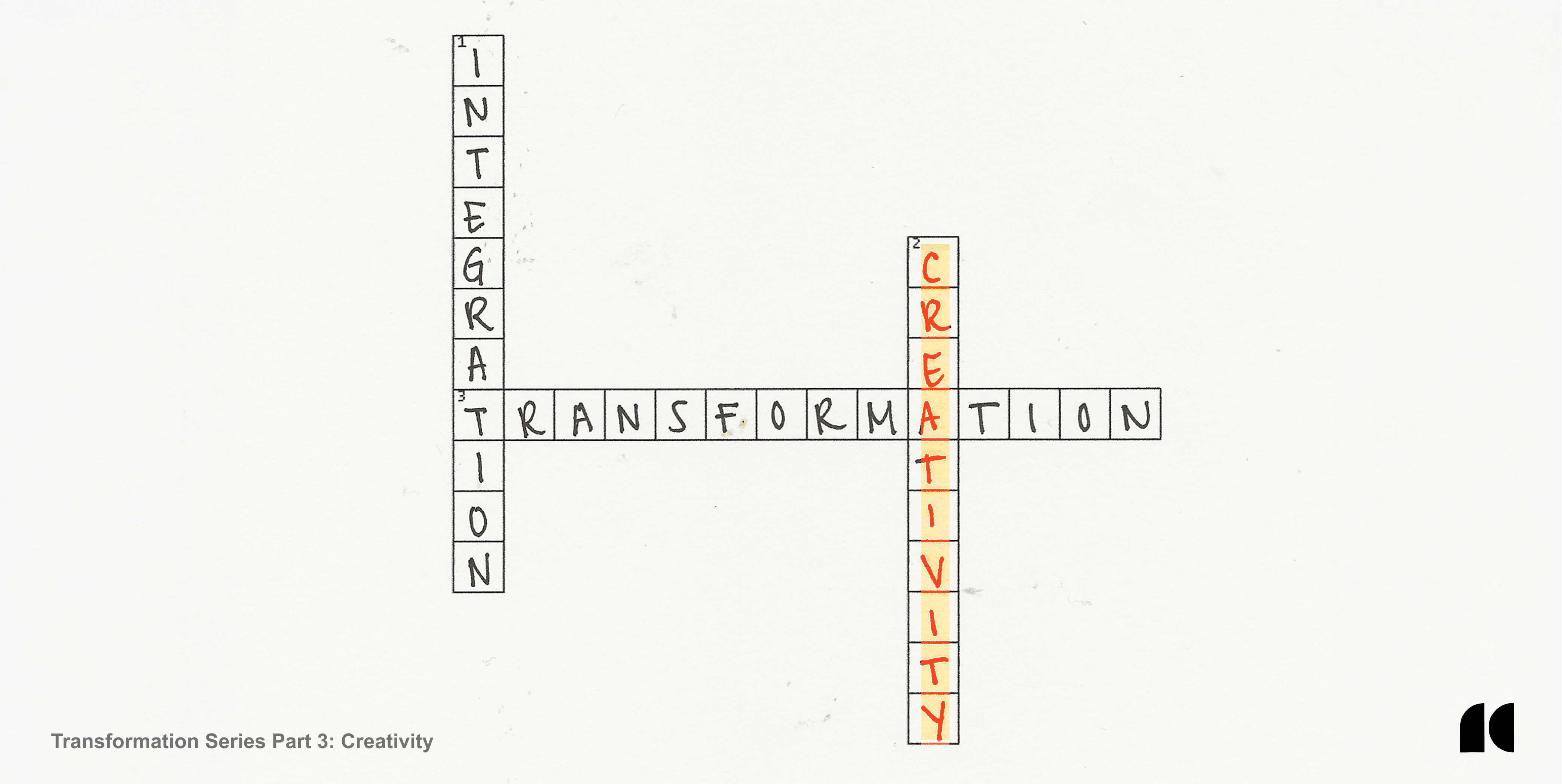
A question that circles around agencies and creative teams fairly often is: Why are we doing this?
This isn’t an existential question to get your head spinning or make you question every professional decision you’ve ever made. We’re asking in a more practical sense. Why are we building brand systems instead of just running campaigns? Why do we care whether a team has psychological safety and not just talent? Why does it matter to us that the work feels alive and not just polished?
The answer, for Friends Everywhere, has always been the same. It just took us a while to say it clearly.
The answer, for Friends Everywhere, has always been the same. It just took us a while to say it clearly. It’s our guiding force and our north star. Yes, sure, deliverables and outputs are a part of our work like everyone else in the advertising sphere. But, creativity? That’s our spark.
Creativity is our reason why. Creativity is a fundamental human thing that we believe deserves better conditions than it usually gets.
This is the third and final piece in our series on how we work. If you've been following along:
Integration was about how we show up, where we’re embedded, present, and inside the systems where work actually gets made.
Transformation was about what we do once we're there. Envision, if you will, the quiet structural changes that compound over time and change what a team is capable of. This piece is about why any of that matters.
Creativity is the answer. Let us try to explain what we mean by that.
What creativity actually needs Here is something that took us a long time to understand, and that we now believe clearly and that is creativity is not primarily a solitary act. It can certainly feel like a silo or isolated space but it's an interpersonal one.
This runs against a lot of the mythology around creative work. The lone artist. The tortured genius producing in isolation. The moody and lonely musician. The solo poet. The idea that real creative insight comes from disconnecting from other people and going somewhere private with your thoughts.
There's something true in that—you do need space to think, and not every creative environment gives people enough of it. But the thing that actually makes creative work land, the thing that makes it feel resonant and true and alive rather than merely technically accomplished and that almost never comes from isolation.
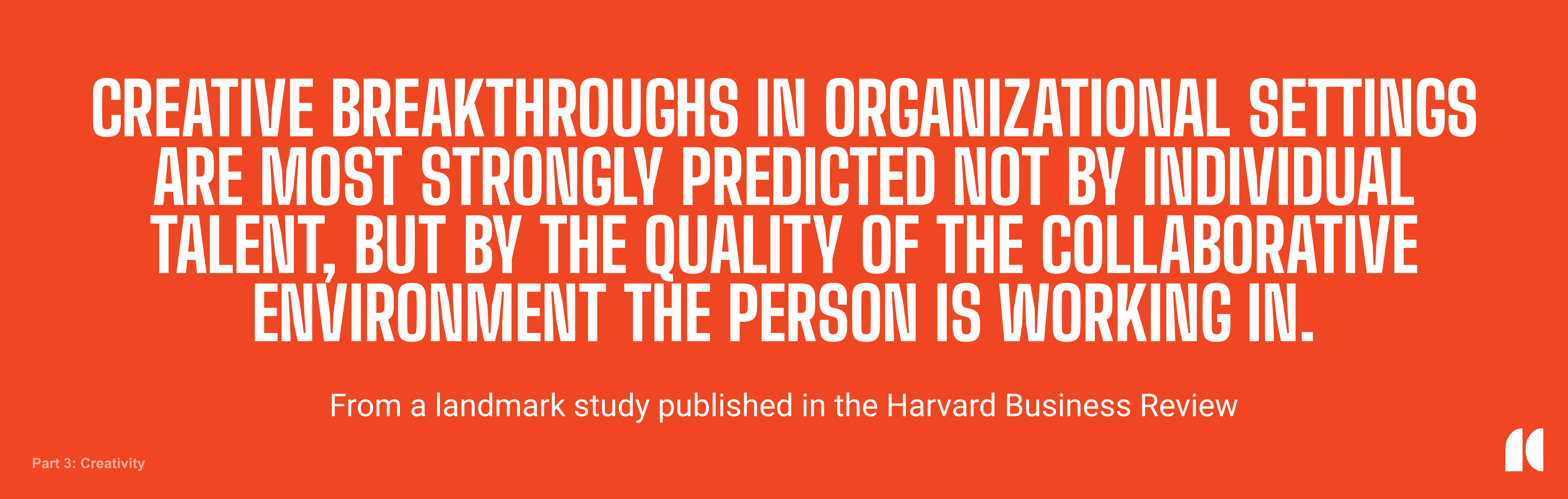
Research on creative performance backs this up consistently. A landmark study published in the Harvard Business Review found that creative breakthroughs in organizational settings are most strongly predicted not by individual talent, but by the quality of the collaborative environment the person is working in. Specifically whether they feel psychologically safe enough to take risks, try things that might not work, and be honest about when something isn't there yet.
A separate body of work on what researchers call “combinatorial creativity”—aka, the idea that new creative ideas emerge from the collision of existing ones—suggests that the people who produce the most original work are disproportionately those who are exposed to a wide range of other people's thinking and can synthesize across domains rather than go deep in a single lane.
What this means, practically, is that the conditions for creativity are really about the quality of the relationships inside which the work gets made.
Which brings us to structure on creativity, as this medium requires structural support in order to thrive. And it's the reason why integration is more than just a model for how we work with clients. It's the way we create the conditions where creativity can actually happen.
The friction that makes things get real
There's a kind of friction that's destructive. The kind that comes from misalignment, unclear ownership, feedback that contradicts itself, systems that require the same conversation to happen four times before a decision gets made. That friction drains energy and produces work that's adequate but not alive.
And then there's a different kind. The friction that comes from two people who are genuinely engaged with the same problem, who trust each other enough to push back, who care enough about the outcome to have the uncomfortable conversation rather than avoid it. That friction produces things.We’ve seen this happen in real time.
A creative director who stops a presentation and says: “This doesn't feel true to the brand and I want to understand why before we go further.” A strategist who, three days before a campaign launches, notices that one asset is pulling the whole thing in a different direction and says so. A client who trusts a partner enough to say: “I don't think this is working and I think we both know it” instead of approving something because the deadline is real and the discomfort of the conversation doesn't feel worth it.
Those moments don't happen when teams are working at arm's length. They require proximity alongside the kind of trust that builds over time from consistent engagement as a team (from knowing how someone thinks to having been in the room for the decisions that led to this one).
This is why, when people ask what makes Friends Everywhere different from other agencies, the answer isn't a list of services or a proprietary framework. It's that we build the kind of working relationships where productive friction is possible. It’s okay if you say the hard thing and it makes the work better rather than derailing it. In fact, we encourage it.
That's our belief about what creativity actually runs on.
What gets lost when the conditions aren't there.
The cost of bad creative environments is real, and it's larger than most organizations acknowledge.
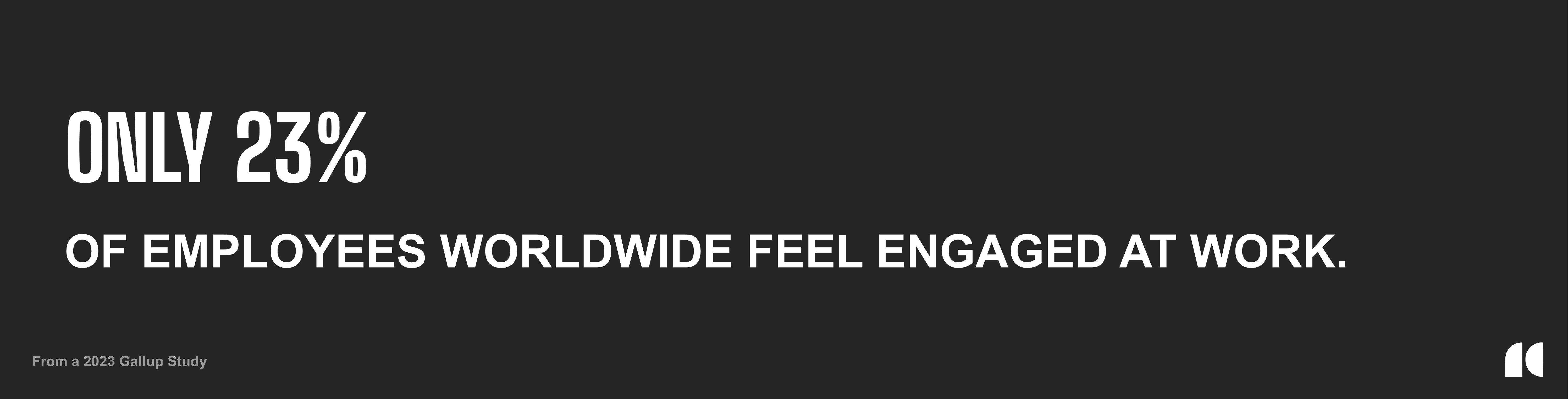
A 2023 Gallup study found that only 23% of employees worldwide feel engaged at work and that engagement, defined here as genuine psychological investment in the outcome, is the single strongest predictor of creative output at the individual level. When people aren't engaged, they produce work that technically fulfills the brief. They're rarely the ones who notice that the brief itself was pointing in the wrong direction.
Beyond engagement, there's the cognitive dimension. When teams are operating in high-friction, low-trust environments and where every decision requires political navigation, the feedback loop is unclear and it's safer to say yes than to push back. A disproportionate share of cognitive energy goes to managing the environment rather than doing the work. Research on cognitive load in creative tasks suggests that this overhead is not trivial: it reliably degrades the quality of creative output, specifically in the areas of originality and coherence.
What this means in practice is that the brands producing the most culturally resonant creative work are not simply the ones with the most talented people. They're the ones where the talented people have enough room to bring what they're actually capable of to the work.
Transformation, the second word in our series, is about building that room. It happens through the small, compounding changes that make the work easier to do well. Picture a collaborative setting with cleaner briefs, shared language, systems that fit how people actually think rather than how they're theoretically supposed to. Each change is incremental. Together, they create the conditions where creativity isn't squeezed into the margins of an overloaded system. It becomes the thing the system is explicitly designed to serve.
What creativity is, actually
I want to be careful here, because “creativity” is a word that gets used to mean a lot of different things. And in the marketing industry specifically, it often gets flattened into something narrower than what it is.
Creativity is not just the visual and verbal output of a campaign. It's not an unexpected headline or an arresting image. Those things can be the product of creativity, but they're not the thing itself.
The thing itself is something more like the capacity to see a problem differently than it's been seen before. To make a connection that wasn't obvious. To find the true thing inside a brief that was pointing at a false one. To know (by instinct or by analysis or by the particular way you've trained your attention over years), what this specific audience actually needs from this specific brand at this specific moment, and to bring that knowledge into the work.
That capacity doesn't live in a single person. It compounds in teams. It grows when people with different disciplines and different ways of seeing are in genuine conversation with each other. It atrophies when people are isolated, when trust is low, when the work is treated as an execution problem rather than a thinking one.
This is why everything Friends Everywhere does is ultimately in service of creativity as the animating force that makes the work worth making.
The close of the trilogy
Integration. Transformation. Creativity.
They're a single argument.
We work inside teams rather than alongside them because that's where the creative conditions are actually built or broken. We make structural changes to how work moves because structure, at its best, liberates rather than constrains. And we do all of it because we believe that creativity—the real kind, the kind that makes work feel true—is worth protecting, worth building around, worth showing up for every day.
That's why we work the way we do. It's the only reason we've ever needed.
No posts
Comments
Nothing yet. Say the first thing.
Sign in to join the conversation.