
The word expert gets thrown around quite often, and it’s used like a credential. Something you earn through roles and titles, years-long career paths that take on a very specific shape. It starts out rather simple. You put in the time, accumulate various roles with levels of seniority, and you have a rolodex of work to point to.
And somewhere along the way, you become someone whose judgment people trust. There’s something true in that. After all, experience and depth does matter. Showing up in hard rooms over time produces a kind of knowing that you can’t shortcut.
But here’s what we’ve learned from building a company that works closely with some of the sharpest creative minds in the industry: expertise, in the creative sense, does not follow that linear path. It shows up in unexpected places, in unexpected people, and in combinations of knowledge and instinct that no LinkedIn profile could predict.
And some of the best creative partners we’ve ever worked with didn’t look like experts on paper at all.
The credential trap
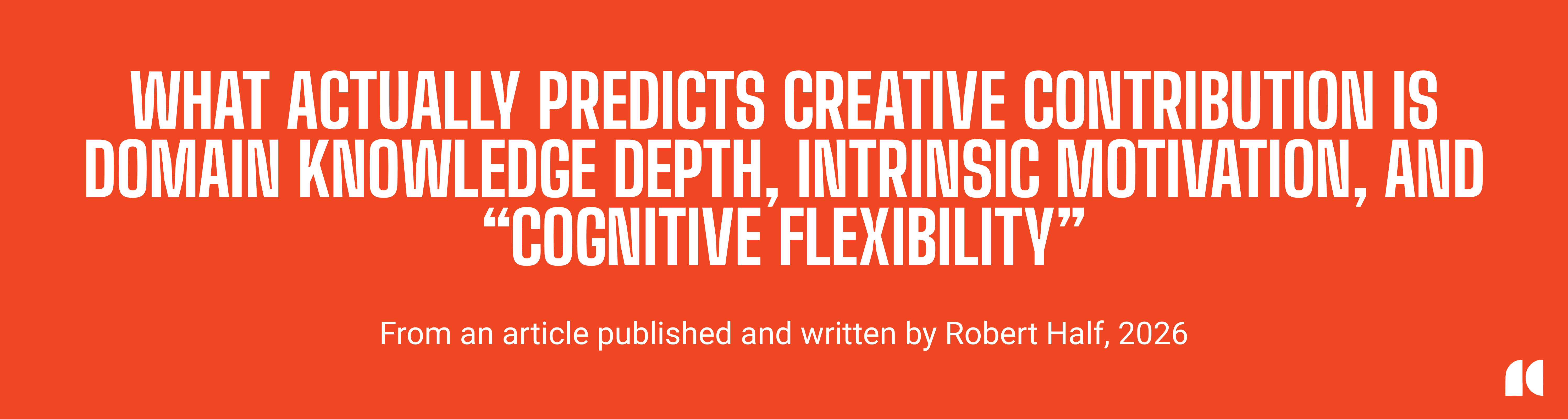
The research on this is subtly uncomfortable for a lot of organizations. A study of hiring decisions at large creative agencies found that senior decision-makers systematically overweight credentials, title history, and institutional affiliations when assessing candidates and that these factors have relatively weak predictive validity for actual creative performance on the job. What better predicts creative contribution is essentially domain knowledge depth, intrinsic motivation, and what researchers call “cognitive flexibility” (aka, the ability to hold multiple framings of a problem simultaneously and shift between them).
Cognitive flexibility, notably, does not correlate strongly with seniority. It correlates with curiosity. With having worked across multiple domains. With having been exposed to problems that don’t have clean solutions. With caring about the craft enough to keep studying it rather than coasting on what you already know. In other words, it correlates with a kind of investment in the work that either exists in a person or doesn’t and that no number of years in a role automatically produces.
What genuine expertise looks like in practice We’ve found, over and over, that the people who bring the most to the work share a handful of qualities that have very little to do with their title or their tenure.
They see problems as systems. When they encounter something that’s not working, their instinct is to map it. Which means to understand the structural reasons behind the symptom before reaching for a solution. They’re suspicious of the first answer because the first answer is usually addressing the visible thing, not the real one.
They have a genuine relationship with the craft because it’s the kind where they’re still reading, still looking, still pulling apart things that interest them to understand how they were built. Expertise that isn’t actively maintained degrades and the people who know this are the ones who keep maintaining it.
They know the limits of their own perspective. This sounds obvious, but it’s rarer than it should be. The most expert people in the rooms I’ve been in are consistently the ones who are most curious about what the other people in the room know and it’s not because they’re performing humility, but because they genuinely believe the answer is more likely to be in the collision of perspectives than in any single one.
And they’re honest about what isn’t working. In the sense of being willing to name the thing the room is trying to avoid, because they care more about the outcome than about the comfort of the meeting.
Friends Everywhere’s actual definition
When we’re deciding whether someone is the right partner for Friends Everywhere, we’re not looking for the resume that follows a certain shape. To be honest, we’re always looking for evidence of the thing itself.
Do they have genuine depth in something? Not necessarily in the thing we need them for but depth in one area tends to generalize. The way you learn to learn, the way you build real understanding of something hard, those habits transfer.
Do they care? Do they think about this problem outside of work hours, not because they’re supposed to but because it won’t leave them alone?
Do they make the work better when they’re in the room? This is the only test that matters, ultimately. Not the credentials, not the title, not the path they took to get here but whether the presence of their thinking elevates what’s being made.
In closing We are drawn to
That’s the only requirement that actually matters. And it turns out it describes a much wider range of people than the conventional definition of “expert” would ever allow.
Who are the people in your creative world whose expertise surprised you? The ones who didn’t look like the typical version of the thing, but turned out to be exactly what the work needed? We’d love to hear about them.
No posts
Comments
Nothing yet. Say the first thing.
Sign in to join the conversation.