
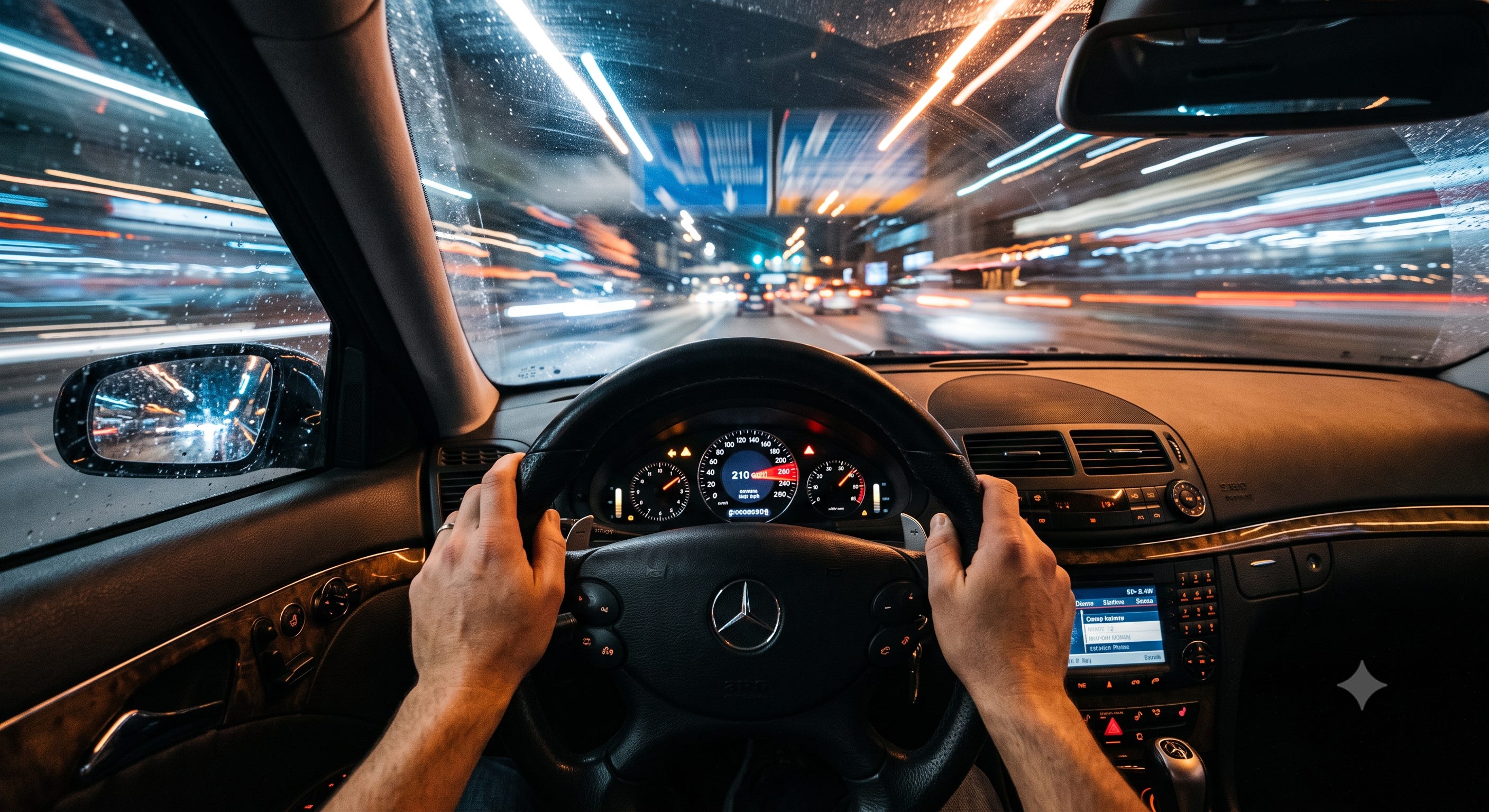
The Speed Limit Changed. Your Car Didn’t.
There’s this interface -- and I keep coming back to this word, interface, because it feels right -- between being free, between chasing what matters to you, and the business of just staying alive. Paying the bills. Managing the logistics. Keeping the lights on. And what I’m noticing is that that interface has become one of the great challenges of our time. Maybe the great challenge.
Here’s what I mean.
We are moving so fast right now that people don’t have time to care for their basic needs. Not really. Not fully. And I’m not talking about food and sleep, although honestly those too. I’m talking about the need to slow down long enough to actually feel something. To be with someone. To let a thought finish before the next one arrives.
And here’s the thing that nobody is talking about. The standard we’re being held to right now is not a human standard.
It’s a machine standard.
Your phone can do seventeen things at once. Your laptop doesn’t need a lunch break. The AI I work with -- and I work with one constantly -- can process information at a speed that I genuinely cannot comprehend. And somewhere along the way, that became the baseline. That became normal. That became the speed limit.
Except nobody told your nervous system.
Nobody told your body that the road had changed. Nobody told your heart that the new minimum was inhuman. You just woke up one day and found yourself driving as fast as you possibly could and still being told you were going slow. Still feeling behind. Still feeling like if you just tried a little harder, managed your time a little better, optimized a little more, you might finally catch up.
You won’t catch up. And I want to say that as kindly as I know how. Not as a defeat. As a relief.
You were not built for this speed. Neither was I. Neither was anyone.
What’s happening to people right now -- the dizziness, the overwhelm, the sense that the center keeps moving just when you think you’ve found it -- that’s not weakness. That’s not a character flaw. That’s a completely sane response to a genuinely insane set of conditions. The road changed. The speed limit changed. And nobody asked whether your car could handle it.
And then there’s the other piece, the one that worries me even more.
Because when you’re moving this fast, you don’t have time for anyone who sees it differently. You don’t have time to sit with someone whose conclusions came from a different life than yours. You don’t have time for the friction that actually produces anything worth having. And so we cancel. We scroll past. We mute. Not because we’ve thought it through -- we haven’t had time to think it through -- but because the pace demands it.
And what we lose in that is everything.
Every real advance I’ve ever seen -- in medicine, in relationships, in the simple project of two people actually understanding each other -- has come from someone being willing to stay in the room with a perspective that made them uncomfortable. Long enough to let it do something. That takes a kind of slowness that the current moment is not offering us.
So what do I want to leave you with?
Just this. Give yourself some compassion. Not because things are easy. They’re not. But because you are driving a human car on a road that was redesigned for machines, and the fact that you are still moving at all -- still showing up, still caring, still trying to connect with the person in the next lane even when you’re both going too fast -- that is not nothing.
That is actually everything.
The road changed. Your car didn’t. And your car, with all its limitations, with all its need for rest and fuel and a moment to just sit in the driveway -- your car is still the only vehicle that was ever built to carry another human being.
Don’t forget that.
No posts
Comments
Nothing yet. Say the first thing.
Sign in to join the conversation.