
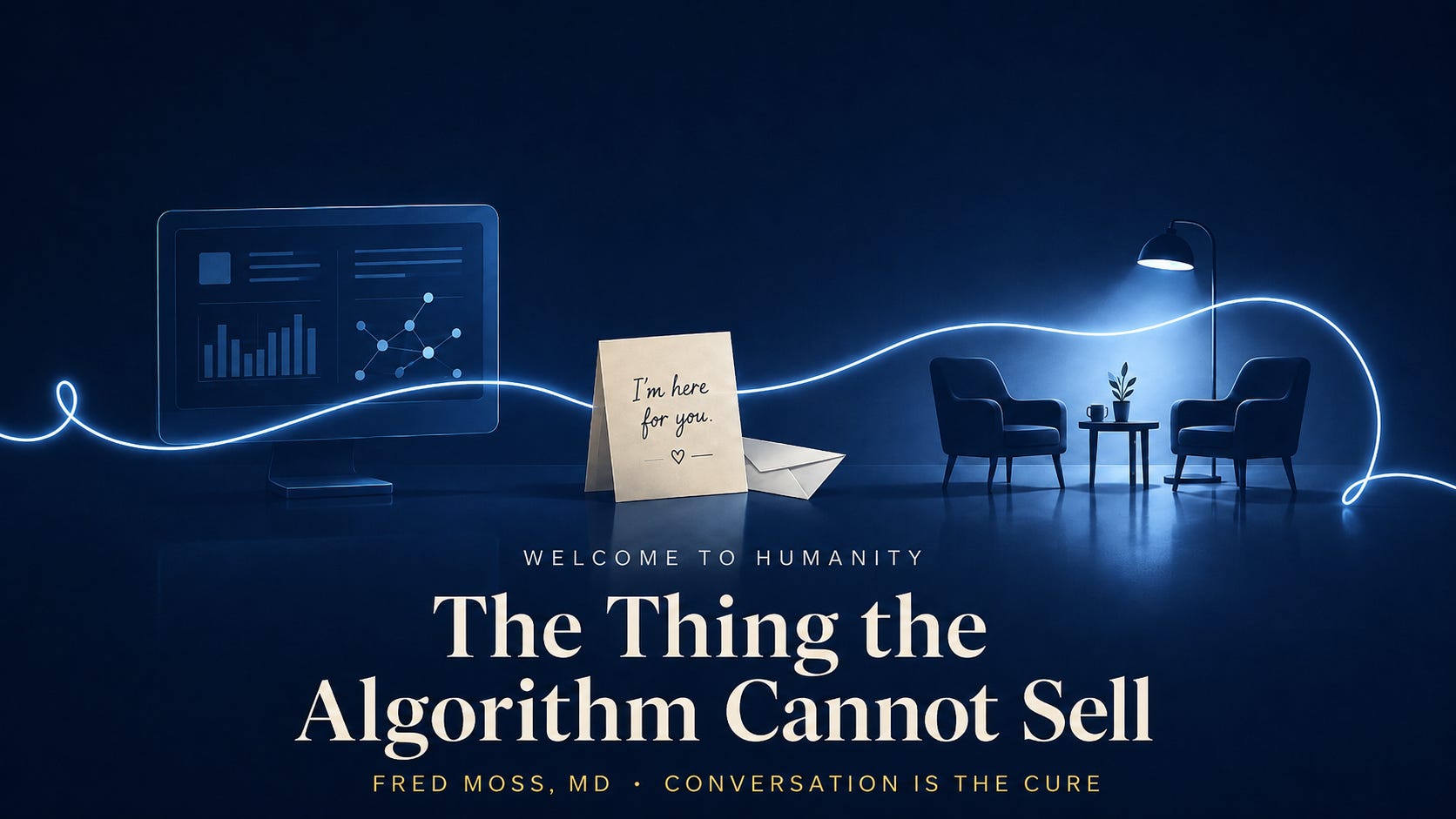
A woman sat across from me recently and cried because ChatGPT had written a sympathy card her sister thought was beautiful.
Her sister had experienced a third miscarriage. The card arrived on nice stock inside a handwritten envelope. The message was careful, compassionate, and perfectly calibrated. It acknowledged the loss without rushing the grief. It offered hope without sounding dismissive.
And she knew.
She could not explain how she knew, but the words did not sound like her sister.
When she called, her sister admitted it. She had not known what to say, so she asked AI for help and copied the response by hand. She thought handwriting it would make it feel more personal.
The woman was not angry.
She was sad.
She said it felt like receiving a hug from a mannequin.
The machine got the language right.
It avoided clichés. It did not tell her that everything happens for a reason. It did not rush her toward acceptance or gratitude. It said exactly what a compassionate person was supposed to say.
But it missed the one thing she needed.
Her sister.
Real people who love us are rarely polished when our hearts are breaking. They stumble. They repeat themselves. They choose the wrong word and try again. Sometimes they say, “I do not know what to say,” because they truly do not know.
That awkwardness is not a failure of communication.
It is evidence that another human being is actually there.
The card contained every appropriate sentiment, but it did not contain the person she needed to feel.
That distinction matters.
I spent 37 years as a psychiatrist and 46 years total in mental health. More than 30,000 patients came through my care.
Over those years, I watched the language people used to describe themselves change.
Today, people often arrive speaking in the language of wellness, trauma, boundaries, regulation, attachment styles, and self-care. They know the vocabulary. They know how healing is supposed to sound and how an emotionally intelligent response is supposed to look.
But sometimes the person underneath the language is missing.
Nobody told them that healing may look like wearing the same hoodie to therapy for six weeks because they are too tired to perform.
Nobody told them that progress may begin with a sentence that comes out badly.
Nobody told them that the moment that changes everything may start with, “I have never told anyone this before, and I do not know how to say it.”
We are becoming very good at creating the appearance of connection.
That is not the same as being met.
The problem is not that algorithms exist.
Algorithms are tools. I use technology every day that did not exist when I began practicing. I am not interested in pretending that every new invention is a threat.
The problem is what we are willing to trade away without naming the exchange.
We are trading specificity for efficiency.
The particular for the scalable.
The unrepeatable moment for the reusable response.
We are asking machines to smooth the rough edges from our language without noticing that the rough edges are often where the person lives.
The hesitation. The strange choice of words. The sentence that has to be started three times. The apology that is not elegant but is real.
Those are not defects in human communication.
They are fingerprints.
Human sovereignty, as I understand it, is the right to remain irreducibly yourself. Messy, unfinished, inarticulate, and recognizable to the people who actually know you.
It is the right not to be optimized out of your own life.
I have seen this exchange before.
The mental health system took human suffering and translated it into diagnosis codes. The codes became treatment algorithms. The algorithms became ten-minute appointments in which a person’s life was reduced to symptoms, medication compliance, and a follow-up date.
A great deal was recorded about people.
Very few people were actually met.
Now we are preparing to make the same mistake again with better technology and a gentler voice.
An AI therapist can remember everything you say. It can respond calmly, structure its answers perfectly, and never become tired or distracted.
It can simulate the appearance of care.
But care is not the flawless delivery of the correct words.
Care is another person allowing your life to affect them.
Care is someone staying when the conversation becomes uncomfortable, repetitive, confusing, or hard.
A machine may imitate the language of that experience.
It cannot become the experience itself.
Connection is the medicine.
I do not mean that as a metaphor. I mean it as a clinical observation from decades of watching what actually changes people.
Healing happens when one human nervous system recognizes another and realizes it is no longer alone.
The algorithm can produce words that sound like love.
It cannot love your sister.
It can tell a grieving person that she is not alone.
It cannot sit beside her.
It can generate the appearance of connection.
It cannot provide the thing connection actually is.
Human sovereignty in the age of artificial intelligence means protecting the parts of life that only work when they remain human.
It means writing the imperfect sympathy card yourself.
It means calling your sister and saying, “I do not know what to say, but I am here.”
It means trusting that your unrehearsed voice has value precisely because no one else could have produced it.
There may be nothing wrong with the part of you that hesitates.
There may be nothing wrong with the part that chooses the imperfect word, corrects itself, or becomes quiet because something true is trying to arrive.
That may be the most human part of you.
And it may be the part another person most needs to meet.
If something in you has been waiting for a room where that kind of conversation can happen, my door is open and the first conversation costs nothing. You can find me at welcometohumanity.net/conversation and we will simply talk.
My book, Welcome to Humanity: A Psychiatrist’s Case Against the Mental Health System, is also available at welcometohumanitybook.com.
There may be nothing wrong with you.
And conversation is the cure.
Welcome to humanity.
Fred
No posts
Comments
Nothing yet. Say the first thing.
Sign in to join the conversation.