
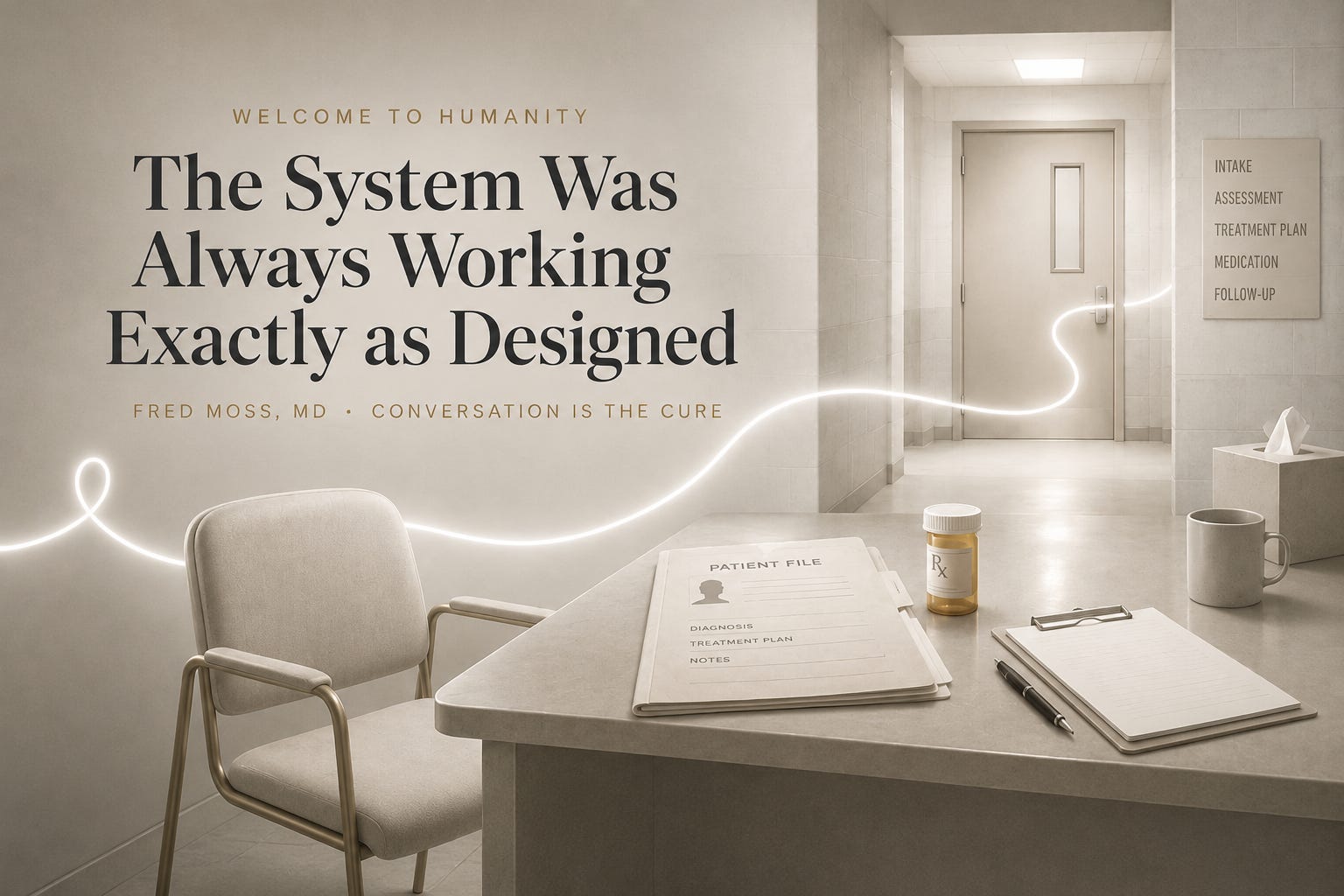
The consultation room was in the basement of the state hospital.
No windows. Fluorescent hum. A woman named Janet sat across from me in 1989, her chart open between us.
Twelve diagnoses. Seventeen medications. Nineteen years in the system.
I asked her what she wanted.
She looked at me like I had spoken a foreign language.
Nobody had asked her that in almost two decades.
People say the mental health system is broken.
After 37 years as a psychiatrist and 46 years total in mental health, I came to see it differently.
The system is remarkably good at doing what it was built to do.
Diagnose quickly. Prescribe efficiently. Document thoroughly. Reduce risk. Stabilize symptoms. Move to the next patient.
Those things have a place.
But management is not the same as healing.
The questions that changed my work were often much simpler.
What happened to you?
What do you want?
What has this experience meant to you?
Who were you before everyone started telling you what was wrong?
Those questions take time. And time is one of the things large systems have the hardest time giving.
Janet received her first diagnosis at nineteen after a breakup and a suicide gesture.
Depression.
Then anxiety.
Then bipolar disorder after a manic response to an antidepressant.
Then schizoaffective disorder after hearing her dead mother’s voice one night in the hospital.
Then borderline personality disorder after becoming angry with a doctor who did not listen to her.
Each diagnosis described something she was experiencing.
But none of them told her story.
She had been sexually abused by her stepfather from age eleven to sixteen. She left home at seventeen. She had little support, little safety, and no language for what had happened to her.
Her suffering did not appear from nowhere.
But somewhere along the way, the diagnoses became the story.
The system had names for what she was doing.
Very few people had stayed long enough to ask why.
The system gave her a diagnosis when what she also needed was a witness.
I have cared for more than 30,000 patients, and I watched this happen over and over.
A diagnosis begins as a description.
Then it becomes an explanation.
Eventually, it can become an identity.
“I have depression” becomes “I am depressed.”
“I was diagnosed with borderline personality disorder” becomes “I am borderline.”
The person slowly disappears behind the terminology.
Medication can help. I prescribed thousands of medications during my career, and there are people whose lives are better because of them.
But a prescription cannot answer every question suffering asks.
Medication is often faster than understanding.
You can write a prescription in minutes.
You cannot understand twenty years of fear, grief, abuse, isolation, resilience, and survival in seven minutes.
That requires something less efficient.
It requires another human being willing to stay.
After Janet’s consultation, I recommended gradually reassessing some of her medications and exploring trauma-focused therapy.
I also wrote something in her chart that changed the way I thought about patients like her.
She was not simply treatment resistant.
She was resisting our response to her.
For years, people had been trying to manage what she was doing without fully understanding what had happened to her.
My attending physician thought I was naive.
He told me I did not understand how the system worked.
In a way, he was right.
I was only beginning to understand it.
And the more I understood it, the harder it became to confuse managing a person with healing one.
There may be nothing wrong with you.
That does not mean you have never suffered. It does not mean symptoms are imaginary, diagnoses are meaningless, or treatment has no value.
It means there may be another question worth asking.
What if some of the things you learned to call symptoms once made sense?
What if they began as responses to something overwhelming?
What if the diagnosis named your suffering but never explained your life?
A human being is more than the worst thing that happened to them.
And a human being is more than the name we gave their response to it.
Healing begins when we become curious about the person underneath the diagnosis.
When someone stays long enough to listen.
When the question changes from “What is wrong with you?”
to “What happened to you, and who are you now?”
Systems need categories.
Human beings need to be known.
Those two things do not have to be enemies. But when the category becomes more important than the person, we have lost the reason the system was supposed to exist in the first place.
If something in you has been waiting for a room where that kind of conversation can happen, my door is open and the first conversation costs nothing.
You can find me at: https://welcometohumanity.net/conversation
My book, Welcome to Humanity: A Psychiatrist’s Memoir and Case Against the Mental Health System, goes deeper into what I learned after decades inside psychiatry and why I came to believe we need a more human way of understanding suffering.
https://welcometohumanitybook.com
There may be nothing wrong with you.
And conversation is the cure.
Welcome to humanity.
Fred
No posts
Comments
Nothing yet. Say the first thing.
Sign in to join the conversation.