
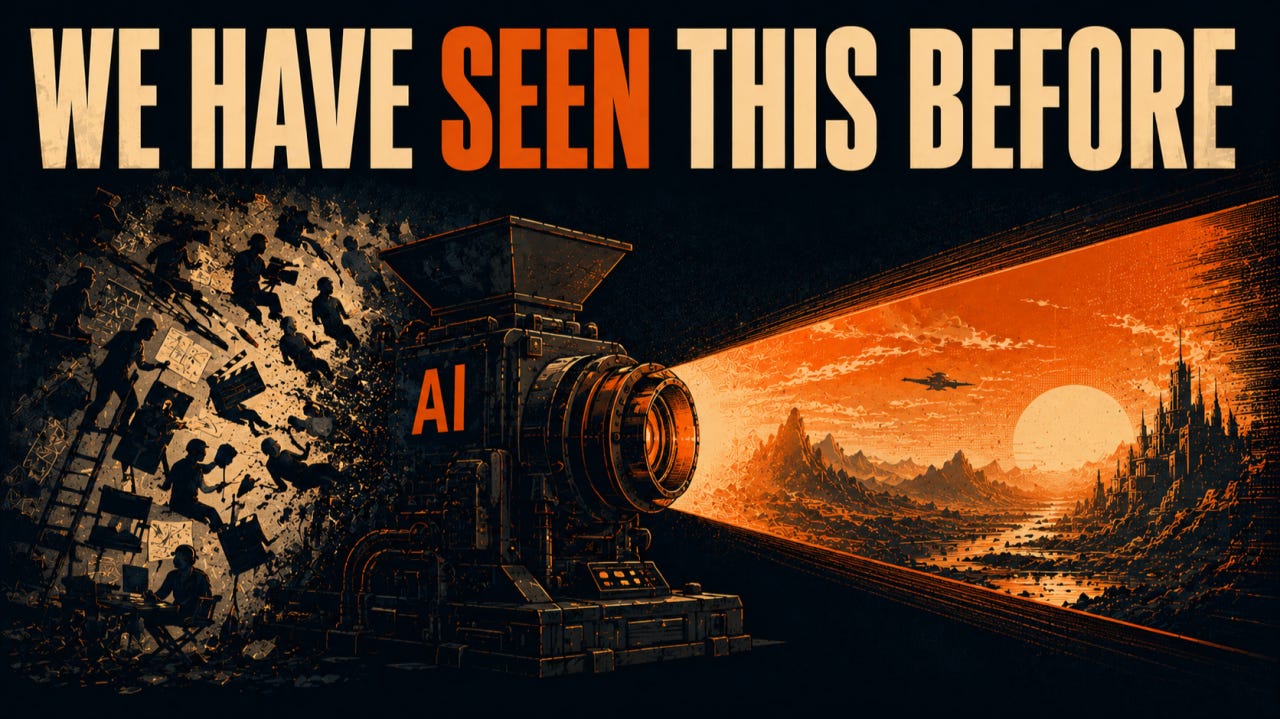
The first mistake is believing the miracle.
Not because the miracle is fake. That would be too easy, and cinema has never been easy. The miracle is usually real. Digital filmmaking really did enlarge the image. It gave filmmakers worlds that could not be built, creatures that could not be photographed, disasters that could not be staged, bodies that could not perform, landscapes that could not exist, and forms of control that earlier generations could only approach with miniatures, glass, paint, optical tricks, patience, and nerve. Artificial intelligence will do the same in its own way, and anyone pretending otherwise is not defending cinema. They are defending denial.
The danger begins when the miracle stops being a miracle and becomes an expectation.
That is the pattern cinema keeps failing to recognize. Every cinematic revolution begins as permission and ends as pressure. At first, the new tool allows the filmmaker to imagine more. Soon after, it allows the producer to demand more, the client to expect more, the budget to assume more, and the schedule to compress more. What enters the room as creative expansion rarely stays there untouched, because cinema does not absorb technology inside a clean artistic space. It absorbs technology through financing, deadlines, hierarchy, fear, ambition, ownership, labor, credit, and the permanent hunger of production culture for the same old miracle: more image, less time, lower cost, fewer complications.
That is where the romance ends.
The AI debate often feels weightless because it keeps circling the wrong question. Can the machine make an image? Of course it can. It can already produce images seductive enough to impress people who mistake surface for meaning. It can generate variations faster than a room full of exhausted artists can explain why one of them matters. It can imitate mood, texture, lighting, genre, nostalgia, prestige, vulgarity, and taste signals with alarming fluency. But the image is not the deepest issue. The deeper issue is what happens when this capacity enters an industry that has already trained itself to confuse visible output with value and invisible labor with cost.
AI is not dangerous because it creates images. AI is dangerous because it makes the old industrial fantasy of cinema executable: more image, less friction, fewer people, cleaner mythology.
We have seen this before.
Digital filmmaking did not simply expand creativity. It reorganized the conditions under which creativity was allowed to exist. It shifted authority, altered workflows, changed the timing of decisions, transformed departments, created new crafts, weakened old ones, opened doors, closed others, and turned many forms of specialist knowledge into something that first had to be defended before it could be respected. This is not nostalgia for vanished methods. Cinema has always changed. The problem is not change. The problem is that the industry repeatedly describes change as liberation while managing it as extraction.
AI is the old story with the waiting time removed.
Earlier revolutions still contained friction. They required machines, facilities, trained operators, software knowledge, production infrastructure, supervision, integration, rendering time, and enough visible complexity to remind everyone that the image had a body behind it. AI compresses that distance. A person asks, a machine answers, an image appears, and the difficult ecology of craft begins to look optional to those who never understood it in the first place.
But cinema was never only the image that appeared at the end. Cinema was always the pressure of choices that led there. It was what was selected, rejected, delayed, protected, misunderstood, rescued, rewritten, reframed, lit, cut, painted, tracked, designed, performed, financed, argued over, hidden, revealed, and finally carried into the dark with enough force to become experience. The final frame is not the work. It is the residue of the work. When we forget that, we do not make cinema more modern. We make it easier to replace with something that looks convincing enough from a distance.
This is where the sentence “AI is just another tool” collapses under its own laziness. A tool in isolation may be neutral, but a tool inside an industrial system is never neutral. It becomes leverage. It becomes a budget assumption. It becomes a staffing decision. It becomes a schedule argument. It becomes a reason to call later, pay less, hire fewer people, skip the conversation, bypass the apprenticeship, flatten the difference between exploration and execution, and pretend that faster output is the same as better filmmaking. The tool may not have intentions, but the system around it certainly does.
And the system has been very clear about what it wants.
AI will not begin by replacing the mythic genius. It will begin by weakening the conditions that allowed the mythic genius to appear larger than life. It will enter through the underprotected zones: the assistant task, the junior pass, the cleanup work, the background element, the first visual sketch, the temp voice, the reference board, the localization draft, the production document, the rough idea that nobody calls authorship until it disappears. It will not start by destroying the cathedral. It will start by removing the scaffolding and then praise the cathedral for standing on its own.
That is the oldest trick in the production book. Sell the film through icons, build it through systems, remember the icons, forget the systems. The director becomes vision. The actor becomes emotion. The studio becomes power. The platform becomes future. Meanwhile, the people who translated uncertainty into images, who made chaos legible, who turned intention into something that could survive a deadline, who solved the problems nobody wanted to admit existed, vanish into the smoothness of the result.
AI does not invent that erasure. It gives it a faster interface.
And once erasure becomes efficient, it becomes very hard to reverse.
The most frightening future is not one in which AI makes bad films. That would almost be comforting, because failure is easy to recognize. The more frightening future is one in which AI helps produce films, series, trailers, concepts, campaigns, and synthetic images that are good enough to keep the machinery moving while the culture behind them becomes thinner. The stream continues. The images improve. The marketing works. The panels fill up. The awards adapt. The platforms announce new creative opportunities. And beneath the surface, the ecology that teaches people how to see, judge, refine, collaborate, fail, recover, and become artists is quietly hollowed out.
A system can become less human while still producing spectacle.
That is the sentence the industry does not want to sit with, because it ruins the comfortable version of progress. It ruins the story in which every displaced craft becomes a chance to reskill, every broken ladder becomes a doorway, every concern becomes fear of the future, and every new efficiency somehow produces more freedom for everyone. Sometimes new technologies do create new professions. That is true. But truth becomes anesthesia when it is used to avoid the rest of the truth. New opportunities do not automatically compensate for destroyed pathways, lost knowledge, weakened labor, opaque authorship, and the disappearance of the modest work where people once learned how production actually functions.
The industry loves talent once talent is profitable. The harder test is whether it protects the conditions that allow talent to emerge.
Those conditions are not decorative. They live in junior work, repetition, correction, failed attempts, production discipline, and the slow formation of taste under pressure. They live in the moment someone learns why a bad brief damages a shot, why a late decision poisons a department, why a small continuity error becomes a sequence problem, why a director reads an unfinished image differently from a supervisor, why a producer’s abstract promise becomes someone else’s weekend. Remove those experiences in the name of efficiency, and the industry may still receive outputs, but it will lose people who understand how cinema is actually made.
That is why AI is a cinema question in disguise. If process becomes invisible, fewer people can defend the value of process. If authorship becomes harder to trace, credit becomes easier to manipulate. If human work is absorbed at scale without visible ancestry, the machine does not simply generate images. It launders cultural memory. It presents the result as clean, immediate, and mysteriously self born, as if no one had built the visual language it now speaks.
Cinema without memory is not cinema. It is content with amnesia.
The real danger is not that AI will attack cinema from the outside. The real danger is that cinema will recognize the old pattern, call it innovation anyway, and once again confuse the expansion of the image with the shrinking of responsibility. It will celebrate new powers without asking who loses leverage. It will praise speed without asking what kinds of thought require slowness. It will applaud access while ignoring dependency. It will speak about democratization while the most powerful platforms own the models, the infrastructure, the distribution, the data, and eventually the terms under which imagination is allowed to scale.
We should know better by now.
Digital filmmaking already taught us that wonder and damage can coexist. It taught us that masterpieces can emerge from unstable labor structures. It taught us that images can become richer while the people behind them become easier to overlook. It taught us that every new production technology writes two histories at once: the public history of what became possible, and the quieter history of what became disposable.
AI is simply writing both histories faster.
So the question is no longer whether AI belongs in filmmaking. That argument is already behind us, whether we like it or not. Serious filmmakers will use it. Serious artists will test it. Serious production teams will integrate it where it serves the work. The question is whether cinema will remain serious enough to understand what must not be surrendered just because a machine makes surrender convenient.
Craft is not nostalgia. Labor is not friction. Authorship is not branding. Training is not inefficiency. Memory is not decoration. Responsibility is not an outdated romantic burden from a slower age.
Cinema has never been saved by tools alone. It has been saved by people who understood what the tools were for, what they were not for, and what should never be sacrificed merely because the sacrifice became technically possible.
That is the line AI forces us to draw.
Not between human and machine, because that line is too simple for the world we are already entering. The real line is between cinema as organized human intention and cinema as automated visual output. One can use technology and remain cinema. The other can produce endless images and still have nothing to say.
We have seen this before, but recognition alone is not wisdom. Wisdom would mean refusing the comforting mythology that every revolution is innocent until proven otherwise. Wisdom would mean admitting that the future is not built only by what a technology can do, but by what an industry allows it to excuse. Wisdom would mean remembering that a cheaper image does not cancel the hidden bill. It only moves that bill to the people, histories, skills, and responsibilities the industry has decided not to count.
The first tragedy was that cinema believed the digital miracle before it understood the machinery behind it.
The second would be watching AI rebuild that machinery at industrial speed, while the industry applauds the beauty of the images and calls the disappearance of responsibility progress.
Keine Posts
Comments
Nothing yet. Say the first thing.
Sign in to join the conversation.