
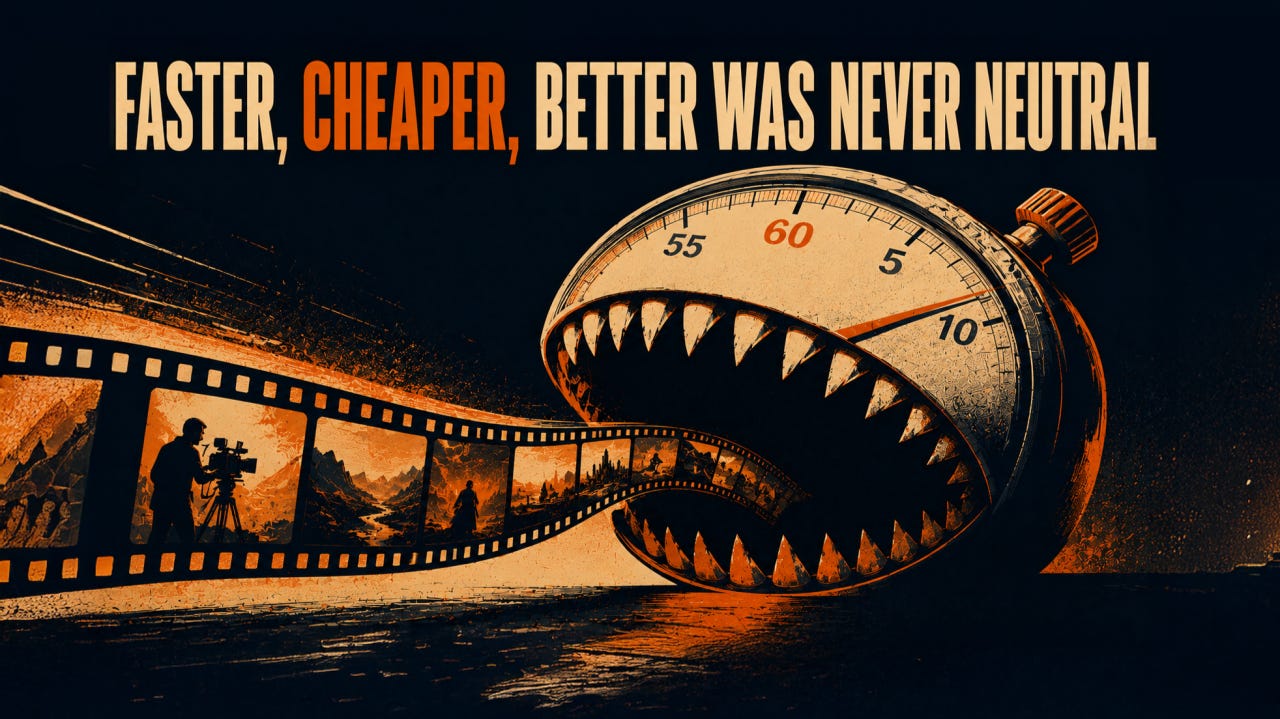
Nobody objects when the sentence enters the room.
Can we do it faster, cheaper, better?
It sounds too reasonable to resist. Faster means professional. Cheaper means responsible. Better means ambitious. Before anyone has examined what the sentence actually demands, it has already made resistance look childish, inefficient, expensive, sentimental, or afraid of progress. That is its power. It does not arrive as ideology. It arrives as common sense.
And common sense is where production pressure hides when it no longer wants to explain itself.
Cinema has heard this sentence at every technological threshold. Digital visual effects heard it when impossible images became manufacturable at scale. Real time engines heard it when worlds could be explored before they were finished. Virtual production heard it when locations, light, camera, and environment could be pulled into the same controlled space. Artificial intelligence is hearing it now with the force of a commandment. Each technology enters through the front door speaking the language of imagination, access, freedom, and expanded possibility. It promises filmmakers that they can escape the old limits of weather, travel, physics, danger, scale, time, budget, and the stubborn resistance of reality itself.
And the promise is not false. That is why it works.
A false promise can be dismissed. A real promise can be absorbed, financed, standardized, weaponized, and eventually turned into a production expectation. Digital visual effects really did expand what cinema could show. Real time engines really did change how quickly a world could be tested. Virtual production really can alter the relationship between performance, camera, environment, and light. AI really can accelerate ideation, variation, drafting, reference generation, synthetic performance, localization, editing support, and visual exploration. Only a fool would deny the creative power of these tools.
But only a child would believe that creative power remains pure once it enters the production economy.
Film technology is usually sold through creative language and adopted through economic pressure. The demo speaks about possibility. The panel speaks about innovation. The marketing video speaks about liberation. Then the tool enters the budget meeting, and the language changes. Can this reduce cost? Can this reduce time? Can this reduce labor? Can this reduce travel? Can this reduce uncertainty? Can this reduce negotiation? Can this reduce the number of people who need to be consulted, paid, credited, waited for, or argued with?
That is where the miracle enters accounting.
And once a miracle enters accounting, it rarely remains a miracle. It becomes a number, then an assumption, then a demand, then the new moral climate of the production. The same ambition should now cost less. The same complexity should now move faster. The same visual standard should now require fewer people. The same uncertainty should now be absorbed without complaint, because the tool was sold as a solution and nobody wants to admit that the solution has merely moved the problem somewhere else.
That movement is the part everyone prefers not to see. Pressure rarely disappears. It travels. It moves from location to prep, from prep to post, from decision to revision, from producer to supervisor, from supervisor to artist, from the people who asked for more freedom to the people who must make that freedom executable under conditions nobody bothered to protect. The technology may expand imagination, but the system quickly asks how much of the human structure around that imagination can now be compressed.
Faster, cheaper, better is not a creative philosophy. It is a production demand. It does not begin by asking what kind of film is being made, what kind of attention it requires, what kind of preparation protects it, or what kind of difficulty gives it meaning. It begins by asking what can be optimized.
That distinction is everything.
Cinema is not only made of images. Cinema is made of decisions, trust, timing, judgment, collaboration, preparation, interpretation, taste, responsibility, and the slow alignment of people who often begin the process by imagining different films. Technology can make an image easier to produce. It cannot make meaning easier to achieve. It can reduce one kind of friction while increasing another. It can remove a logistical obstacle while creating a creative debt. It can make the visible result arrive sooner while leaving the invisible work of choosing, shaping, defending, and understanding the image untouched.
This is where the industry keeps fooling itself. It sees a tool that reduces friction in one place and assumes the whole process has become simpler. A virtual set reduces location complexity, so control is assumed. A real time workflow allows faster iteration, so later decisions are excused. AI produces visual options in seconds, so thinking is treated as cheaper. But the friction has not vanished. It has simply lost its original address.
Virtual production shows this with brutal clarity. It can offer extraordinary control, but that control is not created on the day the camera rolls. It is purchased through preparation, asset readiness, testing, calibration, art direction, technical supervision, camera planning, and decisions that have to become real earlier than many productions are culturally prepared to accept. If a production treats the LED stage as a magic room rather than a consequence machine, it does not gain control. It merely relocates chaos into a more expensive environment and gives that chaos a cleaner surface.
AI intensifies the same pattern because it compresses the distance between desire and output until the difficult ecology of craft starts to look optional to those who never understood it in the first place. A person asks, the system responds, the image appears, and the old difficulty of making something visible seems to collapse. This can be useful. It can be powerful. It can open doors. But speed has a shadow. When images arrive faster, the demand for images accelerates as well. When options become cheap, commitment becomes easier to postpone. When iteration feels endless, judgment begins to look unnecessarily severe.
What starts as creative abundance becomes a factory for delayed responsibility.
Nobody has to commit too early. Nobody has to defend a choice too clearly. Nobody has to say, this is the film, this is the world, this is the emotional direction, this is the image we now protect. Instead, the system circulates options, moods, references, decks, drafts, variations, temporary promises, and synthetic possibilities until the real decision arrives too late and lands on the people least able to absorb it.
The machine did not create that behavior. It merely made the behavior more efficient.
This is why faster is never neutral. Speed always belongs to someone before it burdens someone else. Faster for the executive waiting for a presentation is not the same as faster for the department inheriting an unclear decision. Faster for the producer who wants the illusion of progress is not the same as faster for the artist who must repair the consequences of that illusion. Faster for the director exploring tone is not the same as faster for the team that receives less preparation because everyone assumes technology will rescue the missing thinking later.
Cheaper follows the same path. It can mean a genuinely smarter workflow, less waste, better planning, more intelligent use of assets, and more accessible production. It can also mean that the invoice has simply been moved into unpaid preparation, downstream repair, licensing dependency, burnout, legal uncertainty, weakened training, invisible labor, or future reliance on platforms that will own the infrastructure once everyone has adapted to them. Cinema has a long habit of calling something cheaper when the cost has merely traveled to a place where fewer people are allowed to see it.
Better is the most seductive word of the three, because nobody wants worse cinema. But in the wrong room, better quietly mutates into more polished, more familiar, more adjustable, more marketable, more impressive in a demo, and more acceptable to the people approving the money. Faster and cheaper can be tracked. Better becomes negotiable. The spreadsheet understands time and money long before it understands emotional consequence.
That is how a film can become more efficient and less alive at the same time.
A tool that makes certain images easier can seduce an industry into believing that cinema itself has become easier. But cinema is not difficult only because images are hard to produce. Cinema is difficult because story is difficult, taste is difficult, collaboration is difficult, trust is difficult, and meaning is difficult. The hard part is not always making something visible. The hard part is knowing why it should be visible, what it should withhold, how it should feel, when it should arrive, and what human pressure it is supposed to carry.
No technology removes that burden. It can only make the evasion of that burden look more professional.
That is why the current AI moment cannot be reduced to a theatrical argument between artists and machines. The deeper conflict is between cinema as a culture of judgment and cinema as a culture of output. AI is powerful because it can produce output at scale. Cinema survives only when output is disciplined by judgment. The danger is not that AI gives filmmakers more options. The danger is that the industry mistakes more options for better decisions. The danger is not that AI makes images easier. The danger is that the business side mistakes easier image production for easier cinema.
Once that mistake takes hold, the artist is no longer asked to make a film. The artist is asked to manage abundance. More images. More versions. More options. More motion. Less commitment. The system keeps producing visible activity while the difficult act of choosing is postponed until choice itself begins to feel like obstruction.
But cinema is not saved by abundance.
It is saved by refusal.
By the cut that removes what is impressive but false. By the frame that excludes what weakens the thought. By the decision that protects an imperfect human moment against a thousand smoother alternatives. By the discipline to know that not every possible image deserves to exist, and not every efficient image deserves to survive.
If everything can be produced, the central creative question becomes harsher, not easier.
What are we still willing to choose?
Faster, cheaper, better cannot answer that question. It belongs to the language of optimization, not the language of art. It can improve logistics, reduce waste, remove certain risks, and open certain doors. But it cannot tell us what a film is for. It cannot tell us when a scene is true. It cannot tell us which difficulty should be removed and which difficulty must be protected because the meaning lives inside it.
That distinction is the adult conversation the industry keeps trying to avoid. A mature production culture knows that some friction is waste and some friction is craft, that some slowness is incompetence and some slowness is thought, that some cost is bad planning and some cost is the price of doing the work properly. An immature one calls everything friction and then wonders why the result feels empty.
This is where Augmented Cinema has to become a discipline of consequences. Not against technology. Not nostalgic. Not afraid of change. But unwilling to let every new capability be translated immediately into pressure without asking what kind of cinema that pressure produces.
The right kind of difficulty is not the enemy of cinema. It is often where cinema begins.
Faster, cheaper, better was never neutral. It was always a sentence about power pretending to be a sentence about progress. It asks what can be removed before it asks what must be protected. It celebrates the visible gain before it counts the hidden bill. It loves the miracle, but it does not care much for the machinery of people, decisions, disciplines, and responsibilities that make the miracle meaningful.
The next wave of film technology will not fail because the images look cheap. That would be too easy to notice. It will fail more quietly if everyone agrees that the images look expensive enough, the workflow looks efficient enough, the turnaround looks fast enough, and the budget looks disciplined enough, while the film itself has lost the time, friction, judgment, and human pressure that would have made the image matter.
That is how cinema is weakened now. Not by bad tools, and not by bad images, but by good images produced inside a system that has forgotten why they should exist.
Faster, cheaper, better becomes dangerous at exactly the moment it stops sounding like a question and becomes the moral weather of the room.
Because once that happens, nobody has to argue against cinema anymore.
They only have to optimize it until there is nothing left but the image.
Keine Posts
Comments
Nothing yet. Say the first thing.
Sign in to join the conversation.