
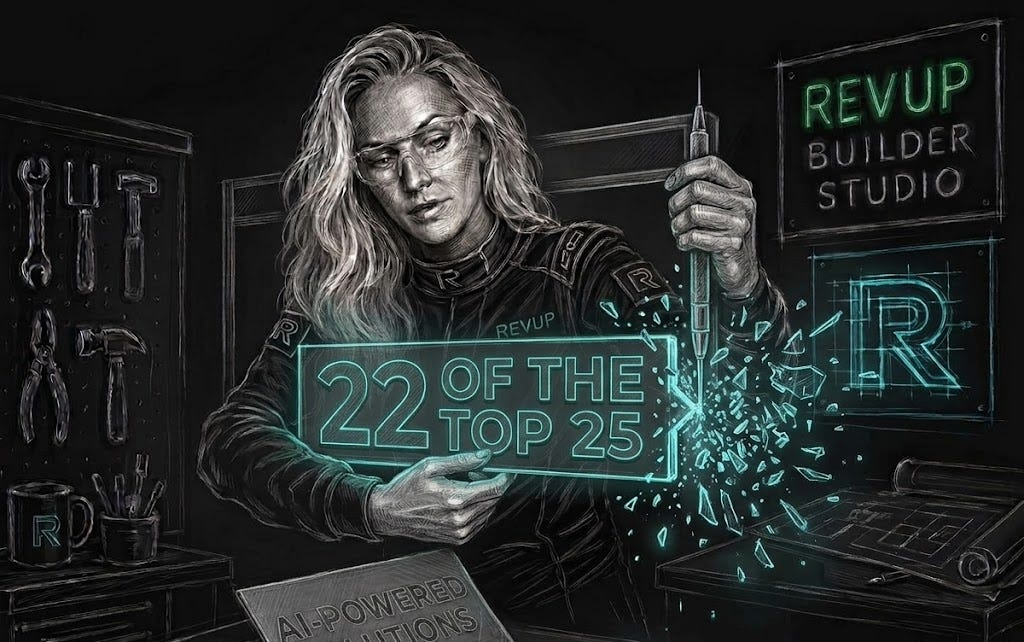
Over the past year I walked the expo floors of five insurance industry conferences: InsurTech Insights in New York, the AAIS Main Event, Target Markets, Insurance Innovators USA, and InsurTech NY. At every one, I collected what companies put in front of buyers. Booth walls, banner stands, demo screens, one-pagers, brochures, and whitepapers.
No report you can buy contains this data.
I have been on both sides of the booth in my career. I spent years inside insurance organizations building the things the industry had never seen: the first mobile storm tracker, a homeowners app that hit 100,000 downloads in four days, FNOL voice AI before anyone called it agentic. I have stood in a ten-by-ten with a banner behind me, and I have walked the halls as the buyer everyone’s banner was supposedly designed to attract.
Here is what I kept noticing this year, show after show. The floor got more polished and less believable at the same time. The words converged until whole aisles said roughly the same sentence.
One fact from the audit is what made me stop to write this article: not one booth wall paired a named customer with a quantified result. Not one. The single most persuasive thing a company can display, evidence that a real buyer got a real outcome, appeared on exactly zero of 130 booth surfaces.
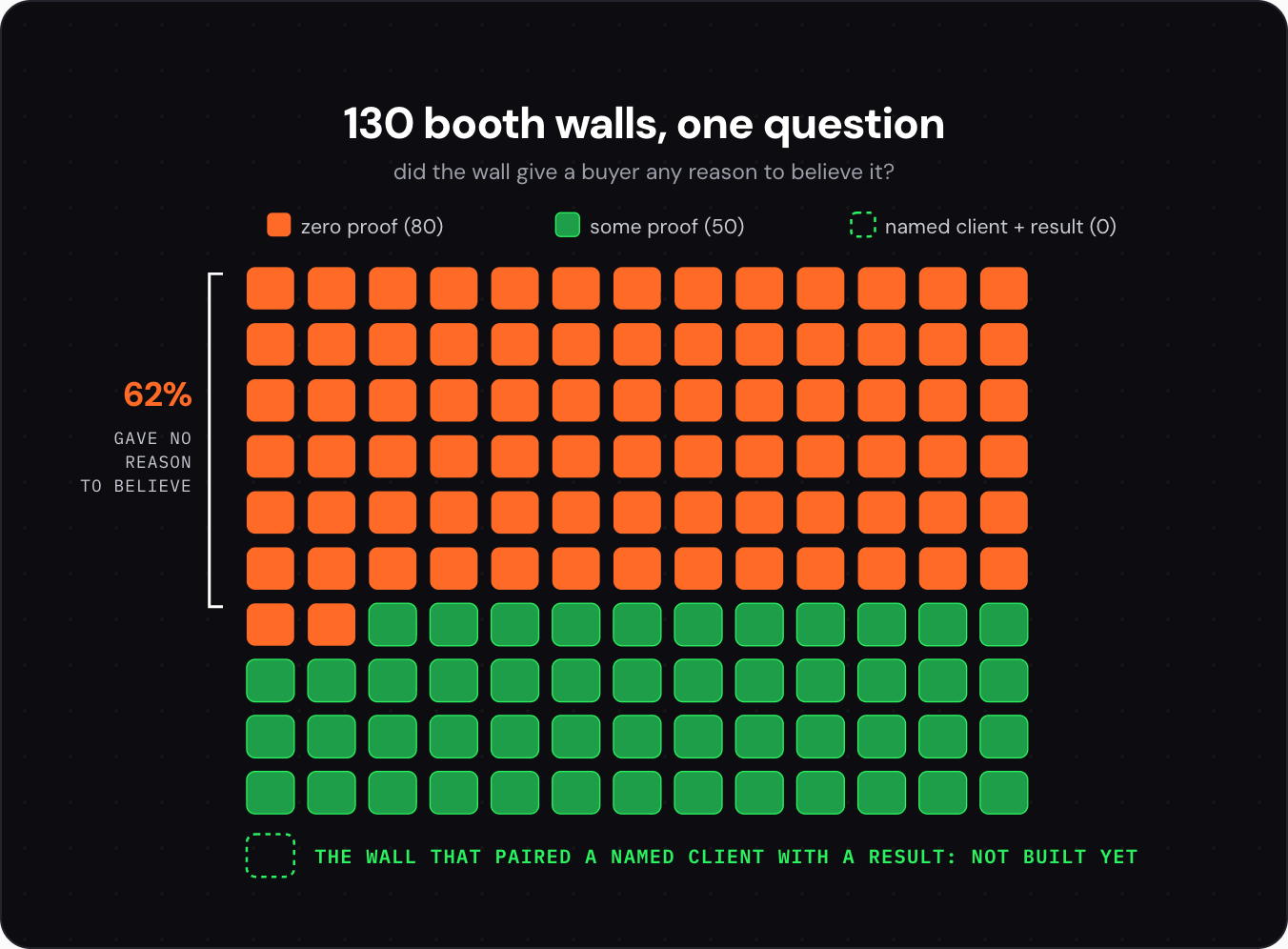
That is the believability gap.
It is also the opportunity, because the bar for standing out is mechanically cheap to clear. Name your buyer. Put one falsifiable number in headline type. Show the product doing its job. Give people a next step smaller than a demo. Almost nobody does all four.
The conventional wisdom says a strong booth needs a clean design, a confident tagline, and the logo big enough to see from the aisle. The floor shows something different. The positioning converged into a handful of interchangeable sentences.
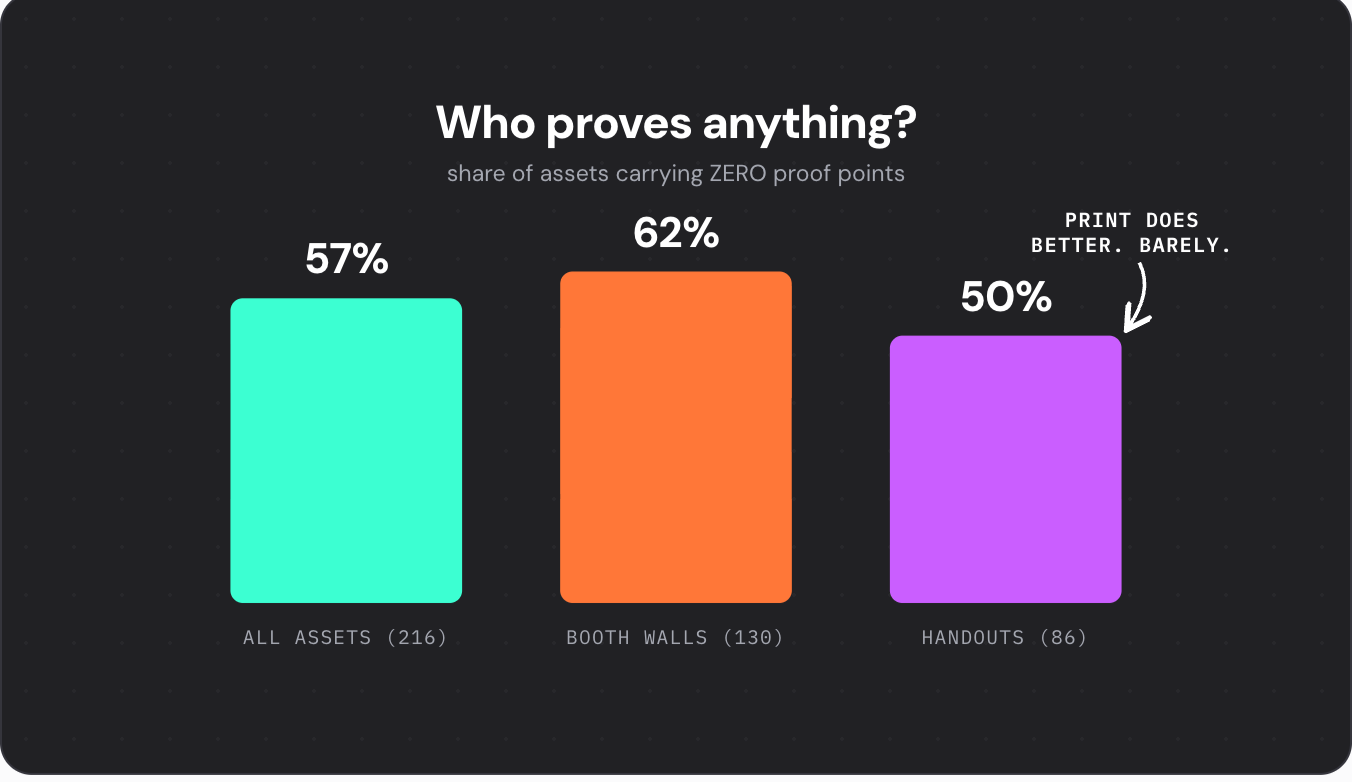
57% of all assets carry zero proof. No number tied to a result, no client name, no third-party validation. On booth walls specifically it is 62%.
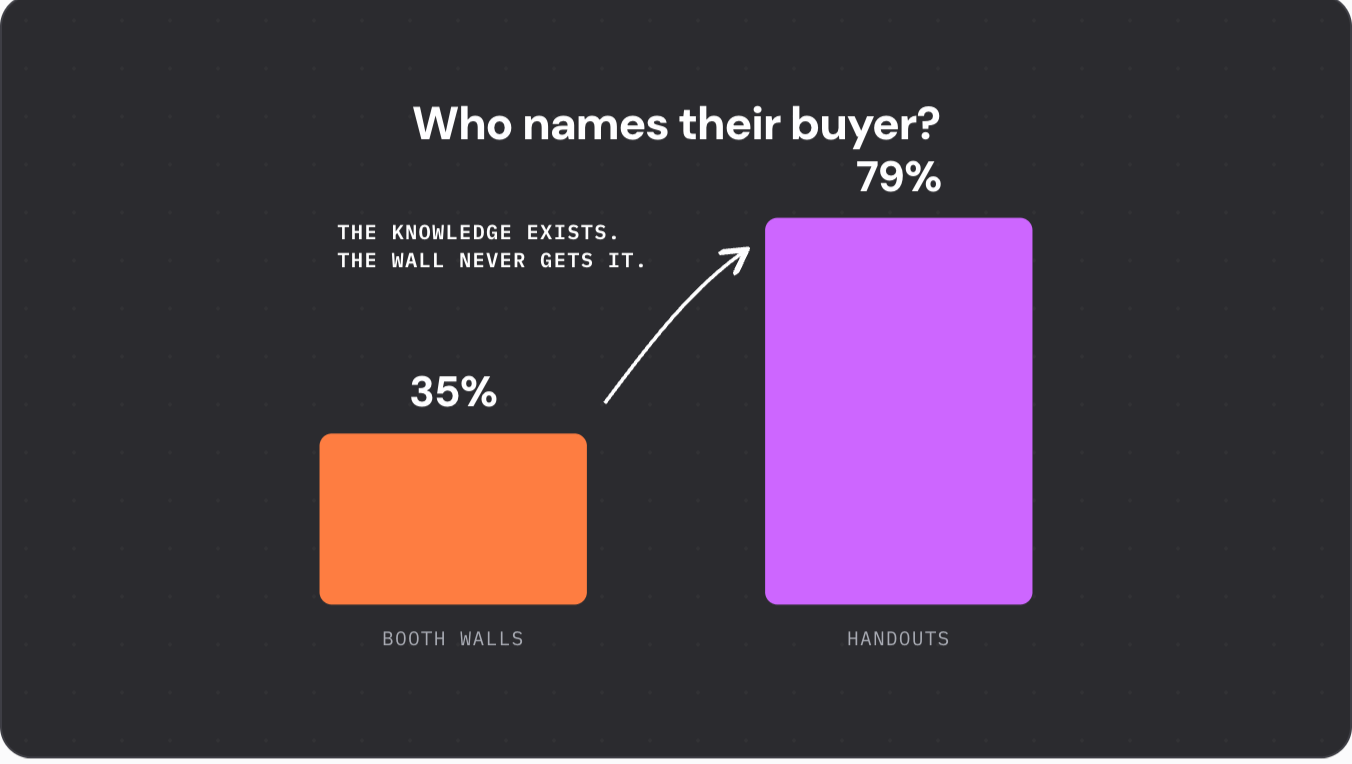
Only 35% of booth walls name their buyer. Handouts do better at 79%, which means most companies know who they serve and leave it off the one surface everyone sees.
41% of booths lead with an AI claim as their headline or identity. On one event floor map, eight or more exhibitors had AI in the company name itself.
Around 5% of the corpus pairs a named customer with a quantified result. Zero booth walls do. Every instance lives in a printed handout.
About 30% of booth assets offered no call to action of any kind. No QR, no URL, no offer, no reason to do anything after walking past.
Then there is the operational layer. 13 booths ran prize raffles as their lead capture: MacBooks, gift cards, coolers, steaks. A raffle collects badge scans from people who want a cooler. 8 booths had dead or no-signal demo screens, including an AI vendor whose television displayed a “looking for signal” message all day. 6 booths had primary surfaces that were logo-only or entirely blank.
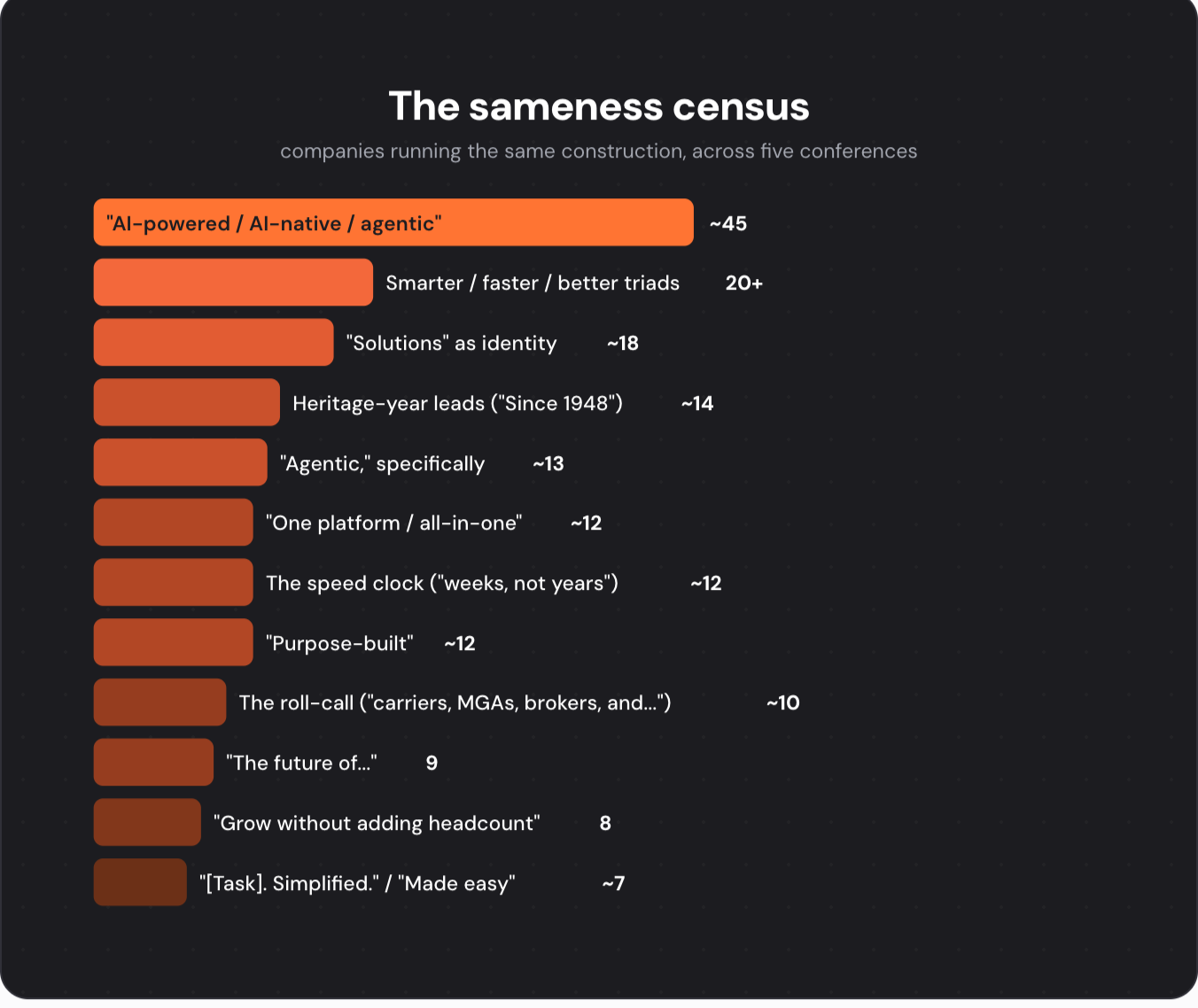
The audit tracked exact phrases and constructions that appeared on materials from two or more different companies. “AI-powered,” “AI-native,” “agentic,” and “powered by AI” showed up across roughly 45 companies. Smarter-faster-better comparatives and triads: 20 or more. “Solutions” as identity: about 18. “One platform”: about 12, four of them within fifty feet of each other at one show. The speed clock, “in weeks, not years”: about 12. “Purpose-built”: about 12.
At one show, two wellness platforms fifty feet apart both led with a phone mockup showing a wellness score: one said 80, the other said 85%. A buyer walking that aisle could not attribute either screenshot an hour later. And in one tote bag, two direct competitors both displayed the same analyst badge from the same research firm, each claiming leadership on the same matrix.
The floor retired the 2019 vocabulary. Synergy, frictionless, and one-stop have vanished. They were replaced wholesale by “AI,” “platform,” “purpose-built,” and “for MGAs,” and every one of the replacements has already crossed from differentiation into sameness.
What is scarce on the 2026 expo floor: a number a buyer can repeat, a named client, and a point of view. That is the whole game.
There are nine failure patterns from the 130 booth assets.
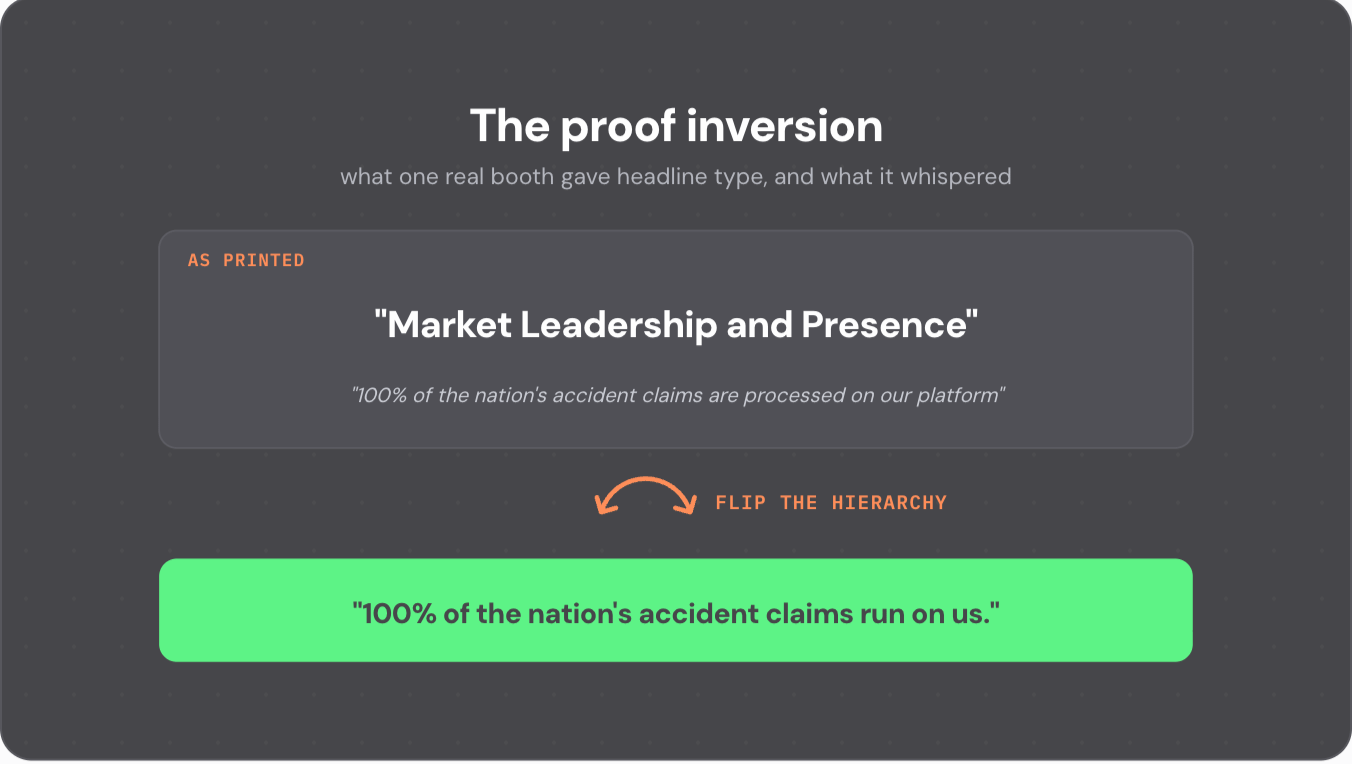
Proof inversion. The floor-wide rule the audit kept confirming: the more provable the statement, the smaller it was printed. A core-platform vendor set “100% of a nation’s accident claims are processed on our platform” in footnote-size stat type underneath a vague header about market leadership. One large operations firm printed a directionless elevation tagline as its headline while its own collateral, lower down and smaller, contained “96% client retention for over 10 years.” The headline belongs to fifty companies. The buried number belongs to exactly one. This happens because marketing treats numbers as supporting detail and brand voice as the lead. On an expo floor that instinct is exactly backwards.
AI as the noun. “Meet the AI intelligence platform.” “Enterprise AI agents.” When 41% of booths lead with the technology label, the label is aisle signage, and it invites the discount rate of a buyer class that has learned to screen for AI-washing. The tell inside this pattern: The real wedge is always somewhere smaller. One claims-analytics vendor’s wall said “AI” twice at headline scale while its genuinely differentiated line, detecting suspicious claims with precision, sat in 20-point column text. The fix is to attach the AI to a P&L line with a unit. “We flag the suspicious 3% of claims before they cost you” out-positions every AI headline in the hall.
Trust words as proof. “Trusted partner.” “Proven partner.” “The leading firm for MGAs.” Superlatives are free to print, and buyers price them accordingly. The audit even caught two vendors in the same tote bag each claiming to be the only one of their kind, a collision that costs both of them. Convert every trust word to its count. “Trusted” becomes “22 of the top 25 P&C carriers.” If you cannot attach the count, the word is not yours to use.
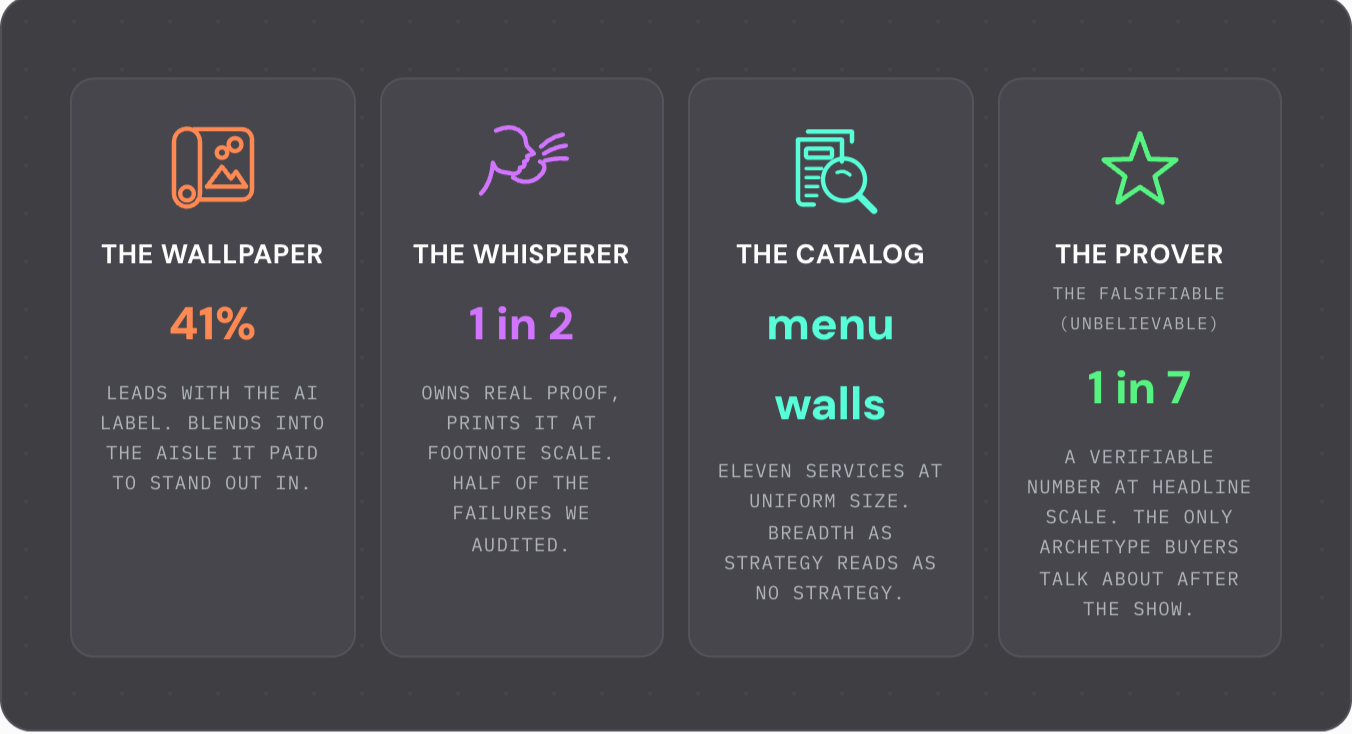
The winners were rarer, and they cluster into six repeatable actions. It just requires you to decide what you are willing to claim and prove.
The strongest booth walls led with a checkable fact at headline scale: “Trusted by 22 of the top 25 P&C carriers and 7 of the top 10 MGAs.” “40% faster from submission to bind. 60 days to launch. +0 headcount added to scale.”
The most believable walls demonstrated instead of describing. An aerial-imagery vendor printed a real annotated photo: a roof scored 73 out of 100, detection chips reading “yard debris” and “staining.” Best of all, a voice-AI vendor put live phone numbers on the wall: “Call and speak with our AI receptionist.” Any skeptic could verify the entire pitch in sixty seconds with no rep involved. That is the best CTA mechanic in the sample, and it cost a phone line.
And the single best asset class in 216 records is the named-client case handout. One document-AI vendor’s sheet: manual PDF extraction took up to 120 minutes per quote, then a 96% reduction in processing time, 1,100+ invoices processed in the first month, three-month payback, with the customer named. One named, quotable customer converts a claim from impressive to believable, and it validates every other number on the page.
The handouts deserve their own autopsy. They name their buyer far better than booths, 79% against 35%. But half of them still carry zero proof, and print adds its own diseases: stacked unsourced percentages, absolutes that procurement will weaponize (”zero errors,” “100% portfolio coverage”), and buried crown jewels. A 200-year-old broker held an exclusive binding authority no competitor in its market can access, and printed it in justified small print under a generic category headline.
The test we now apply to every piece of collateral: at the end of the show, a buyer empties the tote bag onto a hotel bed and keeps two pieces. The keepers, every time, are the ones with an attributed number and a reason to act. Design your handout to survive that cut.
The floor’s convergence has a history. In 2023, insurtech funding fell to a five-year low while the messaging stayed in growth-era language. In 2024, investor pressure forced the pivot to profitability and underwriting discipline, and the vocabulary of proof entered the industry’s own investor story. By early 2026, AI-labeled companies captured 95.2% of US insurtech funding dollars in a single quarter, up from roughly 28% of deals two years earlier, and one widely circulated analysis of 97 insurtech marketing messages found 94% converged on some version of the same sentence.
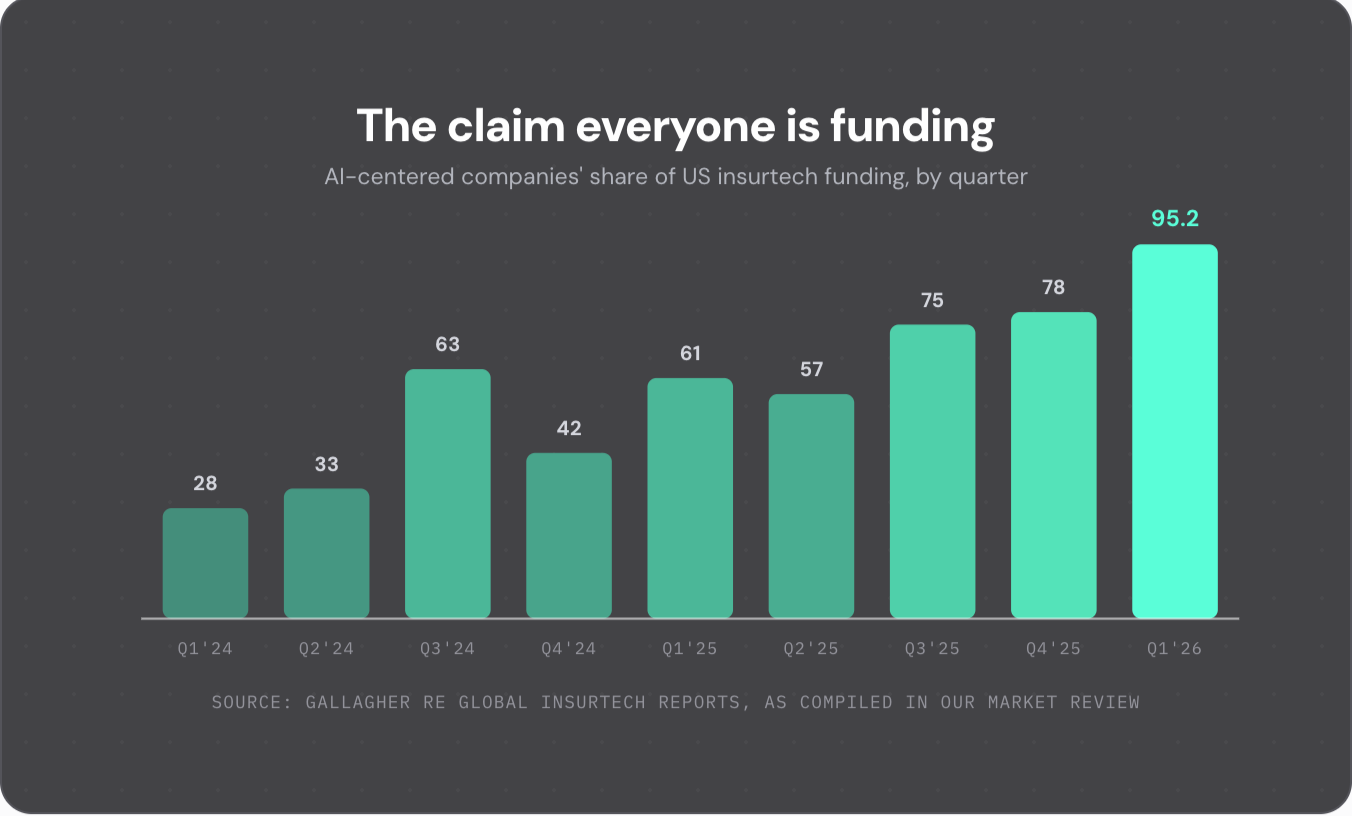
Buyers now respond to that sentence with a question: how is this different from the last twelve vendors? Regulators have model bulletins on responsible AI use. Capacity providers ask how models are validated and monitored. The era when the claim was the credential is over. Claims without evidence no longer clear the bar, because the bar is now taste and judgment, and both are rising fast: in buyers, in investors, and in the AI answer engines that increasingly mediate discovery.
Position for the buyer who checks.
The full guide closes with a twelve-question scorecard and a ninety-day playbook for InsureTech Connect. If you only run five checks against your current booth, handout, or homepage, run these:
Does your headline name one specific buyer?
Does it carry proof: a number, a named client, or third-party validation?
Does it survive the swap test? Cover the logo and ask whether a competitor could print the same sentence.
Can a skeptic verify one claim without talking to a rep?
Is there a call to action smaller than “book a demo”?
If you read this and recognized your own materials in the patterns, you are in good company. Roughly half the failures in this audit belonged to companies that own real proof and printed it too small. The gap is rarely substance. It is the discipline of finding your most powerful truths and engineering the believability of them, on every surface, at every size.
The full guide, “The Believability Gap,” is free at revupstudio.com/expo: all nine failure patterns, all six winning moves, the tote bag autopsy, the complete twelve-question scorecard, and the ninety-day ITC playbook, as a web read and a designed PDF.
If you want a second set of eyes on your booth message, your one-pager, or your positioning against this audit’s bar before ITC, I read every reply/comment.
And if you are a founder building your voice into pipeline, watch for what we are launching in August. Readers here hear about it first.
No posts
Comments
Nothing yet. Say the first thing.
Sign in to join the conversation.