
Peter Diamandis published a number this week that stopped me in my tracks.
The cost of intelligence has fallen roughly 280 times in twenty-four months.
A unit of reasoning that recently cost real money now costs about forty cents. Intelligence is racing toward free, and he went on to say that atoms, not thinking, become the bottleneck on what we can build. That is, the physical world, how fast we can move, that’s the constraint.
That is a profound shift.
It changes everything.
So naturally, I thought a lot about what this means for those of us in insurance, a specific, regulated, unglamorous, but enormously valuable corner of the world.
If the raw intelligence is nearly free, then it is no longer the product.
So what is, then?
Here’s where I landed. It’s context and the value that context creates.
And the way you price it reveals whether you understand that or not.
Think about that and ask yourself: does the way I price my solution define it as worth less than it actually delivers? Have you really done that math?
Strip an AI product down to its components and you find two very different things that look exactly the same.
There is the intelligence itself. The reasoning, the language, the pattern recognition. That’s the part that is collapsing. It is the commodity. It will keep getting cheaper, and any moat built on it will keep getting shallower.
Then there is the context. The proprietary loss history. The underwriting judgment encoded as a framework. The founder’s instinct, built over decades of experience, about which risks are mispriced and which distribution channels are about to matter.
It’s the imaginative leap that decides what this intelligence should even be doing. That part is not collapsing toward anything. It is the asset.
Wait, it is the only asset.
We are in the most powerful place we have ever been to give shape to our instincts.
The collapse in the cost of intelligence is the largest multiplier expertise has ever been handed. And that is the intimidating part, because you now have unlimited ways to define context, and no one is going to define it for you. So here we are with all the excitement that comes with staring into a blank canvas. It’s time to shed complacency, get excited and start building.
People say context like it is a feeling, a secret sauce, a thing you either have or you do not. It is not. Context is buildable. It has an infrastructure, a science, and an art, and a serious founder works on all of these, intentionally.
The infrastructure is where your proprietary data lives, how it flows, how clean it is, how fast it updates, whether the thing your AI knows today is still true tomorrow. A founder with a brilliant risk insight and no infrastructure to keep that insight fed and current doesn’t have a product. Think of context as the plumbing that turns a one-time clever output into a system that stays smart.
In a regulated world, the infrastructure also carries the auditability, the lineage. Infrastructure is what makes context durable instead of momentary.
At RevUp, the infrastructure we build for founders is built on several entities and relationships that are living, ever evolving through operational, market, and consumer data and how that data flows into, through, and out of the system. It is what creates the company and founder brand intelligence, and it is the source of successful marketing execution across channels. Everything is downstream from the infrastructure, so it has to be right AND remain right.
The science is the discipline of knowing what actually creates value and being honest about whether it does. This has been so hard for me. My survival brain is constantly threatening me with what isn’t valuable, and often it’s dead wrong. I challenge every single assumption these days.
And that work right there gives me a significant advantage versus operating on a hunch. It provides me with the signals that genuinely predict whether a piece of context produces content the target buyer trusts and acts on.
This is what separates founders who are “decorating” with AI from founders who are building with it. The science is what lets you say (with evidence) that the context you are giving the machine produces an outcome the customer values and is unlike anything a competitor could offer.
Here’s an example of how I’ve mapped a portion of an AI-native marketing engine to founder value:
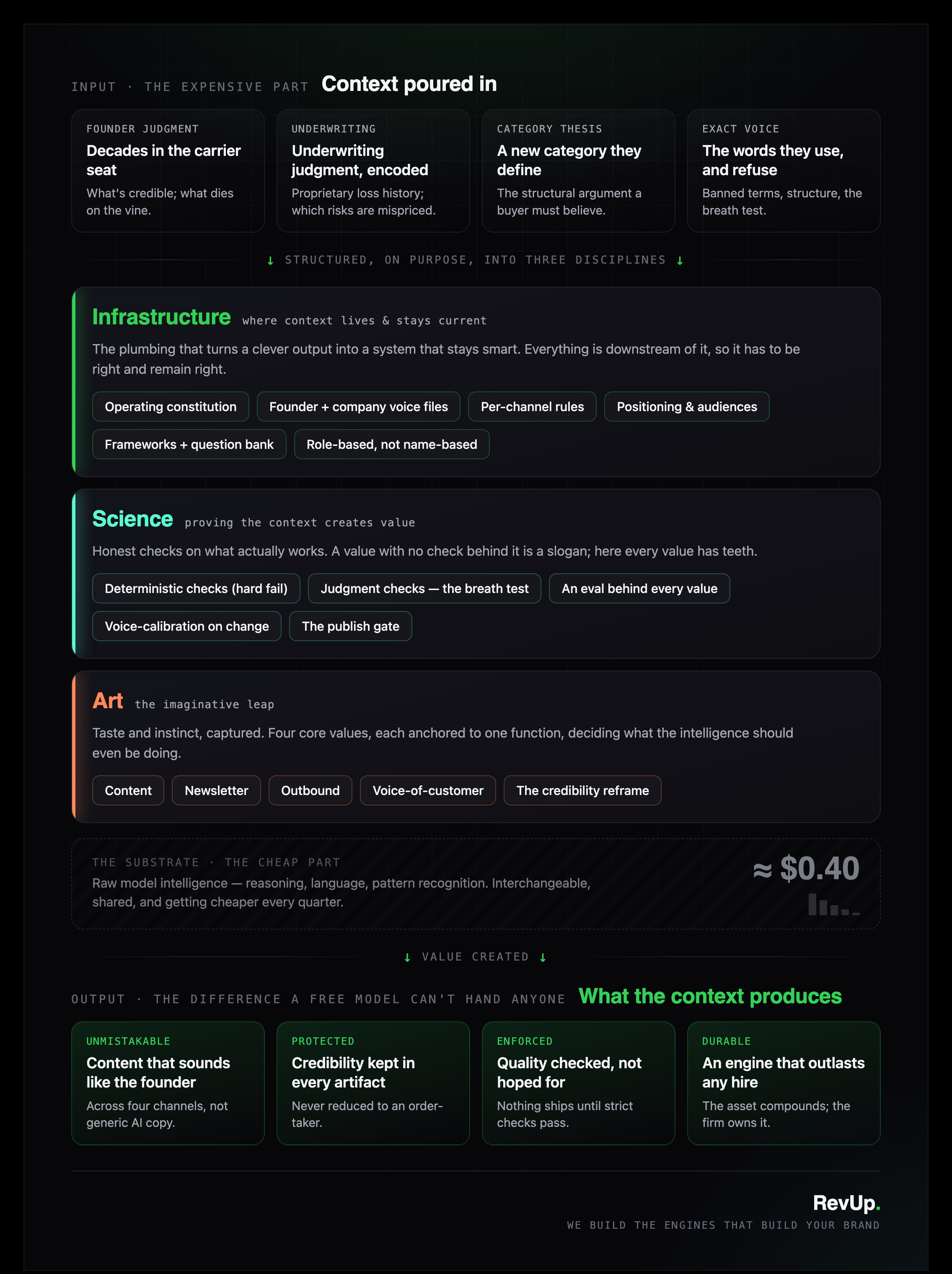
The art is the part no one can copy, and it’s my very favorite part. It is the reason you specifically get to build this.
It is the imaginative leap. The decision about what this intelligence should even be pointed at, which problem is worth solving, which future to build toward before the data exists to prove you right. Oh my!
It is taste, framing, and the instinct earned over your entire career. This is where the uniqueness of us comes to life and delivers to the world in the age of AI.
Two founders with the same models and the same data can build wildly different products, and the entire difference is the art of what they chose to see.
For most of software history, intelligence was the scarce input and engineering was the way to get it done. Solving the hard problem required rare expertise, billed by the hour, hoarded carefully. That constraint just dissolved. You can point near-infinite reasoning at a problem for pocket change.
The bottleneck has moved and that’s another profound shift we’re all thrust into.
What slows things down now is atoms. That is, how quickly we can move context into value. How quickly we can get it done and compound value creation.
That is the opportunity, and it is enormous, and it is also the part that should keep all of us up at night in a good way. The scarce input in your world is what you decide to point the thinking at, and how well you build the infrastructure, science, and art to make that decision real. Context is the product, and your ability to shape it over time is the moat.
Which brings me back to where I started: price. If the intelligence is the cheap part and the context is the asset, then pricing the intelligence (billing by the hour, by the output, by the model’s work) is pricing the wrong thing entirely. You are charging for the commodity and giving away the asset in this scenario.
What actually creates value is the infrastructure you built, the science that proved it true, and the art only you could bring and the continual work you do to make it deliver greater and greater value. That is what you are selling. So price that. Price the outcome it creates, not the reasoning it took to get there.
A few questions for you to think about.
What is the context you are building, and do you believe it is the real product yet?
Anything here you don’t agree with? I’d love to hear from you.
No posts
Comments
Nothing yet. Say the first thing.
Sign in to join the conversation.