
Recently, someone suggested I don’t drop enough truth bombs.
It made me smile.
Because I don’t think I drop truth bombs.
I think I drop thought bombs.
There’s a difference.
A truth bomb tries to end a conversation.
A thought bomb starts one.
It invites people to pause, question an assumption they’ve held for years, and perhaps leave thinking differently than when they arrived.
That’s always been the work I care about.
Which brings me to today.
Today, the EHRC Code comes into force.
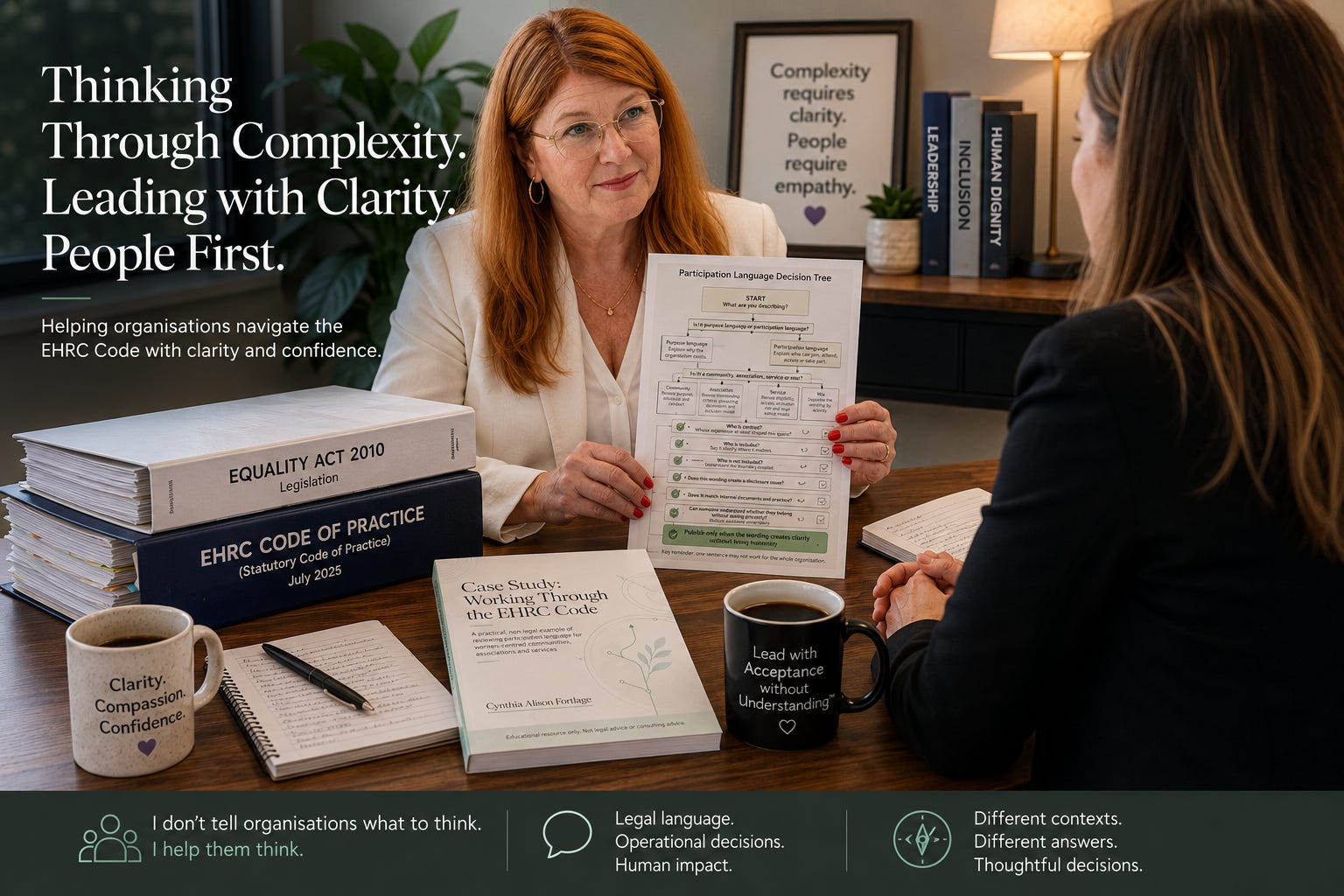
I’ve spent the last several weeks reading it, translating it from legal language into business language, and writing a book about what it means for organisations trying to navigate these changes.
Before anyone asks, I’m not a lawyer, nor do I play one on TV. Organisations should absolutely obtain legal advice where appropriate.
What I bring is something different.
For more than 30 years, I’ve translated complex contracts, governance frameworks and legislation into practical business decisions. That’s exactly how I approached the EHRC Code.
So here’s today’s thought bomb.
The EHRC Code does not make it impossible to be inclusive. It makes inclusive organisations work much harder than organisations that choose to exclude.
The law can tell us what may be lawful.
It doesn’t automatically tell us how to build a workplace where people still feel they belong.
Those are different questions.
I’ve already helped organisations work through the practical implications of the Code.
I haven’t always given the answer people might expect.
Sometimes I’ve concluded that a particular service or activity couldn’t realistically be trans-inclusive under the Code. In other circumstances, I’ve helped organisations find language and approaches that allow them to continue being inclusive.
It depends on the purpose of the service, the legal context and what the organisation is trying to achieve.
I don’t tell organisations what to think.
I help them think.
That’s why I wrote this book.
Not to tell organisations what they must do.
But to help leaders translate legal language into practical operational decisions, understand where choices exist, and express those choices clearly, thoughtfully and respectfully.
If you’re a podcast host looking for a thoughtful conversation about what today’s changes really mean for organisations, I’d be delighted to join you.
And if your organisation is working through one difficult policy, one difficult document or one difficult piece of language, I’d be happy to help you think it through alongside your legal advisers.
Because this has never been about winning an argument.
It’s about helping organisations navigate complexity without losing their humanity.
That’s what Acceptance without Understanding™ has always meant to me.
Sometimes the most powerful thing we can do isn’t drop a truth bomb.
It’s leave someone with a thought they can’t stop thinking about.
Comments
Nothing yet. Say the first thing.
Sign in to join the conversation.