
Let me begin by being honest.
For a long time, I thought I would become a trophy wife.
When I first began imagining the woman I might become, that image shaped almost everything I saw about myself and my journey.
I wanted to be beautiful.
Feminine.
Desirable.
The kind of woman a successful man might proudly choose and place beside him.
At the time, I did not fully understand how much of that image had been shaped by the male gaze, or how much pornography had taught me about what a woman was supposedly meant to look like and how she was expected to behave.
The women I had seen were polished, sexually available, carefully sculpted and designed to fulfil a particular fantasy.
That fantasy became part of the aesthetic I initially associated with successful womanhood.
So I tried to move towards it.
My clothes, shoes, makeup and presentation were all influenced by other people’s ideas of femininity. I was learning how to be seen as a woman before I had fully discovered how I wanted to see myself.

Over time, something changed.
I began to find my own style.
My own voice.
My own understanding of femininity.
Most importantly, I began to find my centre within myself rather than searching for it in someone else’s gaze.
I realised that becoming a trophy wife would not only be limiting. It would sit uneasily beside the feminist values I had developed and the independent woman I increasingly understood myself to be.
I also had to confront a more practical truth.
I did not have a body that could simply be sculpted into the narrow trophy-wife aesthetic I had absorbed.
But eventually, that stopped feeling like a failure.
Because I no longer wanted to become her.
I wanted to become myself.
That does not mean I stopped enjoying beauty, femininity, desire or the pleasure of being noticed. I still enjoy dressing with another person’s gaze in mind at times—although these days, it is far more likely to be the female gaze (wlw).
The difference is that desire no longer defines me.
I can enjoy being seen without allowing someone else’s gaze to become the authority over who I am.
That personal history is part of why the idea of the trophy wife returned to me recently.
I was at an event on the beach, looking around the room, when I found myself noticing women who appeared, at least outwardly, to fit that familiar image: polished, glamorous and standing beside successful men.
But I also began questioning my own assumptions.
One woman was publicly thanked for the community she had helped bring into the room.
Her husband may have created the event.
She appeared to have built the social world that made it successful.
That made me wonder whether the trophy-wife image had always concealed something much more complicated.
For generations, women have not merely stood beside men.
They have maintained the relationships, organised the gatherings, remembered the birthdays, created the warmth, repaired the tensions and built much of the emotional and social infrastructure around them.
They have often been the cultural architects of men’s lives.
And now, many women are no longer willing—or required—to construct their entire lives around men.
Women have spent more than a century gaining greater legal autonomy, financial independence, professional opportunity and freedom over how we choose to live.
Many women no longer need a man in order to have security, status, community or a meaningful future.
That does not mean women no longer value men.
It means men are no longer guaranteed a central place in a woman’s life simply because they are men.
That led me to the question at the heart of this series:
What happens when women change, but many men continue working from the old relationship job description?
What began as one thought quickly took me into far more complicated territory.
It made me reconsider my own early ideas about womanhood, beauty and the male gaze. It brought me back to the feminist work women have been doing for generations. It raised questions about emotional labour, male loneliness, the manosphere, women’s safety, entitlement, relationships and what equality actually asks of men.
There was far too much here for a single article.
So, over the next five pieces, I will unpack the different strands of that question before bringing them together in a final reflection.
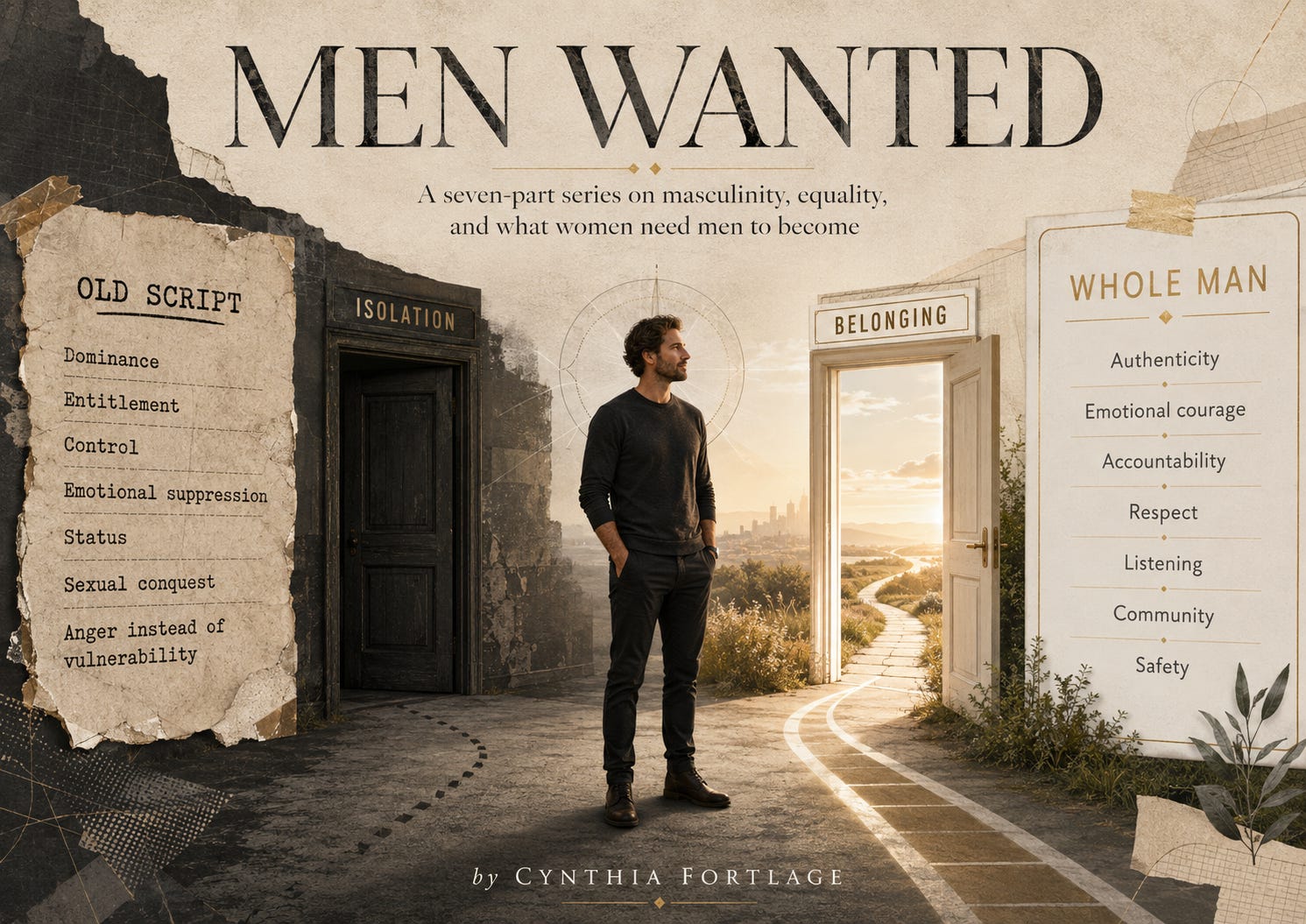
This seven-part series will be published every Monday for the next seven weeks.
We will explore the old relationship job description, women’s role as cultural architects, what happens when men continue following instructions that no longer work, the false promises of toxic masculinity, and what a more authentic and emotionally whole man might bring to relationships and society.
This is not a series about teaching men how to win women.
It is about asking what kind of men women can safely and equally share the world with—whether we choose them as partners or not.
The next article will begin with the old job description and the invisible work women were expected to perform around it.
Subscribe to Gender Perspectives so the next part arrives when it is published on Monday.
Comments
Nothing yet. Say the first thing.
Sign in to join the conversation.