
A timeline of all date markets on Manifold
Polymarket buys a US exchange.
A prediction market on Anthropic next round valuation
Former Senator ~lies to the CFTC for $240K
Polymarket acquired (a) QCEX, a CFTC-regulated exchange and clearinghouse, for $112M, giving it an option to come back to the USA (a). It’s also considering issuing its own stablecoin (as is Interactive Brokers (a)), and offering interest on 2028 election markets.
Polymarket integrated itself with X through its @AskPolymarket account, and with Grok (a).
Polysights, a Polymarket analysis tool, writes about how they found a $100K trade on Thailand strikes on Cambodia. Possibly by an insider. And Polymarket news interviews two (a) sharks (a).
Domah: “The incestuous romance between apathetic UMA voters & malicious Polymarket users marches onward.” UMA is the service which Polymarket uses to resolve markets; it has Keynesian Beauty Contest mechanics (derrogatory), where participants are incentivized to chose the option which other participants will choose.
Kalshi partnered (a) with xAI, following a similar partnership between X and Polymarket last month. Kalshi is moving to 24/7 trading, and a paper analyzes data (a) from the last few years of trading on the platform.
A former Senator who was majorly involved in the Commodity Exchange Act provisions of the Dodd-Frank act, which lay out the regulatory framework for trading commodities and hence probably prediction markets, has now switched tacks to becoming a lobbyist for Kalshi, arguing that she meant to support sports contracts all along. Comments from 2010 (a) make apparent that this is not the case:
Mrs. LINCOLN. That is our intent. The Commission needs the power to, and should, prevent derivatives contracts that are contrary to the public interest because they exist predominantly to enable gambling through supposed “event contracts.” It would be quite easy to construct an “event contract” around sporting events such as the Super Bowl, the Kentucky Derby, and Masters Golf Tournament. These types of contracts would not serve any real commercial purpose. Rather, they would be used solely for gambling.
A commentator on Twitter points out (a) that lobbying data is public, and OpenSecrets reveals that she was paid $180K in 2024 and $60K this year.
The letter overall seems deceptive (a). It’s just sad to see, but it also offers an interesting case study of lobbying in a domain I am very familiar with, in which the intent of the lawmakers seems clear. To me, sponsoring this kind of lobbying is also another sign that Kalshi isn’t really a good citizen of the epistemic commons.
But the regulators at the CFTC already know all the above. So the effect is not to change their object-level beliefs about lawmaker intent around sports markets, but to make it a little bit more awkward for regulators to ban sports markets. If 80% of Kalshi’s $2B valuation is hanging on sports markets1, and this letter has a 0.1% to 1% of shifting the outcome, that’s worth $1.6M to 16M to Kalshi—so it makes sense to pay $240K.
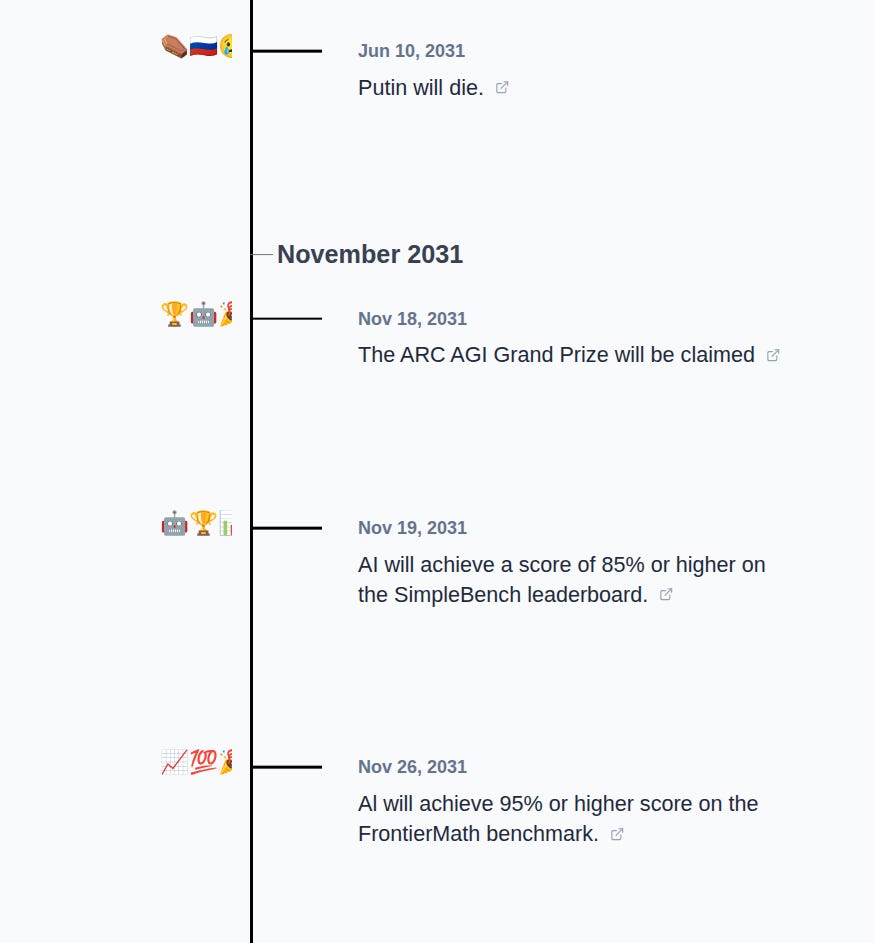
A timeline (a) of all date markets on Manifold:
Limitless raises an additional 4M. It has private valuation markets (a) for Anthropic, Perplexity, Databrics & others (here is a more up to date Anthropic one). And a permissionless prediction market raises (a) 500K.
Bayes.market (a) launched, as did a prediction market for Cardano (a second-tier chain). Seer (a) is also a not so new prediction market; reportedly open source, but I couldn’t get their frontend to run last time I tried to.
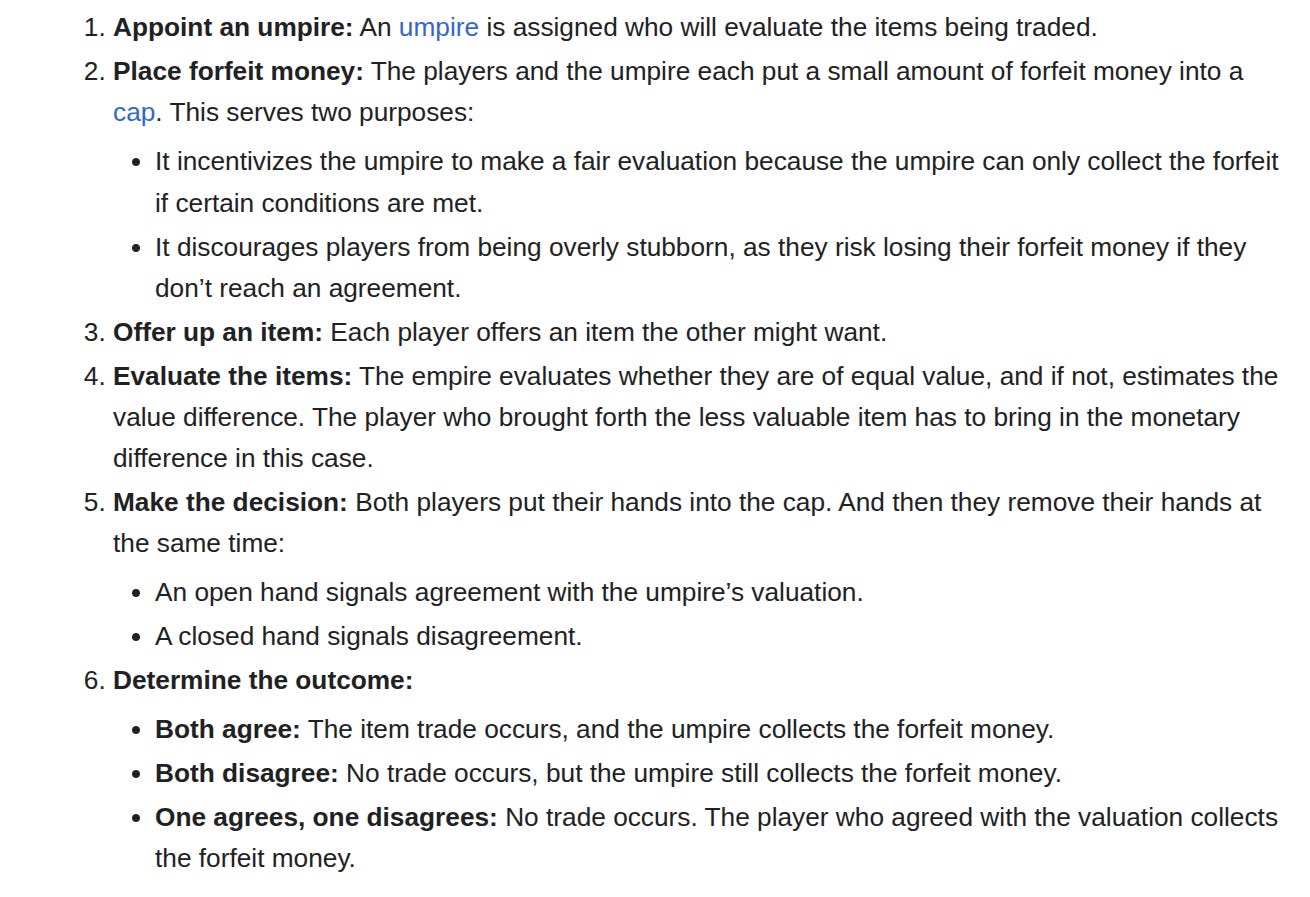
Hand-in-cap (a) is an old English trading procedure that gave rise to the modern word handicap. It was used to fairly trade items of potentially unequal value. It’s not robust to two players coordinating against the third, but still very interesting.
Updated database (a) of prediction markets, from Mick Bransfield. See also Saul Munn’s Map of the Prediction Market & Forecasting Ecosystem (a). These build on some earlier work by Jacob Lagerros and myself
At Sentinel, we continued tracking large-scale risks (a), with an eye to tariffs and trade deals, military drills, AI model releases, and conflict in the Middle East.
US baseball is seeing more sports-fixing (a) as a result of betting.
Model Thinking estimates that in some sense Britain would have 200M people (a) in the absence of emigration, and that the US has more people of British descent than the current UK does.
The deathlist forums try to predict each year which famous figures will die. Here is their leaderboard (a)
Ministry of Finance of the Arab Emirates held (a) a workshop to boost crisis preparedness and forecasting capabilities
My former boss Ozzie Gooen created roastmypost.org (a) for automated AI feedback.
Eric Drexler on considering options rather than estimating probabilities. It probably does hold if one is extremely doomy, in which case this stance probably does make sense and increases agency. But if one isn’t that doomy (if one is playing poker rather than iterated Russian roulette), thinking in terms of probabilities probably still makes sense.
DC Forecasting & Prediction Markets Meetup happening on August 14th; sponsored by Kalshi. See also their frontpage (a) for meetings in DC, Berlin, Dallas and NYC.
A “survival guide” for venture investors allocating to prediction markets:
Nathan Young writes about Learnings from Building Epistemic Tools (a)
Operationalizing forecasting value
Is It So Much to Ask for a Nice Reliable Aggregated X-Risk Forecast? (a) asks Michael Dickens.
Grok is doing more Fermi estimates on twitter, although they are not super great yet. But a substantial fraction of search results for that keyword in Twitter are now from Grok.
Molten Visions, Broken Blades: The Challenge of Forecasting (a) the Character of Future Combat. What a good title for an article for the West Point Modern War Institute looking at past attempts at military forecasting, and trying to synthesize how new changes with drones will interact with the “fundamental nature” of ground combat.
Cultivate Labs on the “Intelligence Community’s Prediction Market (ICPM) (a), the internal forecasting capability powered by Cultivate, which operated for more than a decade until its cancellation in 2020”“.
The RAND Forecasting Initiative on mirror life; Metaculus on AI benchmarking (a)
Nigeria had some fiscal forecasting errors (a), driven by too optimistic oil production estimates and a bad macro fiscal unit.
Indian gaming regulators raided Probo (a) and froze their assets.
DOJ and CFTC dropped investigations into Polymarket. The CFTC is starting a series of crypto sprints (a) and working groups.
California tribes sue Kalshi and Robinhood over sports betting (a) on reservation lands
Japan’s PM Shigeru Ishiba signals intent to stay on despite (a) forecast election blow. Interest interaction between forecasts and reality
Donald Trump Jr. is making tons of money in guns (a) and Crypto.
Riot games is opening up (a) betting for its e-sports.
This seems reasonable to me because there just aren’t that many repeatable events on which retail wants to bet on. Some googling find this article, which finds >75% of volume on Kalshi is for sports—but the calculation for the valuation isn’t a straightcforward extrapolation of that.
No posts
Comments
Nothing yet. Say the first thing.
Sign in to join the conversation.