
AI forecasters not yet here, but soon.
More sports betting on prediction platforms.
“Opportunity markets” as a better business model for a foresight startups.
Polymarket’s builders program continues strong
Metaculus recently released (a) the result of their second quarter contest for AI bots, which had $30K in prizes . The bot which won is (a) now open source on Github (with a viral Affero (a) license, meaning that software which builds upon it will also have to be free).
Metaculus writes that “The best in-house Metaculus bot ran OpenAI’s o3 with @AskNewsApp, topping the multiple-choice-only leaderboard and placing 2nd overall (!) o3 was the best forecasting model of those tested, demonstrating that having a SOTA model (as of the Q2 contest) matters more than bot scaffolding”. This seems reasonable because it’s consistent with the Bitter lesson (a).
Still, two AI forecasting companies, Mantic (a) and Lighting Rod (a), did well, placing 6th and 7th, respectively. Mantic recently shipped a blogpost (a). But it’s a good blogpost. I can see how a team of good engineers can replace progressively larger chunks of forecasting using LLMs. There are questions about whether they can do cost-effectively, whether scaffolding makes sense, whether many forecasting problems are very low n (and so you can’t really “fit a model”). But ultimately when I see what mental processes I’m using to generate those reasons, I think it’s all cope, and human forecasters will just have to look for different jobs (a) over the next few months and years. My Fermi estimation abilities (a) will look quaint when users just ask Grok for a Fermi estimate and it delivers.
Ex-Polymarket, Kalshi staff raised (a) $15M to enter (a) prediction market space, under the name The Clearing Company. One could model prediction markets subsidized with VC money as entering a race where it is advantageous to enter last, because each can use the VC money to offer sweeteners to fight for being the Schelling point platform (and then hike fees at a later date). See perhaps the concept of a dollar auction. Though on the other hand, entering earlier does help with user acquisition, and maybe the factor that most matters is what share of retail gambling a given platform captures.
Nayib Bukele retweeted (a) a Kalshi market on whether El Salvador’s $BTC reserve is worth $1B before December, saying “I could do the funniest thing right now…” As prediction systems become more powerful, they may start to affect the events they predict, see the concept of self-fulfilling prophecies, George Soros’ reflexivity (a), performativity (a), or a list of past examples here (a).
Kalshi has a bunch of Liquidity (a), Volume (a) and Market Making (a) incentives. Much like with Polymarket, these have the straightforward effect of paying to inflate their stats—a market with $1M in volume means less if users are paid to provide it.
Donald Trump Jr. invested (a) in Polymarket (2 (a)). He is now investing in both Polymarket and Kalshi. The Polymarket builders program produced Polymarkets Guide (a) and PolyAlertHub (a). Worth checking out! There now also seems to be leverage (a) on Polymarket
From Polymarket’s blog, see Doomberg (a) on WW3 and reading probabilities from markets:
Take the 12-day war between Iran and Israel. Polymarket had the Strait of Hormuz closure trading at various levels. But I track two key pair trades: landed LNG in Europe versus Brent crude, and WTI versus Brent. If the markets truly believed Iran would close the strait, we’d have seen huge divergences in that spread. But the pairs stayed tight, showing that the market was completely discounting escalation.
A profile (a) of the Chief Technology Officer of a Nigerian gambling/prediction market app, Gowagr with, reportedly, over 400K users (!): gowagr (a)
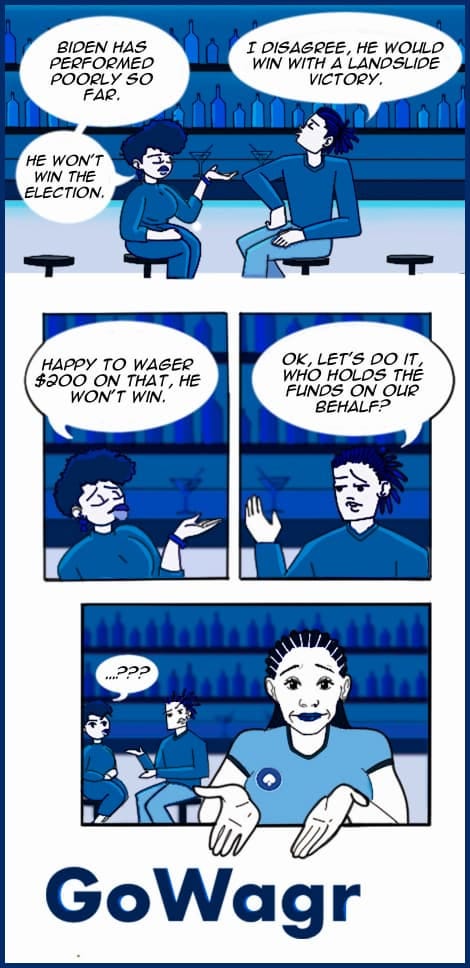
And: trying to fork Augur (a), to kill off holders of its cryptocurrencies that are not paying attention; a “perpetual information market (a)”; Greed (a) is a Kalshi market-making operation with a cool website; trading functions (a), rather than probabilities.
Opportunity markets (a): “private prediction markets where those who find opportunities get paid by those who act on them”, like whether a label signs-on a band. I like this a lot because it offers a business model for prediction markets based on them delivering value, whereas prediction markets like Polymarket have historically struggled to find a source of profit. So far this is just a white-paper, but the sense I get is that Paradigm (a), the investment firm who wrote it, would be excited to invest in people who build a product along those lines. Adjacently, Robin Hanson talks about using futarchy (a) to pick an advertisement agency.
An overview (a) of prediction markets, from a VC. And a reading list (a).
Prophet Arena (a), another benchmark for AI models making predictions.
Prediction markets on mergers (a) could make bets on them much more efficient and profitable.
When we buy a share of US steel, we are buying two things:
a share of the underlying value of US steel.
an option on the deal going through for $55.
We really only want the latter. We don’t have any desire to bet on the former. It’s outside our area of expertise, so we need to try and hedge that part of the trade normally.
A prediction market would let us do this more directly.
An uncertainty datatype (a) from Microsoft in the 2010s.
A look at NOAA’s tsunami forecasting (a)
Two countries adopt (a) a malaria forecasting system developed at Duke.
Ex-CFTC commissioner Brian Quintenz posts (a) some screenshots of his chats with the Winklevoss brothers. They tell a story of how they tried to extract a promise to stop/make amends for a lawsuit in exchange for the commissioner position, and how Caroline Pham might have outmaneuvered Quintenz in order to have him fired so she gets the top job.
The CFTC, now under Pham, launched (a) a “crypto sprint” , issued (a) further no action letters, and announced (a) that foreign companies wanting to offer products to Americans can register on the “foreign board of trade” rather than as a (presumably more involved and expensive) “designated contract market”.
Ohio denounced (a) prediction markets, a judge lets (a) Maryland regulator enforce sports betting laws against prediction market Kalshi, Australia blocks (a) Polymarket, Mongolia banned (a) betting, online gambling, paid prediction activities.
FanDuel partnered with CME Group, which has some relevant licenses. They will offer events contracts unrelated to sports (a), reportedly.
Kalshi continues to allow betting on sports using the form factor of an events contract, and it hasn’t been stopped so far. See an overview from Bloomberg of the history of events contracts, and how the federal government went from prohibiting state sports gambling, to prohibiting states from disallowing them.
Kalshi self-certified (a) to offer football player props, point spreads, over-unders. Sports parlays may be next frontier for prediction markets, says casino.org. Yes, but this makes it less interesting for me, since I think there is no social value in such markets, and since the product lines seem under-differentiated. Another sportsbook in the guise of a prediction market raised (a) $18M, and the share value of FanDuel and DraftKings both have gone (a) down a bit recently.
Point forecasting for strategic horizon[s] is basically pointless, which is why we are rolling out scenarios…
—Wei Li (a) , Global Chief Investment Strategist at BlackRock.
No posts
Comments
Nothing yet. Say the first thing.
Sign in to join the conversation.