
Because we in the Pacific Northwest are famously bad at saying what we really think, I’m going to ask aloud what is being said in private lately at every party, every BBQ, and every dinner that I’m attending.
Does what’s happening in our City Council chamber remotely reflect the current needs of the city?
Because lately, it sure doesn’t feel like it.
At a time when we need big, catalytic ideas and initiatives that reflect broad, long-term thinking, it seems our civic dialogue is increasingly consumed by political theater, performance, and agreements coming from the fringes, rather than the prioritization of policy and plans that can actually solve our problems.
Here are two examples, and they are absolutely connected.
First: Lloyd Center Redevelopment
I grew up in the Portland area, and I spent a lot of time at Lloyd Center. Driving by still gives me warm memories. I remember when Lloyd Center was open to the elements. I remember when it was remodeled and added a bunch of fancy new stores, and I also remember how my older relatives would brag that Lloyd Center was the largest mall in the world when it was first built, or at least that’s what many older Portlanders would tell you.
I have never actually fact-checked that stat, but what’s undebatable is this:
Lloyd Center has been dying a slow death for 20 years. This shopping mall, and others like it, are vestiges of a failed ideology: a post-war, automobile-centric America, Robert Moses-era wet dreams that displaced functioning neighborhoods and replaced them with freeways and big concrete boxes. And while Lloyd Center had its heyday (peaking right around the time I graduated high school), history has rendered its judgment on the urban shopping mall.
Lloyd Center sits 90 percent empty and is slated to close later this summer, and that’s why the city approved a plan for a local developer to implement
a new vision for the neighborhood: a mixed-use grid with green space, a new music venue (that’s already under construction), and thousands of much-needed homes attainable to mixed incomes. All of this is in Central Portland, the city with one of the worst shortages of affordable housing, one of the highest rates of unsheltered homelessness, and one of the lowest numbers of multifamily permits issued of any big city in the country.
Seems like a win, right?
Not so fast.
This week, our City Council resurrected the issue and spent two entire days hearing testimony to appeal this plan and “save” Lloyd Center after its fate was already decided. The fate will be re-decided on July 8th.
Now, to be fair, there are two consistent themes of the Save Lloyd Center movement. First, as national retailers have moved out, smaller independent businesses have moved in, and there has developed a genuinely interesting community of small and quirky businesses there. The second theme is the ice rink is one of the only remaining places to ice skate in the metro area.
These communities deserve empathy, but Downtown Portland has high commercial vacancy where these businesses could relocate, and there are other places to build an ice rink. Lloyd Center remains 90 percent empty.
In what world is that a sustainable model, and who is going to pay for those losses?
Second: Moda Center improvements.
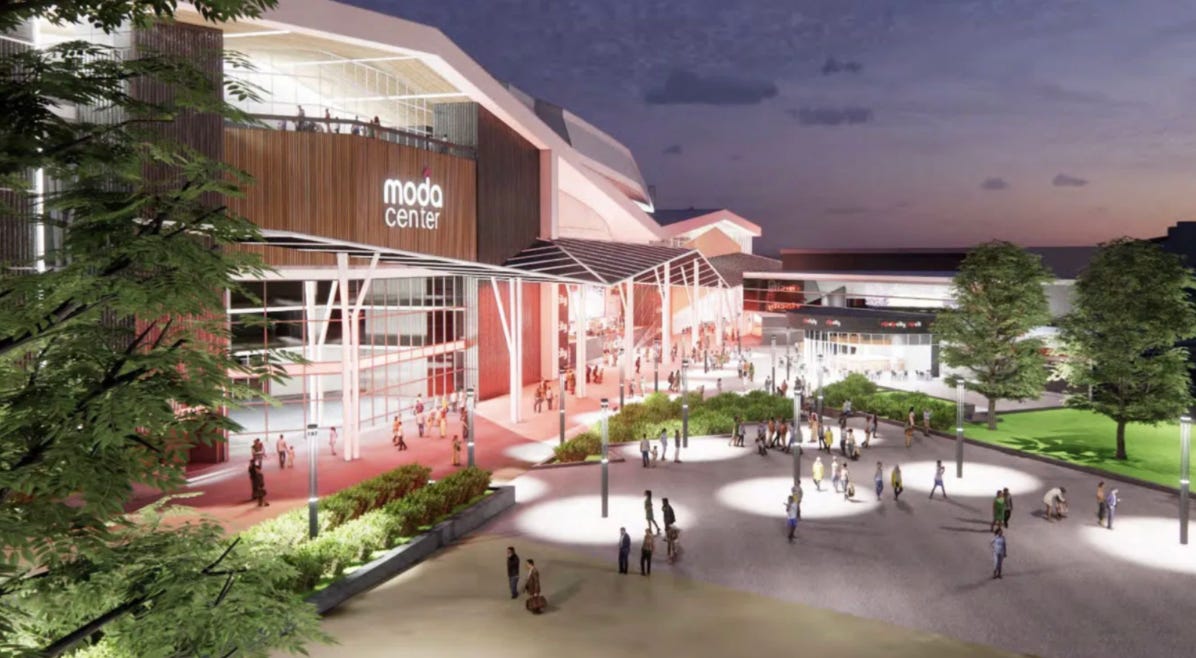
A few blocks away the Lloyd District, the subject of the most potent argument in the city right now unfolds: the city’s portion of the proposed investment toward the redevelopment of the Moda Center, the city-owned venue that’s home to many events but, most notably, is the home court of the Portland Trail Blazers, the city’s only Big Four professional sports team. It is famously the oldest arena in the NBA that has not been updated.
I have not been impressed (or proud to be a Portlander) by how this conversation has evolved, and here’s why. Keeping the Trail Blazers in Portland shouldn’t be viewed as the ideological debate that it’s become. At its core, it’s an economic development decision that aligns with where we should be going.
Here’s the deal:
The City of Portland would invest roughly $120 million, unlocking county and state funding to cover the $600 million remodel. Put another way, for every $1 the city invests, more than $4 comes back from sources that wouldn’t otherwise be available.
The city remains owner of the venue.
I’ll take that deal every time.
I understand why people are skeptical. Public money flowing toward anything associated with a billionaire sports owner in the current age deserves scrutiny. Portlanders have every reason to ask hard questions. But here’s what’s being obfuscated by the current noise: At the end of the day, good policy is determined by outcomes and whether the public receives a return on its investment, and whether an investment aligns with long-term city goals.
This deal, I believe, does all of that.
And to those who have an issue with the public funding from state sources, much of that funding is bonded directly to future revenues generated by the Moda Center and the Trail Blazers. If the team leaves, that funding simply doesn’t exist. It’s not money that can be redirected to other projects.
And despite the rhetoric, these investments aren't simply luxury upgrades for a billionaire owner. Many are fundamental infrastructure improvements to a city-owned arena: structural repairs, aging building systems, restroom renovations, accessibility improvements, and updated team facilities.
Also, the Trailblazers are the most important tenant, but they only represent 20 percent of what happens at the Moda Center. There are concerts, events, The Portland Fire (WBNA), tournaments and other events that drive visitation and activity year-round. There is also the overall impact of sports tourism well documented by this Sport Oregon and ECONorthwest report issued this March.
Like Sears or Nordstrom or Macy’s, or the many tenants that have slowly left and gutted Lloyd Center over the last decade, losing the Trail Blazers would be no different. In many ways, the current state of Lloyd Center is the future of the Moda Center if the improvements are not made.
Let that sink in as you walk through that sad, empty mall.
If we lose the Blazers, confidence in Portland will erode, and Moda Center will become the next Lloyd Center.
And there’s also the ripple effect.
The Moda Center geographically sits in one of the most consequential redevelopment areas in the city, connected to Portland’s most ambitious projects by the Albina Vision Trust and the 1803 Fund. Not only do these investments represent an opportunity to repair historic injustices, they are, quite frankly, the best, biggest, coolest, and most inspiring ideas we have in our city right now.
That’s why this deal needs to be viewed through a broader lens.
The City of Portland would invest roughly $120 million and get its money back four-fold. And that keeps the momentum for these other projects and is only a few blocks away from the Lloyd District, which will be invigorated by a nearby sports and entertainment district—that is, if City Council doesn’t derail it.
Reasonable people can debate the details. But once you move beyond the emotion, the question becomes fairly straightforward.
This is a good deal.
Now, I know there are some reading this and wondering why our new owner, Tom Dundon, can’t invest in a new arena. I agree that, in a perfect world, the team would make an investment. But with this ownership, that’s just not going to happen. Dundon is rich, but he’s not Paul Allen rich, and when you put ideology aside, the reality of this situation is this: Portland is honestly a lot less attractive than some of the other options that Dundon would have if he were to move the team. We are a small market. Portland reportedly ranks last in sponsorship income of all NBA teams.
So that’s why Portland needs to stop acting like our city has a lot of leverage.
All of this said, one can make the argument through the lens of how the state deal is structured that the team is investing dollars in the team—it’s just coming from levers that are more indirect, but it is indeed money that’s directly tied to the Trailblazers and that would not be there without them. At the end of the day, that means we’re getting money from the team to pay for the rehabbing.
If we don’t get this done, we will lose the one thing that still brings everyone together. And if you grew up in Portland, you know that there’s nothing more democratic than loving the Blazers. The Trailblazers are more important than 1,000 fucking ice rinks. Pardon my French.
The reason I bring these two issues together is that they are fundamentally the same conversation. Both are about anchor institutions. Both are about whether Portland is willing to make long-term decisions that strengthen neighborhoods instead of simply preserving the past. And both reveal something larger about how our city is governing itself right now.
Portland needs to show that it’s serious about being a real city. We need to show that we are serious about investing in ourselves, capable of executing big projects, and willing to make decisions that strengthen the city’s long-term future. If we lose our NBA team, we will never get one back. Only 30 cities in the world get to be home to the NBA teams. We are one of them.
Let’s not mess it up.
Whatever your views on billionaire team owners, those views don't change the leverage Portland has today. And while this rhetoric may come from a good place, it’s going to lead to the wrong decisions and outcomes.
The problem at City Hall isn’t that people disagree. Healthy disagreement is part of what makes life interesting. The problem is that our civic conversation increasingly feels optimized for performance rather than execution, and now more than ever.
On Lloyd Center we just spend two full days relitigating decisions that have already been made while the truly difficult work of building housing, attracting investment, improving infrastructure, and creating long-term momentum takes a back seat at a time when that same body of City Councilors are dealing with growing budget shortfalls year after year.
Saving an empty shopping mall and losing our NBA team is not going to grow Portland’s tax base. It’s going to erode it, while also further eroding confidence to those who are still here sticking it out. Having an empty arena on a derelict waterfront blocks away from an empty mall is not the future I want.
We cannot settle for monuments of defeat.
Whether this theater is a function of the new charter itself or simply how it’s operating today, it’s worth asking how we can continue to be better.
Cities are ultimately judged by what they build, what they preserve, and what they make possible.
And right now, too much of our precious civic energy is being spent by performing our values instead of putting them to work. That isn’t moving us forward. It isn’t solving our problems. And it isn’t creating the best version of Portland.
Let’s stop confusing our values with the actual work.
Talk after all, is cheap. And we are better than this nonsense.
No posts
Comments
Nothing yet. Say the first thing.
Sign in to join the conversation.