
I was never much of a Pink Floyd fan.
I kind of liked the rambunctiousness of their early recordings with the spacey surf guitars and strange and rowdy arrangements. But as their more popular stuff goes, it always felt a little too polished for my ears—that is, until I heard Pink Floyd in the right setting.
Our household plans its vacations around good meals and mountain ranges, and that’s why two years ago we ventured to Patagonia to celebrate a big anniversary. We were about ten days into our trip when we crossed into the Chilean side of the southern Patagonia ranges, and we were bummed to arrive on the first of our three days in Torres del Paine National Park on a cloudy day, with a socked-in forecast of the same for the next week. I mean, 6,800 miles is a long way to travel to see some mountains—and then not see them at all.
Thankfully the hotel where we stayed had a nice indoor pool where we spent the entire morning. There were massive floor-to-ceiling windows where we could spy on the weather in between backstrokes and cannonballs. It was still cloudy. Then, while we were eating lunch, we noticed that the sky was unexpectedly starting to clear and you could see bits of sun and mountain peeking through.
Because weather changes by the second in the South of Patagonia, we immediately hopped into our rental car and ventured onto the park’s gravel roads that wind through the scrubby hillocks and lakes that lead up to the mountains. As the sky began to clear, and we could finally see the Torres and the Cuernos Del Paine—some of the most beautiful chunks of pure geology that you’ll find anywhere on this planet. I remember the first time I saw a photo of this place and wondered if someone had dosed me. How could mountains look like that? And here they were right in front of us.
They’re strange-looking mountains indeed. The namesake Torres are three tall, sheer granite towers that rise almost straight up from the earth—clean vertical walls of pale rock that look more like something carved than something formed by the hand of nature. (You have to hike for a few hours to see those unobstructed.) But in the foreground the more accessible and more photographed Cuernos are dark, rocky caps sitting atop sheer light granite, which makes them look almost assembled, like someone set a lid on top of massive granite spires. The whole range rises abruptly out of wide, windy valleys with big turquoise lakes scattered around the base. It’s dramatic in a way that doesn’t seem real.
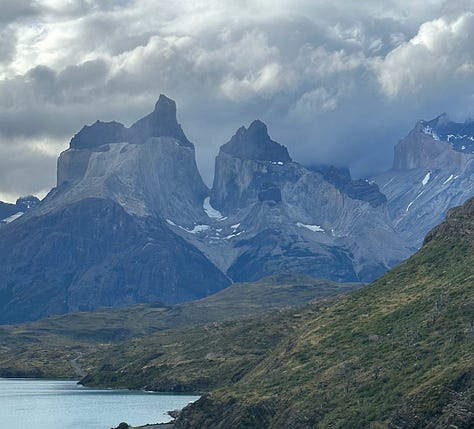
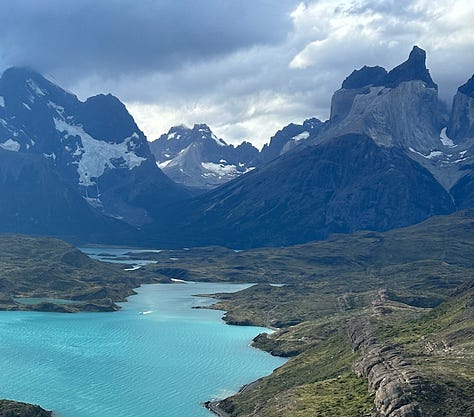
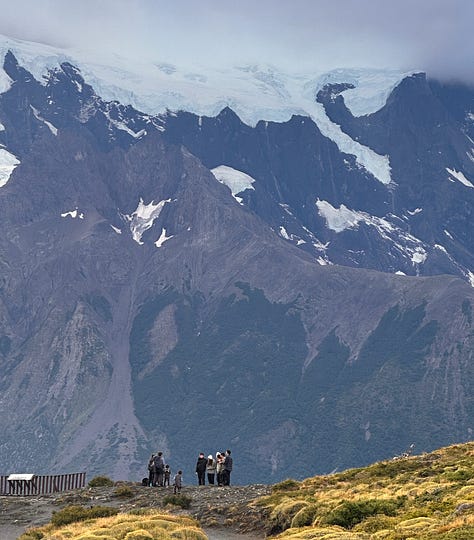
Not to sound cheesy, but this place has the type of beauty that actually brings tears to your eyes—thick, powerful rivers and waterfalls, wind that lifts lake water into the kind of waves that rival oceans (or at least the Great Lakes), and every few seconds you can’t help but look up again to see the Torres and the Cuernos—and to remind yourself that yes, you are actually here.
There’s not much phone reception in the park, or really anywhere outside of the towns in Southern Patagonia, so we had been listening to the same handful of downloaded albums for those last few days. I’m not sure why or when I had downloaded the Pink Floyd live album, but when it came on at the moment I was surrounded by all this bizarre and big and empty and abundant and spacious landscape, I finally had the context to hear and understand what Pink Floyd was all about. And so we played that album on repeat for the next two days. I thought I didn’t much like Pink Floyd, but as it turned out, I had just never listened to them along with the right landscape. There just didn’t seem to be another album worthy of that terrain.
I’m not sure why, but I thought about that drive when I was eating at Locust, a popular one Michelin-starred restaurant in East Nashville, Tennessee, where I joined my friend Matt on an eating and exploration trip a few weeks back.
If I’m traveling a long way primarily to eat a particular meal, and if that meal happens to earn a star or make a certain list (you know the one), then I have certain expectations of what I want from the experience. Of course, dinner at that level needs to have the chops and precision worthy of such a splurge. But more importantly, I need it to exude both a sense of place and a glimpse into the personality of the chef and the restaurant. And these days, when cities like Las Vegas and Dubai have their own so-called farm-to-table restaurants that are located very far from anything resembling an actual farm, it seems we may in fact live in a world where we have forgotten that above all, it is a sense of place that matters most. And when I say place, I’m not just talking about where the restaurant is located. Of course that’s important, but it’s easy to put some local turnips on the menu and talk about the eggs that came from chickens who had names and were raised just outside the city limits. That’s crucial, but it’s also the baseline of what’s to be expected at the higher end of the eating spectrum.
I also want to see place interpreted as personality, as ideas, and I want to see and feel other places and ideas and moments shine through onto the plate as well. Where is the chef from? What do they like to eat at midnight after a long day of work? Where have they worked? Where did they grow up? Have they ever taken a drive through the mountains of Southern Patagonia?
And this is what I loved about Locust—the experience was both a chef bio and a guide to understanding Nashville—precise enough to be taken seriously but also playful, fun, irreverent, and expertly delivered all the while. It was the kind of restaurant that few cities actually have: a place good enough to be anywhere in the world, but one that could only be in Nashville, Tennessee.
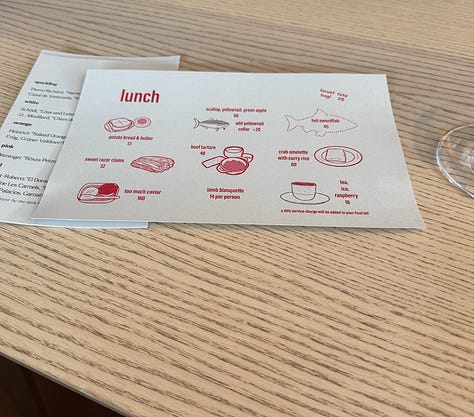
In an era when a menu and dish description actually has no description and reads as a string of unrelated words (turnip, egg, yuzu, cigarette butt, etc.), Locust’s menu is a fun page of food drawings. Each dish gets its own hand-drawn cartoon treatment, and you get to see exactly what you’re getting.
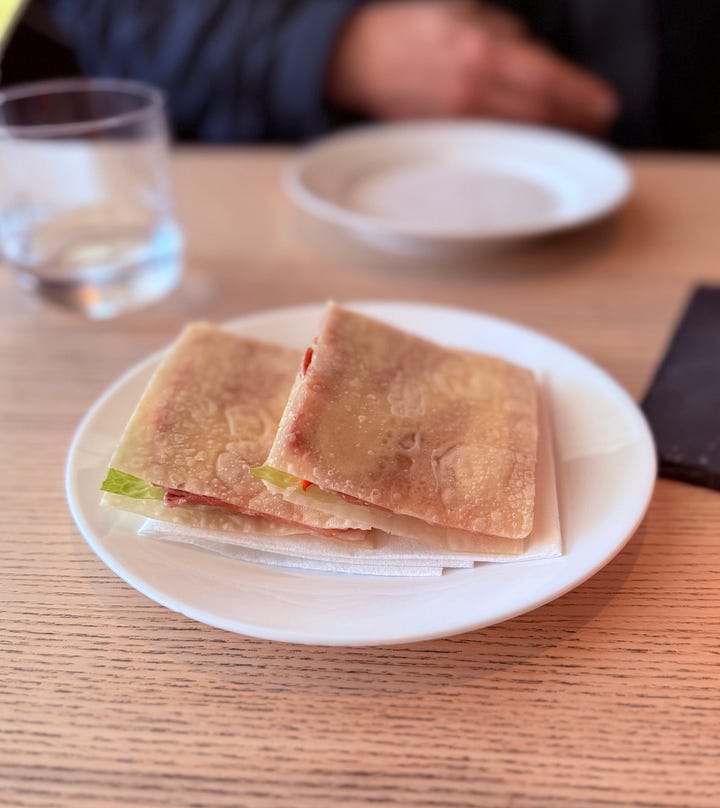
Bite number one was a (perhaps) Crunchwrap-inspired tuna belly sandwich, with the thinnest and crispiest crackers acting as the bread and cool bluefin belly in the middle. It was the perfect way to start the meal—precise, playful, snack-y and likely something that was inspired by fast food. Then came the razor clams. They might have come from Oregon, but were better than any razor clams I’ve had here: sliced just thin enough to snap when you bite into them—like good sashimi.
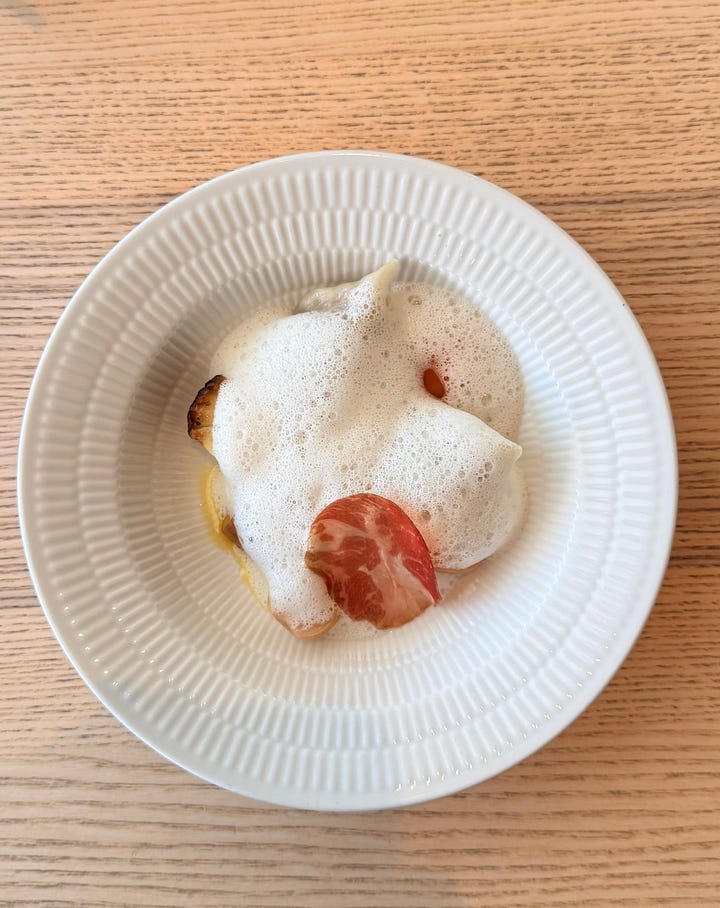
The famous crab omelette arrives as a soft, pale yellow pillow folded gently over a generous amount of sweet Dungeness crab. The eggs are barely set into custardy cylinders, like those Instagram-famous Kyoto omelettes, loaded with big, chunky pieces of good, sweet crab (maybe from Oregon too?). You’d think you were in Japan if it weren’t for the sauce, which felt very Southern: buttery, a tad heavy, but also refreshingly bright. No complaints—we are in the South after all.
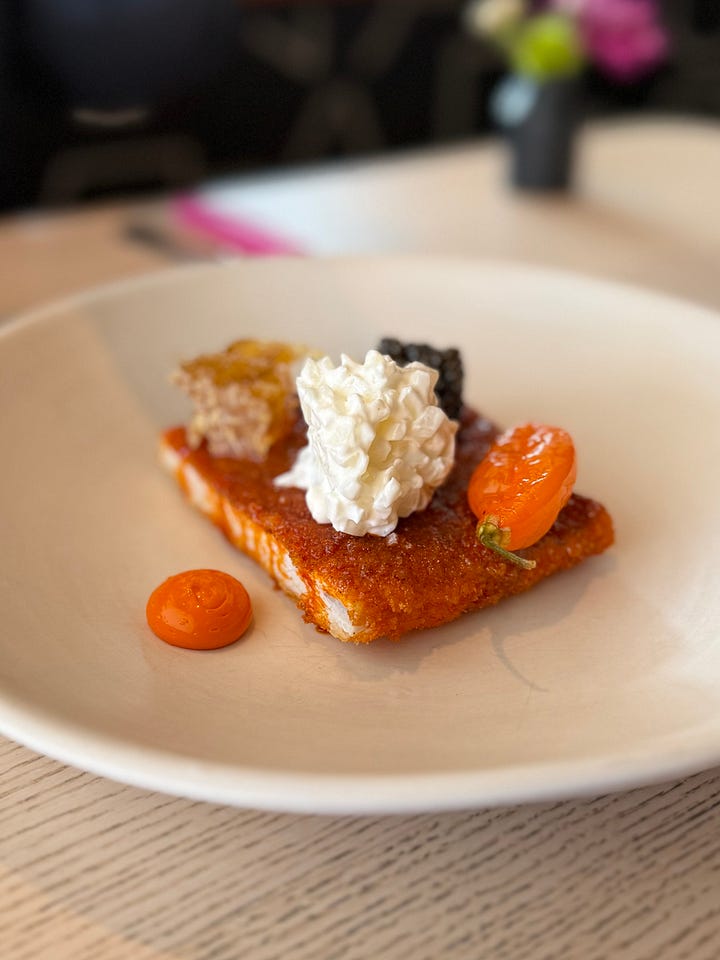
The chef’s most obviously Nashville-inspired dish was the swordfish, which is a take on hot chicken, with a fried piece of swordfish donning the spicy Nashville hot chicken treatment, but served with an actual dollop of caviar portioned with Southern generosity, a chunk of sweet honeycomb, and this chunky white condiment affair that was a nice textural offset to the richness of the dish—but one that I honestly forgot about because I was so into that big blob of caviar.
Locust Chef Trevor Moran grew up in Ireland, and his lamb dish is a play on the Irish Sunday lamb stews that I actually lived on while I spent four months in Galway, Ireland, in my early twenties (His version was better than anything I could afford back then).
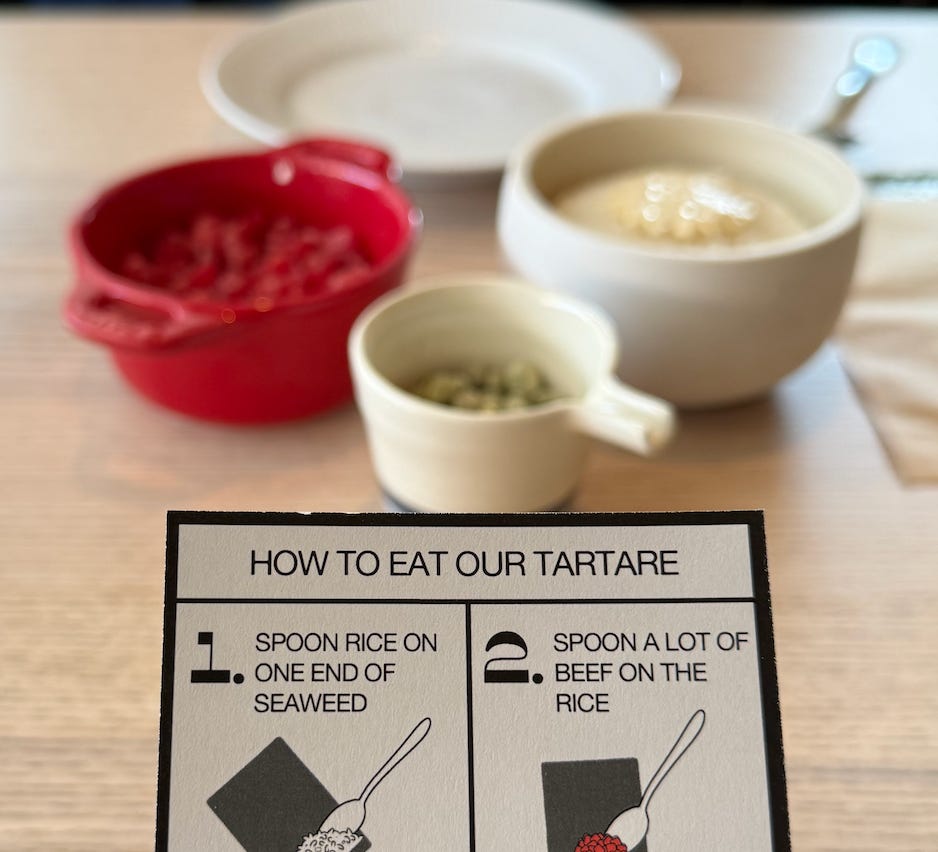
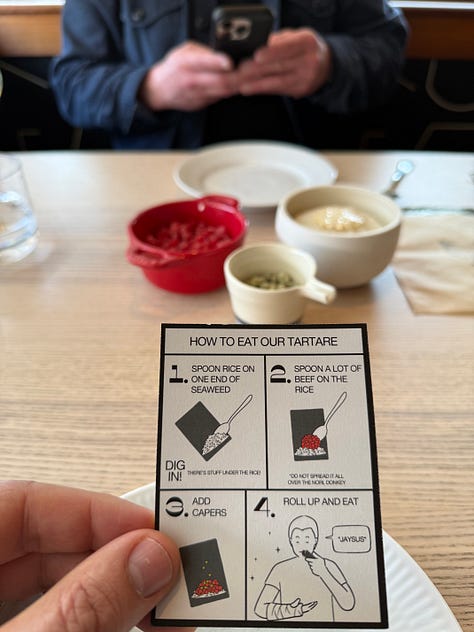
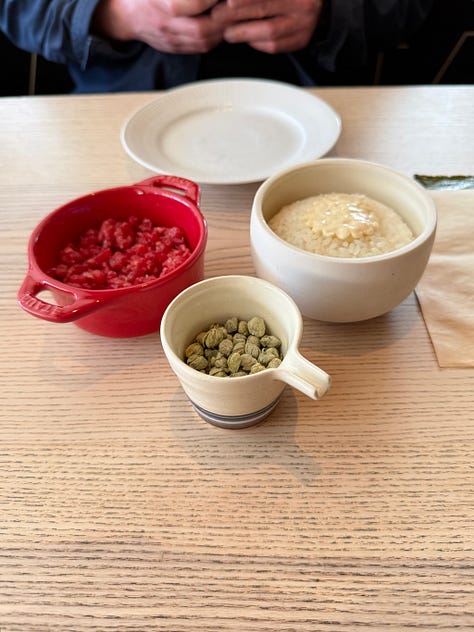
My favorite of all the dishes was the beef tartare, which arrived as a three-part DIY hand roll kit with very good raw beef, freeze-dried capers (why have I never had these before?), and bone marrow rice, served with a sleeve of nori and cartoon instructions on how to put it all together.
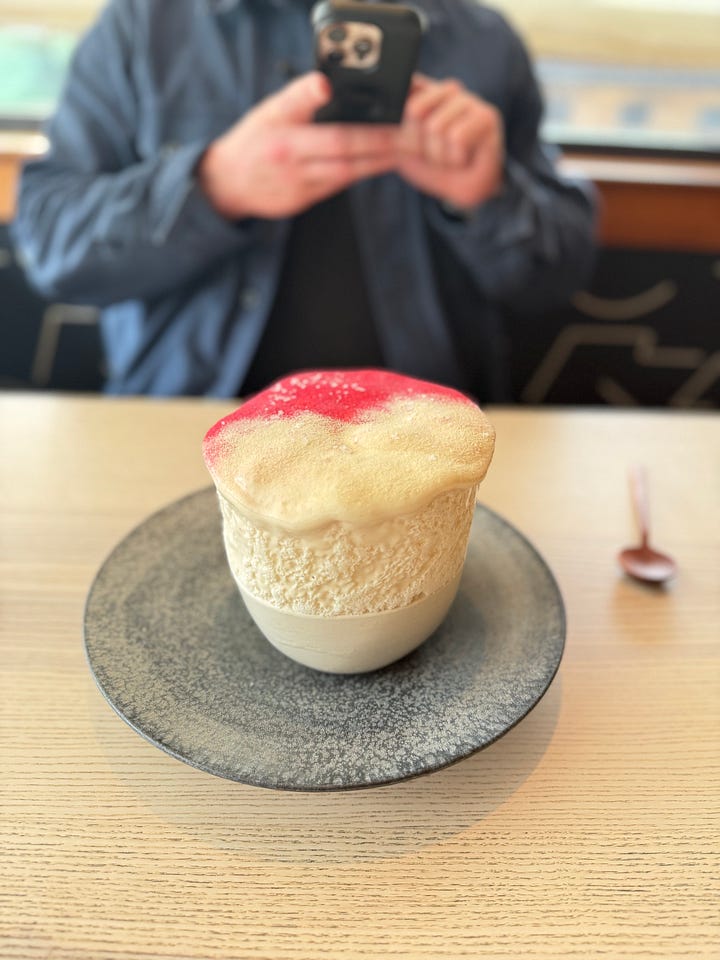
As dinner ended with a tall bowl of Japanese shaved ice, I thought of how fortunate and grateful I am to eat at so many great restaurants all over the world, and that this was without doubt the most fun meal that I’ve had in a long, long time.
And why not have a fun meal in Nashville? Nashville is above all a fun place, and that’s a good thing to be at a time when the world can so often feel too serious. It’s easy to forget that hard work can be fun too, and that often it is the power of culture (a great dining experience in this case) that gives us the agency and inspiration to do the hardest things.
We ate well throughout Nashville.
The famous Arnold’s is Tennessee-style “meat and three” restaurant on the edge of downtown. The mains change by the day, but we enjoyed tasty ribs, chicken, and roast beef, plus tasty and tangy collard greens, cornbread, sweet tea, and mashed potatoes that seemed to mirror the Joel Robuchon formula of one part butter to one part potato—but looked more like Southern cafeteria fare than anything Robuchon likely cooked in his 73 years on earth.
I should not have been surprised that Sean Brock’s Japanese-inspired Sho Pizza Bar would be so good. Sean is a great and inventive chef, and the dinner he did with Matt Lightner at the very first Feast Portland remains one of the dinners people still talk about most with regard to my former Portland food festival. What times…
For the under-informed, Tokyo right now is considered to be one of the best pizza cities in the world, and has developed a style specific to Japanese tastes and techniques. Many Japanese pizza makers run slightly higher hydration doughs than classic Neapolitan formulas, which creates a dough that is lighter, with a softer bite rather than the chew you sometimes get in Naples, or at Portland pizza spots like Lovely’s and Ken’s, which reflect more European-inspired tastes. To be clear, when you’re talking about pizza, there really is no right or wrong—there is only good and less good. And these were great, as are Ken’s and Lovely’s.
I love truffles when they’re treated correctly (because they are so often not), and in my opinion truffles are most crave-able when paired with fatty and pungent flavors—like dry-aged beef with that complex yellow fat, or in this case a pizza with bits of black truffle (not too much) with a funky cheese blend and a little sweetness.
If you’re going to Nashville, there are also the classics. Catbird Seat was the first Nashville restaurant that entered the national fine dining zeitgeist, and Locust is part of the same restaurant group. There’s also Phil Krajek’s Rolf and Daughters—a modern classic with patina—and his new spot, Juniors, which we enjoyed on the first night. Great chicken, and also a lot of Oregon wines on the list, which is always nice to see as a Portland guy.
And you can’t talk about sense of place and Nashville without mentioning music. I’m no expert on live music in Nashville, but there is always a lot to check out both off and on Music City Row. For music fans, the Country Music Museum and Hall of Fame will feel a bit like visiting the Vatican. It did for me. You’ll find everything from Elvis Presley’s limo (with gold-plated door handles) to the flowery hat that Bob Dylan wore on the Rolling Thunder Review tour, the actual fiddle of Bob Wills, and an entire room full of Dolly Parton outfits. And for all you Swifties, there’s an entire room for you as well.
What other city has so culturally punched above its weight?
And maybe that’s the real takeaway.
Nashville knows what it is, and it leans into it hard. The music, the food, the humor, the generosity—it’s all connected to the same cultural operating system. And when a place understands itself that clearly, the results tend to be pretty good.
You can fly direct to Nashville in less than four hours on Alaska Airlines from Portland.
No posts
Comments
Nothing yet. Say the first thing.
Sign in to join the conversation.