
Following our last post on this subject, we have continued to keep an eye out for new data to assist us all in understanding any possible relationships between Serial Numbers and dates of production for the slide rule lines of Keuffel & Esser. We would like to thank our readers for their contributions to our lists of K&E slide rules with serial numbers. To date, we have collected information for almost 1800 slide rules — roughly 990 wooden and 790 plastic rules — which is up by about 500 since our last report.
Starting in 1922, Keuffel & Esser began placing a serial number on both the body and the slide of their quality wooden slide rules. These numbers were used to match parts during production. As the 6-digit serial numbers were stamped on the wooden rules sequentially, these numbers are usually highly correlated with their manufacturing date. The 6-digits were recycled every one million slide rules, but usually other features, such as changes in scale sets, fonts used, cursors, and so on, can be used to ascertain which “series” of serial numbers a rule belongs to.
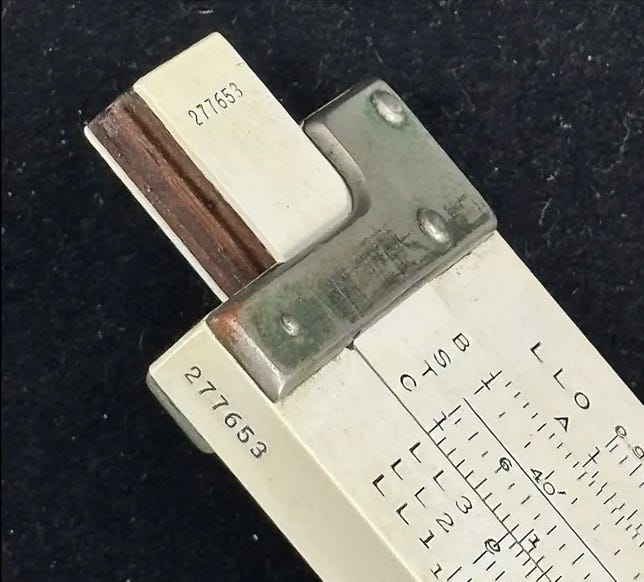
The wooden rules were produced almost entirely in a single factory location, and thus it tends to be easier to use their serial numbers for dating, as a single numbering system was used. But in the 1930s K&E began to construct plastic rules. As their plastic slide rules went through a number of trials and variants, and were even produced at a number of locations, a number of different serial number series were implemented, and the correlation of their serial numbers with actual years of production has been a bit harder to untangle.
A few K&E wooden slide rules were used by Hughes/McCoy as “benchmarks” in their initial studies of the serial numbers for dating purposes,1 as these have known purchase dates or other well-known dates of interest. These rules were presented in our initial introduction to today’s topic. Two other benchmarks, obtained by one of the authors, were also listed at that time. Since then, four more examples have been obtained. The total list of 6 “new” Benchmarks for the wooden slide rules is shown here:
Text within this block will maintain its original spacing when published
Year  S     SN      Type       Note
1922  1  001574  4092-3  -- Earliest found serial number, Tarantolo Collecton
1930  1  323568  4093-3  -- Lloyd Caulkins purchased Sept. 1930, college sophomore
1933  1  456328  4091-3  -- R.J. Paoletti, 1933, name/date etched on leather case
1936  1  583009  4093-3  -- friend of John Kay, purchased 1936
1952  2  691870  4081-5  -- Marvin T. Koerner, purchased 1953, Panama Canal Project
1972  4  620732 68-1210 -- last batch of K&E wooden rules; note from Feely to Kyle
The original 1922 model 4092-3 benchmark rule was one of Clark McCoy’s rules that had the earliest known serial number (8041) at the time of his report, and thus was logically assumed to be from the year 1922. Since then, we have identified six rules with earlier serial numbers, including four 4092-3s, and a 4053-3F. But so far, the earliest rule with a serial number that we’ve found is from the Paul Tarantolo Collection, with serial number 1574 — it is a model 4053-2. We will adopt the use of the earliest known serial number for our future “Benchmark #1” rule, which is therefore 1574 for now. But none of this discussion of the “earliest” serial number makes any difference, of course, to our conclusion. One could easily just use a Serial Number of “1” with a date of 1922.
So, in our data we have the following Benchmarks with Serial Numbers adjusted to Series. That is, the Adjusted Serial Number (“SNadj”) is a 7-digit number with a digit of 0, 1, 2, or 3 (representing the first through fourth series of serial number use) that precedes the actual 6-digit serial number found on the slide rule.
Text within this block will maintain its original spacing when published
                B-1          B-2     	B-3  	B-4  	B-5  	B-6  	B-7
Model	4092-3	4092-3	4053-3F	4093-3	4091-3	4080-3	4093-3
Year	1922	1922	1925	1930	1933	1936	1936
SNadj	1574	8041	111804	323568	456328	521432	583009
                B-8	        B-9	        B-10	B-11	B-12	B-13	B-14
Model     4081-3	4081-3	N4081-5	4071-3	4081-3	68-1200	68-1210
Year        1945	1947	1952	1958	1960	1964	1976
SNadj      1130398	1195932	1691870	2186059	2432306	2810037	3620732
Benchmarks have been based upon purchase or acquisition dates, not necessarily on dates for when the particular rules were made. It has been noted that the wooden slide rules were being produced only until about 1972 or so, and mostly from stock that had its production ended in about 1969.2 But we also have learned that there was a lost batch of slide rules — about 2000 — that were found and finally produced in 1976.3
Our Benchmarks refer to when the slide rule was purchased or contemporaneously acquired, not necessarily the year in which it was “made”. Our last Benchmark is that of a 68-1210 slide rule (old 4081-3) with a serial number of 620732, which is believed to have been in the “last batch” of K&E wooden slide rules.4 As it turns out, though, the actual date when our last Benchmark rule was acquired for the first time, directly from the K&E warehouse, was in about 1996!
We regard this last circumstance to be rather atypical. What we do know is that all slide rule production ended in July of 1976 at K&E, and general sales of K&E slide rules ended rather abruptly thereafter. And so we will use 1976 as the endpoint year for our final Benchmark, with 3620732 as its Adjusted Serial Number. We found that changes in the endpoint, either in year (1975 vs. 1976, say) or in serial number (less by 2000, say) really does not affect our overall conclusions significantly at all.
During our investigations we have found a number of “Military Slide Rules” which we believe were very likely made at the beginning of the US involvement in World War II. A description of this circumstance is presented in a previous post. The image below depicts the hypothesis of this analysis, indicating that an initial bump in production rate during the early war years perhaps gives a better fit to the serial numbers observed during that period than do the previous linear fits used. While we do not have a slide rule from the early 1940s that can be thought of as a true “Benchmark Rule” in the strictest sense, we can imagine a “virtual” benchmark for a Serial Number of about 760,000 in 1942, which is consistent with the military rules and their reference manuals.
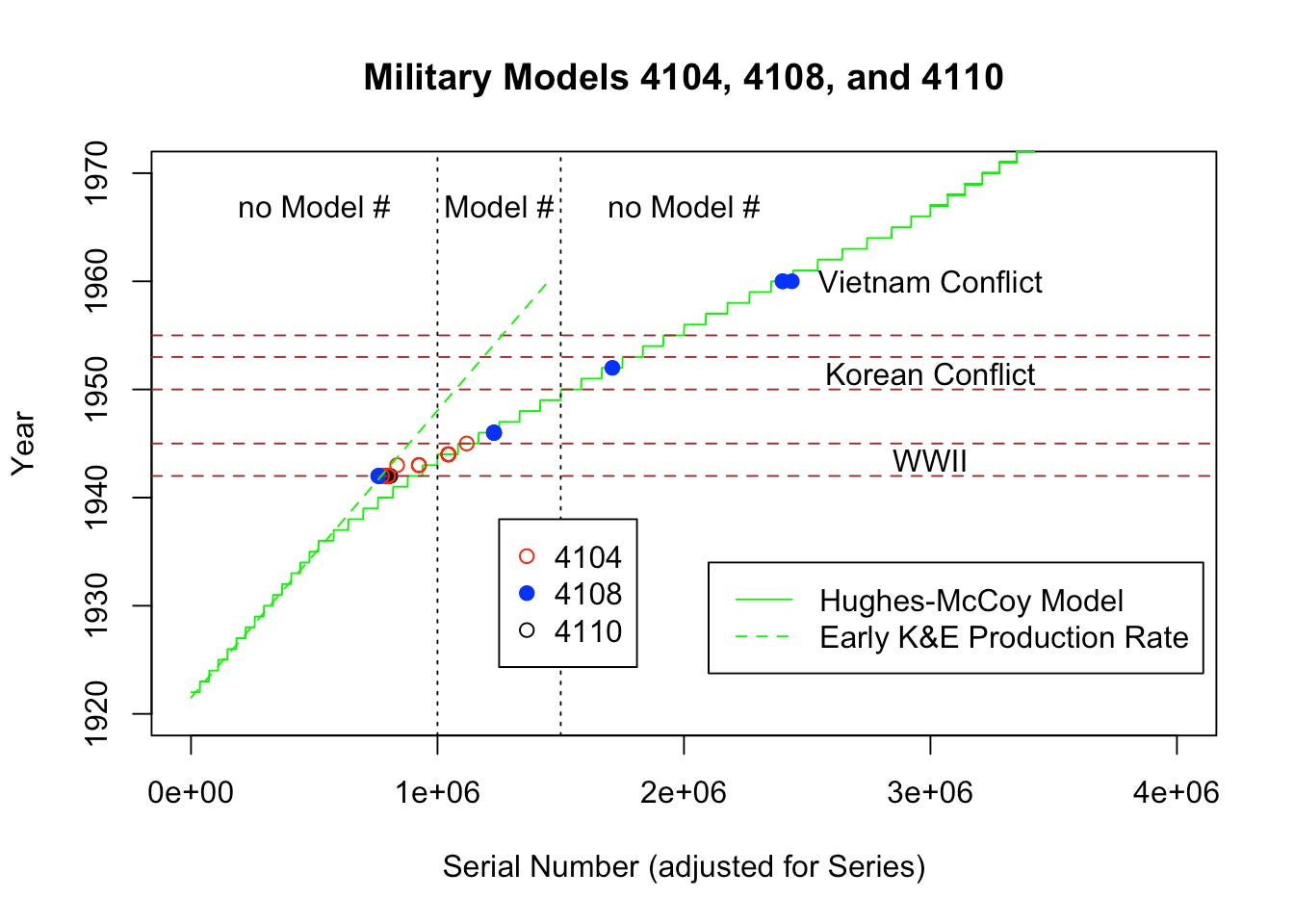
For what follows, we add to our list of Benchmark “data” our earliest Military Rule thus far, assumed to be from 1942, which has serial number 760102.
In addition to simple linear interpolations between Benchmark rules as has been done in the past, we can attempt a polynomial fit of the data. Of course no actual production of slide rules would create a “smooth curve” in reality, but having a single algebraic expression for the production time line curve of wooden K&E slide rules might be of use in some studies. To make a nice smooth fit, several nth-order polynomials were examined. We found that it took a 7th-order curve to best fit through the data with minimal residuals.
If 𝑥 is the Adjusted Serial Number divided by 106, then the best fit through our list of 15 Benchmarks provides the following equation:
\(\begin{eqnarray*} {\rm Year}(𝑥) &=& 1922.6 +14.885𝑥 +55.917𝑥^2 -98.797𝑥^3\\ &~&~~~~~~~~~ +72.673𝑥^4 -27.105𝑥^5 +5.0361𝑥^6 -0.36942𝑥^7 . \end{eqnarray*}\)
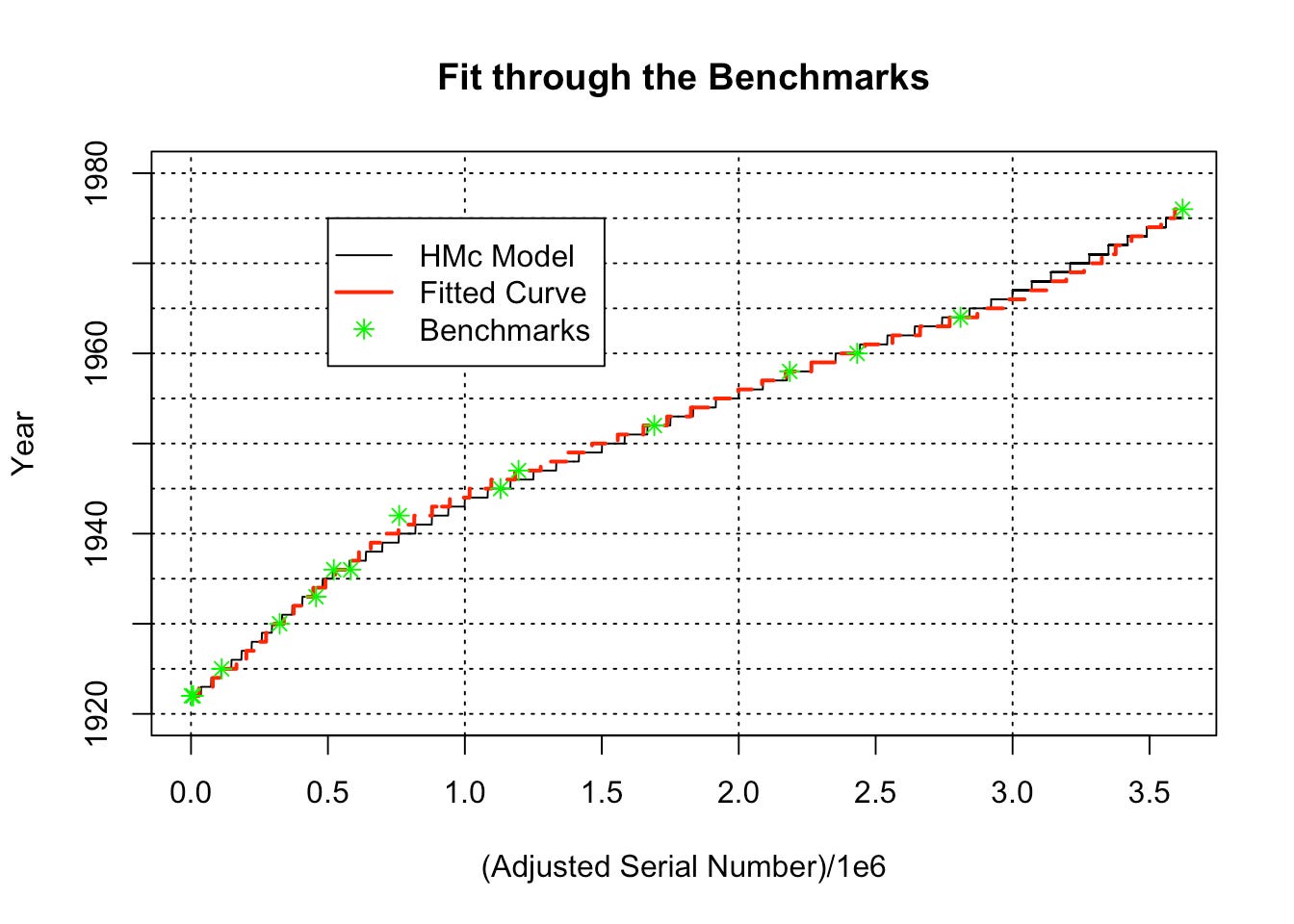
A “floor(x)” function can be used, which just gives the nearest integer below the value of x, when evaluating our function to produce a step function as shown in our plot below; superimposed upon the curve are the Benchmark data:
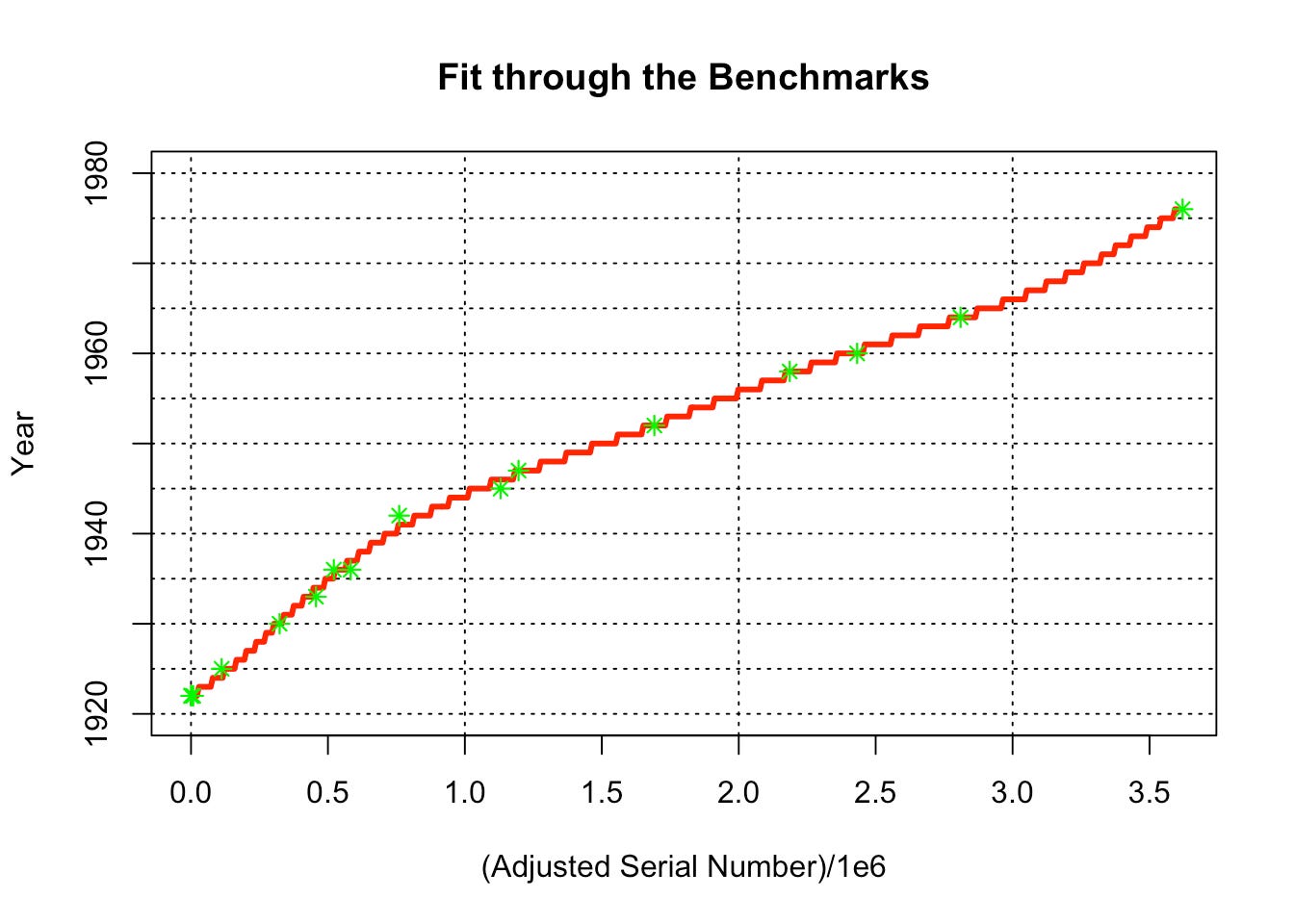
The Serial numbers change by tens of thousands per year, while the “Year” variable of our Benchmarks is a single whole number, and so the error in “Year” could be expected to be roughly ±1 year. The differences between the year provided by the fit (including the use of the Floor function) and the year of each Benchmark are shown next:
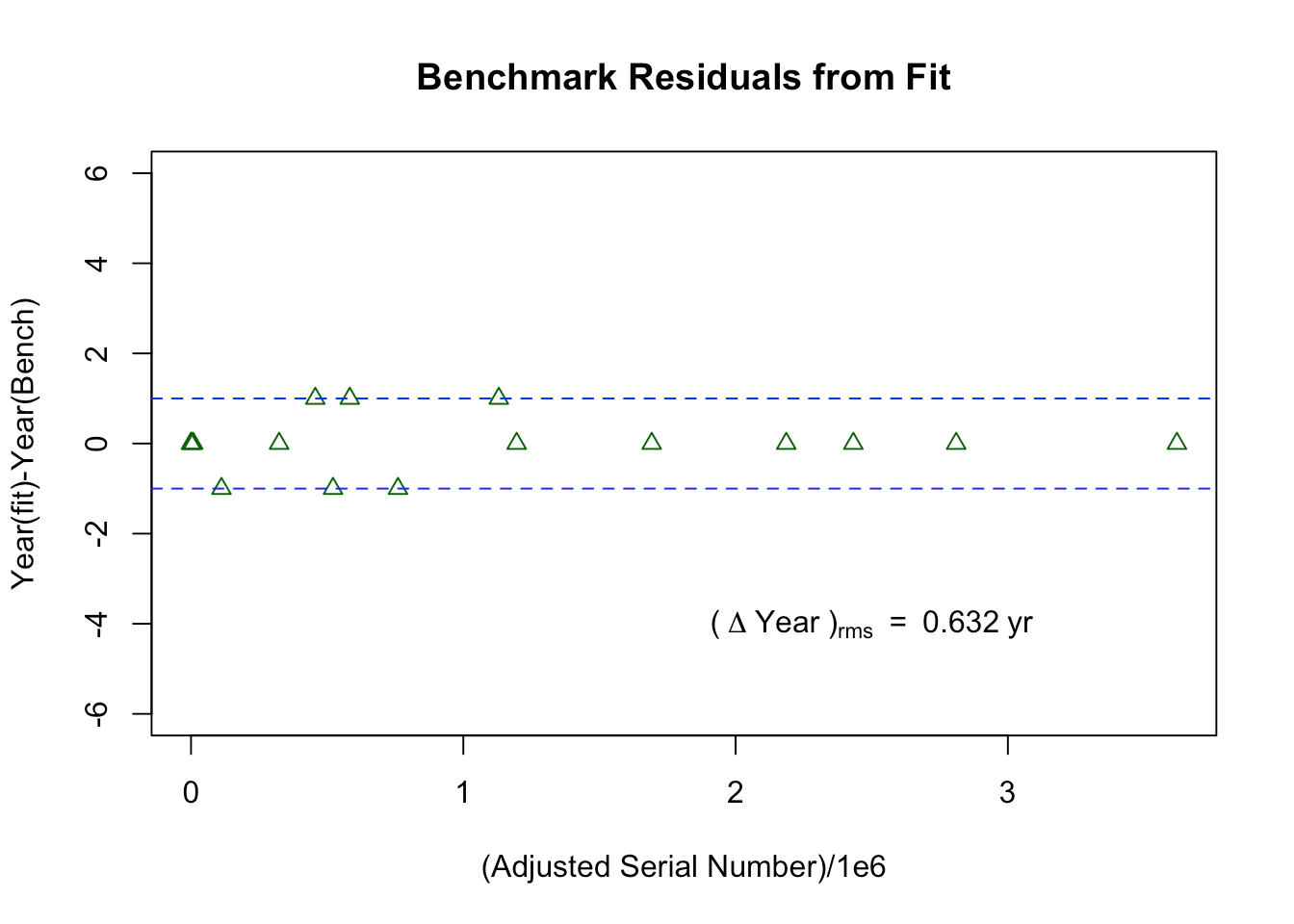
This indicates that an error of ±1 year (or even slightly better) is certainly a reasonable assumption for this model of the Benchmarks, as is the case of the Hughes/McCoy model.
The biggest excursions with respect to the standard Hughes/McCoy model are near the inflection point at the beginning of World War II, driven by our additional Benchmark in 1942 being used. Below is a comparison of the polynomial function (red) to the Hughes/McCoy function (black):
A comparison of the results given by the fit to the results given by the Hughes/McCoy Model, when using a uniform set of Adjusted Serial Numbers, yields the following:
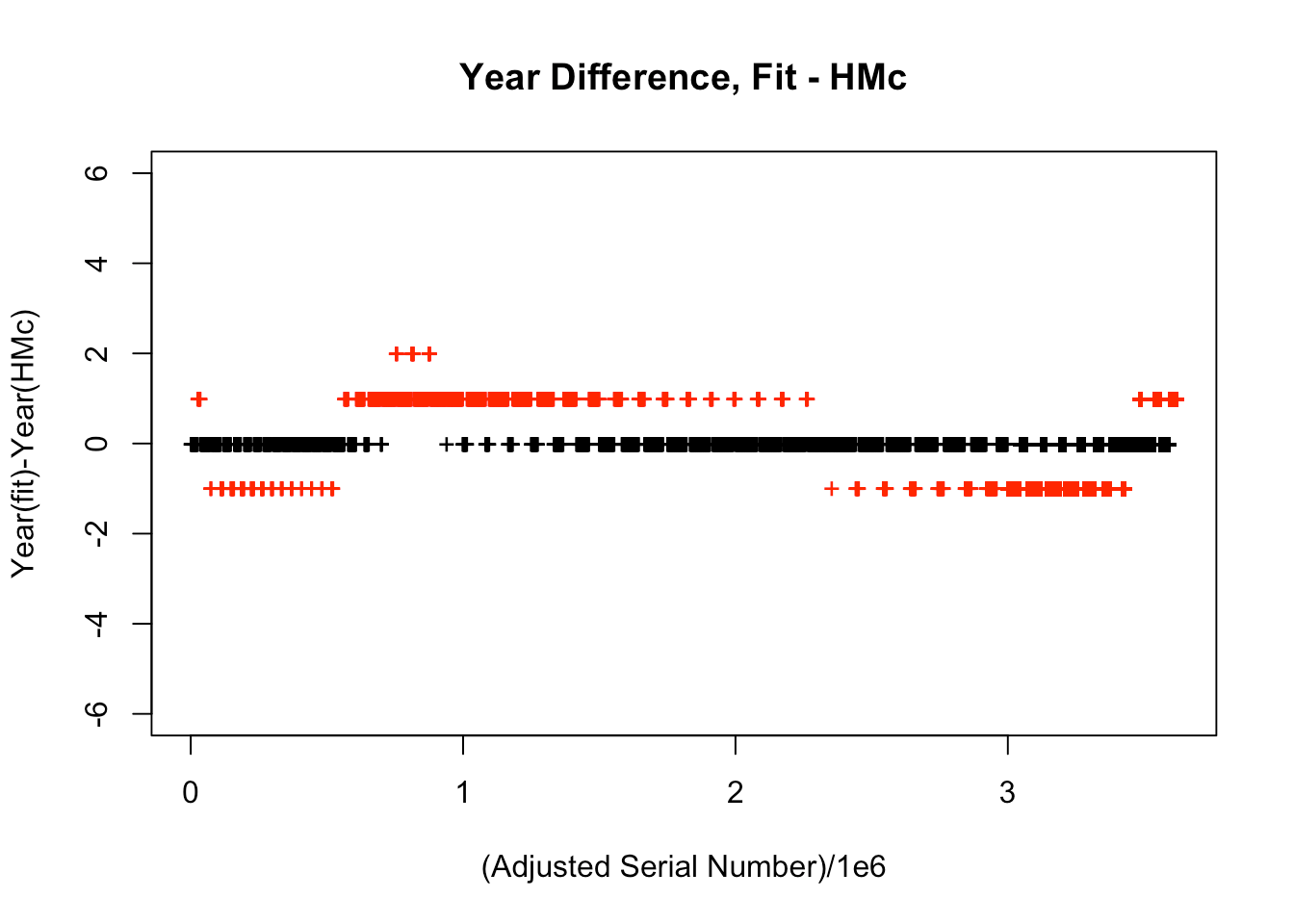
The fit gives the same year as our earlier Hughes/McCoy model, within ± 1 year, with the exception of the “bump” at the beginning of the WWII years. In essence, it produces an increase in production rate around WWII, reconnecting with the Hughes/McCoy model through the 1950s, and then exhibits a deceleration through the end of production.
In addition to the investigation of the dating of the Military Rule discussed above, there are a few updates to some of the other wooden rules.
In our previous post on the Model 4133, our plot showed a data point for an adjusted serial number of 1415945 with a year of 1948, 4 years beyond any other Roylance example. The serial number has been double checked and indeed the number is correct. But we also have since received further details of the rule. From further investigations in which we compared the features of the rule with the McCoy catalogs, we found that this rule is consistent with the model 4133 in the year 1933 — i.e., from Series 1 rather than Series 2 of the K&E wooden slide rule production. The K scale was added to the rule in 1933, which this rule has. And the last time the Roylance was mentioned in the catalogs was in 1944. Over that 11 year period, the design of the Roylance did not appear to change. If we assume a date of 1933 for this rule, the Roylance plot now looks like the following:
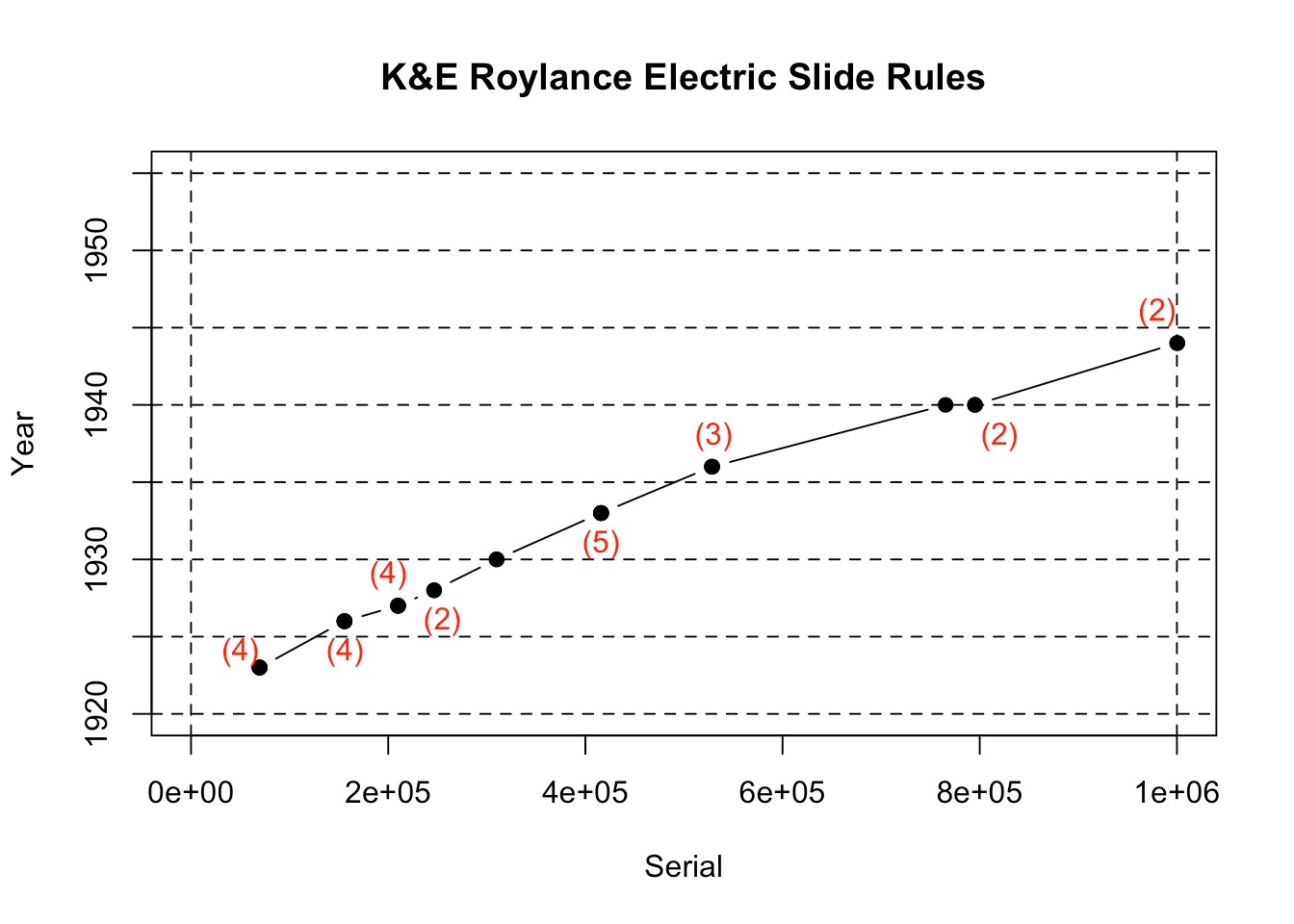
Many of the “dots” shown actually represent groupings of rules that have very close serial numbers. The number of rules (if more than one) in each group is given in parentheses. This seems to suggest that this model was made in batches during its long-term production.
Only two new “Mystery Rules” have been entered since our last post on the subject, which have not changed our conclusions about their dating. But there was one significant outcome to report from our continued investigations into their use. The mysterious “Model 4104” 20-inch slide rule is now known to have been a special scale set designed for the analysis of weather balloon sightings during World War II. Eamonn’s report on the subject can be found in another post.
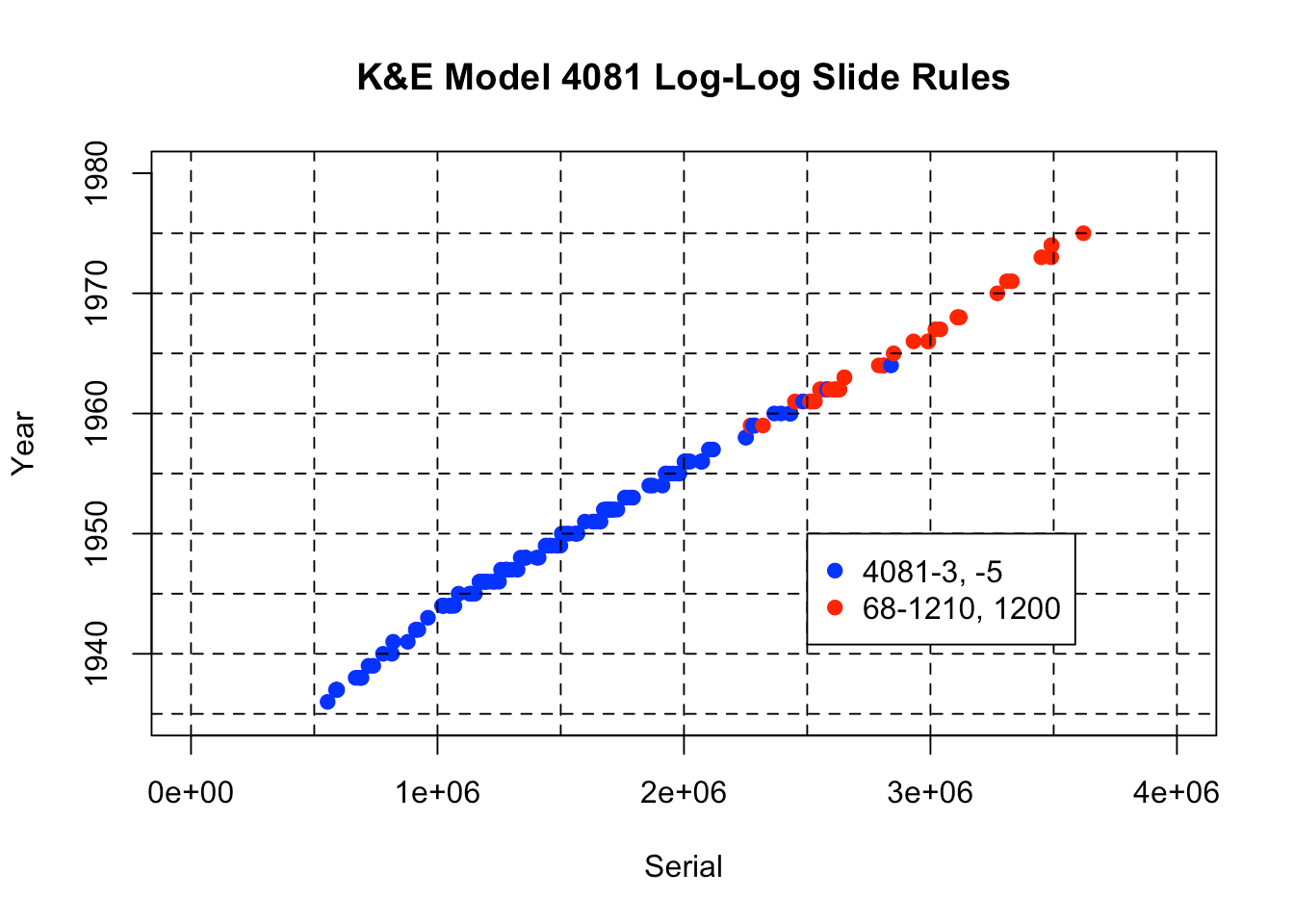
We showed a plot of the Model 4081 slide rules in our earlier post, but our data set is a bit larger now. This is a good example model to look at, as its production spans many of the years for which the serial numbers were being used.
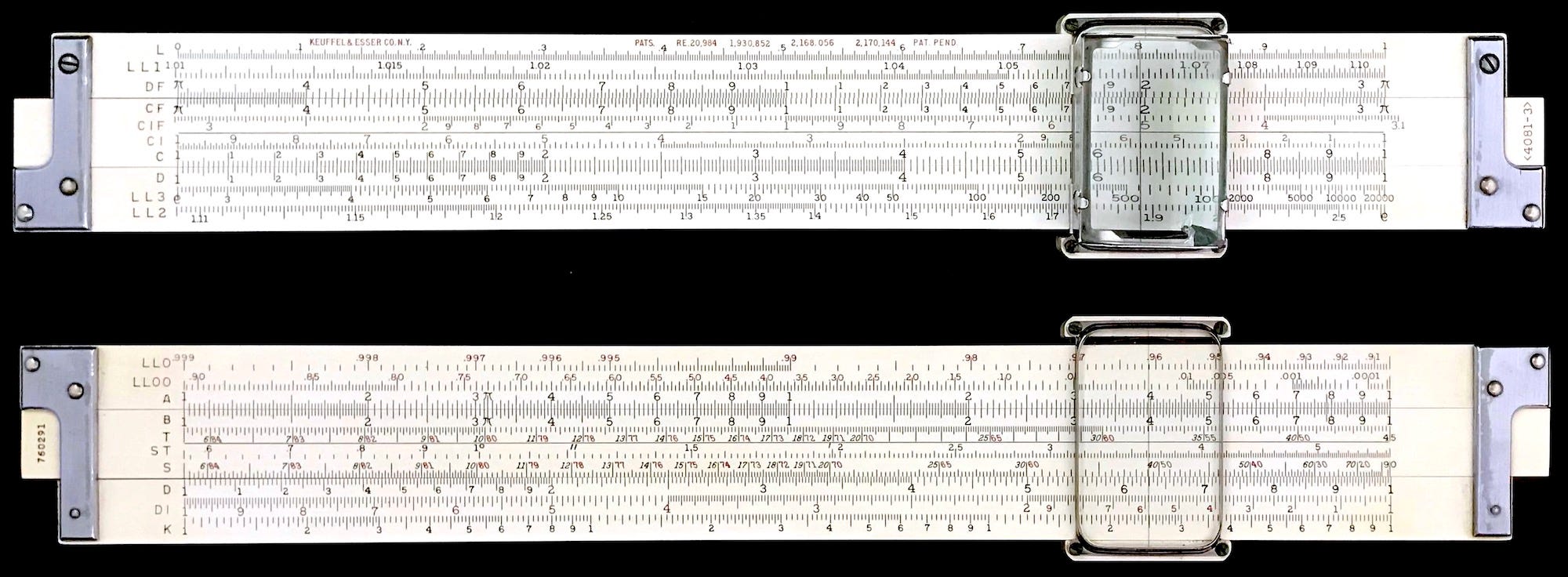
Below we include the rules that were labeled as “68-1210” (10-inch) or “68-1200” (20-inch), which began to appear around 1960. The new model numbers did not appear in the 1958 price list, but showed up in the next catalog which was in 1962. We can see some overlap from about 1959 to about 1964. This is likely due to rules being re-packaged, taking longer time to sell, and so on. We know that often slide rules were found which were labeled with the older model numbers, but came in boxes with the new model numbers.
The plastic slide rules made by K&E had a variety of serial number series. As previously reported, the early 4097 and 4098 had a single series, and the associated future variants (4097B/C/D and 4098A) had their own set, as did the Doric slide rules. And the most modern plastic rules, such as the Deci-Lons, Analons, and the GP-12, each had their own separate serial number sequences. A separate post was made on the Analon serial numbers.
We still have much to learn about the transition of the general slide rule production of the “41xx” model numbers, and their transition into the “68-xxxx” re-numbering of those models. This is still work in progress.
The Deci-Lon 10-inch side rule serial number story has been reported in an earlier article. A “benchmark” Deci-Lon was reported at that time, and since then a few others have been submitted. Here is our present list:
Text within this block will maintain its original spacing when published
Serial No.    Year     Note
        1           1962      assumed start of production
   079538      1964      eBay item 117284906001, receipt 10/12/1964
   095988      1965      FB Marketplace, sold by original owner
   112255      1966      eBay item 127826232449, box dated 9/24/1966
   197897      1968      Ke-Lon prototype
   225540      1971      ISRM:  Jeff Ilseman, West Point
   233300      1972      earliest no-finger bars; assumed 1972
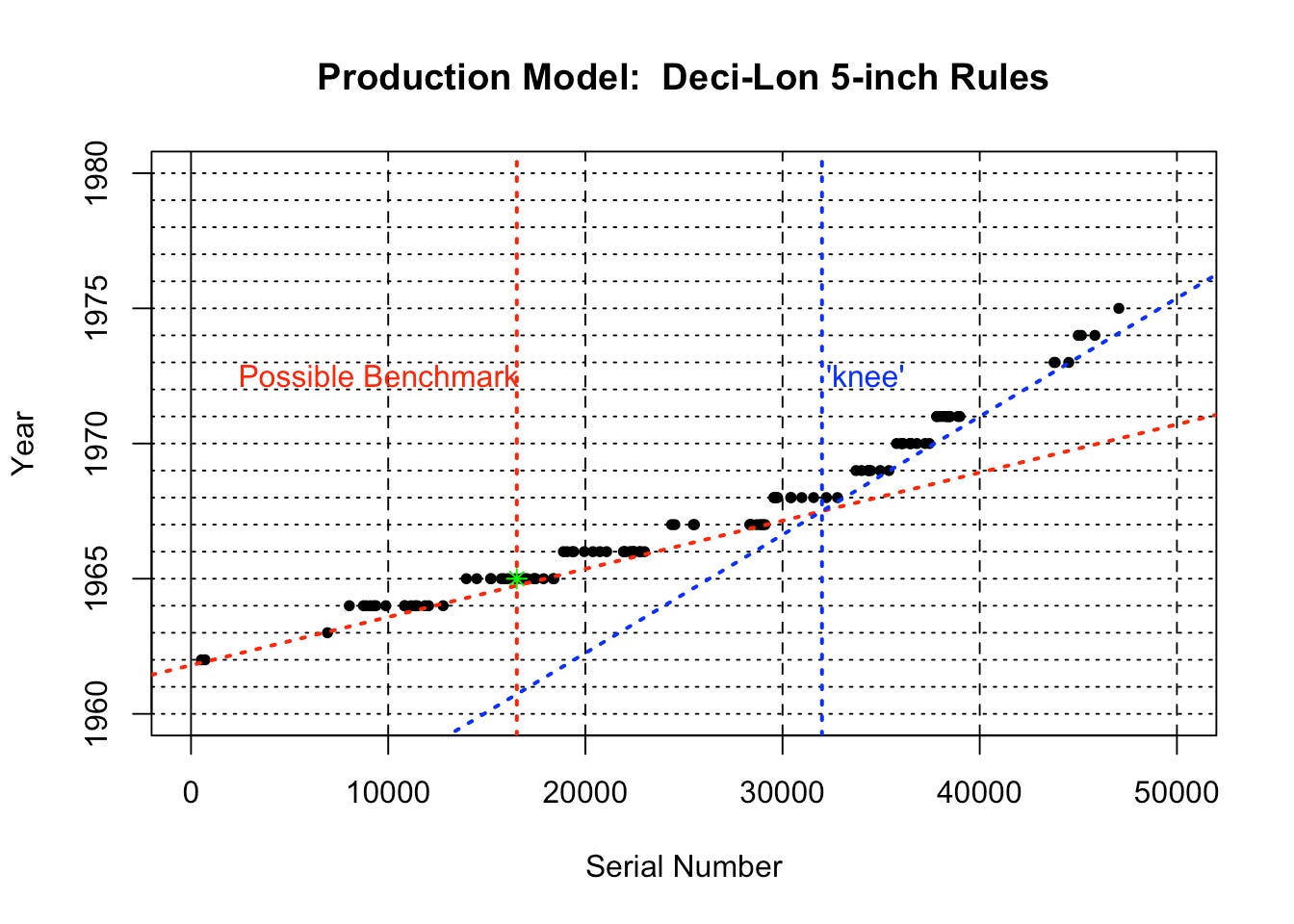
The new benchmarks for the 10-inch Deci-Lons conform fairly well to our previous curve. Since that writing, a possible benchmark slide rule appeared for the 5-inch model. This rule has serial number 016524 and was received by a person in high school after winning a slide rule competition, according to his post in the Vintage Slide Rules Group on Facebook, from May 8, 2026. From what we know, this rule would have been awarded in about 1965, when this person was a Senior. If he was 1-2 years younger, then the rule would need to have been made earlier.
Again, this is not so very reliable, as it is a bit anecdotal, but it does suggest a possible inflection point in the production rate of the 5-inch rules. This should not be too unexpected, as such an inflection occurred in the 10-inch rules. So it is not a bad assumption that the production rate was a bit higher in the beginning.
Originally we depicted the production of the 5-inch Deci-Lons as a straight line, with serial numbers between 1 and about 48,000, distributed between the years 1962 and about 1975-76. If we set the year of the 5-inch Deci-Lon with SN = 016524 to be 1965, then we can line up the front-end of production starting in 1962 to pass through this benchmark. Next, if we assume that the change in production rate of the 5-inch rules occurs in the same year as the better-documented change in slope of the 10-inch rules — roughly 1968 — then we can introduce that inflection point in the 5-inch rules as well, and take the new reduced production rate through to the end production in, say, 1975. The result would look like this:
In one plot, we illustrate the two Deci-Lon slide rules together:
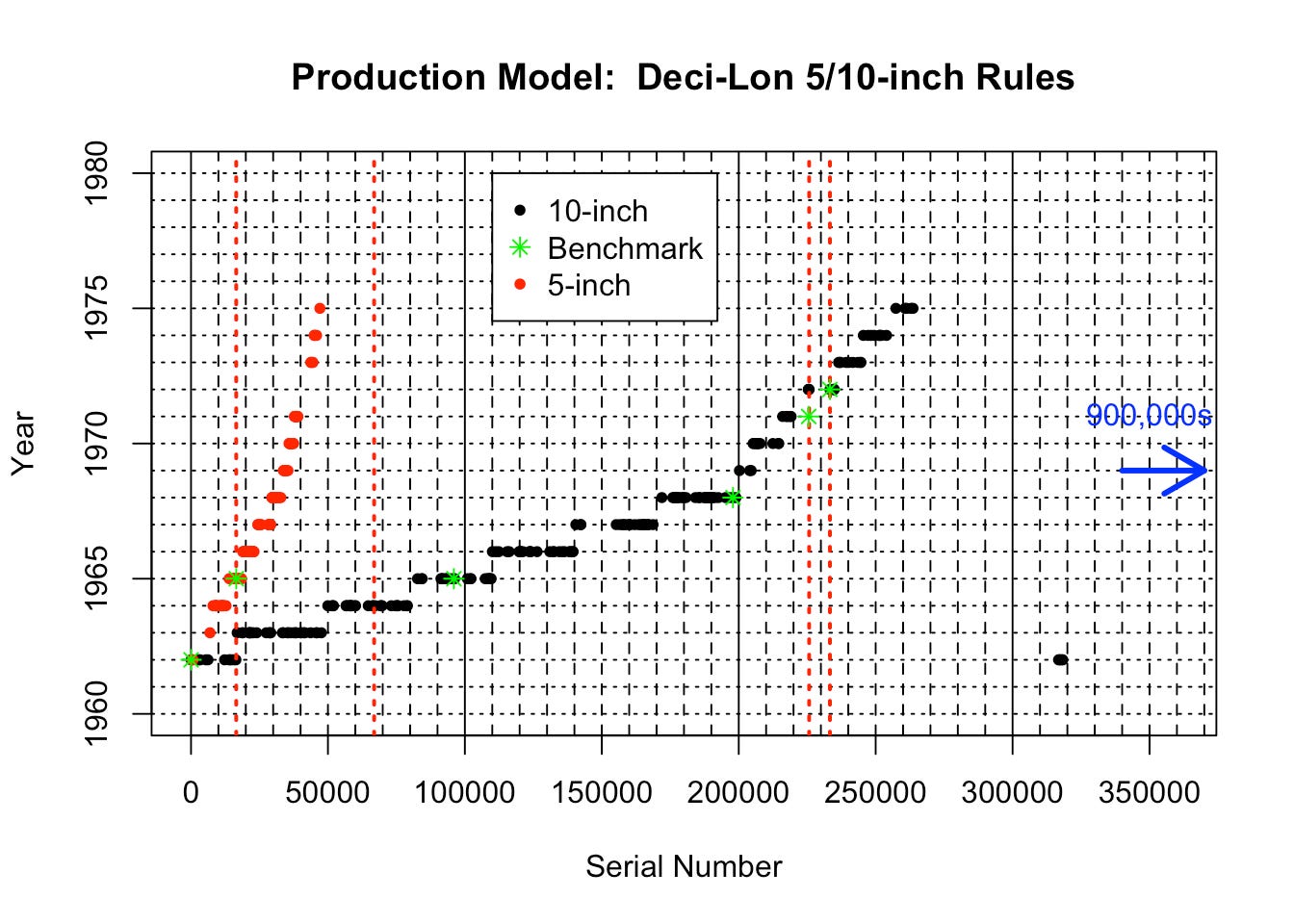
We suggest that this might be a better modeling of the production of these slide rules. Of course if anyone has information that can help to benchmark these rules, please contact us.
From our reader contributions, Deci-Lon information has been one of the most profuse. In addition to data from their own collections, one of our readers found another Deci-Lon for sale on eBay with a serial number in the 900,000s. (SN = 901636.) And, he also found a third serial number font being used on some of the Deci-Lons, which Eamonn was able to confirm. Oh, and then there’s the new anomaly discovered by Eamonn on eBay. He found a 10-inch Deci-Lon for sale that has serial number 240144, which would put it near the end of the production, say around 1973-74. But the rule appears to have finger grips and a D4 C6 electro form marking! These two features go against all the others found thus far in this serial number range. Eamonn’s earlier post noted that the D4 C6 electro form ended around SN = 167000.
So, there you go. As we’ve been saying all along, the serial numbers were for production QA and not for dating of manufacture. And with the plastic slide rules, there are plenty anomalies to go around.
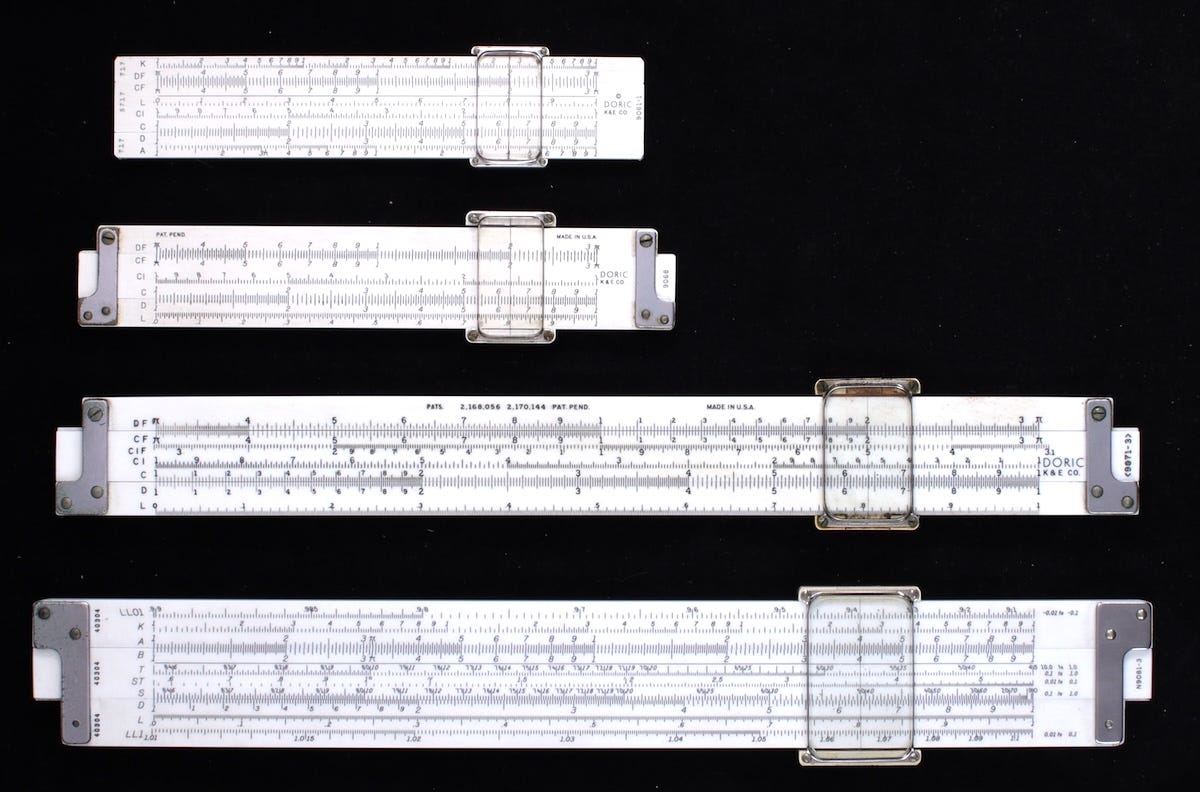
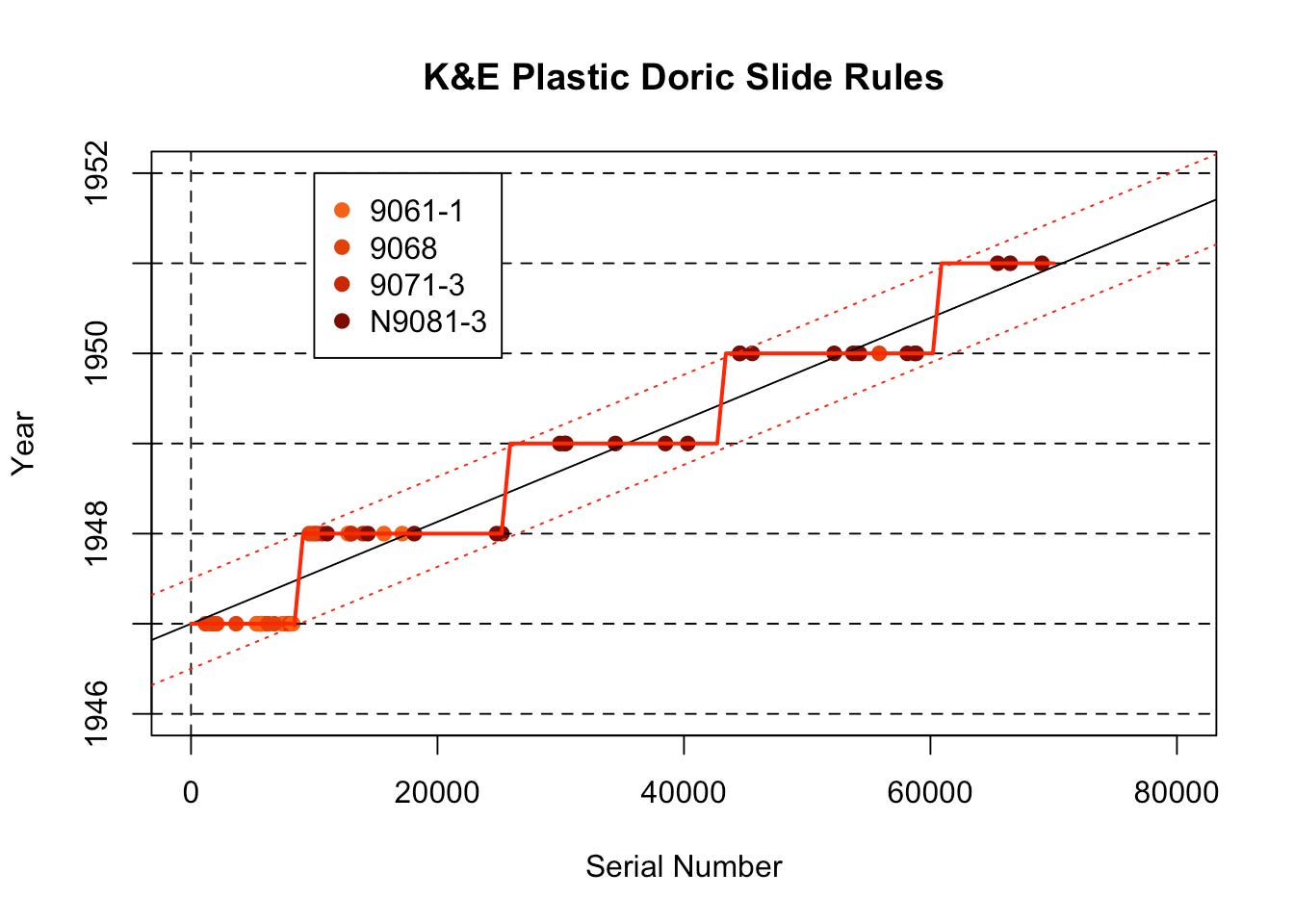
By about 1948 K&E was offering new slide rules made of plastic, the Doric line, which were phased out by 1952. We have obtained data for 54 Doric slide rules. If we were to give each model its own serial number Series, using the K&E catalogs to provide boundaries for the Year values, we would get the following plot for the models collected thus far:
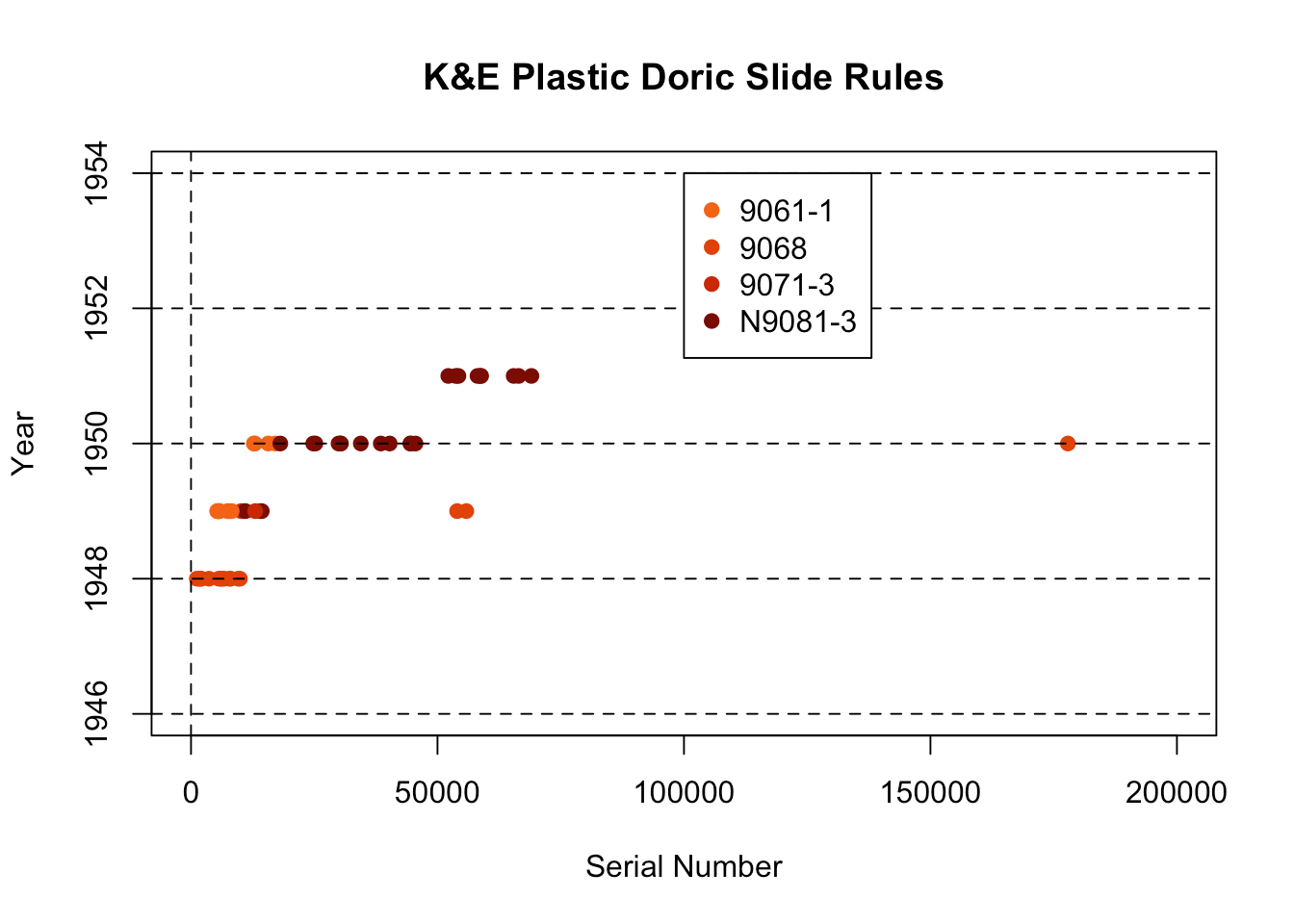
The serial number 177885 for the 9068 in “1950” has been double checked and is indeed that which is displayed on the slide rule. Another apparent anomaly.
If the outlier 9068 in our plot above is in fact part of a special run and thus set aside for the moment, and if a single main sequence of serial numbers of the Dorics is assumed, and spread out over a 4 year period, then we get the following:
We can see that the first year of production appears to have started out with 5-inch rules. This is not a surprise, as the Dorics were to replace the original plastic slide rule line-up of the 5-inch 4097s and 98s. By the third year or so, the production appears to have been concentrating on the 10-inch rules. Of the two 10-inch rules shown in the image above, the earlier one is a Model 9071-3, which is the first plastic version of their wooden 4071-3 model line. The last rule in the image is the Model 9081-3, the first plastic version of the popular wooden 4081-3 line. One can easily see the advancements made in the 10-inch rule construction.
With this number of samples, and several models in the Doric line, there is a lot of uncertainty in our curve shown above, but we feel this is a good first-pass at laying out the Doric slide rules, assuming that a single “main sequence” of serial numbers was used during their production, which appears consistent with the data.
The 5-inch model 9068 was the only Doric slide rule that continued to be manufactured using the Doric brand after about 1951. It was listed as 9068 in the 1940 catalog, was re-branded as model 4168 in about 1951, and after the model numbers were converted in 1962 it became Model 68-1555 (68-1550, if the leather case had a pocket clip). This slide rule and its variations represent the only K&E model found in the catalogs that continued to have the “Doric” label until the end of slide rule production.
There was one other version of this rule, however, which was also labeled with the Doric brand, but which was not shown in the catalogs. This rule, which did not display a model number, was made of a different plastic. The Celanese Polymer Company, a Division of the Celanese Corporation of America, out of New York City, created a new ultra-stiff plastic, which they called Celcon, and to help introduce their new product they had K&E produce a slide rule for marketing purposes. According to Soper, “This “Executive Gift” slide rule was to acquaint potential resin users of the outstanding properties of the Celcon resin. What better way to demonstrate the machining properties than to mold and machine a slide rule using this resin.”5 The Celanese Celcon slide rule was essentially a Model 68-1555, made using the old mold, but using the new plastic.
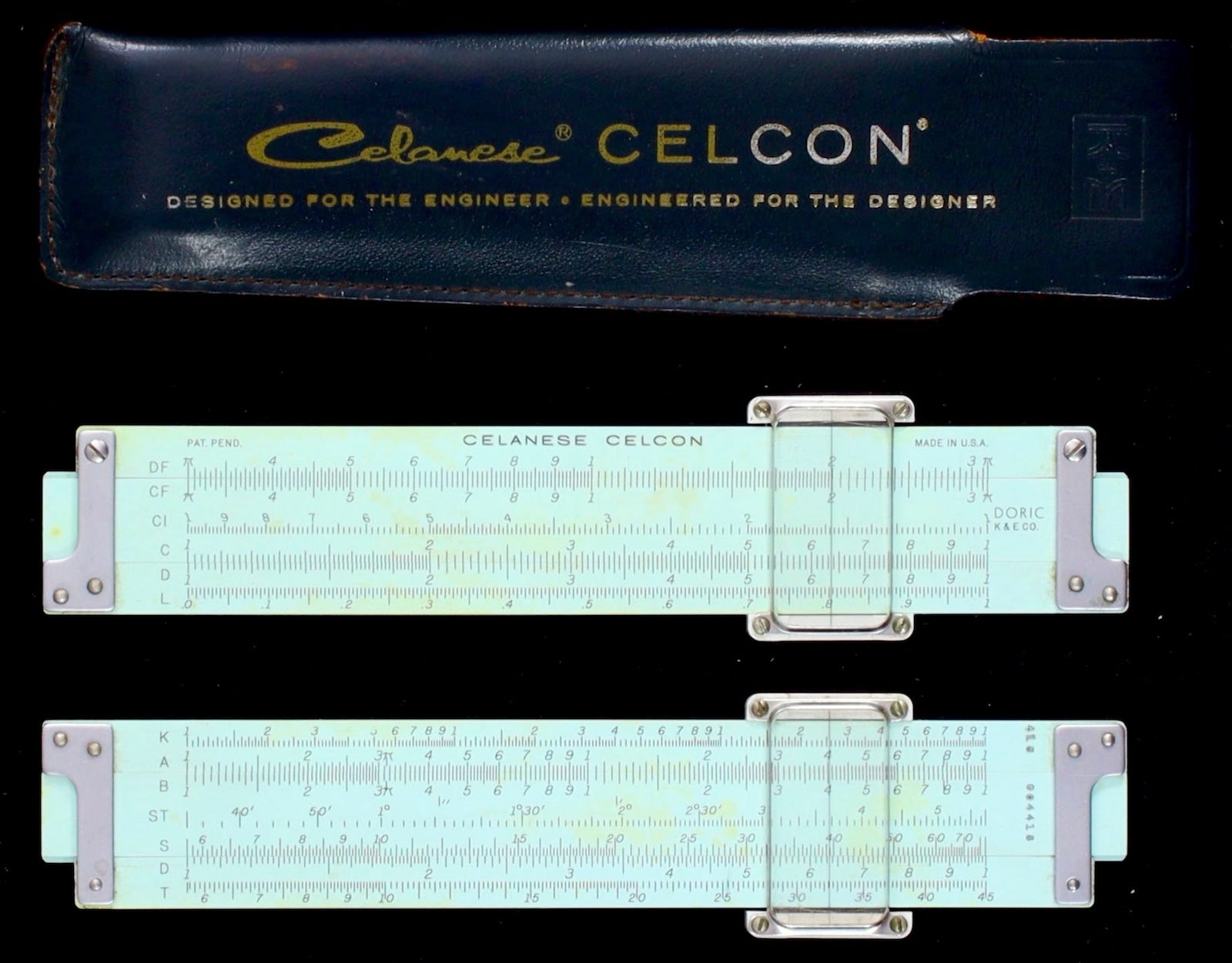
Interestingly, Celanese Synthetics was advertising and selling a Celcon plastic as early as 1947.6 However, the name was repurposed in 1961 by Celanese Polymer for “a new tough thermoplastic, an acetal copolymer”, which “entered competition for engineered parts requiring strength, heat resistance, good color and gloss.”7 Both of these companies were operating divisions internal to Celanese Corporation of America. A slide rule made of Celcon is referenced in the 1964 British Plastics and Moulded Products Trader (found on Google books) and is most likely the K&E rule.
We noticed that many of the Celanese Celcon slide rules have serial numbers, though just about as many do not. Of the 42 samples that have been examined, 14 have serial numbers between 2000 and 8000, two have serial numbers 620214 and 620234, 18 have no serial number at all, and 8 were found for which one could not tell from their images if there was a serial number or not. From this we tentatively conclude that there were at least three production runs of the Celanese Celcon rules.
We believe that the slide rules with serial numbers, which have a range from about 2000 to 8000, are from about 1961-64, during the Celcon marketing push, and which were mentioned in the 1964 magazine. If so, then they definitely had their own serial number sequence. There is also evidence of the Celcons with serial numbers shipping with the 4148 manual, which would be consistent with a 1961-64 time period.
The Celcon rules without serial numbers all look much newer than those with serial numbers. In his book about his time at K&E, Joe Soper discusses a production run of the Celanese Celcon, which would correspond to about 1967-68. This could have been the ones with no serial numbers.
Also interesting is the fact that the serial numbers of the very last wooden slide rules made by K&E were also of the form 620xxx. Thus, it is conjectured that the two Celcons with similar high serial numbers were made near the end of the wooden slide rule production. Note that the very last wooden 4081-style slide rules were made at the Salisbury plant, where the plastic slide rules were also made.
So our tentative dating of the Celanese Celcon slide rules would be:
Celcon rule with 1 < SN < 8000 — c. 1961-64
Celcon rule with no SN — c. 1967-68
Celcon rule with SN > 620,000 — c. 1975-76
With our 14 samples of serial numbers in the first category, we can estimate that around 7500 Celcon rules might have been manufactured with serial numbers.8 If an equal number were made in a subsequent run, without serial numbers, then that brings the total to about 15,000. Since only two examples of the “end run” are known, we suspect these are few in number. All of these estimates of numbers and dates for the Celcon slide rules are highly speculative, as we continue to look for further clues and information.
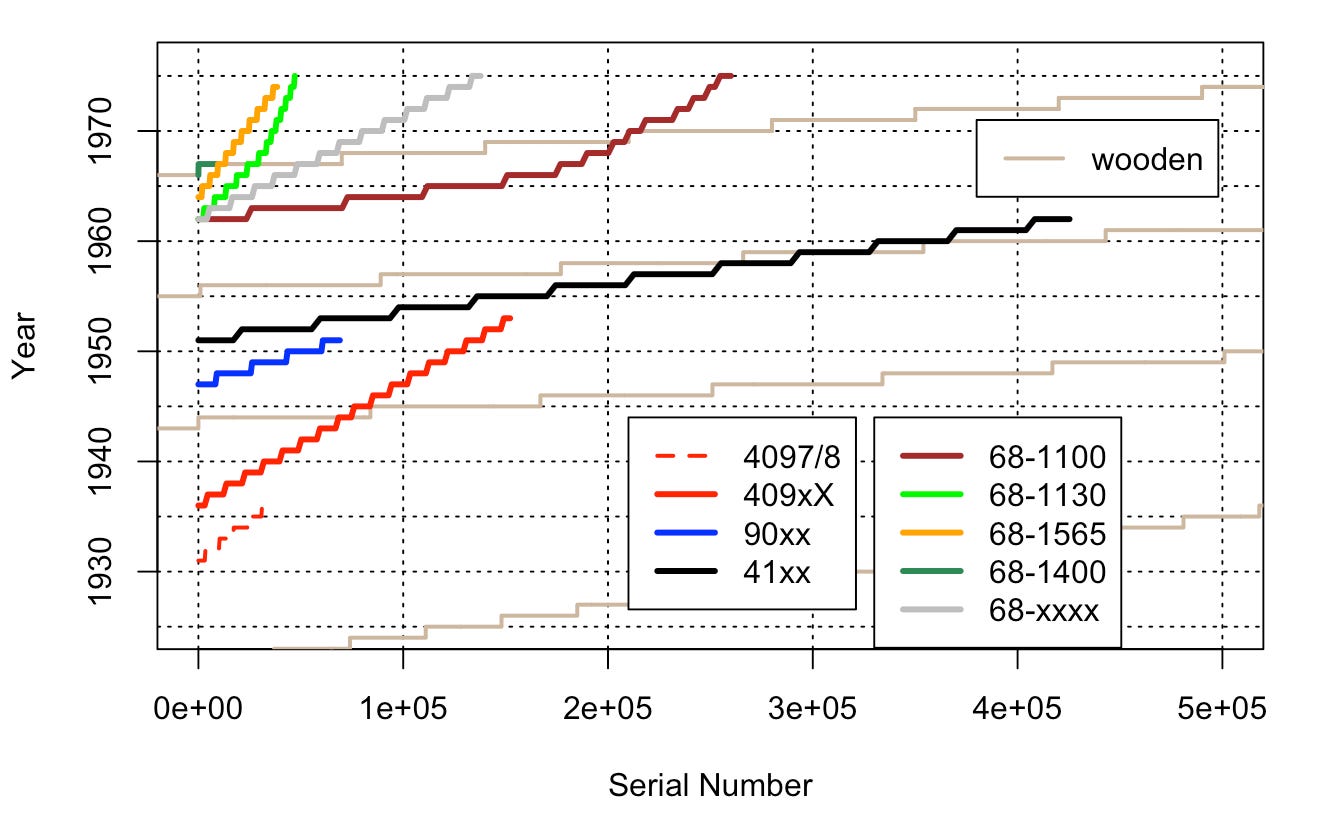
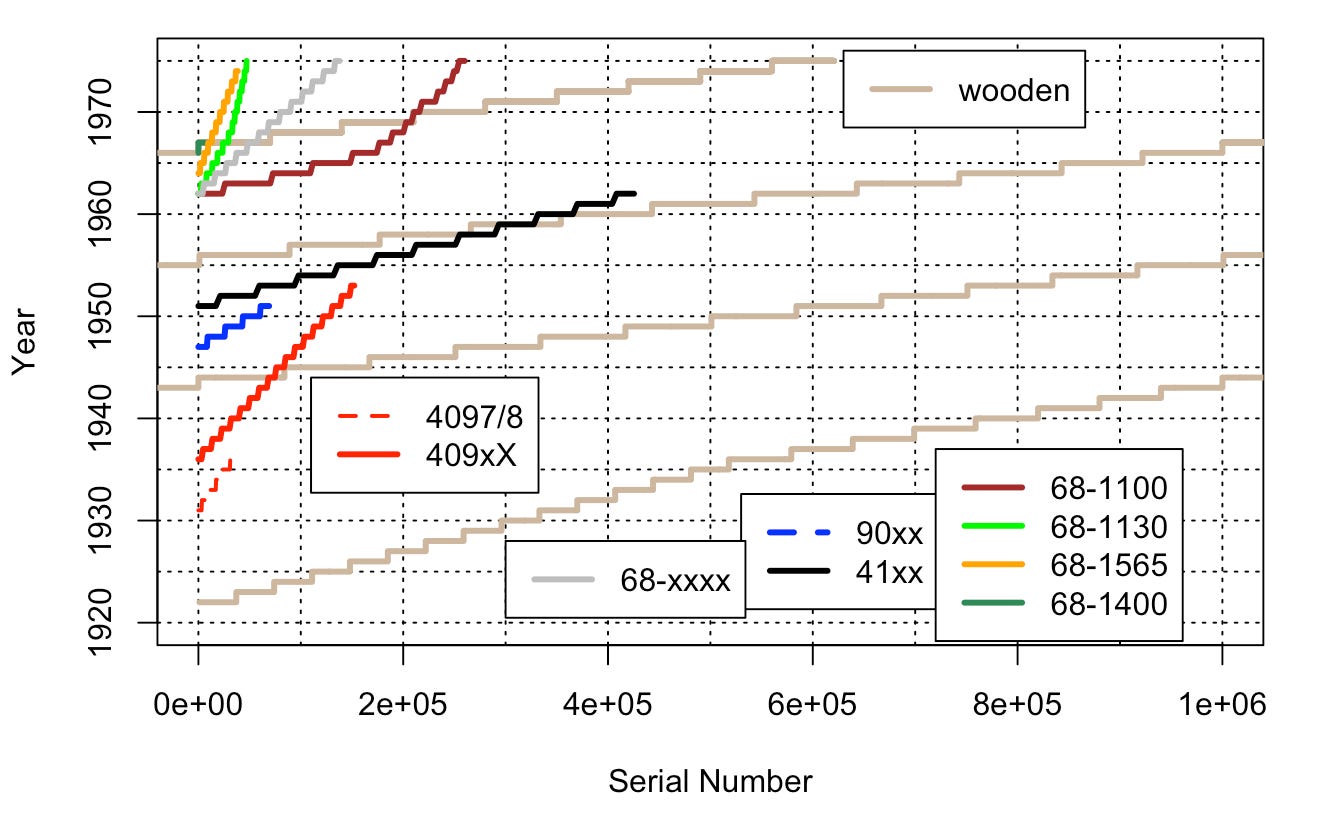
Putting our present understanding of the various plastic slide rule production lines together in one plot, we get the image below. Also included is the wooden slide rule serial number curve superimposed, showing possible overlap conditions for the serial numbers of the wooden rules and assorted plastic models. The series 409xX represents the slide rule models 4097B, 4097C, 4097D, and 4098A. The Doric slide rules have model numbers of the form 90xx. The various serial number anomalies found for several of the slide rule production lines, like the ones pointed out above, as well as the Celanese Celcon slide rules, are not included in the plot.
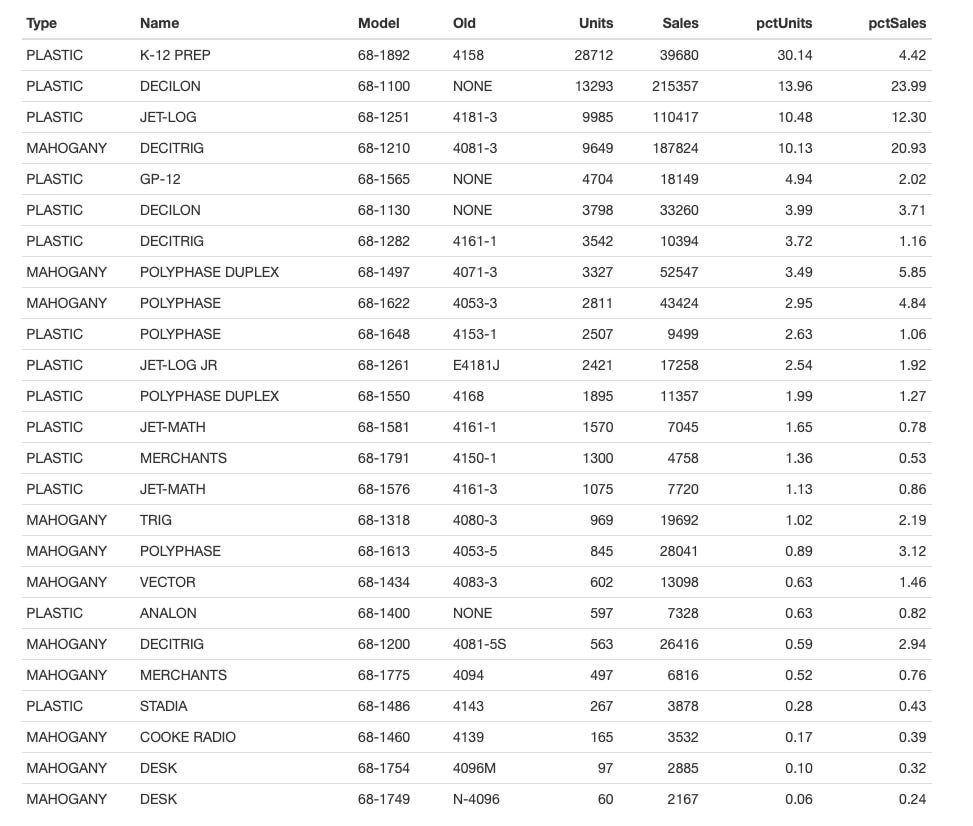
To our knowledge, only one set of instantaneous production numbers has been revealed for the K&E slide rules. The following table is taken from a 1999 article by Wayne Feely,9 which, according to the article, was from information obtained by him from K.G Lutter, dated 7/2/1968. It shows production numbers for K&E slide rules for the year 1967. While this is only a snapshot, we feel it is important in that it can show the relative production of one slide rule model to another, including plastic and wooden rules, for one specific year at least.
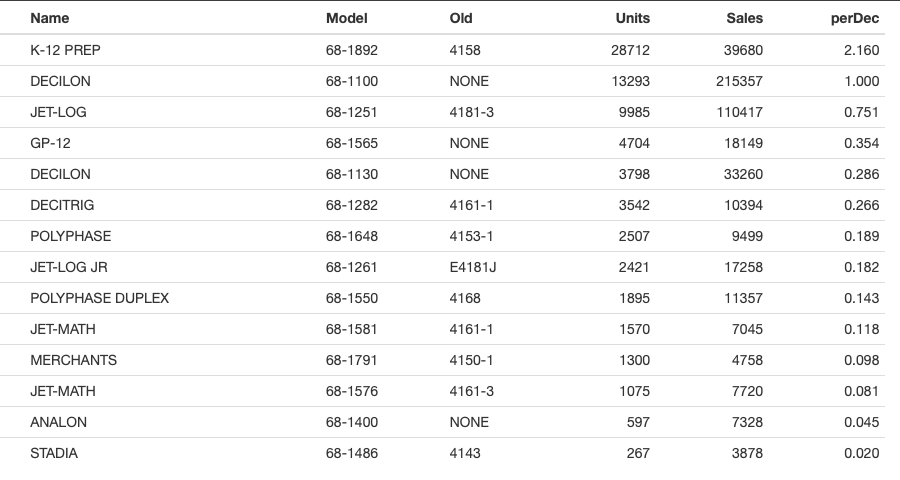
The next table only shows the plastic slide rules, with a new column that shows the ratio of units sold per number of Deci-Lons sold, in the year 1967.
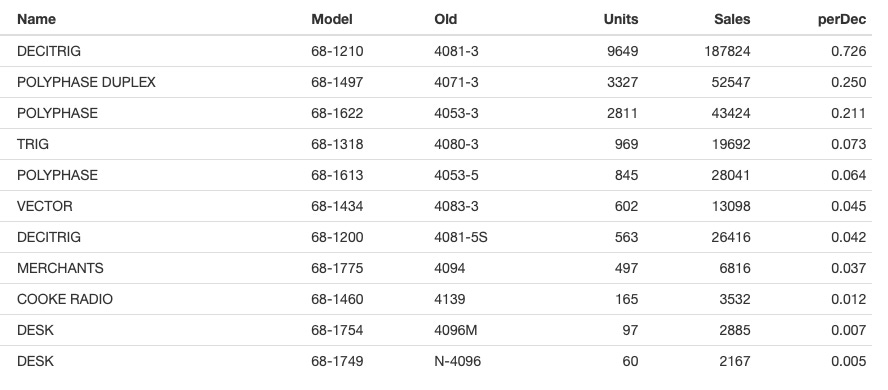
Next is the same, again scaled to Deci-Lon units, but for the wooden slide rules only.
One of the interesting aspects of this is the set of slide rules that do not have any serial numbers — namely, the K-12 Prep slide rules. There were twice as many of these sold as there were Deci-Lons.
We also see that the next biggest sellers behind the K-12 and the Deci-Lons were the plastic Jet-Log (old 4181-3) and the Mahogany version, Model 68-1210 (old 4081-3), each at nearly 3/4 of the Deci-Lon in units sold. Taken together, the total number of “4x81” slide rules sold was 50% more than the total number of Deci-Lons sold. And these “4x81” were evenly divided between plastic and wooden versions.
Next in line, the GP-12, was selling at roughly a third the rate of the Deci-Lons.
Estimating the number of primary wooden slide rules produced between 1922 and 1976 is not too overly difficult, as there was a single serial number sequence — albeit repeated every million rules — that came to a final serial number of about 620,732 in the fourth series. That is, about 3.6 million slide rules in total.
As for the plastic slide rules, using our model of a limited number of production lines with separate serial numbers, we can look at the maximum known serial number from each line and estimate the total number of rules manufactured. We can, if desired, also multiply each of these terms by a factor to take into account a presumed amount of spoilage. (And we believe that only about 1/4 - 1/2 of the Analon’s 10,000 serial numbers actually made it to market.) As the various sets of plastic rules took a bit of development to perfect, there was undoubtedly more spoilage than in the single wooden slide rule line. The wooden rule efforts had 2-3 decades of manufacturing experience, using technologies that were a few centuries old, prior to the entry into the use of new plastic materials. But with the amount of data thus far accumulated for the K&E slide rules, we can attempt to make a reasonable estimate of the total number of slide rules they produced over the years using the technique described earlier in Eamonn’s post on the Deci-Lon serial numbers.
If there are 𝑘 observations of a particular model, where 𝑚 is the maximum serial number observed, then an estimate of the actual largest serial number — assuming the numbering started at “1” — is given by
\(𝑁 = 𝑚+\frac{𝑚−𝑘}{𝑘} = 𝑚+𝑚/𝑘−1.\)
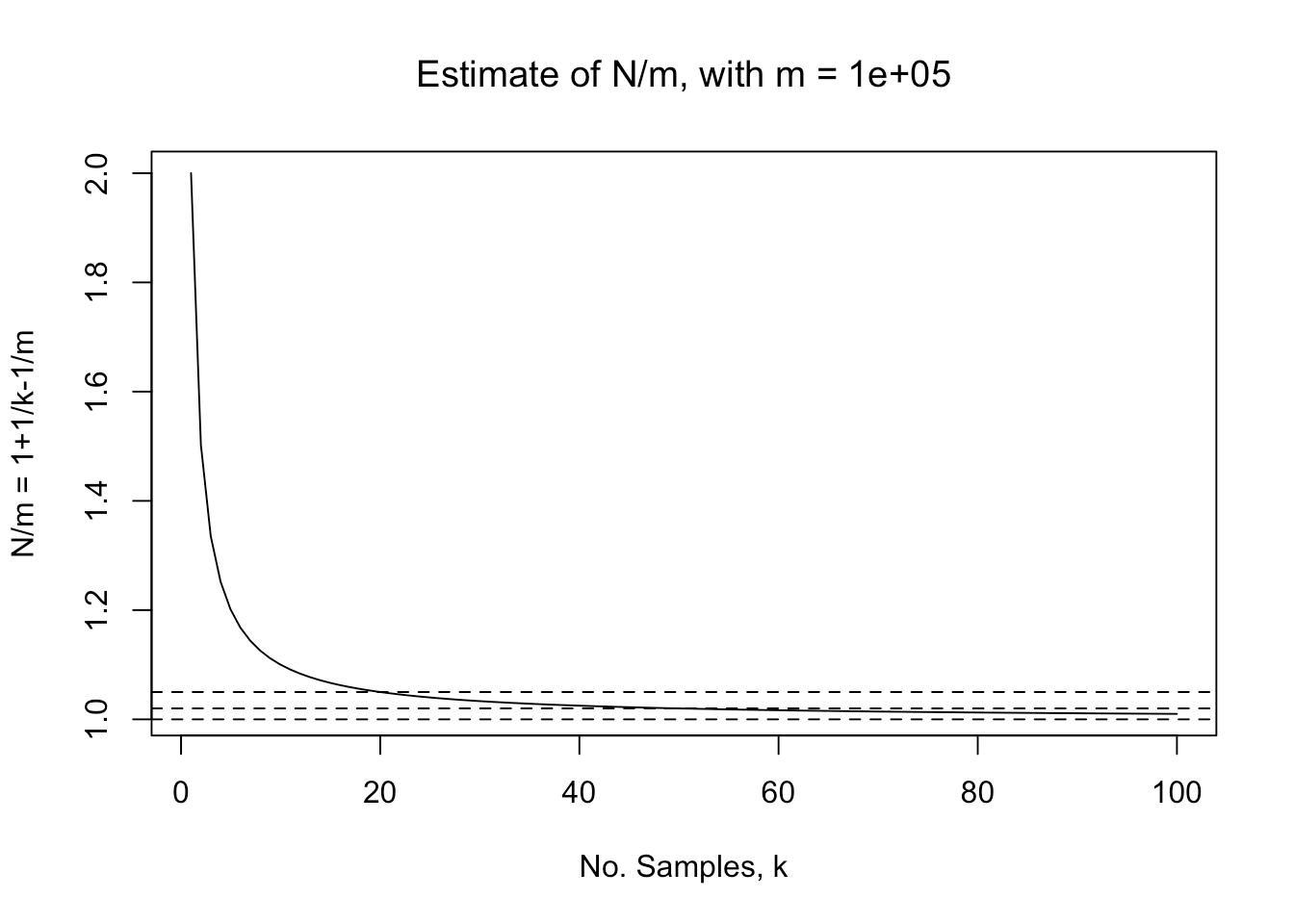
We see that with 20 samples, the maximum observed serial number should typically be within 5% of the correct maximum number 𝑁. Having 50 samples would typically get us to within 2% of the true 𝑁. The plot doesn’t change much for values of 𝑚 = 1000, 10000, 100000, and so on.
Note that for the Doric and Deci-Lons (10-inch) rules, only the serial numbers associated with their main production will be used for acquiring a maximum, while setting aside any “outliers”.
In the table below, Max is the maximum serial number found in the given Series; Nrule is the number of slide rules in our distribution for that Series; MaxEst is the estimate of the maximum serial number for that Series using the above relationship; and Nratio = Max / MaxEst.
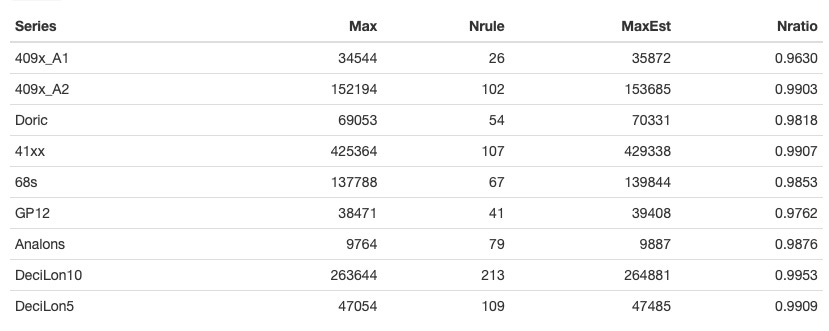
The Nratio column indicates that for each model series we should have captured an example near the highest serial number, within a few percent. From this we estimate that about 1.2 million plastic slide rules with serial numbers were made by K&E from 1930 to 1976. From our counts shown in the table, we reduce the number of Analons by multiplying by a factor of 0.4, in line with the discussion in the prior post on this subject, though this does not affect our overall conclusion. We could also include an overall spoilage rate for slide rule production, but we choose not to speculate this number.
With about 3.6 million wooden slide rules with serial numbers having been made between 1922 and 1976, the total number of slide rules with serial numbers produced by K&E during this period is very roughly estimated to be 4.8 million. Then, to this we can add the early rules prior to 1922, as well as Student’s and Beginner’s rules, and other special rules that were made without serial numbers.
Note that in our table from 1967, the K-12 “beginner’s” slide rule, which has no serial number, accounted for 30% of the total number of slide rule units actually produced that year. Of course this only amounted to about 4.4% of total sales (in dollars). It is hard to guess what the fraction would have been throughout the early-to-mid 1900s, although the student/beginner’s slide rules were always an important component of K&E’s production, ever since the late 1800s.
But, either way, our number of nearly 5 million slide rules is certainly low. If we extend the early production rate of about 37,000 per year (from McCoy’s tables) back about 25-30 years, we get another 1 million slide rules. Of course, the earliest years probably had a slower ramp-up to this rate. But, as we said, the Student’s or Beginner’s model slide rules were a big part of K&E’s lineup from nearly the very beginning of their operation. Hence, a number closer to or greater than 6 million, maybe even slightly over, is not very hard to imagine for the total number of slide rules manufactured by K&E during their history.
From early in their slide rule manufacturing, Keuffel & Esser placed numbers on the ends of their wooden slide rule parts in order to re-match slides and bodies during their production process. By 1922 they were making slide rules at a rate of about 37,000 per year, and placing a three-digit number on the end of their rules for matching purposes was too restrictive, even when letters were used. They soon went to a 6-digit serial number system in that year. This practice continued throughout the production of the wooden slide rules, which ended by the early 1970s. This also meant that their serial numbers were reused over the years, up to 4 times.
By the early 1930s K&E started to produce new rules made from sheets of plastic, which were machined and engraved much like the wooden rules. Following their now-established tradition, the plastic rules had serial numbers used for re-assembling parts. They were being made in Hoboken where the wooden rules were made.
The 4097/98 models, started in about 1931, were constructed out of “white xylonite” plastic. These were the first plastic slide rules of K&E and had their own serial number series. But this numbering was likely reset in about 1936 when the model line was converted to 4097B/C/D and 4098A. The production of these rules was finished by 1950.
By 1948 or so K&E had begun experimenting with new plastic material, and the slide rules were given the brand name, Doric, and the Doric rules were given their own serial numbers.
Near the end of the Doric production K&E was experimenting with molded plastic technology, particularly for their ‘Leroy” lettering sets. In about 1951 K&E finally settled on the new molded plastic technology for creating slide rule parts. This would now be used to start their 41xx line. Though assembled in Hoboken, the plastic molded parts for the rules were manufactured in Pennsylvania by American Insulator Corp. in New Freedom, Pennsylvania, and serial numbers were applied to the parts at that plant. Thus, they had their own counter and serial numbers.
After a few years of production, equipment for the 41xx line in Hoboken made its way to the Salisbury plant in Connecticut, in about 1956-57, and the 41xx rules were assembled there. The parts were still being molded and labeled in Pennsylvania and as such there was no reset of serial numbers for this line during or after the move.
In 1962, all K&E products — not just slide rules — were given new model numbers. We know that slide rules labeled 41xx were being sold in boxes labeled as 68-xxxx. From our data thus far, we have 68-xxxx rules with serial numbers between 1 and 150,000. However, 41xx rules that we’ve documented have serial numbers between 1 and just over 400,000. This includes the Kissam stadia rules (Model 4134), with numbers all in the vicinity of 400,000. Eventually the 41xx-style rules were definitely being produced with 68-xxxx model numbers directly on the slide rule and we hypothesize that they were using a new serial number sequence at that point.
And at the time of the model number changes, or over the next few years, several new models were created: The Deci-Lons (5- and 10-inch models), the GP-12, and the Analon. Each of these models appears to have had its own serial number sequence. Again, these products were being molded in Pennsylvania and parts were shipped back to Salisbury for assembly. The Analons were all made in 1967, while the GP-12s were made from about 1965 to 1975. Their popular Deci-Lon model was made over the entire period from 1962 to 1976.
Interestingly, in 1969 all of the plastic slide rule manufacturing equipment was moved from Salisbury (which was closed down and put up for sale) back to Hoboken. (This was about the time when the production of wooden slide rule parts was ended, although wooden rules were made from parts inventory until about 1972.) This move did not work out well for K&E and within a year they moved their operation BACK to Salisbury (which was not sold yet) and started things up again there. One has to imagine what the impact was on slide rule production during that episode. But production was back on schedule by 1971. And then, five years later, slide rule production closed down altogether in 1976 as the electronic calculators had taken over. A Deci-Lon was the last individual slide rule made by K&E in July 1976.
Also of interest is the fact that of the plastic slide rules, only the 41xx line had serial numbers up to 400,000. Other models went only to 300,000, 150,000 or less. And most models had minimum serial numbers of 1000 or higher. It appears as though serial numbers outside of these rough limits were perhaps typical of trial runs, some of which eventually were sold or somehow otherwise acquired.
The Analon serial numbers are fairly uniformly distributed between 1 and 10,000, but perhaps they never really went out of the “testing” phase.
In the late 1960s K&E was switching to all-plastic slide rules, with the 4181 and Dec-Lon series, which had a better profit margin. The wooden slide rules were labor intensive and had a relatively low profit margin. Slide rules really never made K&E money, though they were better known for slide rules than their other products. The biggest profit maker for K&E was their Leroy lettering sets.
K&E was the last to switch to a slide rule with 8 Log-Log scales, as well as the use of root scales (R1/R2). Their main competition at the time was the Post Versalog and the Pickett N3 and N4 (and 3 and 4 before that). The Pickett Models 4 and N4 were also hyperbolic/vector slide rules, which was a big draw for electrical engineers.
For the future of K&E, the plan was to include an expansion of the Deci-Lon to include hyperbolic scales, which was dubbed the “KeLon”. But, by that time, they were lagging behind the competition, and Pickett appeared to have the market covered. The KeLon never got past the prototype stage by 1972, and then K&E decided to not produce it at all.
All of this is still very much a work in progress, and new data continue to help shape our understanding. We will update our findings again as new information is obtained or inferred. Please don’t forget to inform us of any relevant data you might turn up during your collecting! You comments and insights are very much appreciated.
We again want to thank our many readers who have contributed information and comments for this effort. Their input can be found in the various Comments contributed to the posts on this subject, and to the Chat area for our web site. To see all of our posts relevant to the subject of K&E serial numbers and slide rule dates, see the list at this link, which can also be accessed in the small drop-down menu at the upper left corner of our main Substack web page.
Richard Smith Hughes and Clark McCoy, “Determining K&E Slide Rule Production Rates, 1922-1976: A Beginning”, Jour. Oughtred Soc. 20.1 (2011).
See “An Interview with Jack Burton and Gordon Anthony: The End of the Slide Rule Era at Keuffel & Esser – Part I”, Jour. Oughtred Soc. 7.2 p24 (1998).
Joe Soper, K&E Salisbury Products Division Slide Rules, Oughtred Society Publication p130 (2007).
Advertisement in Modern Plastics magazine, July 1947 Issue, p9 (1947).
“New Acetal Plastic for Strong, Tough Parts”, Materials in Design Engineering, April 1961 Issue, p12 (1961).
Taking estimate = (max - min) × (1 - 2/k) - 1, for k observations. See our discussion in our previous post on the Deci-Lon serial numbers.
Feely, Wayne, “The Last Days of K&E Slide Rules”, Chronicle of the Early American Industries Association, 52.2, pp62-68 (1999).
Comments
Nothing yet. Say the first thing.
Sign in to join the conversation.