
There is a fairly persistent idea that chameleons change colour to match whatever they happen to be sitting on. Put one on a leaf and it turns green. Put one on a brick and, presumably, it spends the afternoon working its way towards masonry.
The reality is more complicated.
Chameleons do use colour as part of camouflage, but some of their most dramatic changes seem to be about communication. Studies of southern African dwarf chameleons found that the species capable of the strongest colour changes also produced the most conspicuous social signals. Males use them during courtship and confrontation. Sometimes changing colour is less about hiding than making absolutely certain another chameleon has got the message.
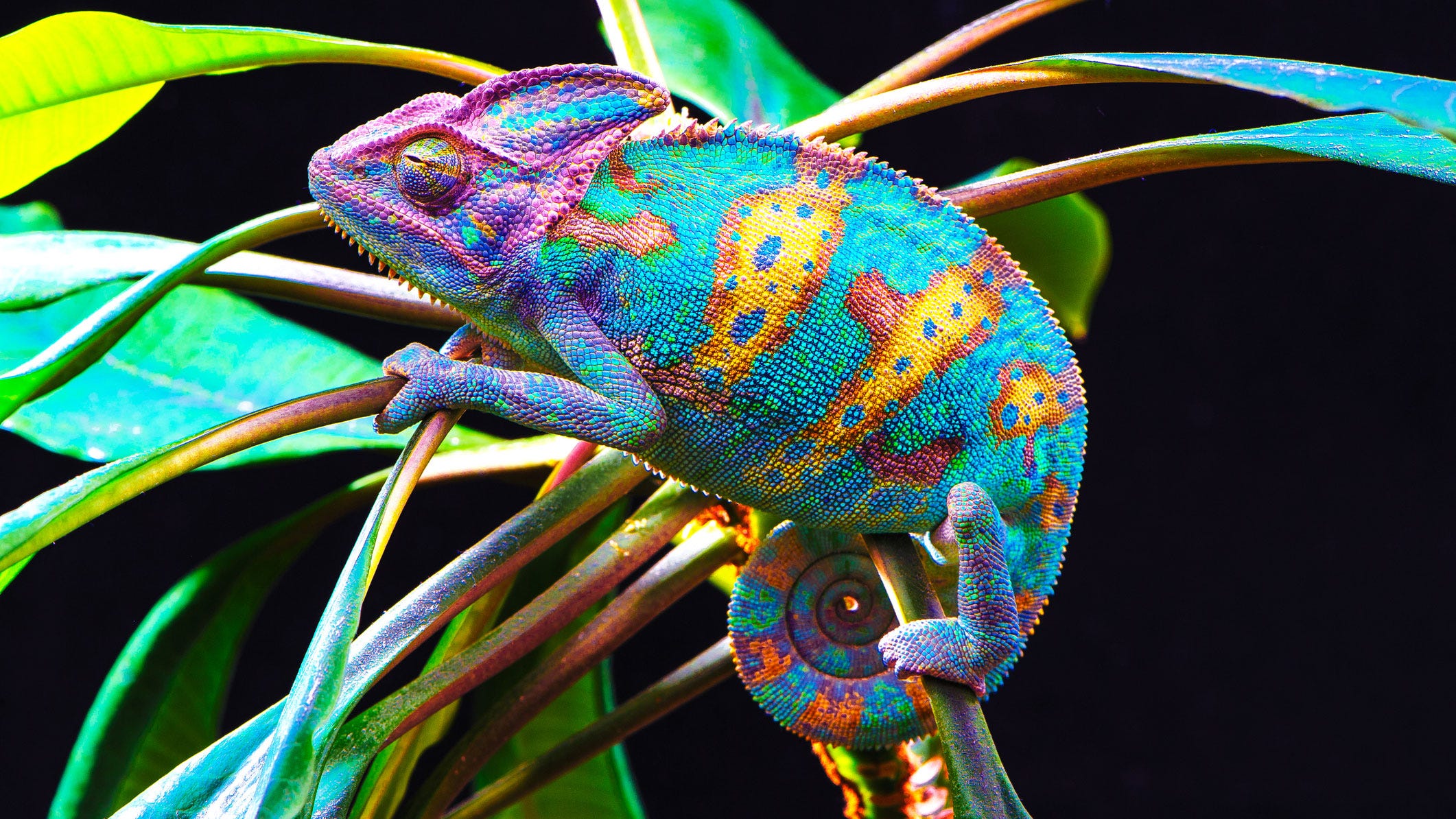
A chameleon displaying a skin pattern that is more about communication than camouflage
I started thinking about this while working on the exterior surfaces of Fleet Obscura ships.
Most vehicles have fairly passive skins. When it’s not the bare metal of a hull (or armor) ships are painted with corporate logos, identification markings and whatever art the crew agrees upon. The surface identifies the machine, and once complete it stays there.
Animals have come up with much stranger arrangements.
Flatfish are a relatively straightforward example. Put some species over different seabeds and their colour and pattern change with the surroundings. Experiments with Japanese flounder showed the fish becoming paler on light backgrounds, darker on black ones, and developing stronger markings over larger contrasting patterns.
It isn’t invisibility. Look carefully and there is still very obviously a fish lying there. But the boundary between animal and seabed becomes harder to read.
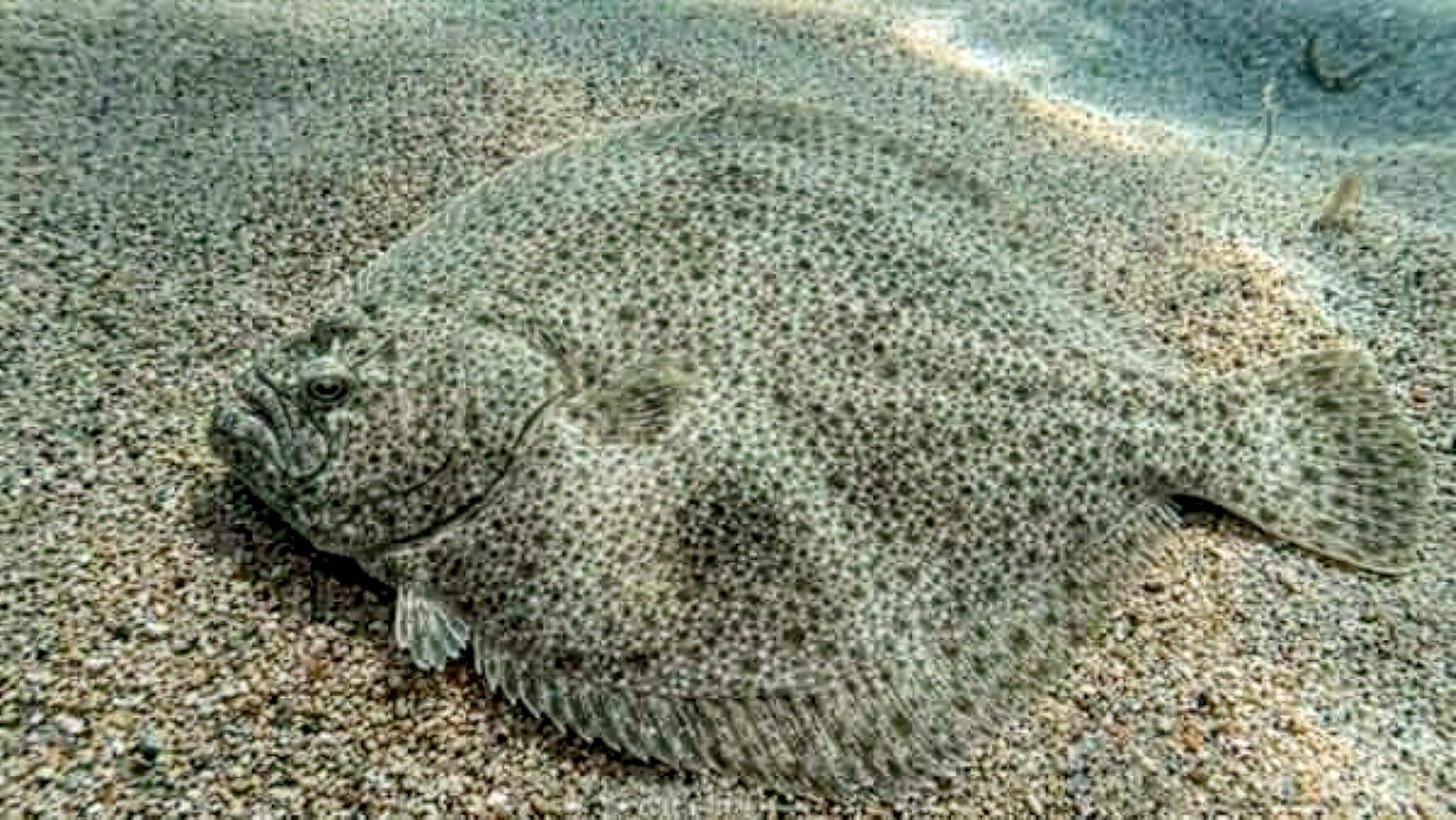
A flatfish doing one and disappearing into the seabed, the cheeky bugger
Cuttlefish, squid and octopuses take the idea considerably further.
Their skin contains specialized structures that can alter color, contrast and reflectivity fast. The best known structures are chromatophores: small pigment-filled organs surrounded by muscles. Expand them and the pigment becomes visible. Contract them and it retreats. One chromatophore does very little. Several hundred thousand of them working together can remake the appearance of an animal.
They are often compared with pixels, which is useful up to a point, although no screen on my desk can change its own texture to imitate gravel or decide that somebody across the room needs threatening.
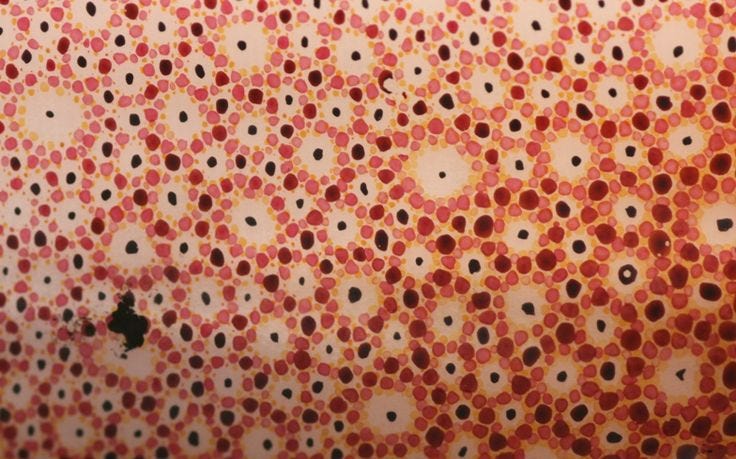
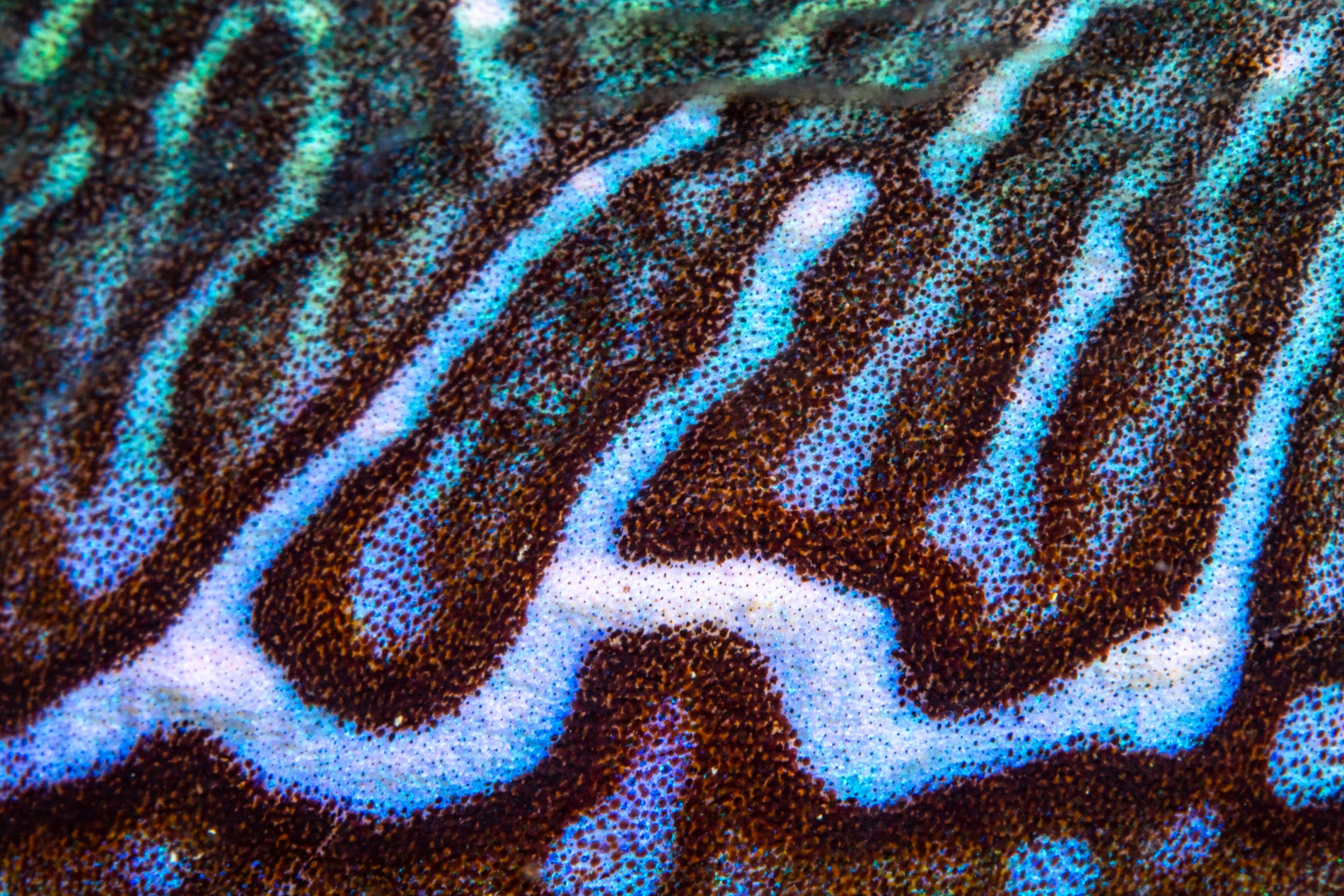
Close-ups of a cuttlefish’s skin chromatophores
A cuttlefish can produce broad areas of colour, fine mottling, hard disruptive patches and moving bands of contrast across its body. When the cuttlefish is trying to hide it doesn’t copy the background in the simple way we tend to imagine camouflage working. Instead, breaking up the outline can be just as important as matching the color. A strong patch across the body that contrasts with the surroundings could make the shape of the animal more difficult to understand.
The really fun part is the same skin can be used to attract attention. Cephalopods flash, pulse and change pattern during encounters with other animals. Humboldt squid produce rapid whole-body flashes when other squid are nearby while Cuttlefish use conspicuous patterns during courtship and confrontation.
So the same piece of biological equipment can effectively say two opposite things: Don’t see me! Look at me!
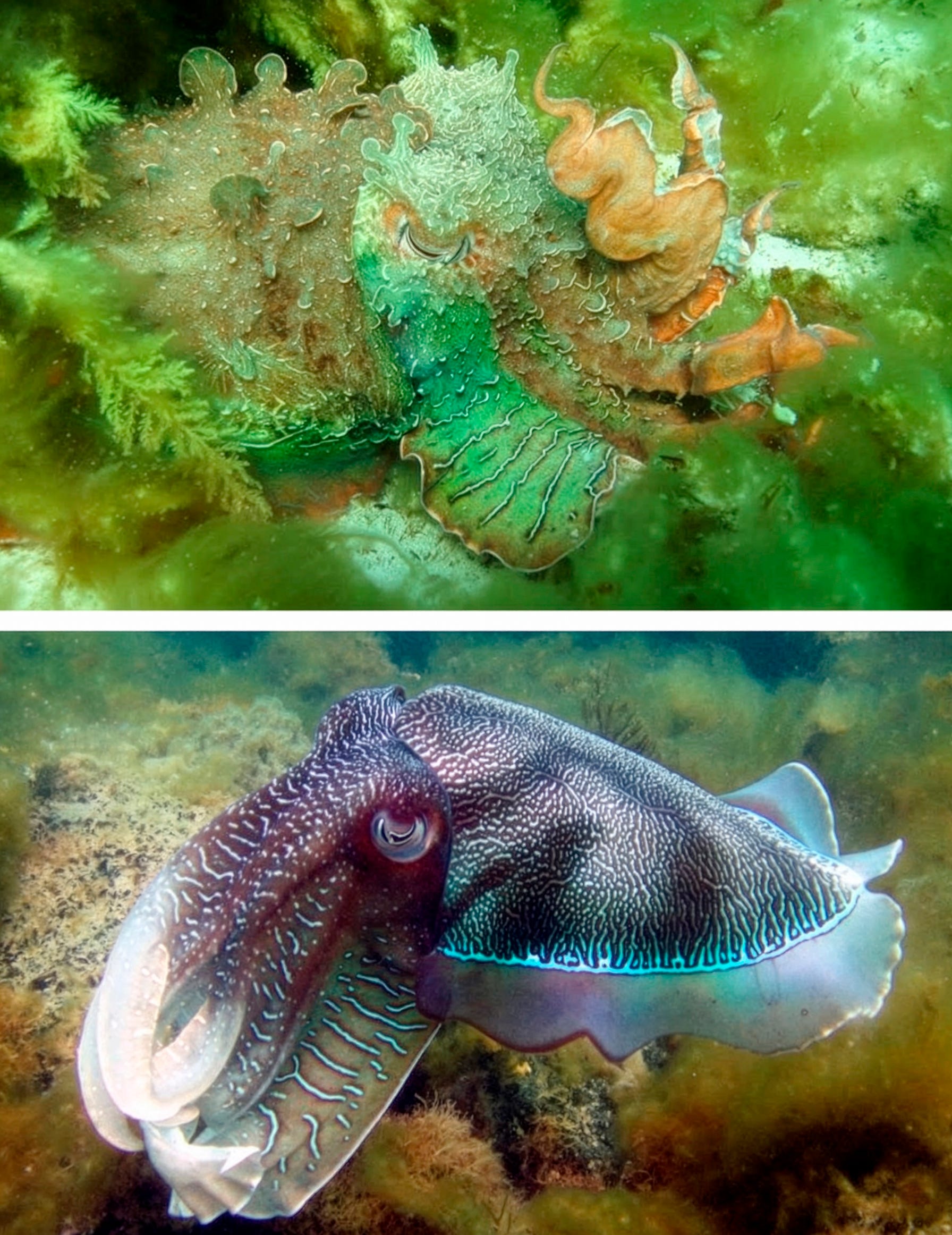
Super awesome alien cephalopods shown in camouflage stage (top, if you can’t tell) and signalling state (bottom, it’s saying either ‘Hey Bro’ or ‘Want some of my crab?’ or ‘I miss Jurgen Klopp’ or all of them at the same time) … this video is so cool
It was this multi-function approach that sent me back to the Fleet spacecraft design.
Engineers have already begun experimenting with adaptive materials inspired by cephalopods: surfaces that alter colour, pattern or optical behaviour in response to their surroundings.
They are still experimental, and I wouldn’t suggest that anyone is about to wrap an aircraft carrier in synthetic cuttlefish camo, but the principle is simple: the surface senses something / the surface changes / someone looking at the surface receives changing information.
That starts to become useful (and super cool) when you’re designing spacecraft.

A Fleet Obscura cloudchaser racing ship in its normal hull state … we will take a look at its camo and how that helps it win the Grand National soon …
Until now, I have treated most of Fleet Obscura ships as having conventional graphics applied to a solid hull.
But Fleet Obscura is set in 3055. These are ships built by a civilisation that can manufacture artificial habitats, rebuild human bodies and crossed interstellar distances. It started to seem slightly odd that the exterior of a warship would still be paint. So I begn wondering what would happen if parts of the hull behaved more like skin.
Not a giant video screen stretched over a spaceship. That feels both fragile and slightly Las Vegas … something closer to an engineered chromatophore system built into the outer layers of the hull: vast numbers of individually controlled cells capable of altering colour, brightness, reflectivity or contrast.
Its first uses might be quite mundane: a ship approaching a dock could display its identity across an area large enough to be seen from kilometers away. Different markings could appear according to fleet assignment or operational state. Another vessel could read information visually without depending on a radio transmission.
That last possibility became particularly interesting.
Fleet Obscura already assumes that combat takes place in an extremely hostile electronic environment. Radio can be jammed, spoofed or deliberately shut down. Tight-beam optical (laser) communications are much harder to interfere with, but they still depend on accurately finding and tracking another ship, which is not easy while both vessels are maneuvering, damaged and / or surrounded by clouds of debris.
There is something appealingly primitive about the fallback: if everything clever stops working, stick your face against the window and look at the other ship to see what it’s saying.

Ships have been doing variations of that for centuries: flags, lamps and semaphore all turned the outside of a vessel into a communications system. In Fleet Obscura, you no longer need the flags. The ship becomes the signal.
It wasn’t designed to make a ship disappear.
It was designed to make the person looking at it wrong.
Wait, what?
Yup. Until then 🚀
Comments
Nothing yet. Say the first thing.
Sign in to join the conversation.