
Any time I answer the question, “what year was my gun made?”, I brace myself for the next inevitable question, “how much is my gun worth?” It’s another one of those trojan horse questions that’s deceptively simple on the surface and infinitely complex in reality. And this is the one question that’s most likely to raise hackles, since most people are disappointed with the answer.
Does “worth” mean what you might get for the gun if you took it to the local pawn shop, or put it up for sale on consignment at the local gun shop? What you should charge your buddy for the gun in a private sale? Or what you might expect to pay for one at the local gun show? Or what it would sell for at auction? Or what the replacement would be for insurance purposes?
“Worth” means all of the above, and a lot more. It presumably represents the sum of money that a person might exchange in a transaction involving this firearm. But context is everything, and what the gun would fetch at a high-end auction house is entirely different than what it would get from the local pawn shop, and both of those are different than the fair market replacement value of the gun to an insurer. Etcetera.
Questions of “worth” often come with incantations of “appraisal,” which is even more fraught of a word. 99% of appraisals are just opinions on fancy paper—and in most cases, they probably aren’t even worth that. To wit, I’m sometimes asked, “what is my gun worth?” I’ll give a finger-in-the-wind estimate, and the person asking will immediately retort with, “but the appraisal says that it’s worth $BLAH!”, as if they’ve just played the trump card in the game of “gotcha.”
(shameless plug: Arms Appraisals LLC is the real deal. I’ve shared a stage with Steve Sinetti at SHOT Show, and he knows his stuff.)
If you sense some frustration from me here, then you’re right. “Worth” is a tiring game to play, because the correct answer isn’t a number: it’s an education. Ergo, this article!
My beloved grandfather—the one I undoubtedly inherited my collecting genes from—was a coin and stamp dealer of long standing in his Appalachian Pennsylvania community. Having answered the same “worth” question a million times, he developed a wonderfully succinct answer: “It’s worth what someone will pay you for it.” As frustrating and unsatisfying of an answer as this is, it is entirely and completely accurate.
Let’s take this apart a bit more.
Let’s imagine a hypothetical gun seller. Joe has an early postwar Smith & Wesson .38 Military & Police revolver that, for one reason or another, he has decided to sell. And we’ll assume for the sake of argument that this is all lawful: Joe is the rightful owner of this firearm that he can legally possess and sell, and he’s of sound mind to enter into a binding sales contract, he lives in a free state where private citizens can sell their private property without government intrusion, etc.
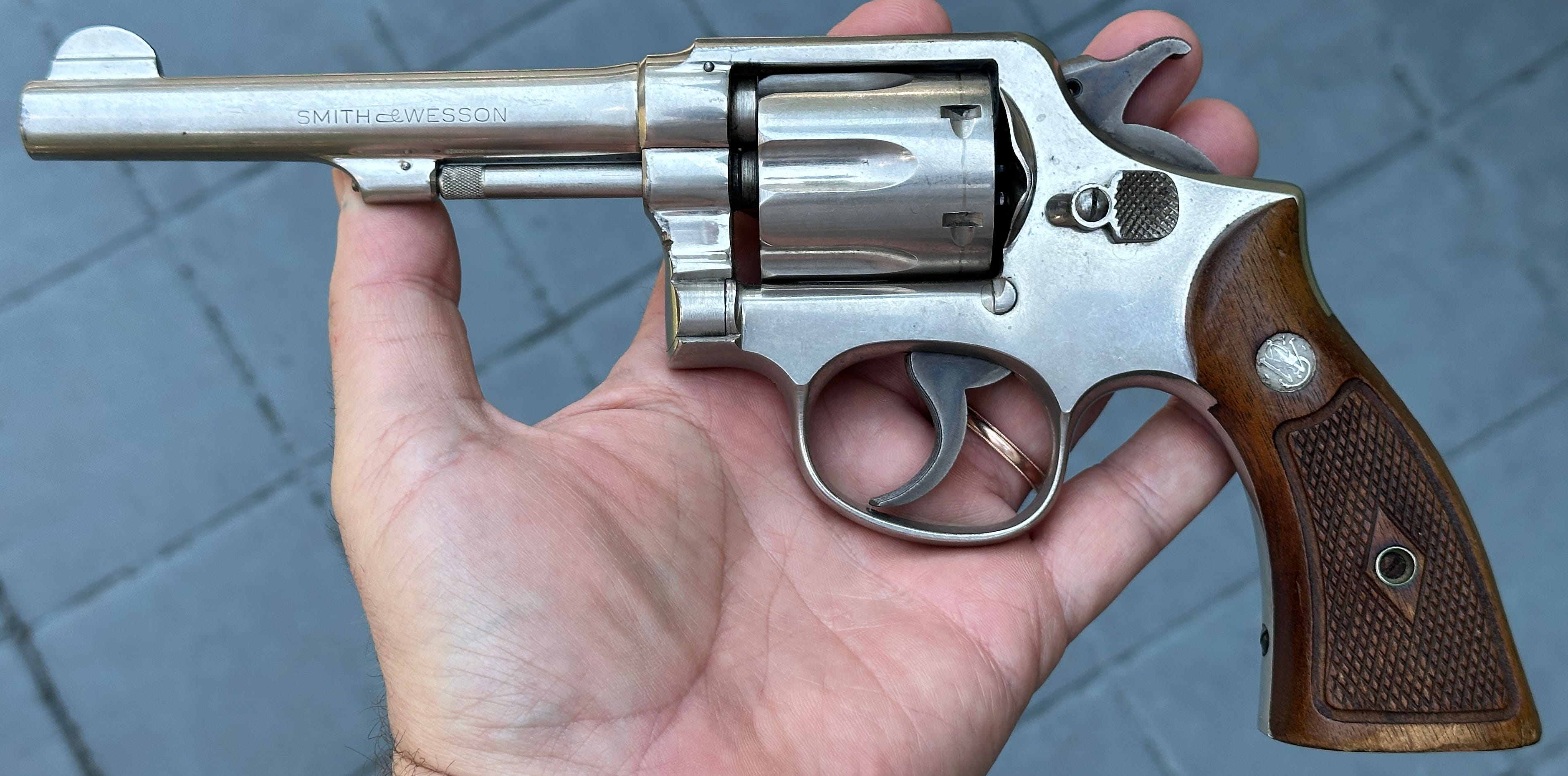
Joe has lots of options. He might go to the local pawn shop, where he might get offered $125 for this revolver. Because pawn shops are convenient and willing to pay cash on the spot for just about anything, he’s going to get a pretty low purchase price for the gun in exchange for that convenience and immediacy.
Joe could also consign the gun at a local gun shop. He’s still going to pay for that convenience, but he’ll get a bit more money because it may take a while for the gun to sell. After the store collects its commission on the sale, Joe might realize $300 from the sale. It’s better than the pawn shop, but he could also be waiting months (or longer) for a willing buyer to purchase it.
Joe could also make a posting on the “for sale” board of the local gun range, or on a local online discussion forum. He may post the gun for $500 and accept an offer of $450, but he’ll also be dealing with a private buyer—an inconvenience that would rightly put Joe in a state of heightened awareness, since he’ll be dealing directly with the buyer and not through an established intermediary. But for his troubles, he’ll probably make more money.
Joe could also send the gun to auction—including one of the many auction houses that now specialize in firearms. Joe knows that auctions run infrequently and that the auction house’s seller’s commission will take a bite out of his profits, but the hammer price of $600 means that he’ll still take home $480. Of course, the winds at the auction house can change quickly, and for no apparent reason at all the same gun at the same auction house might only fetch $350 in the next auction (for a take-home of about $280).
That’s six entirely different prices for the same revolver from the same seller.
A prospective gun buyer has lots of places to purchase from. To illustrate this, we’ll imagine Sally as our hypothetical purchaser.
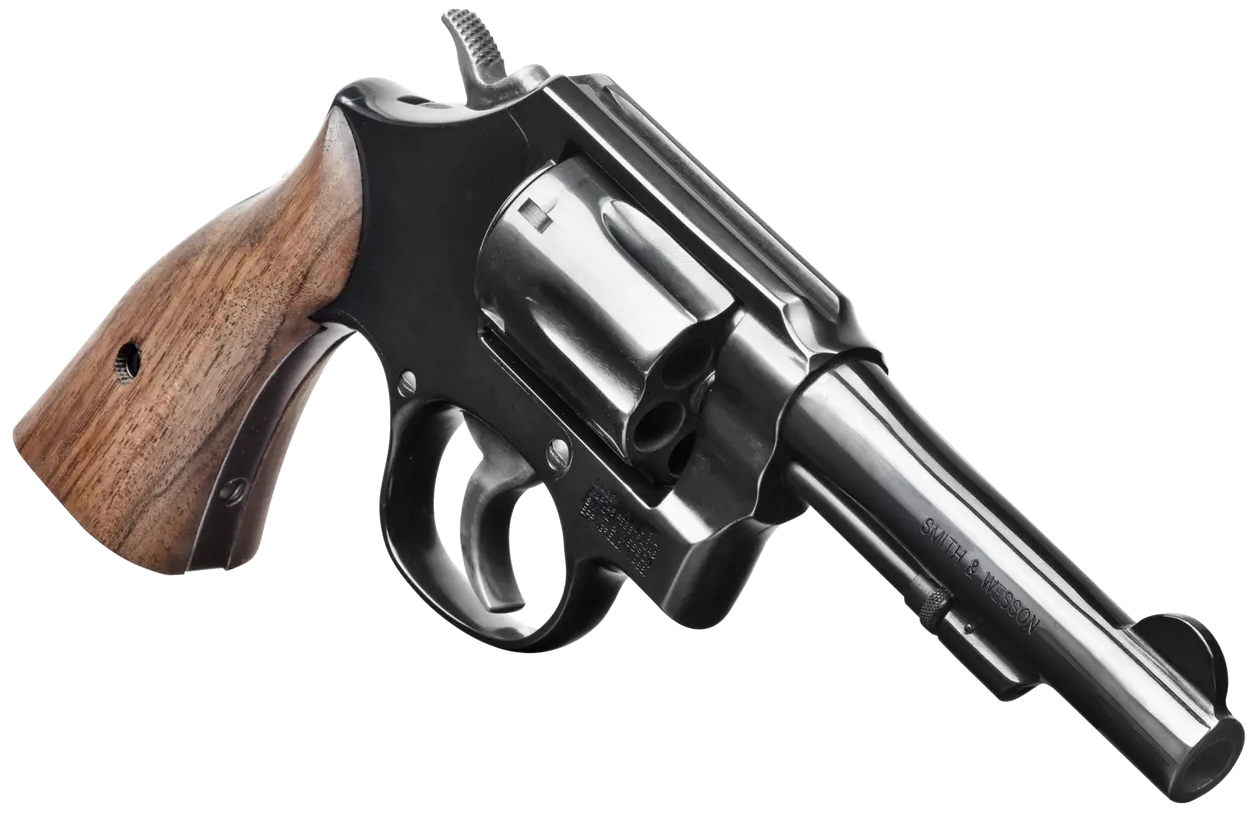
Sally is looking for a nice early postwar Smith & Wesson .38 Military & Police. Her first stop would logically be the local gun store, where they probably wouldn’t have the exact postwar model that she’s looking for. But she would notice that they have a new Smith & Wesson Model 10 Classic revolver for the MSRP of $1029. It’s an attractive revolver that harkens back to the styling of decades past, but Sally really wants to hold out for an actual 1950s hogleg.
She then goes to the local “buy and sell” ads in a few of the local forums, where she finds a few potential revolvers. Prices are all over the map, with one rough looking Victory revolver for a ridiculous asking price of $700, another nice 1950s M&P that sold last week for a pitifully low price of $350, and a few other less interesting prospects.
Sally then looks at upcoming auctions. There’s a lot of guns coming up for sale over the next few months, but auctions are always hit-and-miss and the opening bids of $50 or $100 are in no way indicative of the hammer prices. She bookmarks a few prospects and hopes that she doesn’t forget to login on the day of the auctions.
Lastly, Sally heads over to the local pawn shop. Inventories at pawn shops change from day-to-day, and she sees a few prospective guns with aspirational prices. Sally is a savvy buyer and knows that the longer something sits in a pawn shop for, the more willing they’ll be to come down on the price. She finds two prospective M&Ps that look like they’ve become “stale” and negotiates a cash deal on one of them for $375 out the door.
These numbers are fictional, of course, but they represent buying and selling realities that I see every day. Any of these numbers would be a fair answer to the “worth” question, but they’re correct only in the narrow context of that situation.
And we haven’t waded into the insurance valuation waters yet, because that’s another clusterfuck for another day.
Part of what makes the “worth” space so fraught is the prevalence of misinformation that feeds into this. Brandolini’s Law (also known as the “asymmetry of bullshit law”) comes into full bloom here. To wit, it only takes a few seconds for someone to spout off, “hey, I saw a gun that looks just like yours sell for $30,000!", and it’ll take me an hour to convince the seller that their gun would be doing well to sell for a hundredth that.
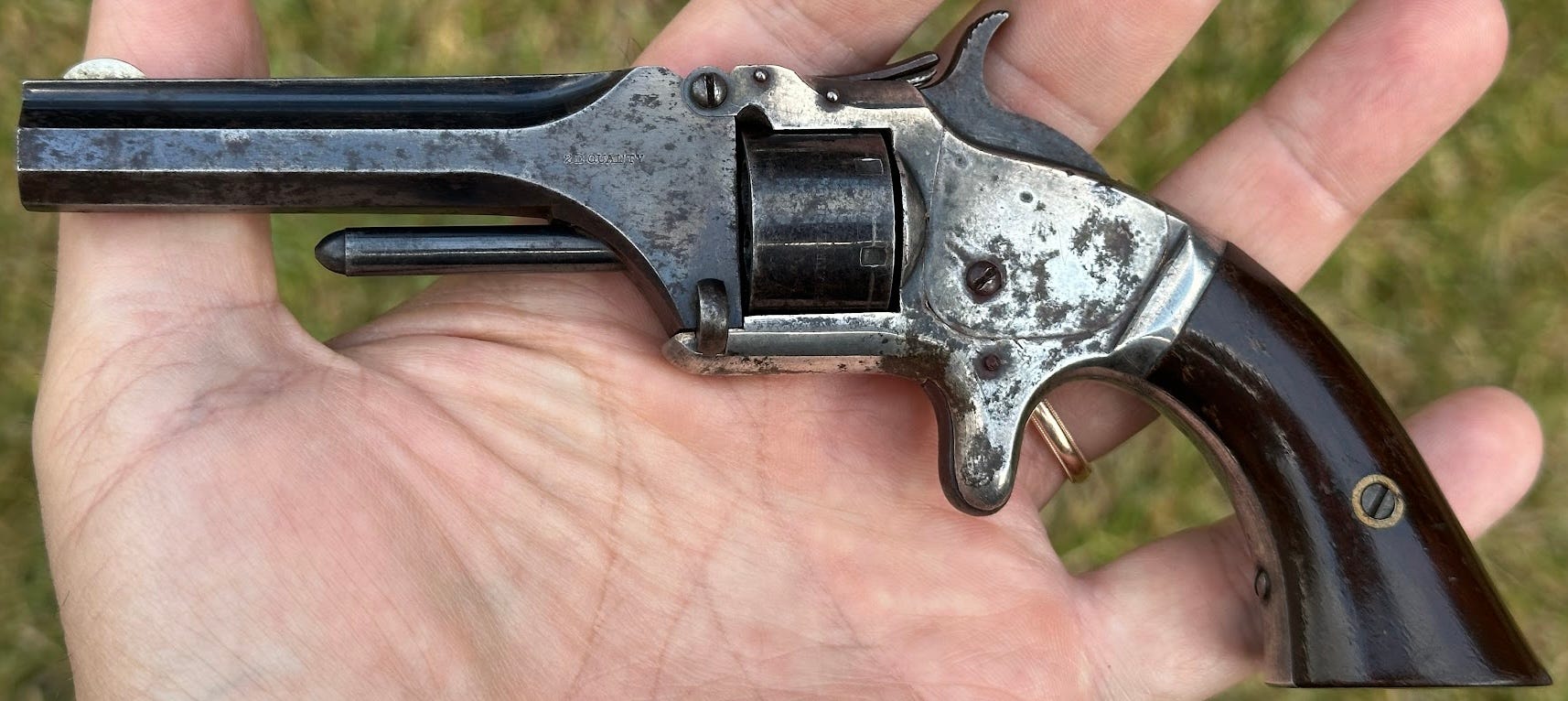
Two seemingly identical firearms can fetch wildly different prices. Part of this can be because of the context in which it’s being sold; another part of that equation is the documentation behind the item. Here’s a great story to illustrate this.
Some years ago a person found a Smith & Wesson .22/32 Heavy Frame Target at a pawn shop. The gun was in reasonably good condition and a purchase price of somewhere in the vicinity of $400 was agreed upon.
So far, this is entirely reasonable. Heavy Frame Targets are a favorite of collectors, but they were also made abundantly enough that there is a steady supply of them on the market.
The buyer bought a factory letter for this revolver, which revealed that it had been shipped from the factory to Frank Butler. You’ve probably never heard of Frank Butler, but you’ve most assuredly heard of his wife, Annie Oakley.
That same revolver subsequently fetched over $30,000 at auction.
This is where it gets tricky. I’ve had a number of people reach out to me about guns that were purportedly owned by western outlaws such as Jesse James. There’s an obvious motivation for this, since authentic western outlaw guns with well-documented pedigrees can fetch silly money.
In most cases, the gun is accompanied by a letter from someone in the family who swears on their mother’s grave that this gun was gifted from Custer to Jesse James, who then passed the gun on to Doc Holliday, who then gave it to Buffalo Bill, who then bequeathed it to his next door neighbor. All sworn to by the next door neighbor’s great-grandson. And notarized to make it extra-true.
Like most appraisals, these letters of provenance usually aren’t worth the paper they’re written on. Standards for documentation vary depending on the context, but they generally need to come from sources that would have had no intrinsic or extrinsic motivation to enhance the value of the gun. Having the gun mentioned by make, model and serial number in a period court transcript is the sort of documentation that we look for. Ditto for original sales receipts, which were a normal part of business record keeping. Etcetera.
Documenting a gun like this can be painstaking and tedious work. I’ve got a few of these ongoing projects that I’ve spent years on. And unfortunately, there’s a lot of guns with famous connections that will probably never get documented fully, since the scant documentation that may have once existed is now long gone.
A wise collector once told me, “buy the gun, not the story.” Same goes for the question of “worth:” appraise the gun and not the story, unless the documentation is substantial and credible.
“Worth” is an entirely abstract fiction until the gun in question is party to a transaction. At that point in time, its full worth is realized as a willing buyer and a willing seller consummate a deal. But even then, the “worth” is only relevant to that exact moment in time, and the same gun could sell for a lot more (or a lot less) the following week.
Past sales trends are the best signals of future sales trends, which is generally why I tell people to look at sites like gunbroker.com, where it’s easy to look at past sales to see what similar guns are selling for. It’s important to make sure you’re looking at guns that actually sold, as a lot of listings (especially ones with unrealistic aspirational prices) go unsold.
Generally, when I provide a value, I call it a '“finger-in-the-wind” guess. What this means is “if I was wandering at a gun show and happened across this firearm, and I was interested in it enough to negotiate its purchase, here’s what I’d consider to be a reasonable price.” With the usual caveat that time, place, and personalities can move that price considerably in either direction.
I’ve mentioned insurance a few times, which is probably a topic best left for another article. Insurance valuations aren’t based on what a willing buyer would pay, but rather what someone would have to pay right now to replace this firearm with one of comparable value. The immediacy affects the value, since we have to find a willing seller. Another challenge for another day.
No posts
Comments
Nothing yet. Say the first thing.
Sign in to join the conversation.