
Early in 2025 I received an email from a young man eager to learn how to become a firearms historian. As I read the email, I reflected on my circuitous journey—one that included a “book” I wrote as a hyper-ambitious 15 year old about the history of the small town I lived near. I audaciously brought a copy of this paper to the library of the university I attended for two years (I had just turned 18 and had more of an ego than I’d like to admit!), where some kindhearted librarian catalogued it in the special collections. I leafed through a copy of that paper that still sits on my bookshelf and fumbled to give any sort of cogent answer to this young man’s question, since journeys like this rarely follow a cogent path. As I reflect on the new year, this email—and the answer it deserves—popped back into my mind.
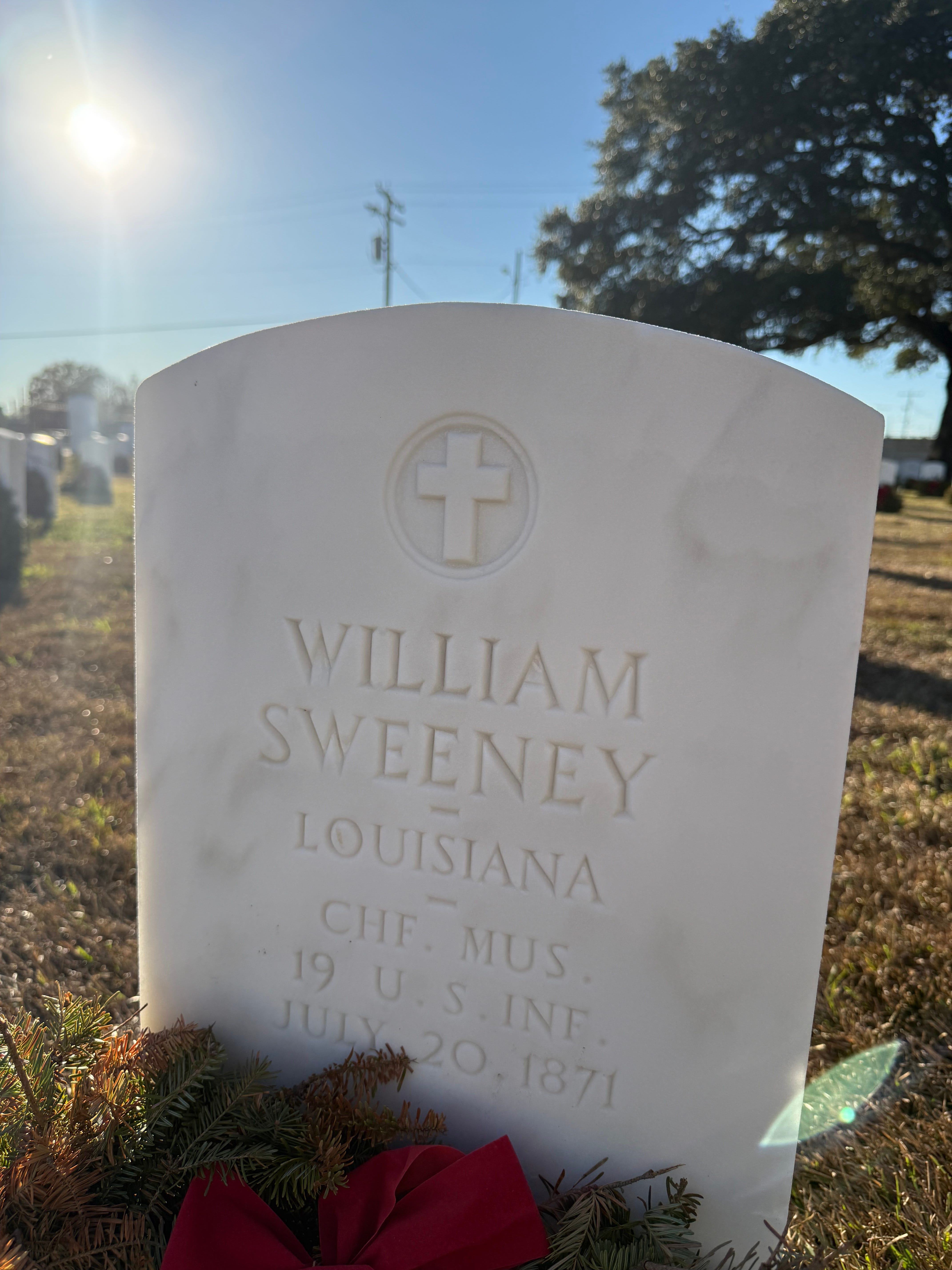
On my way home from running errands today, I swung by Baton Rouge National Cemetery, for which I’ve developed a curious fascination. Nestled on a square plot of land where the 21st Indiana Infantry collided with Colonel A.P. Thompson’s 3rd Kentucky Regiment in the summer of 1862, the occupants of this cemetery (and of the neighboring Magnolia Cemetery) read like a who's who of local luminaries. But I wasn’t there to visit Philemon Thomas or Joanna Waddill or author Lyle Saxon (all people that deserve your curiosity); I was there to visit a man that remains virtually unknown to most. And since the best lessons are taught demonstratively, I figured I’d take a swing at that here.
This past summer I began researching this important revolver:
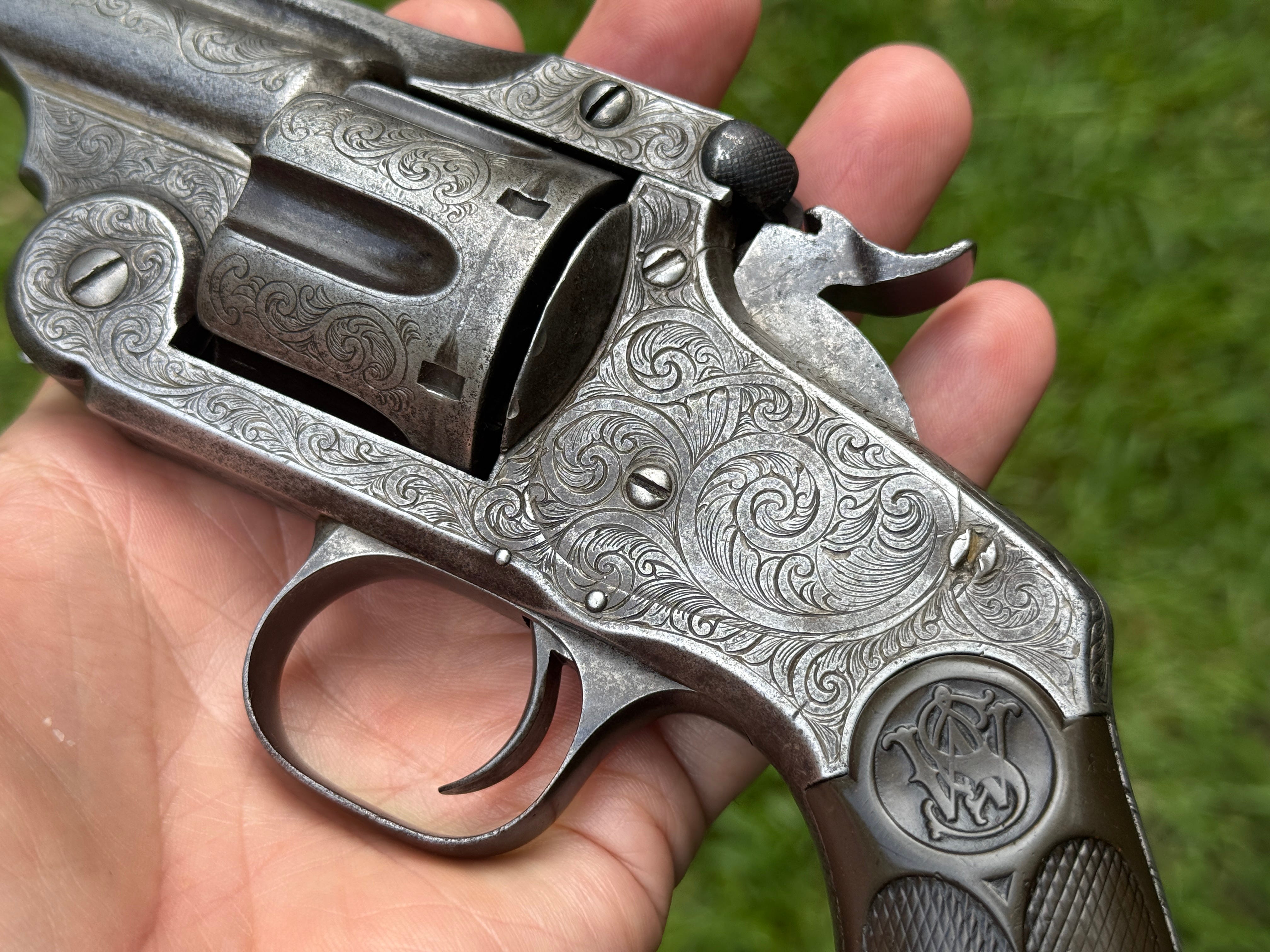
The factory letter for this revolve reads:
We have researched your Smith & Wesson New Model #3 .44 Single Action, caliber .44 S&W Russian in company records which indicate that your handgun, with serial number 19647, was shipped from our factory on August 25, 1886, and delivered to M. W. Robinson, New York City, Smith & Wesson’s largest distributor …
Most factory letters tease and tantalize with a few scraps of information, and that was definitely the case here. And the New Model 3 is well-known to collectors, with plenty of ink spilled about its importance in the evolution of American large frame revolvers. Thankfully, the back strap for this revolver told a much more interesting story that took me down a canyon-sized rabbit hole:
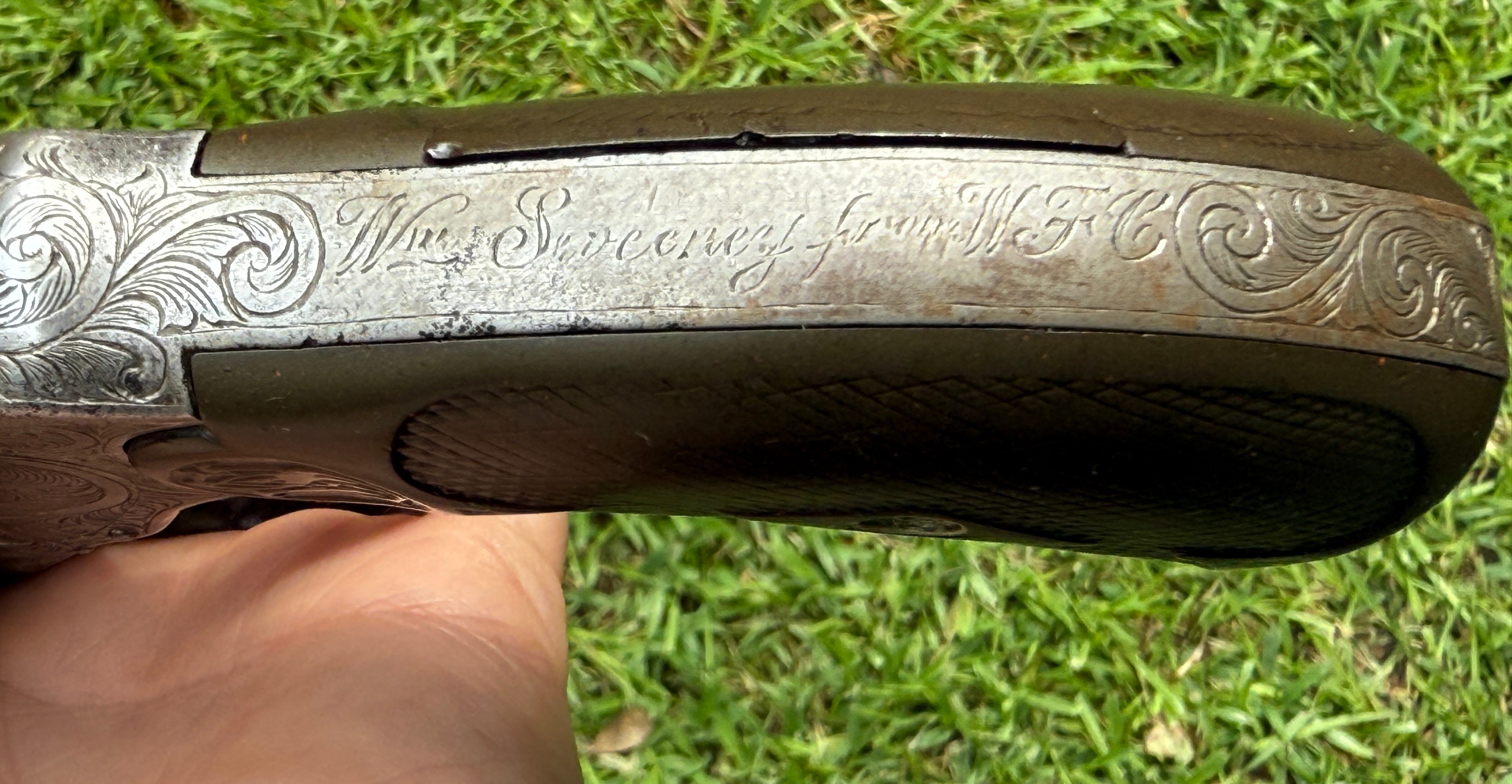
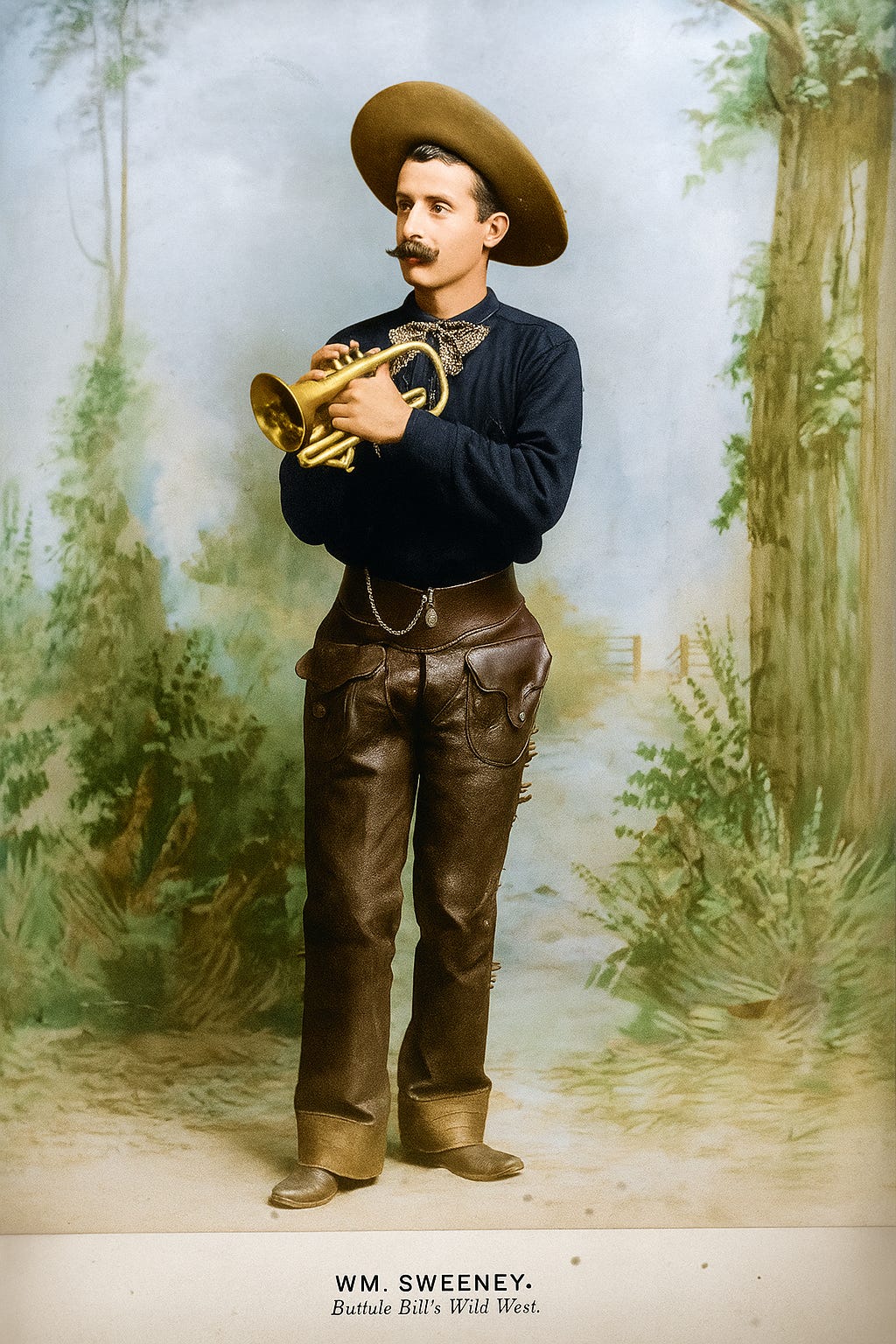
“William Sweeney” was, in the late 19th century, one of the world’s most well-known band leaders. “W. F. C.” stood for “William Frederick Cody,” or “Buffalo Bill” as he is known in popular culture.
Despite having been Cody’s band leader for almost 20 years, Sweeney remains virtually unknown. A few of the well-known works on Cody make peripheral mention of Sweeney … that, and a few cabinet photos that circulate the internet constitute most of our knowledge about him. That made him a perfect research subject!
If I was ever invited onto a panel to discuss undergraduate history curriculum, one of the things that I’d advocate strongly for would be the inclusion of genealogical methodology. Other than metal detecting (which can be inherently destructive to historic sites—a topic for another day!), I can’t think of any other historical vocation that is so accessible and so personal to so many people.
Really engaging historical storytelling is inevitably about people. The guns and the engraving and the technology and the artistry are cool too, but what really makes historic guns interesting are the innately human stories behind them.
Some people are elusive, and William Sweeney was one such person. For many genealogists, the basic building blocks (I call it the “scaffolding”) are the decennial federal census records, which have been taken every 10 years since 1790.
The only census record I could turn up for William Sweeney was from 1870, when he was a 15 year old boy living in New Orleans with his parents and three younger sisters. But this was a start, and it yielded a ton of non-obvious clues:
I left a few columns out that weren’t particularly helpful here, but I left a lot of blank columns in that are most interesting.
At a glance: in 1870, William Sweeney Sr. and his wife, Rihanna Sweeney, lived in the Army barracks in New Orleans. With them was their 15 year old son William Jr. (who went on to be Cody’s band leader) and their three daughters: 10-year old Nellie, 8-year old Lillie, and 5-year old Independence. So far, pretty normal stuff.
William Sr. was born in England, which raises obvious questions: when and why did he come to the United States? Was he immigrating for something, or to get away from something?
The census claims that William Jr. was born in New York State, which contradicts everything else I’ve found that indicates he was born in Minneapolis, Minnesota. Even more curious is that the three sisters were born elsewhere: Indiana and Kentucky. Apparently, the family moved around a lot!
With this one snapshot, we already have a glimpse into this family’s life.
My next clue about William Sweeney Sr. came in a single handwritten ledger entry about Sweeney’s death in 1871:

“Delirium Tremens” is the clinical term for “alcohol withdrawal syndrome.” In some circles people talk about “getting the DTs,” which explains where that acronym came from.
These two snippets in time start to create a more complex picture of William Sweeney Sr., and the world into which our band leader William Sweeney Jr. was born.
It gets a lot more complex than this, but I’ll stop here and offer my next historical tidbit:
What most collectors and antiquarians lack is broad historical context: that critical base of knowledge that puts the details into a larger social, political, and economic narrative. To wit: the Smith & Wesson New Model 3 was important to the evolution of large frame revolver. It’s far more interesting to place the New Model 3 in the context of Westward Expansion and the marketing of the American West to the American public—and foreigners—that the federal and state governments were eagerly recruiting into places like the Colorado Territory and the Dakota Territory. This is doubly important when we consider why Buffalo Bill and his “Wild West Show” had such deep cultural impact. It also touches on some more sensitive issues like Wild Westing and the Indian Wars—topics that need to be examined to tell the full story.
This is the real value of the academic history degree: its front-loaded emphasis on imparting a broad base of historical knowledge—important departure points for historical inquiry, and important context in which to make historical “deep dives” relatable to a larger group of people.
Of course, knowledge doesn’t need to come from a degree. To advance my work as a professional historian, I’ve asked dozens of history professors for the syllabus for their class. I do this primarily because I want the reading lists. Reading the book isn’t a perfect substitute for taking the class, but it gets me a lot closer for a fraction of the cost.
To that end, I offer you this suggestion: William Freehling’s The Road to Disunion books (Volume 1 and Volume 2) are among the most well-written books about Colonial and Antebellum American history. These were required reading for my “Civilization of the Old South” class. Neither deal specifically with arms production, but they’re books that I refer back to on a monthly, if not weekly basis for my arms history work.
A pun I started telling a few years ago goes something like this: “nobody can kill history like a history teacher.” Somehow, in the world of academia, we’ve come to believe that history has to be dry, brittle, and omnipotent. Adding insult to injury, academicians suffuse this “death-by-boredom” with a lot of smart-sounding coded jargon, with terms like “intersectional,” “framework,” and “heteronormative.” It’s insufferable, and it’s why I don’t make a habit of reading academic journals.
This is where good history goes to die. The affectation of trying so hard to sound erudite and smart is the opposite of actually being erudite and smart. As every good writing instructor teaches her students, “show, don’t tell!”
Great historical narratives read effortlessly. Storytelling done well magically takes us to places we couldn’t have gone on our own. It inspires our imagination, it tantalizes our senses, and it does this through the magic of well-crafted language. None of this happens accidentally: plot arcs need to be carefully mapped out, complex characters need to reveal themselves through their actions and their words, and the conflicts (and their resolutions) need engage our natural curiosities. And if that wasn’t difficult enough: all of this needs to be backed by high quality research, lest we wander into the territory of historical fiction.
If this sounds hard, it’s because it is.
Good writing is a learned skill. And most good writing comes from bad writing, as Shitty First Drafts reminds us. “Start somewhere,” as this article encourages us, and get “something -- anything -- down on paper.”
And for what it’s worth: I started writing this article over three weeks ago. It will continue to dog me because of the vast terrain I didn’t cover with it. Simple questions like “how do I become a firearms historian” have elusively complex answers, and I’ve no doubt that the full answer to this question will consume many forthcoming articles. But a shitty first draft is better than no draft at all, right?
No posts
Comments
Nothing yet. Say the first thing.
Sign in to join the conversation.