
America has spent decades building one of the most sophisticated energy systems on earth. It produces the most oil on earth, possesses a strategic petroleum reserve buried beneath Texas and Louisiana, controls some of the world’s largest refineries, and has enough military power to secure energy supplies almost anywhere on the planet. Yet, there is an uncomfortable limitation to all of that power: some of the most important oil in the American economy comes from the country next door.
Ironically, that country is Canada.
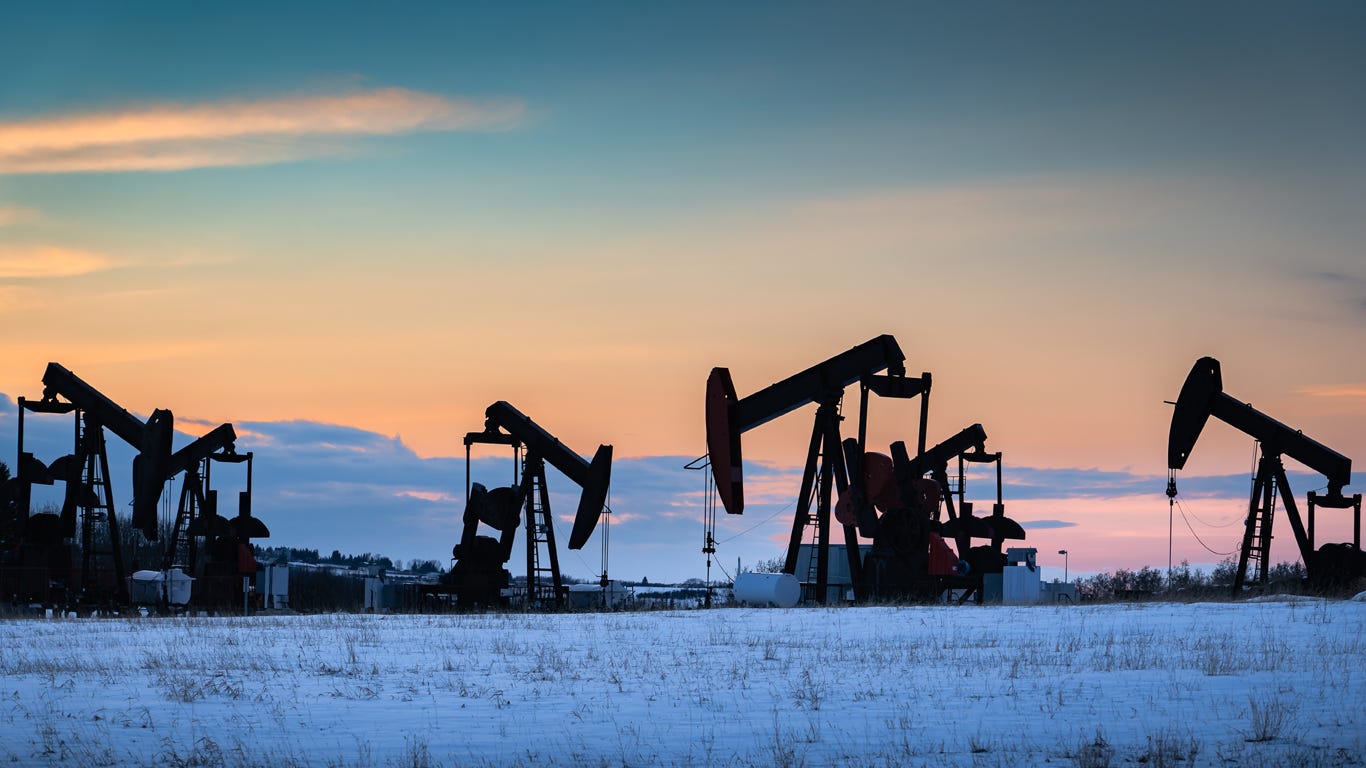
While the United States now produces roughly 14 million barrels of crude oil a day, its refineries still process millions of imported barrels. In 2025, Canadian crude alone accounted for 63.4% of U.S. crude imports. The issue is not a shortage of domestic supply, but a fundamental mismatch in chemistry. American shale basins primarily yield light, sweet crude, whereas the sprawling refining network across the Midwest was specifically engineered and retrofitted decades ago to process something entirely different: the heavy, dense, and sulfur-rich bitumen flowing out of Alberta's oil sands.
Treating crude as a simple, interchangeable commodity hides these hard engineering realities. A barrel is just a barrel until it enters a specialized refinery, where chemistry, pipeline routing, and metallurgy suddenly dictate economic survival.
Over the decades, American refiners poured billions of dollars into facilities designed exclusively for heavy Canadian feedstock. The BP Whiting refinery in Indiana alone burns through roughly 430,000 barrels a day of it, with identical configurations anchoring industrial hubs across Illinois, Michigan, Wisconsin, Ohio, and Oklahoma.
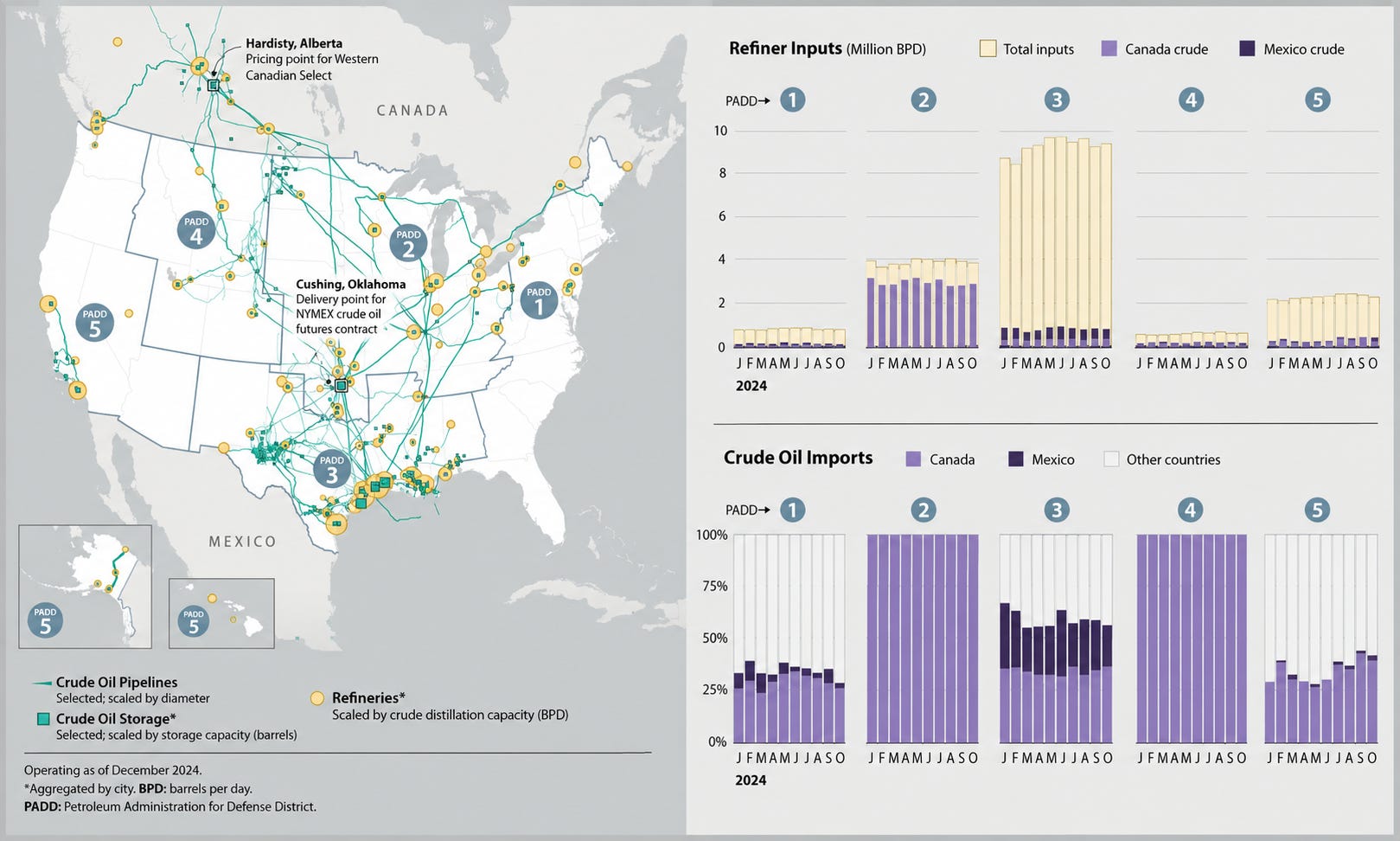
In the Midwest specifically (PADD 2), Canadian crude accounts for essentially 100% of all foreign crude imports, leaving zero alternative foreign barrels entering the region. Consequently, American energy independence is an illusion when viewed through the lens of processing; the nation's production is diversified, but its refining capacity is concentrated. Retooling these complex refineries to process different types of crude would be costly and take years. It is not something U.S. refiners are currently planning to do—a reality detailed by Reuters:
“U.S. refiners are not planning to make big-ticket investments to process more domestic crude and less oil from top suppliers Canada and Mexico, industry sources and analysts said, an obstacle to President Trump's plan to boost oil output.”
The Kansas City Federal Reserve was already warning of this vulnerability last year, highlighting the limited ability of Midwest refineries to replace Canadian crude without incurring high costs:
“U.S. imports of Canadian oil—a heavy sour crude—have doubled over the past two decades. Most of this oil is sent to Midwest refineries that specialize in processing heavy sour crude. These refineries have limited flexibility to substitute other types of crude without incurring the cost of switching equipment. As a result, higher prices for Canadian crude, including from tariffs, could lead Midwest consumers to pay higher prices on refined petroleum products such as gasoline, holding other factors constant.”
The mutual reliance has quietly morphed into a profound vulnerability precisely as Washington's geopolitical cushion has worn thin. Earlier this year, the disruption of the Strait of Hormuz choked off a major global shipping artery, triggering a massive international emergency release. The United States tapped its Strategic Petroleum Reserve (SPR) for 172 million barrels, treating it as a buffer against foreign shocks. But instead of preserving what remained, Washington chose this exact moment to ignite a trade dispute with its largest energy provider under the looming shadow of the 2026 CUSMA review deadlines.
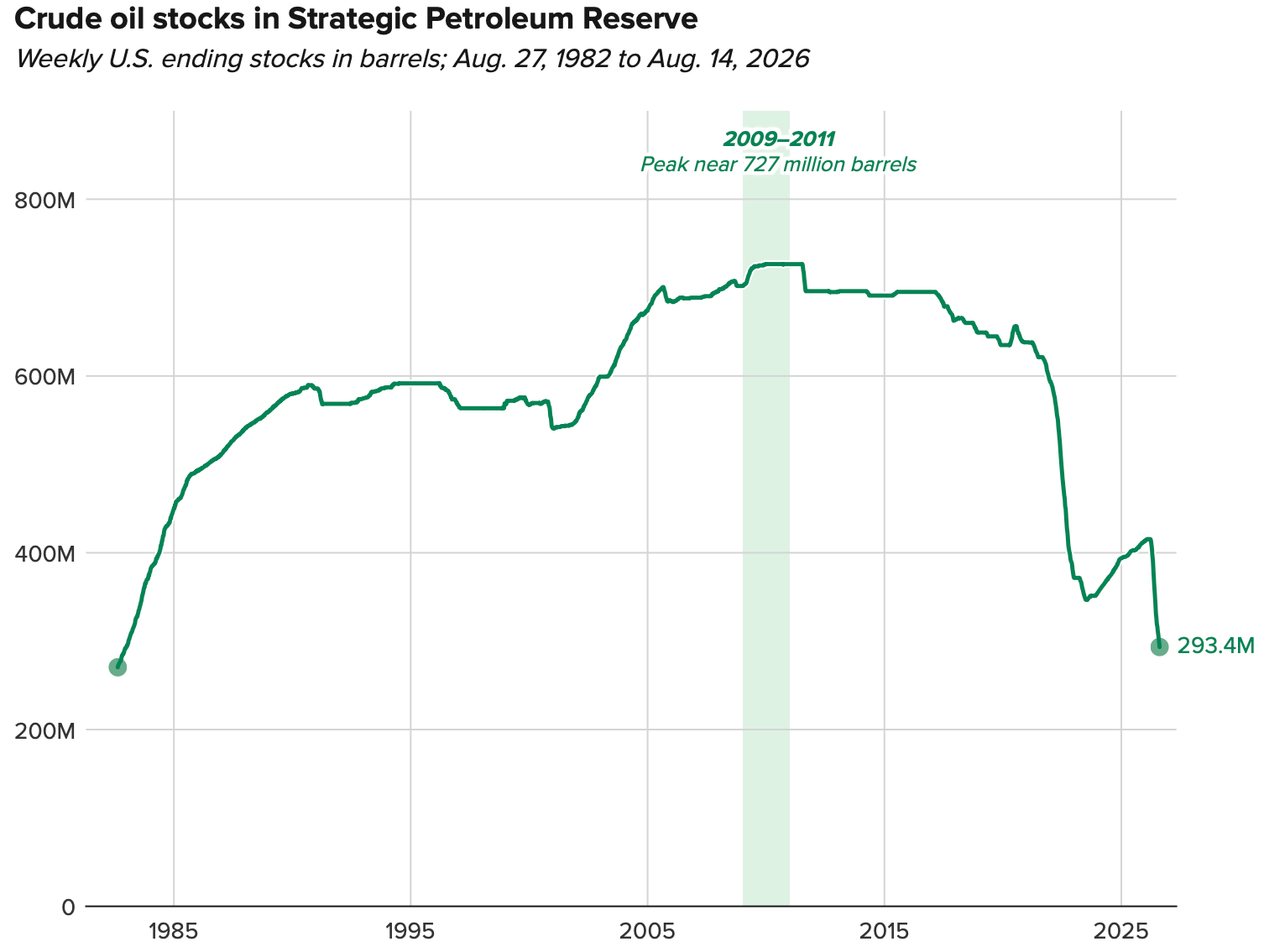
By mid-August, the SPR had plummeted to roughly 293 million barrels—less than half its 2010 peak and sitting at its lowest mark since the Reagan administration. Worse still, the Government Accountability Office has warned that more than a quarter of the remaining inventory may not be immediately available:
“The SPR’s drawdown, distribution and fill capabilities are currently limited and are at risk going forward due to longstanding issues with aging infrastructure compounded with ongoing major construction intended to address them.”
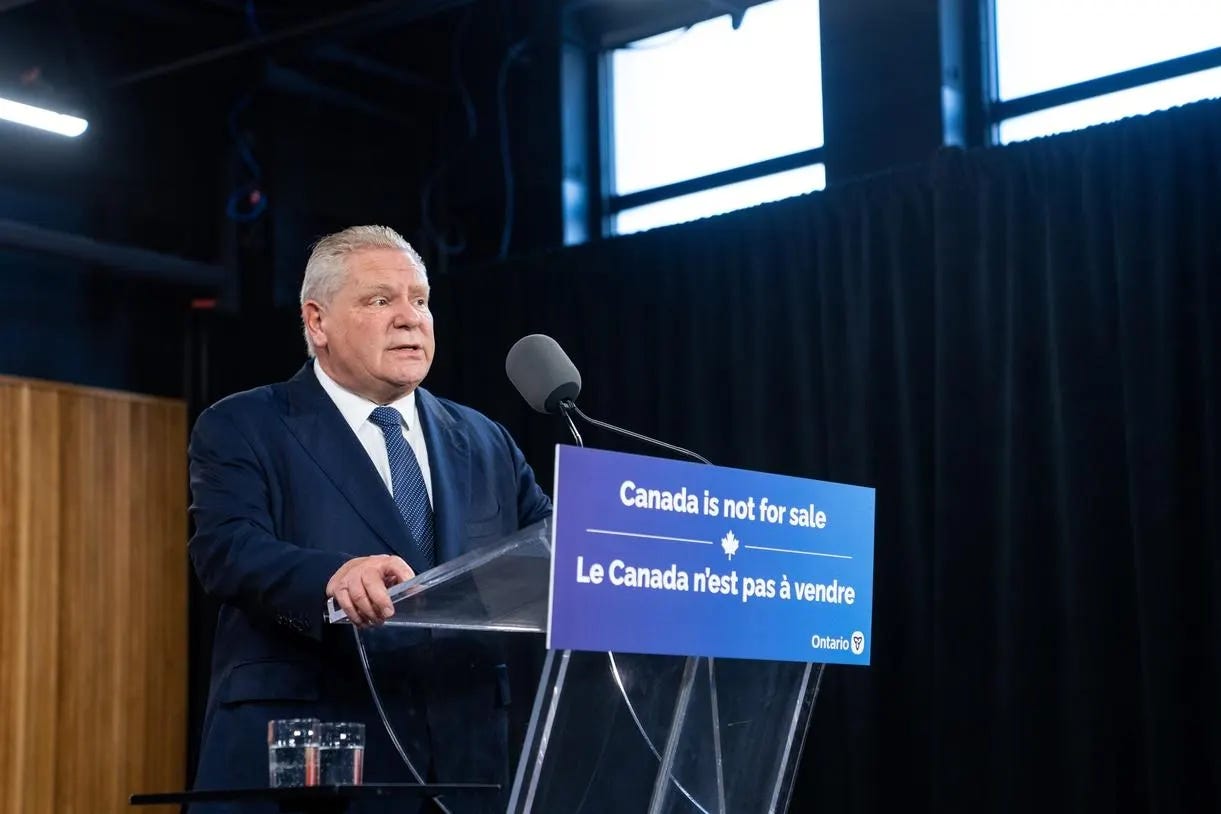
Ignoring these physical constraints, Washington enacted steep 50% tariffs on roughly $20 billion worth of Canadian goods. In response, Ottawa and provincial leaders like Ontario Premier Doug Ford placed everything on the table—including potential legislative mechanisms to directly tax or throttle energy flows south—while preparing dollar-for-dollar retaliatory strikes targeting American steel, electronics, and agricultural machinery starting September 8, with all diplomatic channels currently frozen.
Yet, market data immediately exposed the disconnect between political bluster and physical reality. During the very week the tariffs hit, imports of Canadian crude actually surged by nearly 600,000 barrels a day, averaging 4.2 million barrels daily. Refineries running at high utilization rates could not throttle back even if they wanted to.
This friction exposes a deep contradiction. Consider Line 5, the 73-year-old pipeline crossing beneath the Straits of Mackinac to pump 540,000 barrels of oil and gas liquids daily, supplying over half of Michigan's propane. While Washington slaps tariffs on Canadian commerce, the U.S. Department of Justice finds itself jointly fighting in court alongside Ottawa to prevent Michigan regulators from shutting that exact pipeline down. The border is political lines on a map; the energy grid is an integrated physiological system that rejects artificial borders.
For half a century, this continental pipeline network operated smoothly precisely because nobody treated it as a foreign entanglement. But that era is officially drawing to a close. Prime Minister Carney made this clear last week in remarks on Canada-U.S. trade negotiations:
“We cannot control the storm blowing in from Washington. We can chart a new course by building Canada strong at home and diversifying our trading relationships abroad.”
Canada has spent recent years aggressively insulating itself against American unpredictability. The completion of the Trans Mountain expansion (TMX)—often referred to as the Canadian ‘Trump-Proof” Oil Pipeline— in 2024 doubled pipeline capacity to nearly 890,000 barrels a day, carving a direct highway for Alberta crude to reach the Pacific coast.
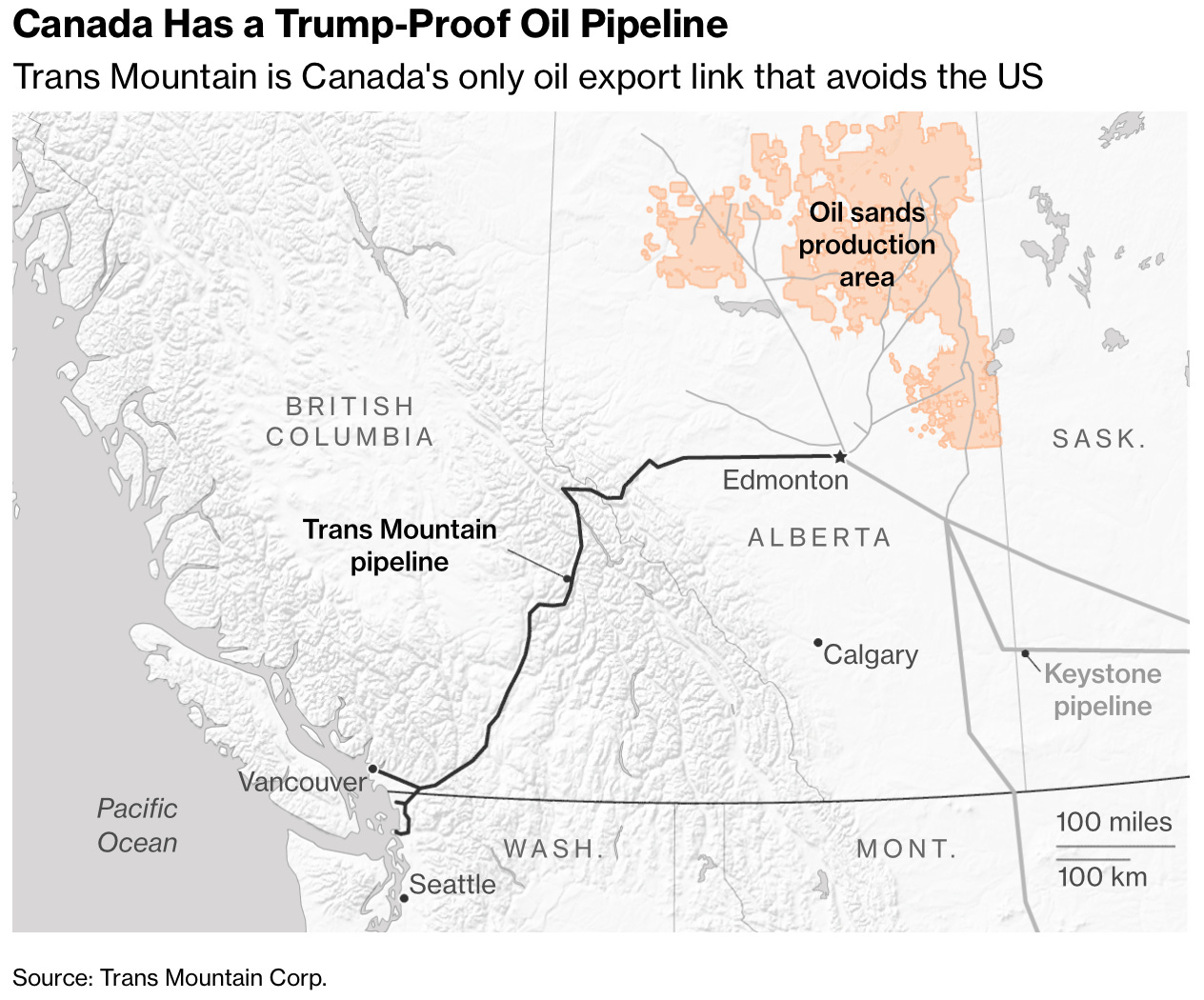
The shift became increasingly visible in 2025. Trans Mountain transported an average of 761,000 barrels per day, up 37% from 555,000 in 2024, while 67% of the vessels loaded at its Westridge Marine Terminal were destined for Asia. Driven by the strong global pricing premiums Asian refiners pay above North American benchmarks, Prime Minister Mark Carney's diplomatic push in Beijing and across Europe has unlocked billions in non-American trade agreements, paired with exploratory plans for a brand-new West Coast export pipeline that could eventually divert another million barrels daily toward Asia.
Washington still operates on the outdated assumption that Canadian crude has nowhere else to go. While the Trans Mountain expansion and new trade agreements are opening alternative export routes, the ties remain deep: roughly 85% of Canada's oil still flows south. Severing that volume abruptly would deal a heavy blow to Canadian producers and provincial budgets.
Yet this cuts both ways, exposing a blind spot in U.S. strategy. For decades, refineries in the American Midwest and Gulf Coast have been optimized specifically to process heavy Canadian crude from the oil sands. Washington routinely underestimates this operational dependence. Halting or heavily penalizing this supply leaves American refiners with few alternatives and drives up costs directly for domestic fuel consumers.
Rather than forcing Canada into submission, a trade war is simply accelerating a multi-year diversification away from its dominant partner. The pipelines that once bound the two nations together are shifting from a permanent union into a strategic choice—and acquiring that choice changes the balance of power.
The ultimate question remains: who blinks first?
Thank you for reading!
If you enjoy connecting the dots behind the headlines, subscribe for free. New pieces land straight in your inbox
📨 If you think someone would enjoy this, send it their way!
Comments
Nothing yet. Say the first thing.
Sign in to join the conversation.