
In 1867, the 15-year-old Erasmus Jacobs found an unusually shiny and transparent stone on his father's farm near the Orange River in South Africa. It came to be known as the Eureka, the first diamond found in South Africa. Two years later, the discovery of the much larger Star of South Africa helped trigger an unprecedented rush to the diamond fields around Kimberley. Thousands of prospectors arrived, competing fiercely for claims as diamonds poured out of the ground. Within a decade, South Africa was producing roughly 95% of the world's diamonds.
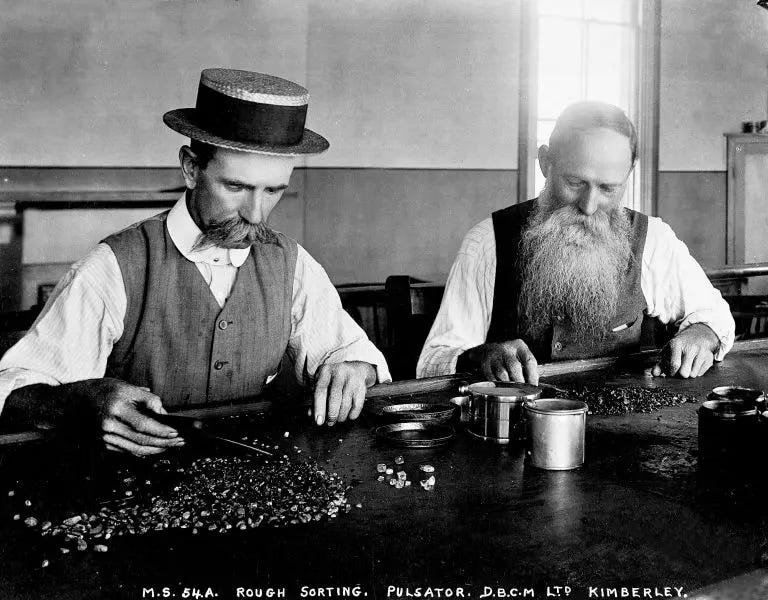
Diamonds derived their value from scarcity, but suddenly there were far too many of them. Cecil Rhodes and Barney Barnato, once fierce competitors in Kimberley, eventually consolidated their interests in 1888 to form De Beers Consolidated Mines. What followed was the creation of one of the most powerful monopolies in history. De Beers bought up competing mines, controlled distribution, and regulated how much rough diamond supply actually reached the market. When necessary, stones could be kept out of circulation to protect prices.
De Beers understood that controlling supply was only half the equation. It also had to manufacture demand. Through decades of advertising, the company transformed the diamond into the ultimate symbol of love, marriage, and status. In 1947, it introduced the iconic slogan: "A Diamond Is Forever." To cement this, they engineered the famous two-month salary rule, turning a luxury purchase into an expected social obligation. De Beers was no longer just selling stones. It was selling scarcity, romance, and the expectation that a diamond was a mandatory milestone.
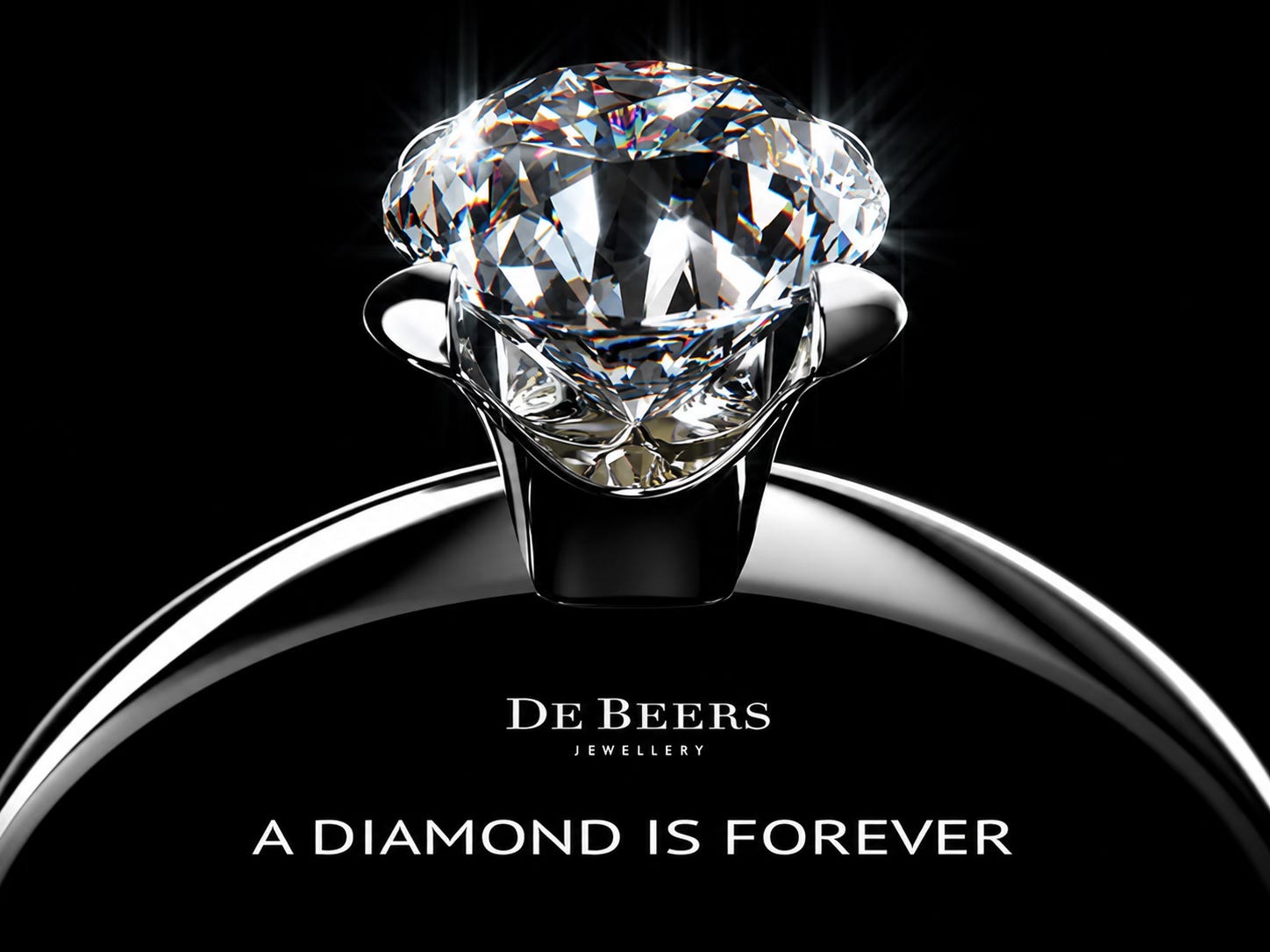
For most of the twentieth century, the formula worked remarkably well. De Beers hit its peak in the mid-to-late 20th century by controlling between 80% and 90% of the world’s rough diamond supply and strictly regulating prices through its London-based Central Selling Organisation (CSO).
In 2012, Rihanna famously sang that we should “shine bright like a diamond,” reflecting an era when the market was still at its zenith.
Eventually, however, the shine faded.
Over the past fifteen years, the natural-diamond market has entered a prolonged decline, hitting De Beers with three consecutive years of write-downs totaling a staggering $6.8 billion. To defend its turf, the company spent years trying to hold prices well above the true market rate. But last month, the pressure finally proved too much, forcing De Beers to make some of the deepest cuts ever to its official diamond prices. Even that desperate move failed to stem the bleeding. Last week, Bloomberg’s DIAMINDX—which tracks the spot market value of a standardized basket of natural diamonds—plunged to an all-time low, sitting roughly 70% below its 2011 peak.
Ironically, this crash isn't happening because natural diamonds are suddenly abundant. In fact, global supply has steadily declined since its peak in 2005. In recent years, major diamond mines have permanently closed or suspended operations due to depleted reserves, meaning natural diamonds are genuinely becoming scarcer. Yet, despite this natural supply crunch, the market is imploding.
The roots of this disruption go back decades. They were born not of luxury, but of sheer industrial and strategic necessity. As the hardest natural material on Earth, diamond features a rigid, three-dimensional carbon lattice that makes it unmatched for heavy-duty manufacturing tools and drill bits. Yet, its utility extended far beyond the factory floor. Because diamonds handle extreme heat and radiation better than almost any other material, they are also vital for military and aerospace applications.
Rather than relying on earth-mined stones, scientists learned to replicate nature inside the laboratory. They created synthetic or lab-grown diamonds that are physically, chemically, and optically identical to their natural counterparts.
To meet the growing demand for industrial-grade diamonds, China built a massive manufacturing footprint centered on Henan province. China methodically scaled up massive high-pressure, high-temperature (HPHT) capacity. Using heavy presses to recreate the extreme conditions of the Earth's mantle within factory chambers, they laid the groundwork for mass-producing lab-grown diamonds.
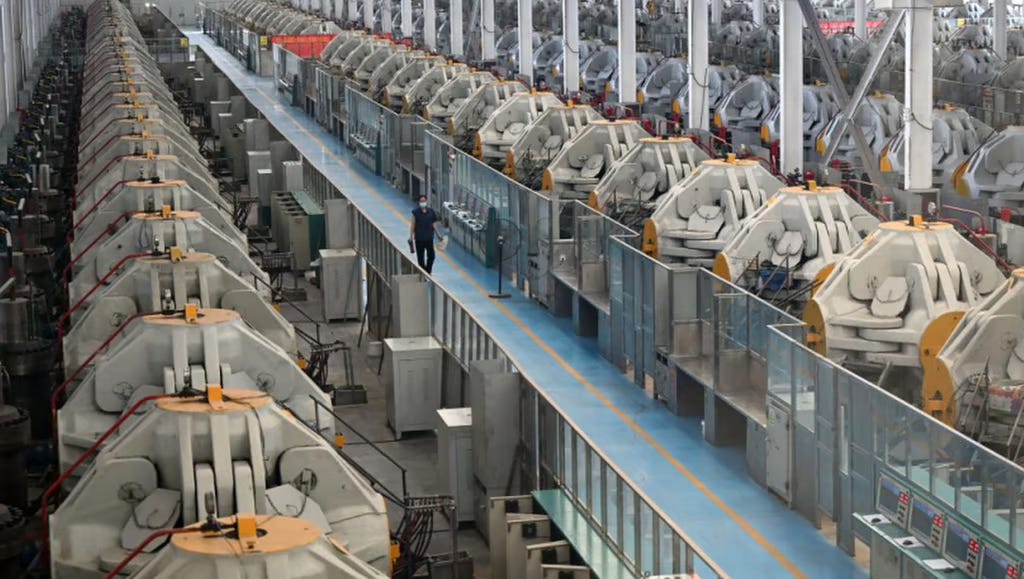
With the technology maturing, Chinese manufacturers realized those same heavy industrial presses could produce gem-quality stones. As diamond demand reached record highs and astronomical prices in the 2010s, that profound industrial muscle pivoted.
What started as a quest for industrial self-reliance exploded into a lucrative rush for consumer wealth. Although lab-grown stones were priced well below natural ones, their sheer volume and surging popularity captured the booming demand, dragging down the broader market and reshaping consumer expectations. China quickly cornered over 60% of global lab-made diamond production—with some estimates pushing past 90%—turning a rare luxury into an industrial commodity.
For De Beers, the irony is hard to miss. The company was originally forged in response to a nineteenth-century oversupply crisis and spent the next century mastering how to control it. This time, however, the new flood of supply isn’t coming from another mine, but from massive manufacturing lines.
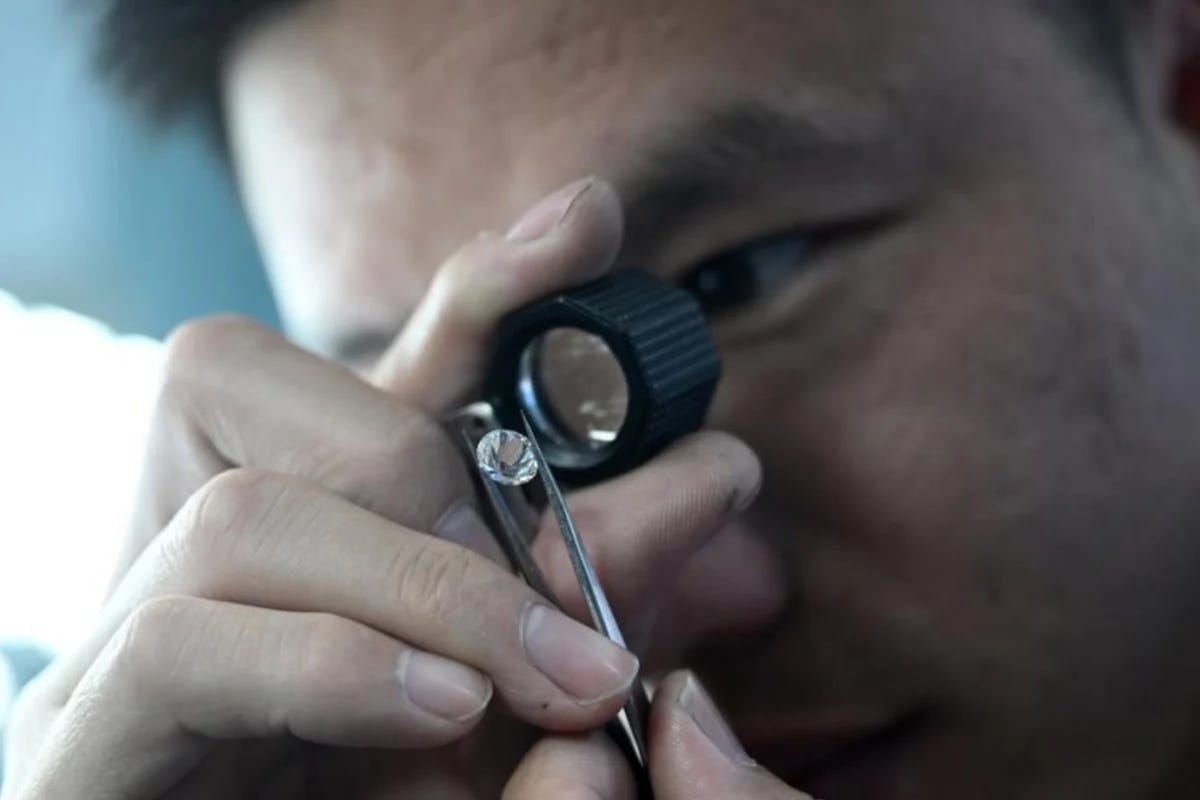
The effect on the jewelry market has been brutal. As production expanded and costs plummeted, lab-grown diamonds have become dramatically cheaper than their natural equivalents, now generally costing 75% to 90% less. Consumers can suddenly buy a physically and chemically identical stone for a fraction of the price, while completely sidestepping ethical concerns like conflicts and blood diamonds. In the United States—which is the world’s largest jewelry market—lab-grown diamonds have rapidly captured the engagement-ring sector, while demand for natural stones steadily weakened. Demonstrating this shift, 61% of buyers in the US opted for a lab-grown diamond in their engagement ring last year.
The price collapse marked a harsh reversal for manufacturers. Historically, companies producing lab-grown diamonds enjoyed massive gross margins, often exceeding 80% to 90%. But as supply quickly overwhelmed demand, the entire jewelry market became bogged down in relentless overproduction, destructive price wars, and tumbling retail prices globally.
Yet, against this backdrop, shares of China's largest lab-grown diamond producers have recently surged. The catalyst is a surprising and fitting turn of events.
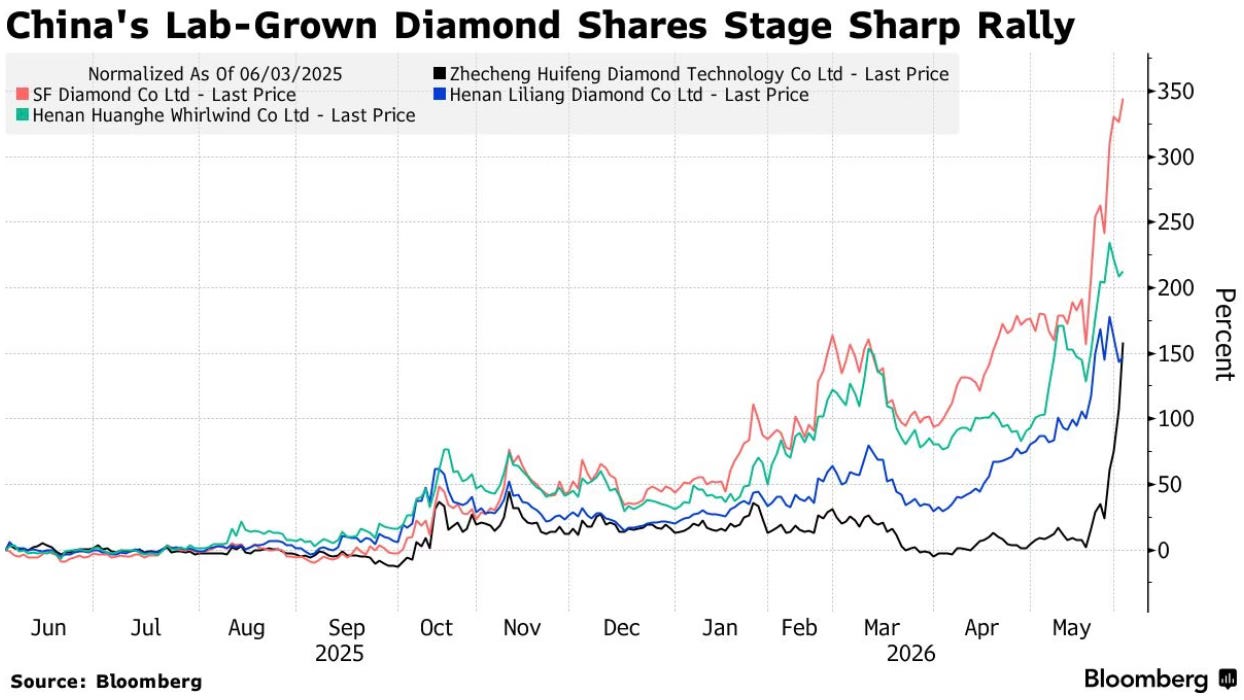
The diamond industry is finding an entirely new customer in artificial intelligence, driven by the material's exceptional physical characteristics. For the industry, this high-tech shift is far more than a clever niche application. It’s bringing the material's journey full circle.
To understand why this matters strategically, we have to look at the physical bottleneck holding back modern AI infrastructure. As companies like Nvidia, AMD, and hyperscalers pack billions of transistors onto denser silicon wafers, power consumption and specifically heat generation have skyrocketed. Traditional cooling methods, including liquid cooling and standard copper heat sinks, are rapidly hitting their thermodynamic limits. In high-density AI clusters, chips literally begin to throttle their own performance to prevent melting, turning thermal management into the single most critical constraint on computational scaling.
This is where lab-grown diamonds alter the strategic calculus. Thermal conductivity refers to a material's ability to conduct and transfer heat away from a source. Diamonds possess a thermal conductivity roughly five times higher than copper at room temperature. By integrating diamond heat spreaders directly onto or beneath AI accelerators, engineers can dissipate heat with a speed and efficiency that copper simply cannot match. It shifts diamond from a discretionary luxury item into a critical enabler of scalable compute.
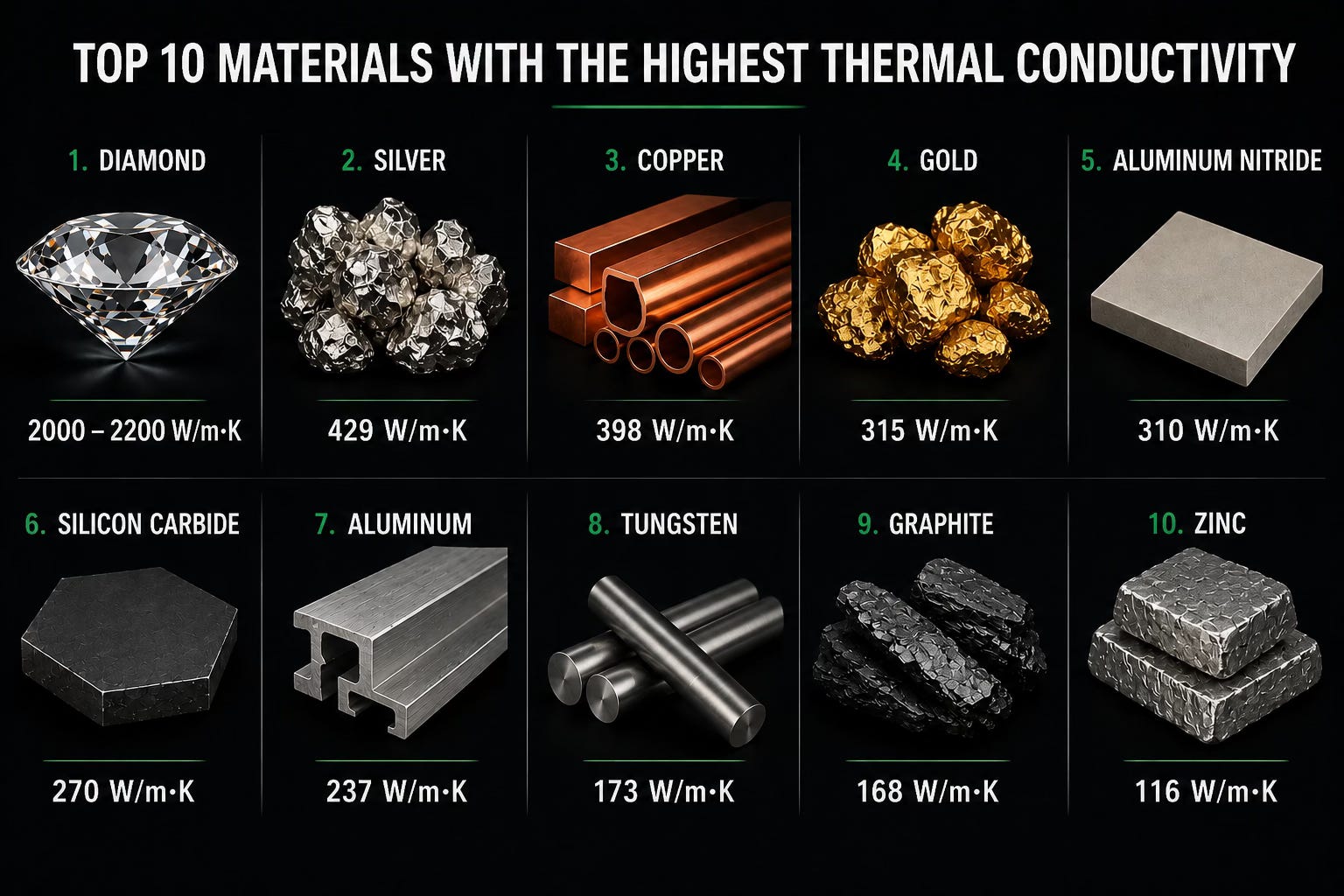
Emphasizing how conventional materials are hitting a wall that threatens future progress, Liu Yuenan, an analyst at Shanghai-based Guotai Haitong Securities, points out the importance:
“Thermal management for high-density AI computing stands out as a core growth driver. Copper, the conventional material, is approaching its performance limits.”
This realization turns historical market dynamics completely upside down.
In February, California-based Akash Systems delivered the first diamond-cooled Nvidia GPU servers to an Indian cloud provider. Simultaneously, Chinese manufacturers began shipping high-spec diamond heat spreaders after passing rigorous overseas qualification tests. This practical implementation is rapidly scaling up on the ground. Researchers from the Chinese Academy of Sciences recently deployed a new diamond-copper composite material in an AI computing node in Henan province, successfully boosting cooling efficiency by up to 80% and helping the industry leap past the physical limits of traditional copper.
This stark pivot marks the ultimate irony for the entire industry. De Beers spent generations convincing humanity that a diamond’s value lay entirely in its rarity, backed by artificial scarcity and emotional marketing. But the market’s true future is being forged in high-pressure chambers where scarcity is obsolete, and utility is everything.
As this new reality takes hold, the implications extend far beyond the gemstone trade. China has taken a material once defined by geological scarcity and turned it into a scalable industrial input—first for manufacturing, then for consumer goods, and now potentially for the infrastructure powering artificial intelligence. That matters because control over the AI supply chain is increasingly shifting away from the chips themselves and toward the materials needed to make them run. In that sense, the diamond's transformation is not merely a story about the collapse of a luxury market. It is a striking microcosm of a much larger shift: China is increasingly turning abundance, scale, and industrial capacity into strategic power.
The gem once marketed as an eternal symbol of scarcity and romance has seen its shine fade, as it quietly transforms from a symbol of luxury into a high-tech workhorse born on a roaring Chinese factory floor.
Thank you for reading!
If you enjoy connecting the dots behind the headlines, subscribe for free. New pieces land straight in your inbox.
📨 If you think someone would enjoy this, send it their way!
Comments
Nothing yet. Say the first thing.
Sign in to join the conversation.