
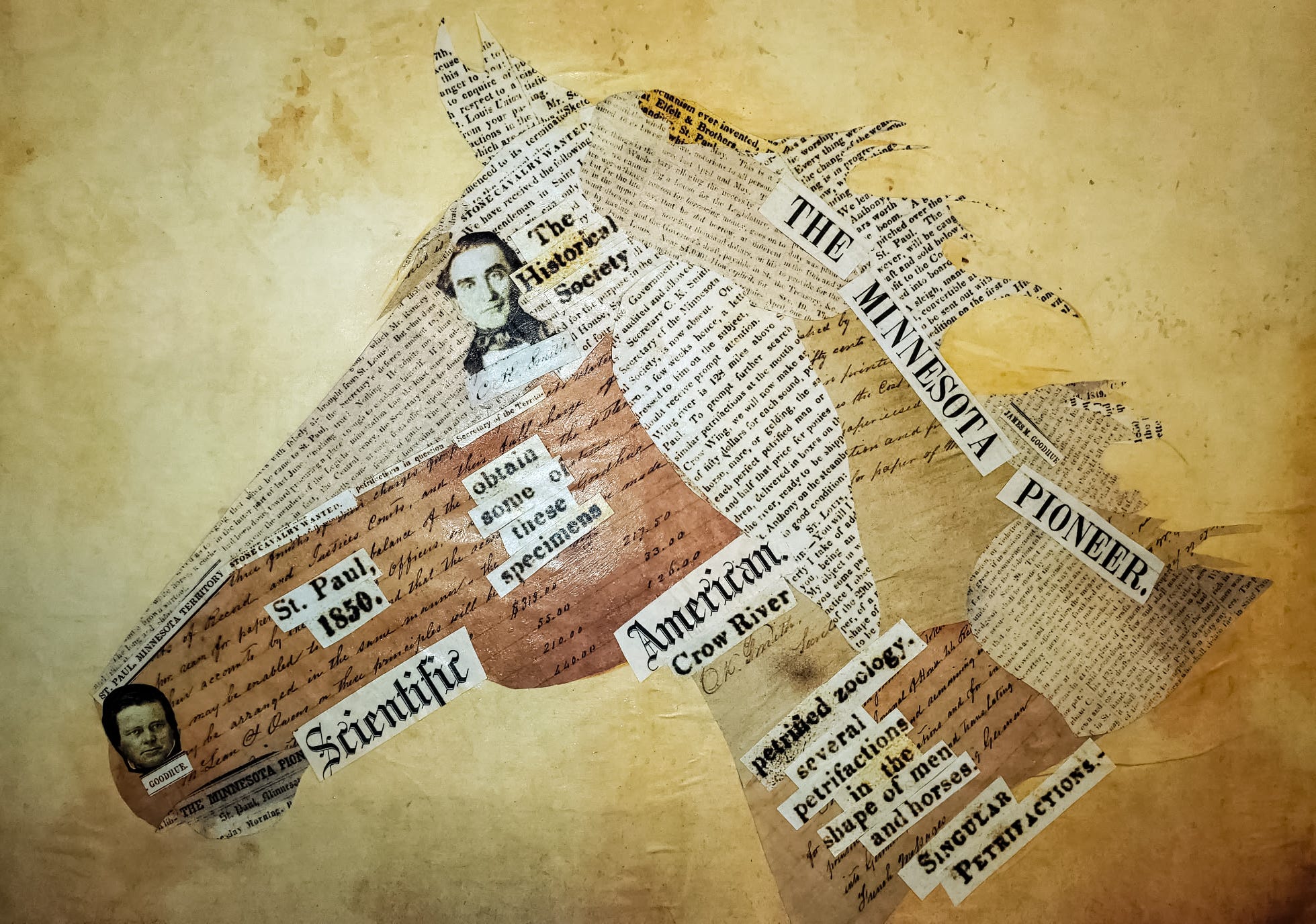
This all started with a stray paragraph.
I was paging through an 1850 issue of Scientific American when a tiny filler item grabbed my full attention. Tucked between a report of charcoal being used to clean a cistern and a story about a surgery, the headline nearly escaped my attention.
Stone Cavalry.
What followed was brief and strange. The short feature reported that “four petrified horses and riders are said to have been discovered at the bottom of Crow Wing River” north of St. Paul, Minnesota, and the Pioneer would pay anyone who could deliver any of the specimens.
There was an interested “St. Louis Barnum,” said the paper, and promised that a letter to the head of the local historical society would be returned soon.
144 words and not nearly enough information.
That’s all it took to pull me into a chase that has now lasted months. Stone horses in a river in Minnesota were an anchor around my neck, and I couldn’t get away from them.
Almost two centuries earlier, I suspect the horses did something similar to a man named Charles Kilgore Smith.
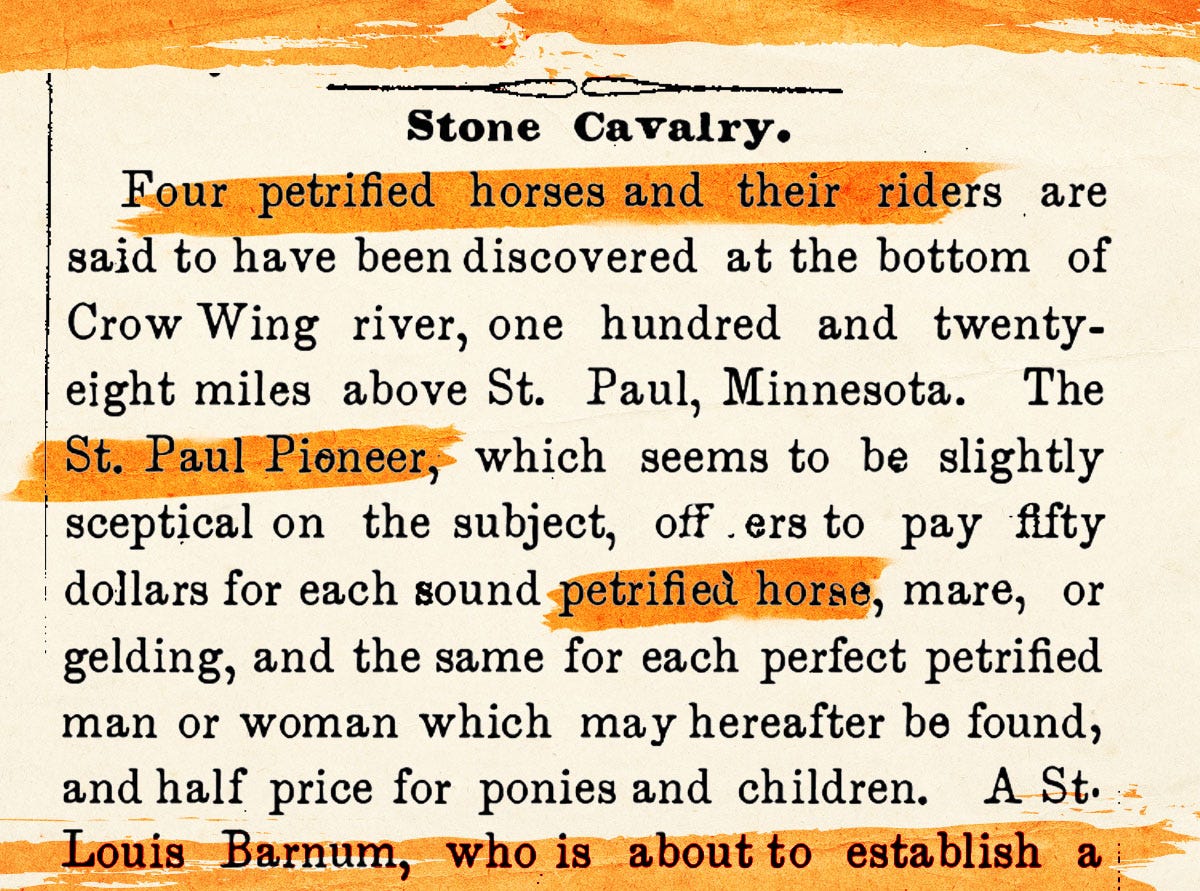
I started on the trail of these stone horses and immediately found myself at a roadblock. There was no St. Paul Pioneer in existence in 1850. Through some digging, I confirmed that there was a Minnesota Pioneer, and there were printed references to it that referred to it as the St. Paul Pioneer, because it was printed there.
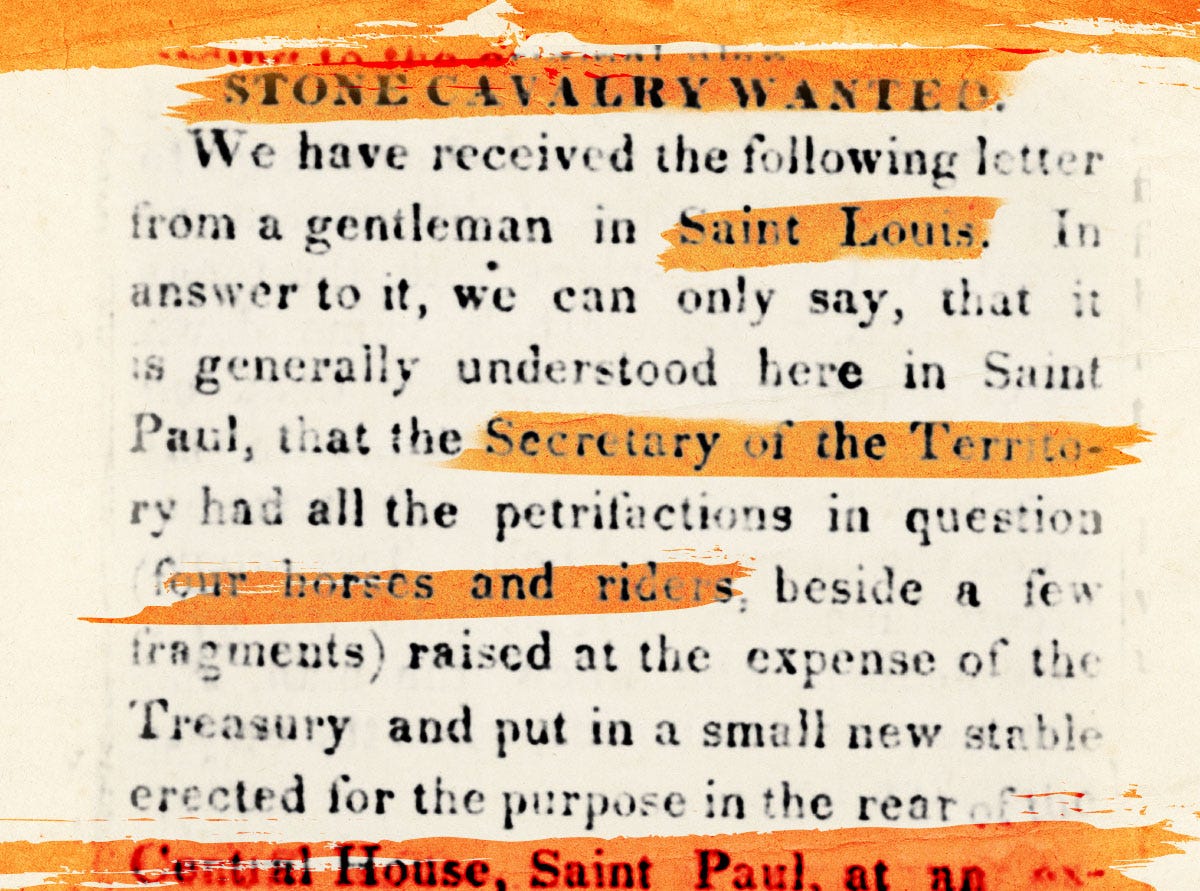
Starting with a few words and a timeframe, I began to dig through 1850 issues of the Minnesota Pioneer until I found what I was looking for. On May 16, 1850, the Minnesota Pioneer ran a story that featured the headline, “Stone Cavalry Wanted.” The article is a response to a letter, which in the paper goes unsigned by its sender, and the Pioneer makes no effort to identify its sender other than saying “a gentleman from Saint Louis,” and claims that the petrifactions have been raised from the river and brought into St. Paul.
“... the Secretary of the Territory had all the petrifactions in question (four horses and riders, beside a few fragments) raised at the expense of the Treasury and put in a small new stable erected for the purpose in the rear of the Central House, Saint Paul, at an expense of four hundred and thirty-one dollars to the Government, which has been duly audited and allowed in his accounts.”
The article continued:
“To prompt further search for similar petrifactions at the mouth of the Crow Wing, we will now make an offer of fifty dollars for each sound, petrified, horse, mare, or gelding, the same for each perfect petrified man or woman, and half that price for ponies and children…”
It was absurd. It was also very specific. So specific, I wondered if there could be something more here.
This is where things went sideways. I wanted to know whether anyone had ever gone up the Crow Wing River to look for those horses. I wanted to know who paid for the trip, if it happened at all. And as I dug into the territorial records and written Minnesota histories, one name kept surfacing.
Charles Kilgore Smith, the first secretary of the Minnesota Territory and the founder of the Minnesota Historical Society.
If anyone in 1850 St. Paul had the authority and obsession to turn a rumor about petrified cavalry into an official errand, it was probably him. If he was chasing down stone horses in Minnesota, like I was now, then how did he do it? Was it really duly audited and allowed to his accounts as the article in the Minnesota Pioneer said? Or was this whole thing something more?
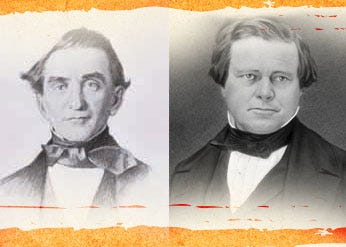
To understand how a throwaway item about stone horses became loaded, you need to meet two men who did not like each other.
Charles K. Smith was born in Ohio in 1799. He worked in banking and law, served as an assistant county judge, and in 1849 was appointed the first secretary of Minnesota Territory. The secretary kept records, recorded laws, communicated with Washington, D.C., and handled the territorial treasury. He wasn’t the highest-ranking politician in the Minnesota Territory, but one could argue that his control over the funds appropriated to the territory made him the most powerful one.
Smith arrived in St. Paul that summer with an eye for influence. He helped organize a Masonic lodge, maneuvered in local politics, and, most importantly for the topic at hand, drafted the act that created the Minnesota Historical Society.
Later opinions are not kind to him. A speech from Minnesota politician William P. Murray, read at a meeting of the historical society in 1901, called Smith’s appointment “an unfortunate one,” describing him as a man of ability whose temperament “led him into antagonism with everyone,” convinced that he should have been governor instead of secretary.
On the other side stood James Madison Goodhue, born in New Hampshire in 1810, Amherst-educated, a lawyer turned editor. In April 1849, just days after the territory was created, he hauled a press upriver and founded the Minnesota Pioneer, the first newspaper in the territory.
Daniel S. B. Johnston said in one of his collected histories that Goodhue wrote in a style called “intense personal journalism.” His editorials named names, mocked enemies, and blurred the line between political argument and personal feud. Through sheer influence and determination, he was named the official printer for the territory legislature. As the printer for the legislature and the first and largest paper in St. Paul, James Goodhue could easily be seen as the most powerful citizen in this young territory.
Smith controlled the money and disbursements. Goodhue controlled the main printing press and the loudest public voice. They were bound to clash. They did, quickly and aggressively.
By 1850, Goodhue was already accusing Smith of dragging his feet on paying government printing bills. Smith, for his part, used his office to push projects he cared about, especially the Historical Society.
You do not need much imagination to see how a rumor about stone horses in the Crow Wing could get pulled into that fight.
With new background information, I knew I wanted to dig deeper.
The stone horses first appear in the Pioneer a few months before the May article that spawned the Scientific American mention, on February 20, 1850. The paper ran a tiny item under the headline “Singular Petrifactions.” It reported that stone horses and their riders were found in the Crow River, about thirty-five miles from St. Paul. It went on to suggest that the Historical Society should make arrangements to “obtain some of these specimens of petrified zoology.” The Historical Society had its first official meeting in January of 1850, and in February, it can safely be said that C. K. Smith was the Historical Society.
But here, the details are slightly off. In the February mention, the river is named as the Crow River, while the May article (and the supposed letter from the St. Louis Barnum) names the river as Crow Wing. These are two distinctly different rivers. The Crow River is thirty-five miles away from St. Louis; the Crow Wing River is one hundred miles further away.
The change in rivers feels like more than a typo. Crow River, being relatively close to St. Paul, would be easier to explore and search for these so-called petrifactions. Their existence could be fact-checked. The Crow Wing River is much further away, and becomes a larger financial matter. To travel that far into the American frontier of 1850 was an ordeal. The February mention of the stone petrifactions appears to be printed in earnest—the May article reads with an acidic wit and drips of sarcasm, especially when listing the prices the Pioneer was willing to pay for specimens. Was the change in location meant to preserve the ruse?
Then, in June, the Pioneer reprints a short piece from the Philadelphia North American that says the stone horses and riders were brought to St. Paul and stored in a purpose-built addition to the Central House. This detail is from the May mention, and the Pioneer responds to the assertion:
“Yes; but as oats in Saint Paul are scarce at one dollar per bushel, the Secretary enlisted them in the new company of dragoons and they were shipped down on the Dr. Franklin, No. 2, last week …”
This retort is a deadpan admission that there were no stone horses in St. Paul. The absurd explanation that C. K. Smith has shipped them away due to the cost of oats is another jab at the Secretary, disguised as humor.
It looks to be a joke on the surface, but underneath the scattered mentions of the “singular petrifactions,” there was serious conflict. Withheld money, a largely preoccupied secretary, and stone horses weighing down two of the most powerful men in the territory.
The Pioneer was not making up its obsession with petrifactions out of thin air. It was playing to a national taste.
Nineteenth century readers were fed a steady diet of stones that used to be something else. Petrified forests, fossil men, giants, and animals frozen in time grabbed headlines and were common features of sideshows.
Later in the century, the Cardiff Giant would become the most famous of these stone curiosities. In 1869, workers digging a well on a New York farm unearthed a ten-foot figure that was quickly presented as an ancient petrified man. Crowds flocked to see it before it was fully exposed as an elaborate hoax. Carved from a block of gypsum, there was nothing ancient or petrified about the Cardiff Giant.
Showmen loved this stuff. In 1853, the New York Herald advertisement trumpeted “HORSE AND RIDER TURNED TO STONE!” This exhibit was supposedly a rider and horse turned to stone, described as having a giant snake coiled around its base. This was advertised and shown by none other than the now-famous showman P. T. Barnum. These types of curiosities fascinated P. T. Barnum so much that he would, years later, try to purchase the Cardiff Giant. He would fail, create his own version of the Giant, and show it under the pretense of authenticity.
Scientific American itself participated in the fever. The same page that printed the “Stone Cavalry” filler about Crow Wing also carried a short item titled “Western Giants,” describing oversized skeletons dug up in Cattaraugus County, New York, their skulls large enough that a living man could reportedly fit his head inside. The journal was an early science magazine that also acted as a clearinghouse for marvels.
So when the Pioneer joked about petrified cavalry, it was not just making local fun. It was taking part in a national conversation about how far one might trust stories of stone flesh, giant bones, and bodies that ignored ordinary limits.
Into that environment walked Charles K. Smith and James Goodhue, arguing over money, influence, and what counted as proper use of public funds. The stone horses became part of that argument.
Given the petrifaction fever of the 1800s, particularly in frontier territory where official U.S. geological surveys were tasked with cataloguing fossils, ruins, and other features of the land, it’s really no wonder that James Goodhue thought that a story about petrified riders and their horses would be a good vehicle for his ongoing complaints against C. K. Smith.
As the contracted printer for the territory and its legislature, Goodhue was doing his job and placing considerable faith in the local government when he purchased paper, ink, and other supplies out of his own personal funds. Imagine his irritation when C. K. Smith failed to pay him promptly, often putting him off without much of an explanation at all. It’s well-documented in Minnesota histories that Goodhue was not paid promptly.
Worse than that, Goodhue felt that Smith often played favorites, paying other claimants faster when they aligned with his own politics. When questioned on this, Smith would defend himself to locals and officials in Washington, D.C. by arguing that certain expenses were not explicitly authorized, and therefore would have to wait for future federal appropriations.
In other words, Smith was executing his duties as secretary with a kind of procedural literalism. This is how he actively delayed payments to those he disliked. Of course, for someone like Goodhue, who lived on these printing contracts, it hit him right in his pocket. And for Goodhue, it was plain and simple. Smith was a thief.
Goodhue was not alone in his bickering with Smith. The very behavior that incensed Goodhue led to a strongly worded letter from the U.S. Treasury regarding Goodhue’s unpaid bills.
But Goodhue was present in the territory, directly affected by the missing money. Any letter-writing pencil pusher in D.C. was days, even weeks, away.
Knowing how James Goodhue really felt about C. K. Smith is crucial for understanding the framing of the Stone Cavalry of Minnesota. The May article now reads as an example of waste in the government, treating the horses as expensive pets of the Secretary, raised at the “expense of the Treasury” and housed in a custom-built stable. You can imagine Goodhue fuming as he wrote the descriptions: Smith has money for this, and yet Goodhue goes unpaid. This is the meat of his argument, and how he chose to drag his complaints out into the public.
So, let’s recap once more: first, a straightforward novelty. Strange stone horses and riders not too far from St. Paul. Then, after an unsigned letter from St. Louis to call the story back to the headlines, we have the suggestion that the Secretary has already spent hundreds of dollars of government money to raise the specimens and build them a stable. And then, in a final stroke, we learn that the horses are no longer in St. Paul, sent away by the Secretary because oats were too expensive, vanishing down the river as part of a newly drafted troop of dragoons.
So much effort, and nothing to show for it.
It is hard to avoid the conclusion that Goodhue is harnessing the horses to pull his own load. The more he jokes about government money spent on stone relics that are now nowhere to be seen, the more clearly he levels his complaint of government waste, mishandled money, and perhaps outright fraud.
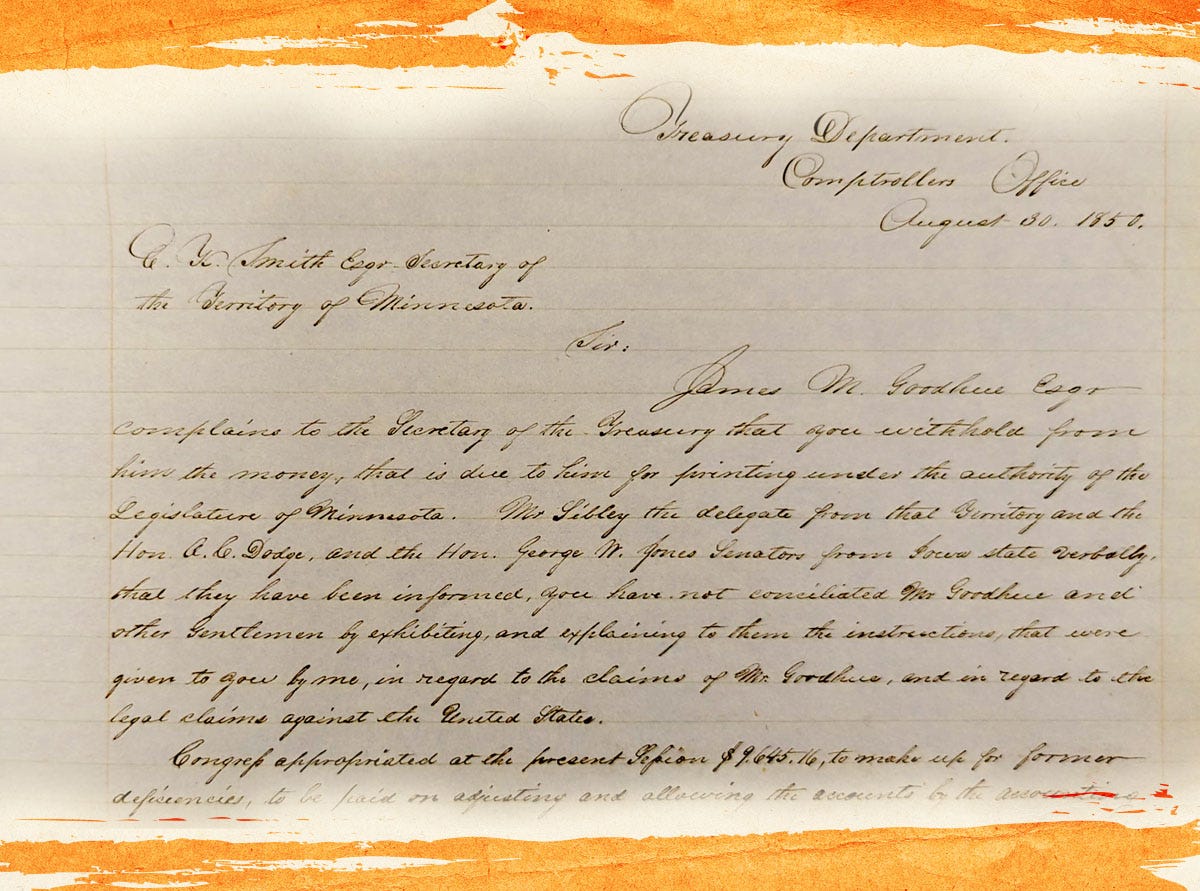
Things moved quickly in the new territory. A little over a year had passed in the feud between Goodhue and Smith by the start of 1851, and things were fast falling apart.
Goodhue’s confrontational style didn’t stop with Smith, and it led to a very real fight. After penning a scathing editorial against a local judge running for higher office, the judge’s brother tracked him down. The confrontation turned violent, and shots were fired. Reports vary on the event, painting it as one or the other’s fault for beginning the aggression, but what we know is this: Goodhue was stabbed multiple times and the injured editor shot his assailant in the groin. The judge’s brother died a few months later, likely from complications due to that injury.
Smith’s fortunes were also crumbling. Pressure over his handling of accounts, disputes with local figures, and the constant hounding of Goodhue combined to make his position untenable. In August 1851, he left the office of secretary and departed Minnesota, to return to Ohio.
Goodhue seized the moment to deliver what is likely the most quoted editorial in early Minnesota history, writing that Smith “stole into the territory, he stole in the territory, and then he even stole out of the territory.” He captures in a single line his belief and accusation that Smith’s presence, his conduct, and his escape from accountability were all forms of theft.
After months in the archives for this story, I am left with more questions than answers.
Were the stone horses ever there? Was it based on any shred of truth at all? What led to that first snippet in the Pioneer in February of 1850?
All we have is the ink, an idea. What we do not have is any surviving stone. No catalog entry for a petrified horse in the early holdings of the Minnesota Historical Society. No description of such a thing in official government surveys. No records to show anyone from St. Louis ever actually wrote to the Pioneer to spur that second article.
Did Smith mishandle, or even steal, treasury funds to chase relics for the Society? The documentary record shows slowness, defensiveness, and poor judgment. It shows unpaid bills and mistakes in calculation corrected by men in D.C. We know that C. K. Smith mixed his duties as secretary with his position as head of the Minnesota Historical Society. The Society used the secretary’s office as its headquarters for the first year of its existence. We have accusations of payment vouchers sold or traded at under face value, changing hands so as to benefit Smith’s private pocket. But it’s all gray area, no clear line crossed. Nothing that I could find that veers into clear fraud or diverted funds in the name of historical obsession.
So we stand at the Crow (Wing) River. On one side, a national appetite for petrifaction stories, giants, and stone beasts, eagerly fed by editors and showmen from New York to St. Paul. On the other, a very real struggle over power, money, and memory in a newborn territory. Somewhere between them, four stone horses and their riders, trotted in and out of print by a printer with a grudge.
Almost two centuries ago, if the Pioneer is to be believed, C. K. Smith may have chased those horses upriver, following rumors into cold water in the hope of bringing back something solid for his Historical Society. Today I am chasing them through the words that are left, in old newspapers, recorded histories, and faded suggestions. The story found its way from the fledgling territory to the East Coast. Surely there was more than just a metaphor for unpaid invoices.
For now, there is no final answer, just the peculiar satisfaction of knowing how many people those imaginary horses managed to carry. A secretary with a taste for history. A printer with unpaid bills. A national audience hungry for stone wonders.
And me, still turning the pages, deciding whether I am finally ready to let them run free.
If you liked this article, please consider supporting 50 States of Strange with a small donation of any size. All articles are free, and your donation will help keep it that way.
Share this post if you thinks others would like to read it.
No posts
Comments
Nothing yet. Say the first thing.
Sign in to join the conversation.