
“I can not help reflecting that if we fall, we fall, like Lucifer, out of the heavens, and that our arrival upon earth, or rather upon water—for we are over the middle of Lake Michigan—we would be literally DEAD.”—Newton S. Grimwood, July 15, 1875
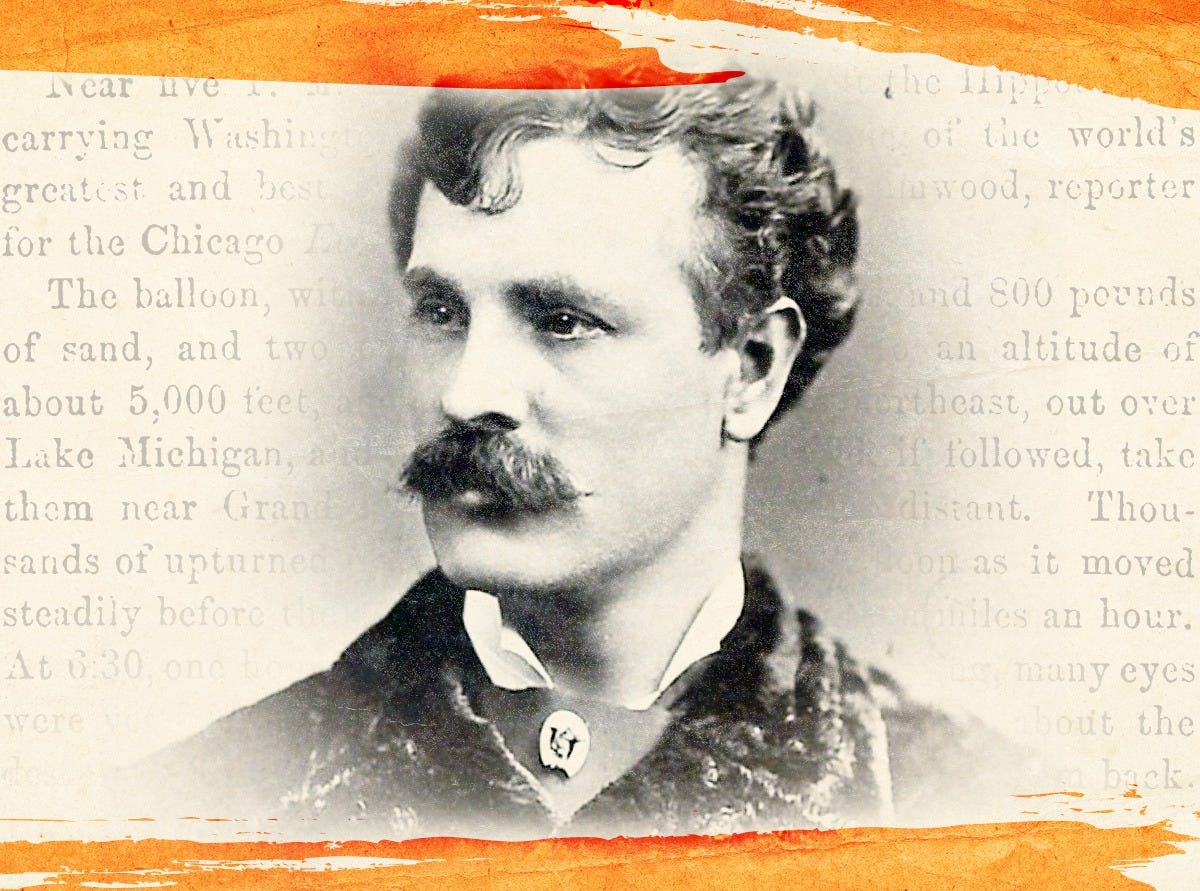
In the 1870s, American ballooning lived in a space between science and spectacle. A balloon ascent could be a technical demonstration one day and a near-religious thrill the next. Imagine an untamed sky, with controlled flight a distant dream. Add to that now a balloon filled with gas or hot air, and a basket tethered beneath it to allow humans to shed Earth’s grip and ascend into the blue.
It felt magical. Balloon flights often gathered crowds and collected headlines.
This environment is where Washington Harrison Donaldson thrived. He was an illustrator, a magician, and a ventriloquist that grew into a daredevil that constantly pushed the limits of his abilities. It was this exact nature that led him to a natural progression from tightropes and magic tricks, to balloons and the open sky.
Donaldson was born in Geneva, New York, in 1840. Before balloons, he made his name in the physical arts of the day: gymnastics, trapeze work, rope-walking, and public stunts that seemed designed to test how much danger an audience could applaud. Accounts of his early life place him on tightropes and in feats that treated gravity as a suggestion, including a well publicized rope-walk across Philadelphia’s Schuylkill River.
Along with the daredevil act he tried his hand at stage magic. In one trick, as recounted in History of Donaldson’s Balloon Ascensions by M.L. Amick, M.D. (1875), he performed an illusion of cutting off a man’s head and then restoring him to life. The illusion was reportedly so convincing that his audience was appalled at the “blood spectacle.” Despite his attempts to convince the audience that is was merely a trick, he deemed the trick to be unpopular, and abandoned it in future acts.
His focus would return to tightropes and death-defying stunts.
He began ascending beneath balloons in 1871. The ground could not keep him, and the sky continuously reminded him of his limitations.
The sky offered a bigger stage than his previous tricks and performances, and a more outrageous type of peril. A man with no wings, acting as though gravity had no control over him, quickly grabbed the type of attention that he wanted. His ascents turned into events and people gathered to see a man fail as much as they were gathering to see him succeed.
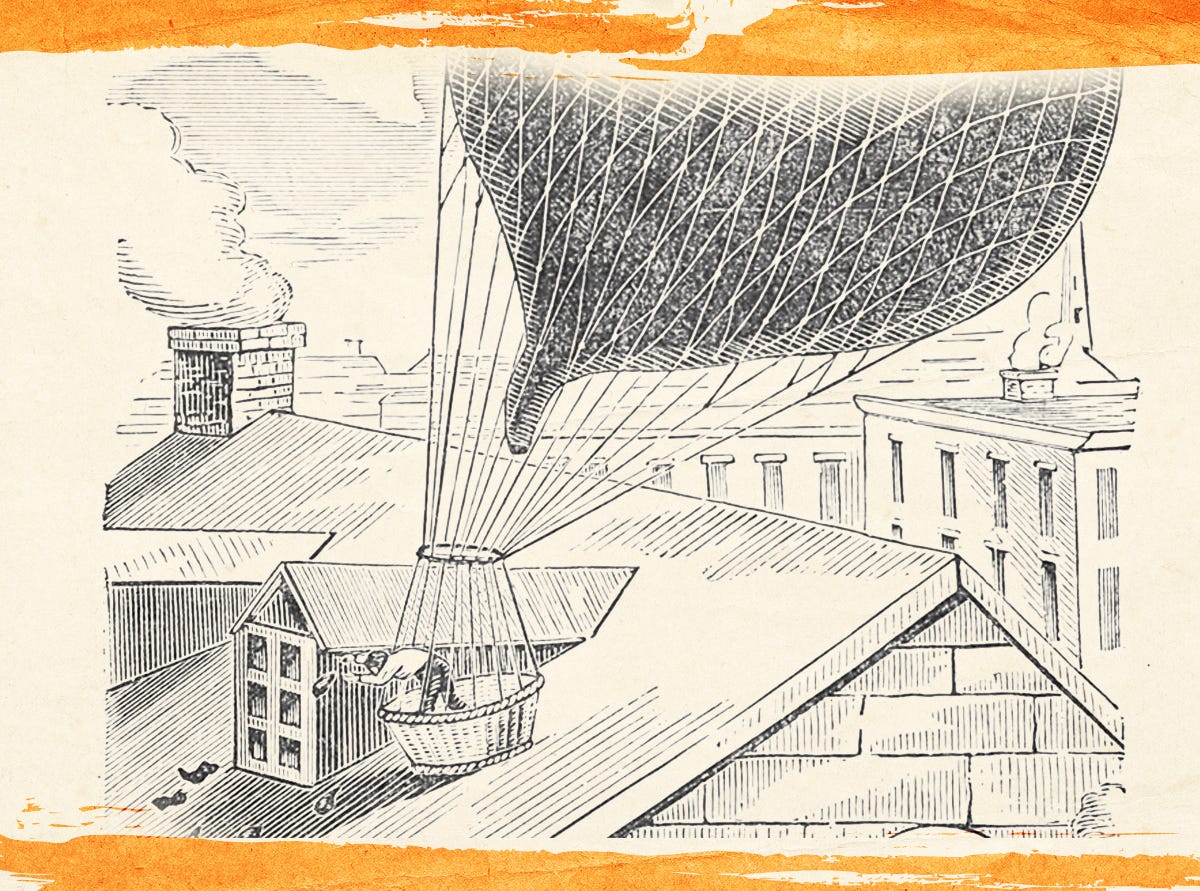
Some of his earliest flights were high-profile failures. In fact, his first attempt at ballooning led to him ditching his boots, coat, and other articles of clothing from his basket just to achieve lift. The reports that follow him record a series of near-misses, and dangerous bail-outs. Newspapers began to follow him because ballooning, or specifically, Washington H. Donaldson ballooning, was ready-made drama: there were crowds, scientific whimsy, dangerous weather, and the ever-present possibility of a fatal landing.
Long before July 1875, Donaldson was pulling off balloon flights that were as much a show of endurance as they were showmanship. Multiple flights were conducted without the safety of a basket, leaving Donaldson suspended beneath the balloon on a trapeze, performing tricks above astounded crowds. He climbed netting, he survived burst balloons, and emerged unscathed from multiple crashes.
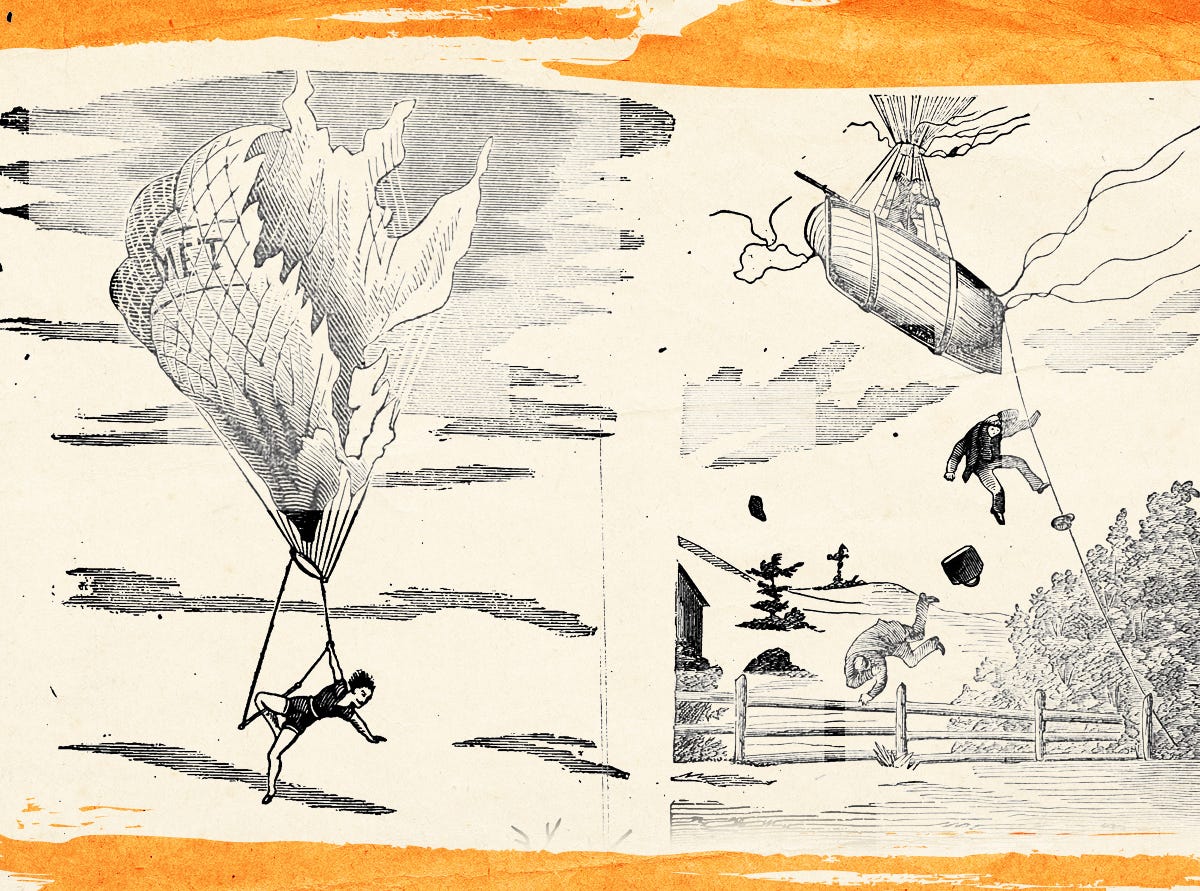
Soon, Donaldson became enamored with what was the era’s grandest balloon fantasy: the Atlantic crossing. Believing a theory proposed by a collaborator and friend, the theory that one could ascend high enough to catch a steady wind that would carry a balloon across the ocean, Donaldson was soon making plans.
The trip would never be completed, after a failed attempt at the crossing during his thirty-sixth flight on October 6, 1873.
By the mid-1870s Donaldson had become, in the public mind, a professional gambler against the sky. But gamblers often push for greater returns, and face greater risks.
P. T. Barnum didn’t invent show business, but he perfected the art of the show. He knew how to market, how to draw a crowd, and knew how to entertain. It’s hard to overstate just how perfect Donaldson was for P. T. Barnum. Barnum knew that the public would pay for wonder and danger, more than willing to part with their hard-earned money in exchange for entertainment.
Donaldson sold tickets, just by being Donaldson. His background in stage magic and daredevilry meant he could engage a captive audience and dazzle them with gymnastics and acrobatics that elevated his ascents to more than mere scientific demonstration. It’s this bombastic personality and skill that led Barnum to offer him a position with his hippodrome. Donaldson’s track-record for failure didn’t matter. Rise or fall, either outcome would sell plenty of tickets, and Barnum knew this.
Washington H. Donaldson’s ballooning feats only got bigger and bigger with Barnum. He stopped being a sideshow and became a leading man. Ascents were staged, publicized, and timed. As part of the hippodrome, Donaldson blurred the line between endurance, theater, and stunt. His ascents got longer, more daring. One long ascent from Gilmore’s Garden kept him aloft for thirteen hours, using a drag rope to manage his altitude. During another ascent, he carried passengers into the night sky, rose to an altitude where the balloon could not be seen in the dark, and returned the next morning, stretching the idea of what a “show” could be.
His flights were not without failures. In fact, it’s part of what sold tickets. Every time an inflation failed, or a balloon sprung a leak, or the wind carried them off course, and Donaldson returned to tell the tale in his energetic, stage-ready way, his crowds got bigger. Journalists would clamor for a chance to go up during his ascents, with some of the flights resulting in articles written by journalists while suspended beneath Donaldson’s balloon.
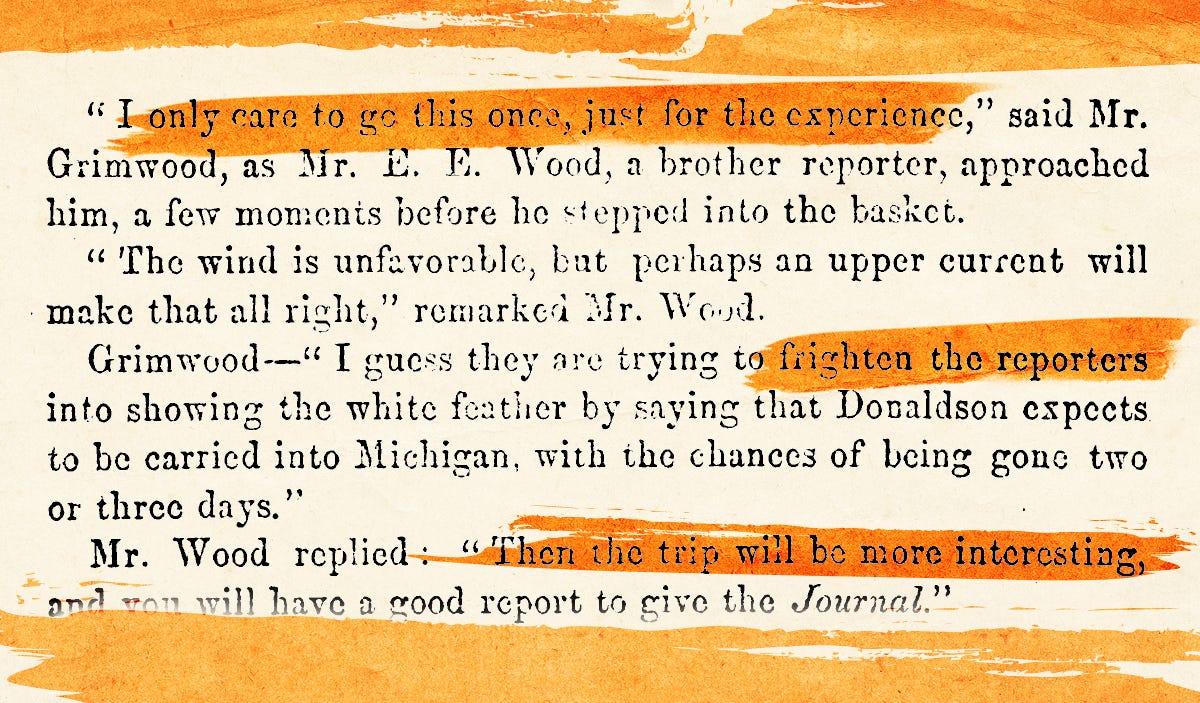
On July 15, 1875, Donaldson planned his 139th ascension, a flight that was meant to carry journalists and himself away from Chicago and out across Lake Michigan. As with his previous flights, there was press and spectators. A storm earlier in the day had delayed plans, but now, the balloon was beginning to inflate. While other men may have been deterred by the weather, and the gusting wind, Donaldson had cultivated a reputation for escaping danger time and time again. This reputation sold tickets and convinced journalists and crowds alike that Washington H. Donaldson had an unbreakable kinship with the sky.
As the balloon continued to inflate, there was another problem. The cool air of the later hour was reducing the balloon’s buoyancy. Instead of multiple passengers, Donaldson decided, he could afford only one. The gathered journalists drew lots from a hat, and Newton S. Grimwood of the Chicago Evening Journal was the winner. He was to accompany Donaldson as they navigated the balloon across Lake Michigan, from Chicago, to Michigan’s shores.
The ascension happened without issue, and the balloon rose with a crowd watching. Before the flight, Grimwood had borrowed ten dollars from another journalist after hearing Donaldson suggest that they could be aloft for two or three days making the trip. The wind was not agreeable, and the crowd found itself murmuring about the possible outcomes of the flight. Would they be blown back inland, to Chicago? Or would they actually achieve their goal of landing in Grand Haven, Michigan?
The balloon was swallowed by the night, with the crowd receiving no answers.
Hours later, a tugboat on the lake reported seeing the balloon skimming the water, before a sudden ascent, the balloon shooting up into the night sky, and disappearing forever.
Newton S. Grimwood’s body was found a month later on August 16, 1875, washed up on the shores. His boots had been removed, and he was wearing a life preserver. His written partial account of the flight was discovered on his person and later published.
Washington H. Donaldson was never seen again.
Or was he?
All things that rise must also fall. This law of nature has been known since before gravity had a name.
On March 3, 1876, in Bath County, Kentucky, a shower of flesh rained down on a farm, scattering pieces of meat across the ground. The event attracted locals that fed pieces to their pigs and chickens, reporters that questioned witnesses, and early scientists and saved samples.
It is one of the strangest, and well-documented, events of Kentucky’s early history. But what’s it got to do with a missing aeronaut?
Among the various theories of what caused the downpour of flesh, a small snippet reprinted across America suggested that the explanation was more macabre than the event itself: could this be the remains of the lost Washington H. Donaldson, carried on the winds from Chicago, only to rain down on a farm in Kentucky?
Another theory of the people is that poor Donaldson’s remains wafted over to Bath county after the great aeronaut had paid his respects to the man in the moon.
The eventual explanation for the strange Kentucky weather was vulture vomit, but the mere suggestion nearly a year after Donaldson’s disappearance is evidence of his cultural footprint.
While his real ending was likely in the lake on the evening of July 15, 1875, just as Newton Grimwood’s, the headlines of his life (and his possible, and likely, death) ensured he would inspire writers, journalists and other balloonists for years to come.
If you liked this article, please consider supporting 50 States of Strange with a small donation of any size. All articles are free, and your donation will help keep it that way.
Share this post with others who may like to read it.
No posts
Comments
Nothing yet. Say the first thing.
Sign in to join the conversation.