
Welcome to part two of our exploration of early American attempts to explore the supernatural with science. In the first part of this article, a spirit machine in Ohio tried to prove the existence of ghosts, while a photographer went on trial after claiming to capture the dead on his plates. There was also the story of James Murray Spear, preacher turned spiritualist, who built a mechanical Messiah and had a ritual birth for the machine as he tried to give it life.
Now, we push further, to see a dentist use a new technology known as a typewriter to channel a new Bible for the world, men try to apply the rigor of science to the supernatural in a so-called laboratory setting, and Thomas Edison discusses life after death, and a device that could allow speaking to the dead.
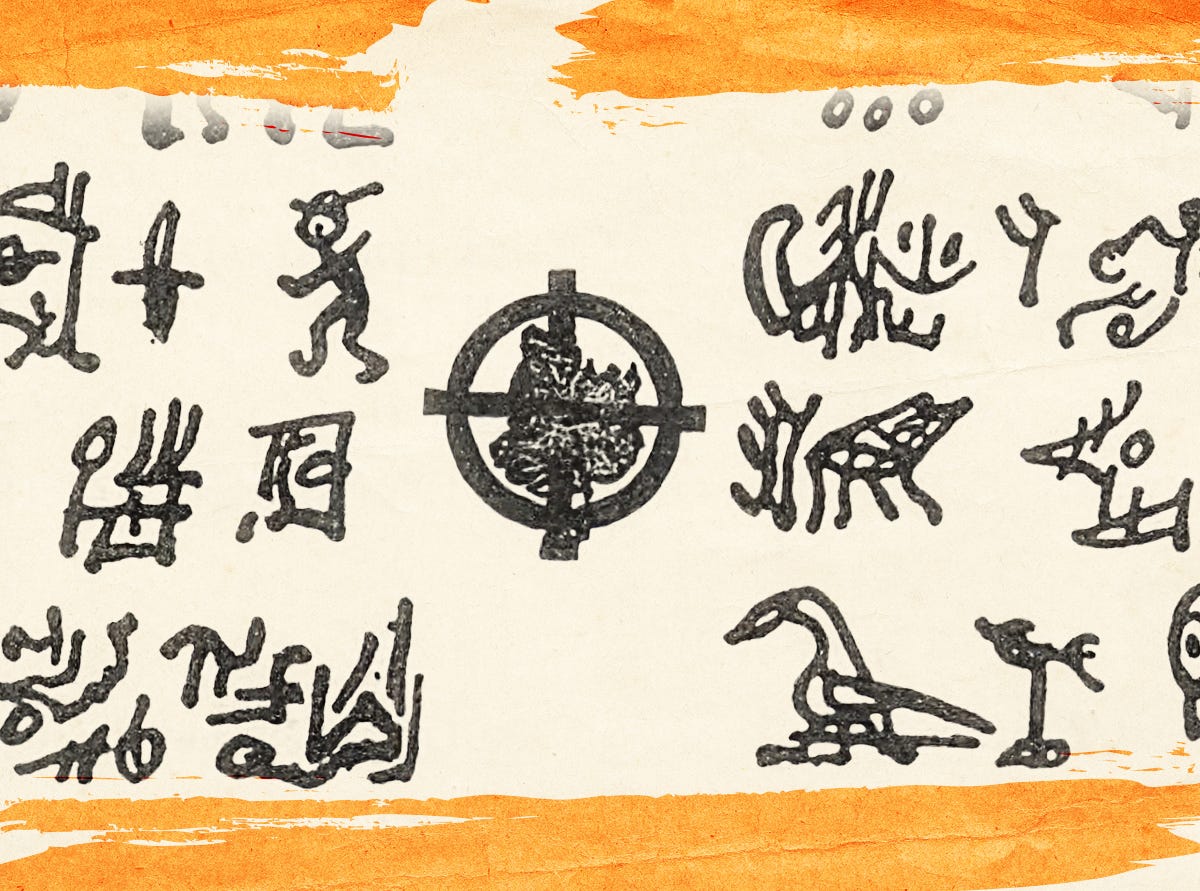
In this case, the machine is not strange coils of copper, or a camera lens, but a new kind of writing tool. The newly invented typewriter.
John Ballou Newbrough was a dentist and long-time spiritualist who claimed that in 1880 he received a series of visions and angelic instructions. Guided by them, he said, he sat at a typewriter for about half an hour each morning while a strange light surrounded his hands. His fingers, he insisted, moved without his conscious control. He did not write the text. He merely provided the body.
Out of these sessions came Oahspe: A New Bible in the Words of Jehovih and His Angel Embassadors, published in New York in 1882. It is a massive book, nearly nine hundred pages in its first edition, that claims to present a vast cosmology and history of Earth and its “heavenly administrations.” It outlines a number of religious cycles stretching back 24,000 years. Throughout the book, there are diagrams and glyphs that purport to show ancient alphabets, cosmic maps, and spirit realms.
The title page calls it a “New Bible.” Within its pages, Newbrough introduces “Faithists,” those who accept this revelation and live by the disciplines it lays down.
Reporters were as interested in the method as in the message. A New York correspondent described visitors filing into Newbrough’s home on West 34th Street to examine the strange scripture and to hear the story of how it had been produced. Articles romanticized the idea of a man sitting at a mechanical keyboard, eyes half closed, while unseen minds dictated a new holy book.
By the mid-1880s and 1890s, short pieces in distant newspapers were still explaining the phenomenon to curious readers abroad. They stressed the novelty. This was not like any other medium. This was not your standard spiritualist. This was a scripture, they said, “inspired per typewriter.”
Once again, the supernatural claim runs through the device. The typewriter is not described as a convenience for a busy dentist turned seer. In the story that grew around Newbrough, the machine itself becomes part of the miracle. A neutral office tool is recast as a spiritual instrument, its clacking keys reimagined as the voice of “angel embassadors” striking paper. Ancient authority, modern mechanism, fused in one object.
By the 1880s, another figure steps into the picture. Not a farmer building a spirit machine, and not a self-appointed prophet at a keyboard, but a psychologist with a notebook.
In 1884, William James and several colleagues founded the American Society for Psychical Research. Their aim was not to construct new engines for spirits, but to test, as carefully as they could, the strange reports already circulating. Telepathy, apparitions, automatic writing, trance speech, haunted houses. If there was anything real at the bottom of it, they wanted to know.
The early volumes of the Proceedings of the American Society for Psychical Research are thick with this effort. Committee reports and case studies read like a cross between séance transcripts and early lab records. Names are sometimes replaced with initials. Times and dates are carefully noted. Hits and misses are counted.
One of their central cases involved the trance medium Leonora Piper. For years, James and others arranged sittings under conditions meant to block obvious tricks. Sitters appeared under assumed names. Stenographers took down Piper’s words verbatim. Afterward, researchers compared her statements with independently verified facts about the sitters and their dead.
In his essay “What Psychical Research Has Accomplished,” James tried to explain all this to a general audience. He admitted how common trickery and self-deception were in the field, yet he also insisted that there remained a stubborn “residuum” of cases that refused easy explanation. Something seemed to be happening at the edge of their instruments.
Here, we see notebooks and method replace machine. Even so, the pattern matches the earlier stories. Mediumistic phenomena are passed through tools, measured, recorded, and translated into charts and protocols.
These “laboratory ghosts” marked a shift. The supernatural left the parlor and entered a quasi-scientific space. Psychical researchers tried to pin it down with the same methods they used for perception and habit.
William James has since been critiqued, his methods dismissed, his work scorned. But the foundation he helped to found set the stage for the thinning of the wall between science and the supernatural. We see this same mode of thinking still today—thinking that if we could just measure the strange, study the weird, capture the unbelieve—then we could understand it. And perhaps even control it.
Share this post with someone who might like it!.
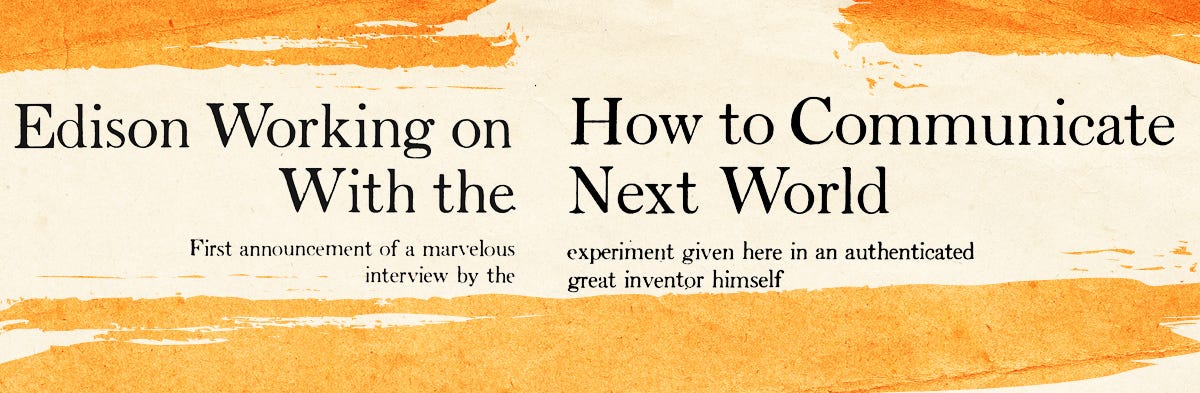
The last figure in this chain spent his life turning invisible forces into devices you could buy.
In the early twentieth century, Thomas Edison began to speculate publicly about what a human being really is. In one widely reported interview, he suggested that personality and memory might be rooted in unimaginably small entities that cluster together to form living organisms. If those tiny “units” survived bodily death, he argued, there was no reason in principle that a sufficiently delicate apparatus could not detect them.
At first, this was presented as a thought experiment. A way for an inventor to talk about life, death, and physics. But the idea took on a stranger, more spiritualist flavor in 1920, when financial journalist Bertie Charles Forbes published a feature in which Edison spoke of working, at least conceptually, on a device that might allow communication with whatever remained of people after death.
In that article, Edison imagines an instrument so sensitive that, if anything of us persists and retains a will to act, it could register the faintest touch. He talks about circuits, amplifiers, and thresholds. He does not offer a blueprint, but he treats the notion as a legitimate problem of engineering.
Scientific magazines followed up, summarizing his comments on “life units” and their possible persistence. Religious and popular papers did the rest. Headlines soon announced that Edison was “trying to get the spirit world on the wire,” recasting the cautious speculation of a late-career inventor as a plan to build an actual spirit telephone.
Whether he ever devoted serious time and laboratory resources to such a project is uncertain. It could have all been a light-hearted hoax. There are no detailed plans or models, working or otherwise. Yet the image stuck. By the 1920s, the height of the spiritualist movement in the United States, people were already used to hearing distant voices through telephone lines and catching disembodied speech out of thin air by turning the dial of a radio. Extending those signals one step further, into the next world, felt like a small leap.
An ordinary piece of technology becomes a possible bridge between the living and the dead. A typewriter channels the words of angels. Zinc and copper wire becomes a god. Coils, microphones, and relays, all ignite the possibility that a great inventor may open the door between this world and the next. Spiritualists build tables in the woods of Ohio to quantify an unseen world, and that becomes an epicenter of unseen musicians. Photography, glass and chemicals reveal ghosts with their loved ones.
These stories all illustrate the American tendency, and in truth, a human tendency, to want to know more about what comes next.
Some may have been charlatans and cheats. Others were true believers.
The worlds of spirits and science mingle, as we find new tools and new methods, to explore and search the unseen.
No posts
Comments
Nothing yet. Say the first thing.
Sign in to join the conversation.