
From the mid-1800s through the early twentieth century, American spiritualists did something very specific with their ghosts. They stopped treating spirits and the occult as a purely folkloric or religious problem and started treating them as a technical issue. To some, technology held the answers to questions about the afterlife, about what comes next, about gods and demons.
If something of the dead remained after they died, perhaps what remained could be measured. If they could be measured, they must be some force or energy. And if they were some force or energy, then those forces could be captured by batteries, magnified by coils, etched on glass, channeled through a keyboard, or studied in a lab. Telegraphs, cameras, typewriters, wires and meters became part of a new and evolving occult tool kit.
Set against a growing spiritualist movement in America, these early approaches mixed the growing industrial world with the world of the “other side.” Let’s explore the idea of electric ghosts.
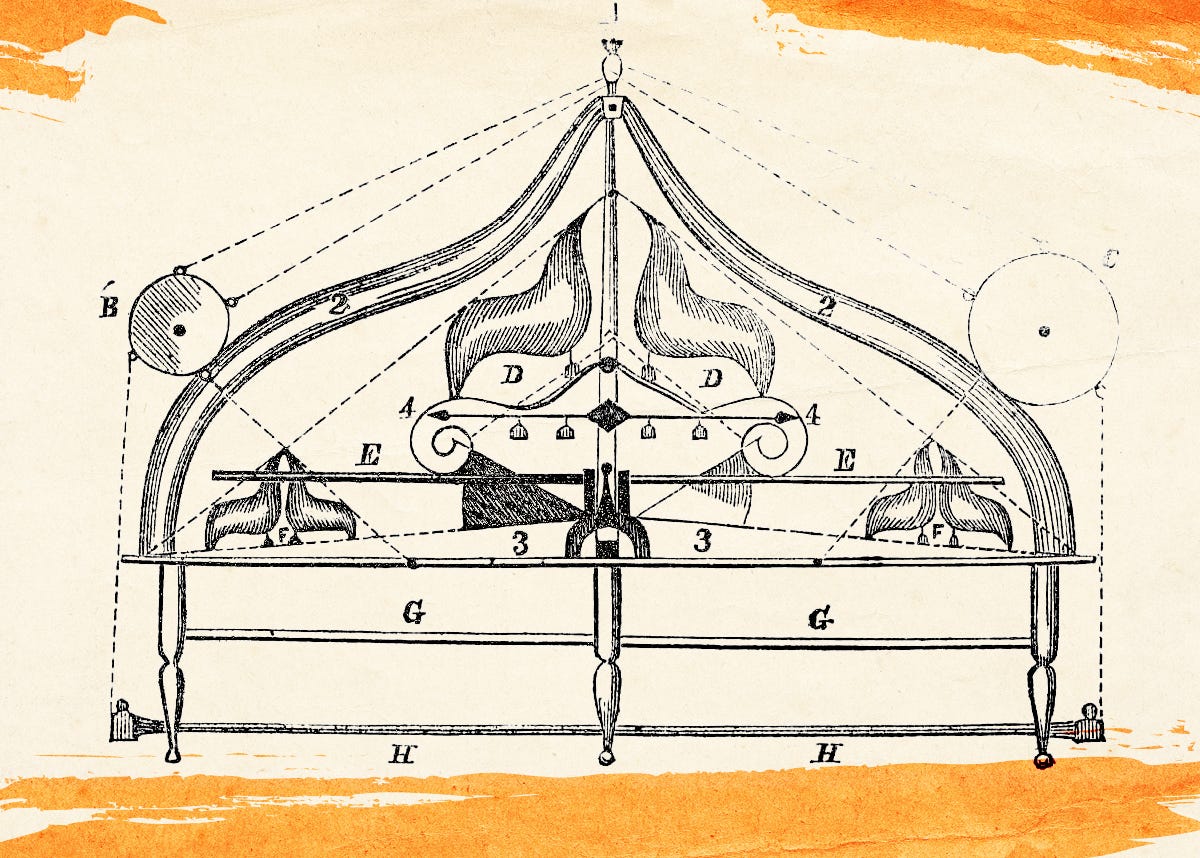
Jonathan Koons was an Ohio farmer struggling with his religion. A new wave of belief was sweeping across America, as spiritualism took hold. Talk of ghosts, spirits, messages from the grave, and persistent visions of afterlife delivered to living mediums dominated headlines. Despite his skepticism, he would soon join them, with a cabin built on his property, which he would call the Spirit Room.
In 1853, a small book titled A Book for Skeptics was published and contained accounts from those who witnessed the activity at the Spirit Room first-hand. In it, Koons shares some of his insight with an editor of The Seraph’s Advocate, an occultist publication. This letter, if taken as truth, lets us see the transformation of Jonathan Koons, the nonbeliever, to Jonathan Koons, spiritualist investigator.
He said:
“… I set out with a determined will to detect the cause of this strange phenomenon, which had manifested itself through our country, and causing so much fear and alarm through my own neighborhood. Some were bold enough to declare that it must be the devil, some that it was electricity, some said that it was biology in a new form, and others that it was a deception.”
Here we see that he sets himself apart from other spiritualists. He’s not just a channeler of the other side, no mere medium. No, he wants to find the cause. He goes so far to position himself as a skeptic that he outright says he started his quest with the belief that spiritualism was a fraud “imposed upon the credulous part of the community.” This fraud, he claimed, is what he wanted to detect.
Koons said his investigation led him to the daughter of a man he identifies only as Mr. S. This daughter was an accomplished medium, and his access to her through a mutual friend of Mr. S afforded him the opportunity to witness her behaviors and study them in detail.
A séance was held, in which a set of questions provided by Mr. S were answered through various raps upon the table. Unsatisfied, Koons provided his own questions, “many of which were asked mentally.” He claims they were all answered, correctly. And yet, he was still not convinced.
But upon his return home, he began to be influenced by something otherworldly. Soon, he said, he was a writing medium. And he was not the only one affected by these “strange spiritual gifts.” Soon, his entire family became involved. His children, and his wife, all began to channel something from behind the veil that separates this world from the next. In his letter to the editor of The Seraph’s Advocate, he says all eleven members of his family were now mediums.
Koons still found himself unsatisfied with the situation. While his family enjoyed their newfound gifts, he found himself wholly confounded.
But as far as it concerned myself in regard to the application of this strange phenomena to either electricity, biology, Satan or what not, I found that I was constantly discomforted in my various investigations …
It’s during this described disappointment and continued skepticism, despite his own professed manifested abilities, that the solution arrived. His oldest son, aged sixteen at the time, delivered a promise that came from the spirits. If he would build a table that held a machine based on a draft as drawn by his son, and place it into a private room, he would be able to drive away any doubt left in his mind, and prove the existence of the spirit world, definitively.
It’s this machine that became his focus, and was at the center of every viewing he held at the log cabin he called the Spirit Room. The project grew, based on things that Koons claimed the spirits required. Soon, in addition to the machine, he’d added musical instruments. A banjo, an accordion, drums, tambourine, a trumpet. These instruments were played by the spirits, he said. They also demanded a “number of pistols” that “were charged and fired by the spirits themselves.”
This machine of his proved beyond all skepticism the existence of spirits, angels, and the afterlife, Koons asserted, explaining it in terms of electromagnetism and physical energies that combined to form a composite through which the spirit world could interact with our world. And his assertions, along with the spectacle of instruments playing in the dark, guns firing at random intervals, and voices delivered through a trumpet, were enough to convince many of his claims.
In a further mix of science and the occult, the February 3, 1855 issue of Scientific American reprinted an illustration of the Koons Spirit Machine. They were not as taken with it as countless headlines and witness statements from the 1850s. Their opinion of the device is harsh:
It is a wonder to us that any grown up men and women in our country, where we boast so much intelligence, can suffer themselves to be deluded with such nonsense.
John Murray Spear was a Universalist minister and social reformer, championing causes such as women’s suffrage and abolition, speaking alongside prominent activists in the 1840s. Once such speaking engagement in 1844 nearly killed him. While speaking on an anti-slavery tour in Portland, Maine, a mob of hostile listeners dragged him from his platform and beat him so badly that it took months for him to recover. He spent much of his recovery time in varying states of consciousness.
This event changed him, and while his progressive causes remained in place, he also began to consider himself a vessel or tool for a collection of spirits. By 1852, he considered himself a medium, and was receiving messages from spirit associations made up by prominent figures such as John Murry (his namesake and founder of the Universalist church) and Benjamin Franklin. He outlines some of them in his short work, Twenty Years on the Wing, but the one that delivered the most important information, he said, was called the Association of Electricizers. It’s from the group of spirits, headed by Benjamin Franklin, that John Murray Spear received instructions on how to build what he termed a “New Motive Power,” his Mechanical Messiah.
Various writings exist to describe its intent, but the accounts vary. What is most certain is that Spear was toying with the idea of perpetual motion. But it gets even stranger.
Spears viewed this as a new God, and needed the machine to be birthed into the world through a ritual mirroring Christ.
Once the machine was built over a period of nine months, a devoted follower lay on a couch beneath the machine and underwent a symbolic labor. Following this birth, the new motive power would awaken and radiate a transformative influence over humanity.
This did not happen.
An angry mob, by some accounts comprised of Christians and spiritualists alike, dismantled the machine and destroyed it. Spears shares his own account in Twenty Years on the Wing, distilling it down to threadbare detail:
[Instructions] came, and continued to come, for nine months: following out with precision the varied instructions as they were given, an external mechanism was elaborated, vibratory motion was secured, which was perpetual as long as the mechanism lasted; but on being removed by direction to Randolph, N.Y., a mob broke into the building in which it was stored, and the machine was demolished;
This event damaged his reputation dearly, and he soon found himself stripped of positions with the Universalists, and considered eccentric, or even dangerous, by many spiritualists.
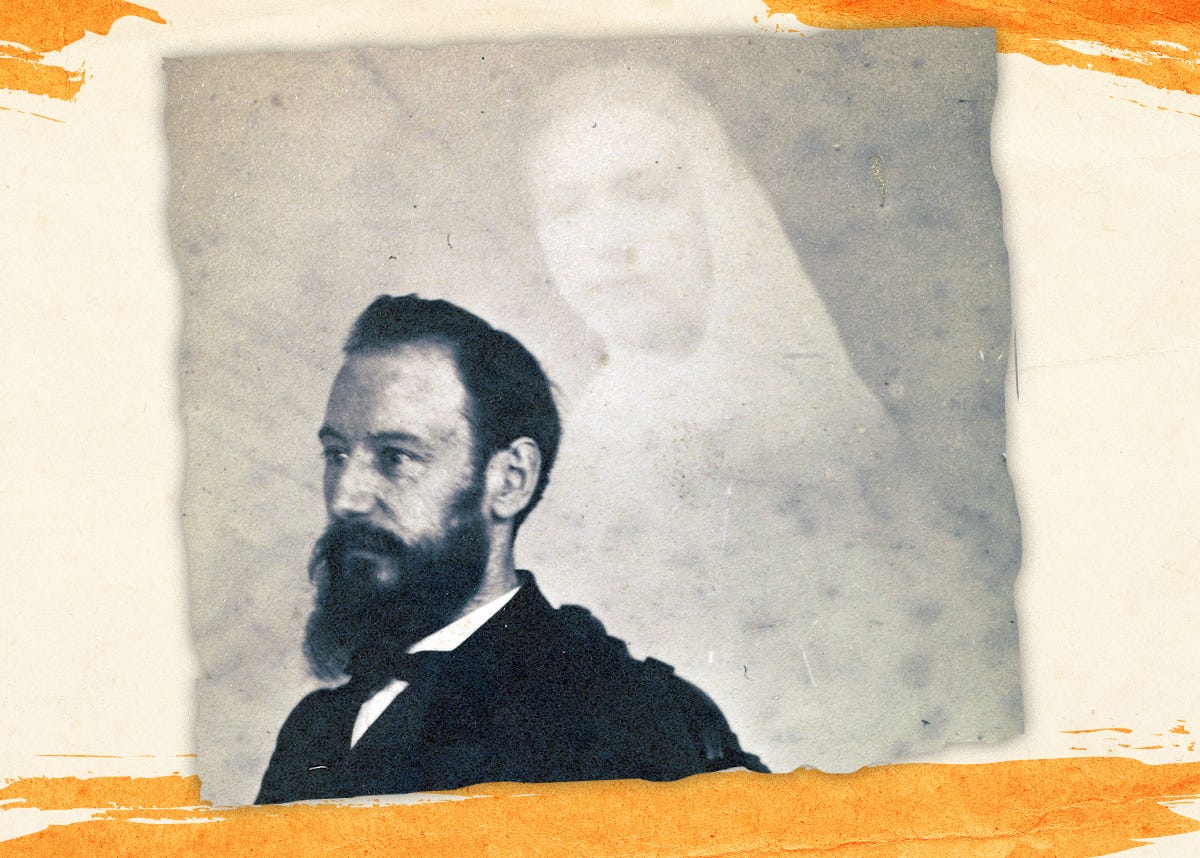
William Mumler was a Boston engraver who began working with photography is the early 1860s. In his book The Personal Experiences of William H. Mumler, Spirit Photographer, he describes how he got started as an accident of happenstance. He developed what he expected to be an ordinary self-portrait, and instead found the dim form of a dead cousin beside him.
Technology had made the invisible world of the dead visible.
Word spread quickly that Mumler could capture the dead in his photographs, and he began to give clients what they wanted. Grieving subjects posed for portraits in his studio and later discovered extra figures hovering near them in the background of the prints. Sometimes, the spirit faces were recognizable, and in other cases, they were barely present at all. But it was enough for many.
But not all.
When William Mumler took his equipment to New York to capture his ghosts in glass there, he was charged with fraud. Expert testimony is immortalized in a printed version of the prosecutor’s address before the court. Titled The Mumler “Spirit” Photograph Case: Argument of Mr. Elbridge T. Gerry, this testimony exposed possible tricks used by Mumler. Gerry spoke of double exposures and reused negatives, and accused Mumler of being a huckster and a fraud. Worse yet, Mumler was accused of preying upon grief to make a profit.
Despite relying heavily on science in his testimony, Gerry also relied on religion. He often contrasted Christianity and Spiritualism to an extreme, often as a way to further discredit the idea of the photographs being actual depictions of spirits.
Professional showman (and some could argue, a fraudster himself) P.T. Barnum produced his own spirit photograph to demonstrate the science of the technique, and newspapers were on fire with wild headlines during the case.
But it went nowhere.
The judge tossed the case and said that the prosecutor had not proven beyond doubt that deception occurred in the specific instances brought before the court.
Mumler, for his part, continued to claim that his photographs were genuine. He is most famously credited with creating a photograph of Mary Todd Lincoln, that showed a ghostly image of Abraham Lincoln standing behind her, resting his hands upon her shoulders.
Here, the machine is a camera, photographic plates, and chemicals, coming together to create another medium where science and the supernatural can comingle.
Next week, we’ll return to this theme for three more instances of the spirit world colliding with science.
John Ballou Newbrough put his hands on a typewriter and an outside force brought his fingers down to write a bible for the machine age.
William James forms the American Society for Psychical Research, the oldest research organization of its type in the United States.
And finally, Thomas Edison envisions a world where we can speak to the dead, and claims he is working on a device to allow it.
No posts
Comments
Nothing yet. Say the first thing.
Sign in to join the conversation.