
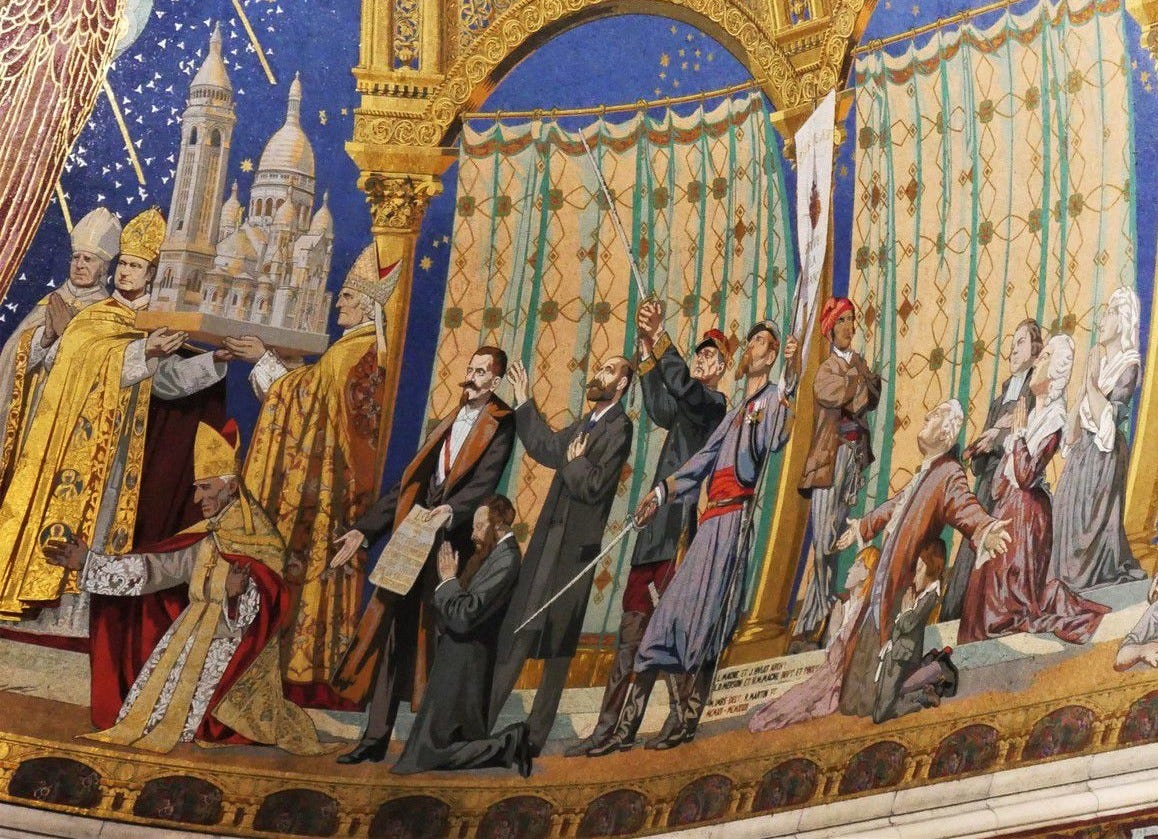
Partial mosaic at the Basilique du Sacré-Cœur de Montmartre in Paris.
General Sonis and General Charette present the banner of the Sacred Heart (the battle standard of the Volunteers of the West) to Christ at the Basilica. To the right stand Louis XVI and Marie-Antoinette, depicted among those united in fidelity to the Sacred Heart. In stark contrast, a French revolutionary turns his back, arms crossed in visible contempt. The symbolism is unmistakable: the Revolution and the Republic recoil from devotion to the Sacred Heart, while the faithful embrace it, even to the point of laying down their lives. The mosaic presents a powerful vision of true Catholic patriotism, rooted in sacrificial fidelity to Christ.
Patriotist is a natural virtue, a consequence of the fourth commandment of God’s Law: Thou shalt honor thy father and thy mother. The very word Patriotism derives from the Latin, Pater, Father. Just as the knight was called to honor his parents, he was also called to honor and love the country in which he was born, the culture which he received in childhood and adolescence. The French knights loved France and the Teutonic Knights loved Germany, just as every knight loved his country.
Very interesting was the views of a Knight from Flanders, who, when he arrived in the Holy Land for the Crusade, exclaimed that Palestine was a very ugly land, and he almost said that Our Lord Jesus Christ would have been done much better if he had been born in his country, in Flanders:
“I am much amazed, that God, Son of Holy Mary, have come to live in such a desert.” He accepted that Palestine was a Holy Land only because the Lord had chosen to be born there, but He might have done much better if he had chosen his own Flanders…
In the farewell of William of Orange, when he left France for the Crusade, you see the same concrete love in the simple symbolism of his gesture. This is a description of the event:
Towards the sweet France, he turns, and the wind of France comes and touches his face. He opens his shirt so the wind of France may come in. And placed against the wind, he falls on his knees and says, ‘Oh sweet blue of wind that comes from France, there they are all those whom I love. I deliver into the hands of the Lord God, all of you, because for me, I know I shall never see you again.’ And he departed from the crusade.
The word motherland (in French it is a feminine word), was considered to be the spouse of the Knight, and, when he died in combat, his motherland would become a widow.
Although chivalry existed in various forms all over Europe during several centuries, its great mark was in France in the eleventh and twelfth centuries. But unfortunately, the word chivalry conjures up today a host of images for many people, mostly distortions or outright lies. Hollywood often portrays knights as greedy, ineffectual, hypocritical womanizers (such as in “Kingdom of Heaven”). University students learn how knights were supposedly members of an oppressor class who killed or raped peasants on a whim.
On the contrary, chivalry had a high code of conduct that was strictly enforced by fellow knights. Its main tenets were summarized in the Commandments which French Historian Leon Gautier compiled from primary sources from the Middle Ages. Chivalry was essentially military valor put to the service of the Catholic Church, of the good, and of the right, by men who loved their countries and fought against evildoers and infidels.
Pope Leo XIII in his encyclical letter Immortale dei (paragraph 21) explains the nature of the countries inspired by the Gospel of Jesus Christ, which was the goal of the knight’s love and preference:
There was once a time when States were governed by the philosophy of the Gospel. Then it was that the power and divine virtue of Christian wisdom had diffused itself throughout the laws, institutions, and morals of the people, permeating all ranks and relations of civil society. Then, too, the religion instituted by Jesus Christ, established firmly in befitting dignity, flourished everywhere, by the favor of princes and the legitimate protection of magistrates; and Church and State were happily united in concord and friendly interchange of good offices.
The State, constituted in this wise, bore fruits important beyond all expectation, whose remembrance is still, and always will be, in renown, witnessed to as they are by countless proofs which can never be blotted out or ever obscured by any craft of any enemies.
The Pope reenforced the view that the spirit that inspired chivalry changed barbarians into men of virtue, and even saints.
Christian Europe has subdued barbarous nations, and changed them from a savage to a civilized condition, from superstition to true worship. It victoriously rolled back the tide of Mohammedan conquest; retained the headship of civilization; stood forth in the front rank as the leader and teacher of all, in every branch of national culture; bestowed on the world the gift of true and many-sided liberty; and most wisely founded very numerous institutions for the solace of human suffering. And if we inquire, how it was able to bring about so altered a condition of things, the answer is-beyond all question, in large measure, through religion, under whose auspices so many great undertakings were set on foot, through whose aid they were brought to completion.
It is perfectly understandable that the Knight loved and was devoted to his country of birth, since his country was deeply inspired by religion and produced fruits unprecedented at the times. Among the Polish knights, especially the heroic winged hussars who crushed the Turkish invaders of Vienna, there was little difference between the love of the Church and the love of their country, Poland.
How does a Catholic man today fulfill the fourth commandment - Love the country where you were born?
Firstly, by learning about the Church teaching on Christian civilization, whereby a sound patriotism does not despise other countries but gives the first place to one’s own;
Secondly, by fulfilling one’s civic and political duties, not allowing them to be neglected or forgotten, in his life;
Thirdly, by striving to protect his country against invaders, either by military or by illegal immigration, defending the laws in vigor;
Fourthly, by joining forces with like-minded countrymen, to oppose and fight those who want to destroy the nation by subjecting it to an outside power, such as the United Nations;
Fifthly, by praying for his country, for those who govern it, by standing up and being counted in issues of importance for the nation, such as defense of the pre-born, combatting socialism, defending the family against anti-natural behavior, and corruption among politicians and bad clergy.
Devotion to the Sacred Heart of Jesus is a major element in the soul of every Knight – every Catholic man - who loves and honors his country.
In the times of civil war in Spain, when Catholics stood up against the Communists, the motto of Catholics was inspired by the Sacred Heart of Jesus, who would have said, “Regnabo in Hispania”, I shall reign in Spain! We could appropriately say, regarding the same Sacred Heart of Jesus, King of Kings and Lord of Lords, Regnabo in America, I shall reign in America!
Some years ago, on Pentecost day, I was privileged to attend a traditional Latin Mass at the basilica of Chartres, in France, with all the pomp and ceremony of the Church tradition, with choir, organ, trumpets and drums. Over ten thousand people, most of them young, filled the basilica, many of them carrying the flags of every country in the world. They had spent three days walking, from Notre-Dame basilica in Paris to Notre-Dame basilica in Chartres.
At the solemn moment of the Consecration, while only the bells were heard in the majestic silence of the medieval Cathedral, indicating the heavenly reality that the King of Kings and Lord of Lords was present in the hands of the celebrating bishop, all national flags were lowered before the Sacred Host being elevated, indicating the subjection of every country to Our Lord Jesus Christ. I was most impressed and moved to see a young man carrying an American flag, in which the Sacred Heart of Jesus was depicted among the stars. I couldn’t but exclaim in the silence of my heart and mind, God bless America!
Sir Raymond J. de Souza ☧
Sir Raymond J. de Souza is a Knight of the Equestrian Order of the Holy Sepulcher of Jerusalem, Defenders of the Catholic Faith.
No posts
Comments
Nothing yet. Say the first thing.
Sign in to join the conversation.