
Americans Rally to the Pope
In the fall of 1867, the Lazio region, the last territory of the Papal States, came under attack from a group of revolutionaries under Giuseppe Garibaldi was a 19th-century anti-clerical Italian revolutionary hell-bent on unifying Italy at any cost. His army of followers, known as the Red Shirts, shared his republican ideology and were willing to do whatever it took to make that vision a reality. With the backing of the Piedmontese, the Red Shirts sought to take Rome and topple the temporal power of the Pope once and for all. None of the Catholic powers were willing to lend aid to the Pope during this difficult time. While it seemed bleak, the Papal Army fought on, through glorious sacrifices and some French assistance, the Pontificals succeeded in repelling the invading force at the Battle of Mentana on November 3, 1867.
The victory at Mentana galvanized Catholics worldwide, inspiring many to rally to the Pope’s standard. Recruitment among the Papal Zouaves surged, particularly among Canadians, English, Irish, and Dutch volunteers. The impact of this victory even reached America, where it stirred a deep sense of duty among the faithful. Men such as Charles Tracey, a future congressman fromNew York, left their comfortable lives in the States to fight for the Holy Father. Charles Jerche, a student at St. Xavier’s College in New York City, was another volunteer, who was moved by the sight of Canadian Papal Zouaves marching through the city on their way to Rome. Jerche was compelled to join their cause and set off alongside them to defend the Holy Father. Others contacted their bishops to inquire about how they might contribute to the cause. Archbishop Spalding of Baltimore sent a letter to Cardinal Barnabò the Prefect of the Propagande Fide after some young men in his diocese asked how they could join the Papal Army:
Some young men from good families in this area would like to offer themselves to our most beloved Holy Father, to enlist in the Papal military and fight, even shedding their blood if necessary, for the defense of His Holy Person. Now, in order to respond to these good young men, I would first like to know: would they be accepted, and under what conditions? Also, if their number is not sufficient, would they still be accepted, or must they form an entire Company?[1]
These were fair questions because before the 1867 campaign there were no large groups of Americans heading to Rome to defend the Pope and his temporal power. Cardinal Barnabò replied on February 17, 1868, and discouraged Americans from volunteering to fight but rather, he requested they donate financially:
As for those young men who wish to come to Rome and enter into the service of the Holy Father in his army, I must say that the financial constraints of the treasury, on the one hand, do not allow for too great an increase in the number of soldiers, although many of those we currently have are maintained at the expense of Catholics. On the other hand, if the army were to grow significantly, it might not be possible to avoid a serious political complication.[2]
While the Vatican behind the scenes seemed to discourage Americans from volunteering, some of the laity in the public sphere were enthusiastic about the prospect. The idea of an American Papal Army contingent originated with James McMaster, the editor of the New York Freeman’s Journal and Catholic Register. McMaster was a conservative, ultramontanist, and a state’s rights Democrat and his paper reflected his values. A week after the Battle of Mentana, taking inspiration from the Canadian Papal Zouave contingent , McMaster wrote an editorial that the United States should raise an American Papal Zouave company, “Our suggestion would run thus: One company a maximum of one hundred and twelve officers and privates. To be accepted, a certificate of a parish priest, countersigned by the Bishop of the Diocese, to be required, certifying to the moral and religious character of the applicant.” Additionally, it was proposed that the applicants pass a rigorous physical examination and that the company “would be a religious Confraternity, like the old knights of St. John.”[3]
While it was merely an editorial, the readers of the Freeman’s Journal thought it was a call to action, and that the paper was the principal organizer of the company. Letters and funds began arriving asking for more details about how to provide assistance; even veterans from both sides of the American Civil War inquired. One priest from Wisconsin even offered McMaster two soldiers who could be employed immediately.[4] The large support was a pleasant surprise for McMaster, since he thought the editorial would just galvanize “prominent Catholic laymen”[5] to approach their bishops and start the process. However, he now believed due to the immensity of the support that a much larger battalion sized force could be raised instead of a company and he wrote on January 25, 1868 that those planning its formation could “use of our columns to further the design, and, according to our means, our own contribution.”[6] However, it was imperative they received support from the American hierarchy as “Without the spiritual direction of some of our Prelates and their blessing and oversight, we have not faith in the success of any such undertaking.”[7]
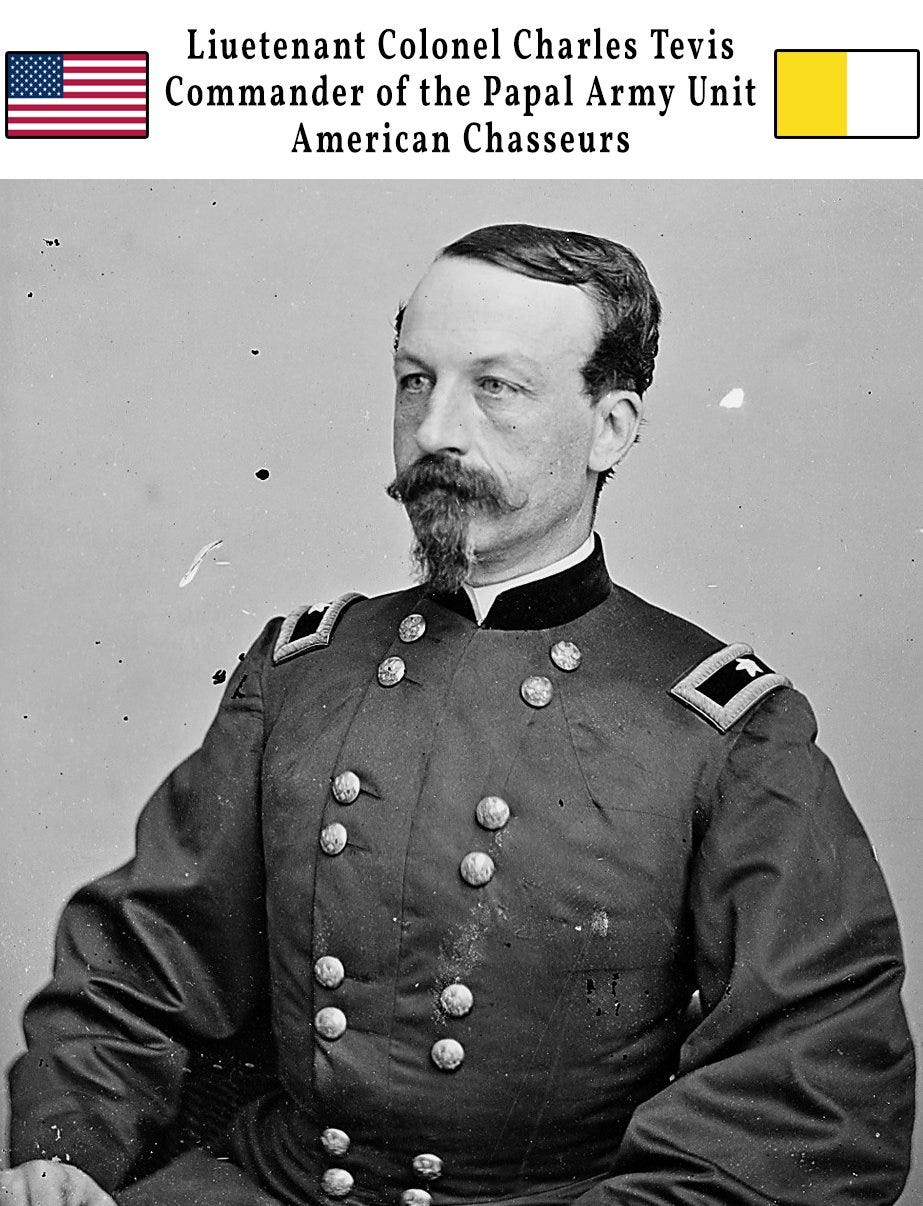
Former U.S. Army Brigadier General Charles Tevis became one of the prominent laymen to spearhead the project. Tevis had a very interesting military career. Graduating from West Point, he originally served in the U.S. Army from 1849-1853. He left the Army in 1853, travelled to Paris, and converted to the Catholic Faith, and then announced plans to become an officer in the Pope’s army.[8] However, that plan changed when he accepted commission as a major in the imperial Ottoman army and fought in the Crimean War Through his service on the battlefield, Tevis was promoted to lieutenant colonel. He left the Ottoman Army in 1855, returned to Paris, and then returned to the United States in 1859. During the outbreak of the Civil War, his experience was recognized by the Union and he received a commission as a lieutenant colonel in the 4th Delaware Volunteer Infantry Regiment on August 18, 1862. Tevis had a successful Civil War record until he was tasked with organizing and leading the 3rd Maryland Volunteer Cavalry, a regiment consisting of hundreds of Confederate prisoners of war, many of whom had been captured at the Battle of Gettysburg and had agreed to serve the Union. Tevis’s new unit was assigned with overseeing elections in Maryland, which was a difficult task as during the Civil War, Maryland was deeply divided between Union and Confederate loyalties.
Things escalated when Tevis, in an attempt to follow General Orders No. 53 and 55, which were meant to prevent Confederate sympathizers from voting, issued a controversial proclamation urging voters to support the “Government ticket”, which was the Unconditional Union Party. His order implied that only the Union-endorsed ticket would be recognized as loyal to the government. The situation worsened when some of his men arrested political opponents, rival candidates, and election officials. As a result, General Schneck, his superior officer, ordered Tevis’s arrest. However, after an investigation, it was determined Tevis was acting in good faith and had been misled by his Provost Marshall Captain John Frazier who had written the order. While his actions were wrong, they did not warrant imprisonment, he was released and honorably discharged with a brevet rank[9] of Brigadier General.[10] After the Civil War, Tevis became involved with the Fenian Brotherhood, serving as an Adjutant General and helped plan an invasion of Canada in 1866 to support Irish independence. Logistical failures led to the operation’s collapse and his dismissal. Secretly, Tevis was a paid agent of the British Crown, providing intelligence to undermine the Fenians after he had a rift with their leadership.
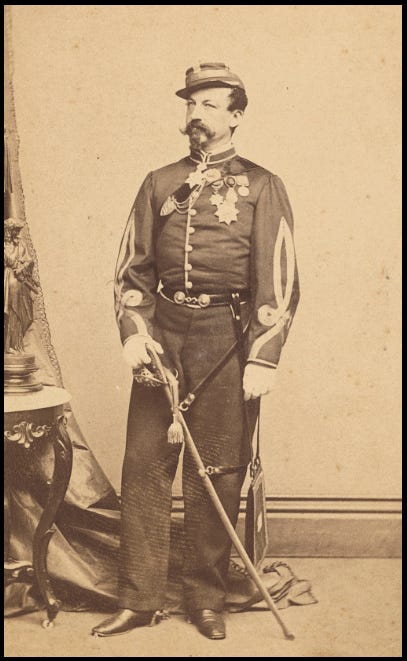
General Tevis During the Civil War. Library of Congress.
General Tevis, now went to Rome to fulfill a promise he made almost fifteen years earlier.[11] He desired to see the American Papal Zouave Battalion come to fruition. In an editorial in the Freeman’s Journal he wrote:
From the North of Europe, from the West, from the South, from Asia, Africa, Canada, the Indies, even from New Zealand zealous champions of the Church have hurried to her defense; and yet from the United States—the nation of soldiers—two men only have been found willing to take up the musket for their faith.[12]…Among the six millions of Catholics in the United States, can no one be found willing to take the initiative?...The expense of a Papal Zouave has been calculated to be five hundred francs, only one hundred dollars in gold per annum. Surely among the wealthy Catholics of America some could be found who could contribute…Let the priests, the bishops all the faithful Catholics in the United States imitate the noble example of Catholics of Europe, and show to the world that America is not deaf to the call of religion and justice.[13]
The Freeman’s Journal also requested additional funds to support the initiative. On March 7, the newspaper sent $625 to the Cardinal Vicar of Rome with the address:
Most Holy Father: We learn that the foes of religion and well-ordered human society are in arms to destroy your independence, that we recognize to be essential to the peaceful government of the Catholic Church throughout the world. We therefore ask the privilege of furnishing a well-appointed force of Catholic soldiers, to the number of…men, and to support these, at our own expense, as a rampart for you, as the visible Head of the Church, and Vicar of Christ, against your enemies![14]
The American fund received a significant boost from Mr. George Peabody, a wealthy American who was in Rome at the time. Before departing to America, he contributed five million francs to the Pontifical treasury.[15] Another American from St. Louis sent multiple letters to General Kanzler, Commander of the Papal Military and Minister of War, saying he had both men and funds ready, they just needed permission and additional details.[16] Letters from multiple people were also sent to the American consul for the Papal States, Edward Cushman, asking if they could proceed with raising troops in America for the Pope.[17] Cushman sent a letter on April 20 to Hon. William H. Seward, the Secretary of State to ask if this was legal. A negative response was received on May 12, [18] indicating an act of Congress had rendered all foreign enlistment illegal.[19] Instead of informing American Catholics that they were not allowed to serve in the Papal Army, Cushman remained silent.[20] This is likely because, although a Protestant, he sympathized with the Holy Father and his present condition in Italy. His spirit of adventure compelled him to accompany a column of Papal troops for several days during the 1867 campaign, including their capture of Nerola. While with them, there were two occasions where he was targeted by Garibaldians. To protect himself he picked up a rifle and fired back, later he also went to a hospital to care for the wounded on both sides. The State Department was furious and reprimanded Cushman, which would eventually lead to him being replaced in April, 1869.[21] For the Americans who were interested in joining the Papal Army, they likely didn’t know about the neutrality act, or they didn’t think it applied to them since the Papal States weren’t at war with United States allies.
The Battalion is Approved
Tevis was making headways with General Kanzler and the Pope. Kanzler wrote to Tevis in early February encouraging him to raise money for the Papal Army. Which he began to do in earnest by continuing his columns in the Freeman’s Journal and republishing his letter with Kanzler:
Ministero Delle Armi,
Rome, Feb. 6, 1868.
To Gen. Carroll Tevis:
My Dear General—You have often manifested to me your desire to prove the attachment you have to the Sovereign Pontiff, and to his august independence. You ask me what specific form you had best give to the sentiments of your Catholic countrymen, in favor of our defense of the Pontifical Throne, which, certainly, is one of the most remarkable pages in contemporaneous history.
In answer to your generous intentions, already known, and to your good will, I reply by a summary statement of the needs of our little army, called already, and, perhaps, again to become, in the hands of Providence, the instrument of His benedictions.
There has been, in the face of the danger that has threatened us, so rapid an increase of this army that we have been obliged to put restraints on its expansion. The outburst of sentiment has been in all parts of the world, but our condition requires that it be held to normal limits. What has, already, taken place has occasioned a very heavy increase of expenses.
To this rapid increase of numbers in the Army, the cost of the late campaign against the invaders is to be added. We have to support, moreover, as you know, the expenses of important defensive works at Rome and at Civita Vecchia, and an entire re-arming, with new fire-pieces, of our infantry. You are aware, then, that neither men, nor the material of war are failing us. But, you are aware, that, despite our rigid economies in administration, the war budget, under these exceptional circumstances, has been heavily burdened.
And, you, also, know, that, in these exceptional circumstances, the Government of Victor Emmanuel refuses to pay the debt agreed on as due by the Provinces of which, by outrageous robbery, the Holy See has been despoiled.
From this statement of facts, my dear General, you can draw, as I do, this conclusion: The pressing need of the Holy See is for the generous offerings of Catholic hearts, to aid the Holy Father, powerfully, in face of his enemies. This, in one word, is what I would ask of your good will to communicate to your fellow countrymen. It is thus they can best aid in the common work. If you can promote collections and subscriptions for this object, in favor of the defense of the Pope, you and your noble-minded countrymen will have deserved well of the holiest of causes.
Accept, my dear General, the assurance of my very affectionate esteem:
Kanzler,
Minister of War.[22]
Tevis even made a large donation of $500 to the Freeman’s Journal American Papal Defense .[23] He was made a chamberlain of the Sword and Cape, one of the first Americans to receive the honor, by Pope Pius IX in March.[24] Tevis finally obtained an audience with Pius IX on May 9, where he convinced the Holy Father to approve a contingent of Americans. However, instead of a company of Papal Zouaves, they were an entire separate Battalion of Americans, called the Chasseurs Americans.[25] Tevis was put in charge with the rank of Lieutenant Colonel and Charles Rondot was chosen as second in command with the rank of Major.[26]
Emboldened by his new position and authority, Tevis reached out to Catholic publications such as the Freeman’s Journal and Morning Star and Catholic Messenger to drum up recruits and support for the Chasseurs Americains. In a letter to the Morning Star and Catholic Messenger on May 11 he wrote:
Dear Sir—In the New York Freeman’s Journal of a recent date I have seen an extract from your paper which quoting a passage from one of my letters, expressed an approval of the movement in aid of the Holy Father.
Some two months since, I had the honor to forward to his Excellency, the Archbishop of New Orleans, the copy of a letter addressed to me by General Kanzler, the Papal Minister of Arms, in which I was requested to intimate to American Catholics the manner by which they could best aid the cause. It is but justice to my countrymen to state that they have responded generously to the appeal, no only by money, but by offers of service.
The imminence of a general European war, and the danger of a withdrawal of French troops from Civitia Vecchia, has so modified the policy of the Pontifical Government, that His Holiness has been pleased to direct the minister of arms to accept the services of a battalion from America, provided that the expenses of the corps be defrayed by their Catholic fellow-countrymen, for, as you are well aware the resources of Pius IX will not admit of this outlay.
In order to obtain the proper guarantees for the mortality and sincerity of the volunteers—officers and men—the entire movement must be placed under the direct supervision of the clergy and, for this purpose a circular from his Eminence, Cardinal Barnabò will be sent to the different bishops, who will take such measures as in their judgement will best promote the good work. With the advice and consent of the minister of arms, I now earnestly solicit the assistance of the Catholic press in the collection of funds and the enrollment of volunteers hoping that all differences of political feeling will be laid aside, and that all will forget that they are Northerners or Southerners, to remember only that they are Catholics, fighting for the cause of their faith.
Among the discharged Confederate soldiers there must be many devout Catholics who will gladly join the defense of the successor of St. Peter and to them I appeal.
It has been decided here that the corps will be called “Chasseaurs Americains,” enlisted for three years; all officers to be appointed by the Pontifical Minister of Arms.
The fear of interference on the part of the present Radical government at Washington, will necessitate great prudence in the organization and to arrange this movement, I would suggest that any officer desirous of serving as such, should at once communicate with me, sending on a statement of their age, present occupation, record of past services, number of men whom they can enroll, and when they can be ready to start. This will be submitted to the department here for approval and action. I will add that no officer or enlisted man will be accepted without the written recommendation of his parish priest, countersigned by the bishop of the diocese.
You will readily understand that it is most desirable to secure men who know the extent of the sacrifices required of them, and who are not in any way infected with revolutionary ideas; in short, earnest sincere Catholics, who will fight from a sense of duty, and who will not grumble because they are badly and insufficiently fed, and subjected to very severe discipline. No one should be deceived on these points—the spending money of a Pontifical soldier amounts to about two cents per diem, the sum allotted for his subsistence to eight cents.
To cover the first expenses of equipment, armament, encampment, journey to Rome, and pay for the first year, something like two hundred and fifty dollars, in gold, for each man will be required; consequently, all enrollments made should be based upon this calculation.
I would suggest that a committee be formed, under the direction of the archbishop, to collect funds and select volunteers, and that a division of labor among those persons who may be selected as proper candidates for appointment to positions of commissioned and non-commissioned officers, according to the system pursued in the Propaganda, will greatly expedite matters. It is urgent that the corps should be in Rome, ready for service, on or before the first of September, 1868.
Allow me again to express a hope that your paper, as well as the other Catholic journals, will contribute their efforts to advance the good work.
I have the honor to be very respectfully, your obedient servant,
Caroll Tevis.[27]
For his part, Pius IX would not let foreign enlistment acts prevent faithful sons of the Church from joining his army. The Papal Army had already worked around similar laws concerning the Irish, English, and Canadians. On May 13, a circular was sent by Cardinal Barnabò to the Bishops of the United States, sharing the approval of the American Battalion by Pope Pius IX and the conditions stipulating its formation:
Comments
Nothing yet. Say the first thing.
Sign in to join the conversation.