
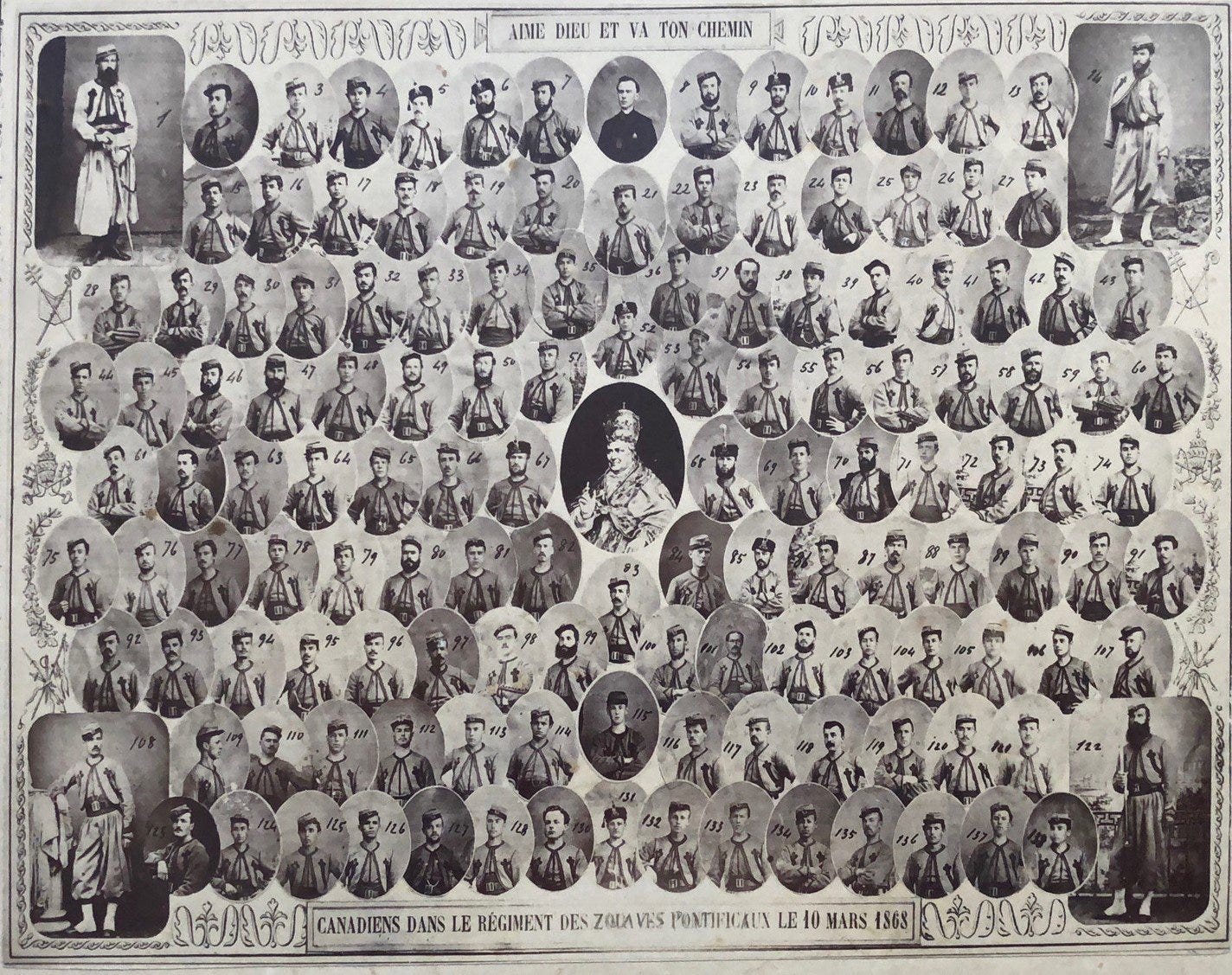
Some members of the Canadian detachment of Papal Zouaves, March 1868.
Originally published in The New York Freeman’s Journal and Catholic Register April 22, 1871.
Nos Croisés (our Crusaders)—or a History of the Expedition of the Canadian Volunteers to Rome for the Defence of the Church. Published in French, by the firm of Fabre & Gravel, Montreal.
The author was unfortunately absent from Rome during the siege, being unable to proceed through France with the additional contingent he had gone to Canada to bring over. The volume forms an octavo of 335 pages. In the appendix is given a list of all the Canadians enrolled in the Papal army. Canada sent to Rome seven detachments, the last of which did not reach the Eternal City. The number of Canadians who served in the Zouave Regiment, amounts to five hundred and forty-two hundred and fifteen of whom were present at the siege. The number of deaths in the service amounts to nine. With a few exceptions, the composition of these detachments is French Canadian, the English speaking Catholics in Canada not having taken any part in this movement. This is easily explicable, as, being recent settlers in the country, they have not the same means at their disposal.
This work will probably be translated into English.1 It comprises a letter from the Bishop of Montreal; the history of the movement in Canada for the organization of a Papal contingent; the Canadians in France; the Seventh detachment in Brittany; the Zouaves in Rome, and the taking of Rome. This latter part furnishes some valuable pages. The different Canadian detachments went to Rome under the guidance and direction of chaplains named by his Lordship, the Bishop of Montreal. In their long voyages no trouble or disorder of any kind ever occurred. In reading these pages we are carried back to very distant times—we can hardly realize that such a thing as a Crusade did really occur in this century. It did, but in very small proportions—may be the harbinger of something more colossal than the great Crusades of the middle ages. There are some touching anecdotes given in the interesting pages of “Nos Croisés.” We shall select one amongst many:
“Eugene had reached his sixteenth year. Gifted with a mild and sympathetic disposition—he was the beloved comrade of all his fellow-collegians. Full of life and gayety, how was it that at times a dark shade would pass over his beaming countenance, and that, fleeing from his companions, he would seek solitude, oftentimes in the Sanctuary. Eugene was not happy; oh no, life was bitter to him. The scandalous and disorderly conduct of his father was the source of his grief. His family was being ruined and desolated by one who ought to have been the joy and support of it. When on a holiday, Eugene would go to his mother’s, it would be to behold her sorrows, and his heart would be breaking at the sight. Could he only, by some prodigious effort, hasten on his studies and help his mother and three little sisters in their deep misery.
He hears in December, ’67, that young Canadians are going to fight for Holy Church. The grandeur, the sublimity of this act enkindles his enthusiasm. He decides on leaving with them, and asks his mother’s consent.
“Mamma,” he says, “you know that many young Canadians are on the point of leaving for Rome to defend the Holy See; well, with all my heart do I desire to be a Pope’s Zouave; I only want your permission; you will not refuse me?” He throws himself into his weeping mother’s arms.
“My dear child, I admire your faith and your courage. I feel very proud of it; this holy enthusiasm shows me the elevation of your sentiments; but Eugene, we are not in a position to allow your following this up; alas! how your poor father acts to his family; and how can I remain alone with your little sisters? who shall console me, if you leave, and who will help our misery?”
“Dear mother, the Holy Father is said to be so good, and I shall see him, and ask his blessing for you; the benediction of the Vicar of Jesus Christ abounds in consolations.”
“My son, how can you stand the privations and hardships of a soldier? You have not considered all the miseries and fatigues, so hard for one so young and feeble, unaccustomed to manual labor; you will not be able to stand it.”
“A soldier’s life will strengthen me; after two years’ service, I shall return a strong, able-bodied man, and I will toil for you.”
“But if you fall on the battle-field?”
“Then, dear mamma, you shall have all the gain.”
“What do you mean, Eugene?”
“God would then have accepted the sacrifice which I offer him... my life for your happiness and for... above all... the conversion of my father.”
The mother’s heart was overflowing with grief, yet, with joy; pressing her child to her bosom, and raising her eyes to heaven: “And I too, my child, I offer up generously the sacrifice, go my son, God bless you. God will give me the courage to sustain the separation.”
Eugene left for Rome. “Mother,” he said, on leaving, “when I return, papa will be a worthy father, or he will have died repentant.”
Comments
Nothing yet. Say the first thing.
Sign in to join the conversation.