
The following is a translation of the articles published in the Roman Catholic periodical Il Divin Salvatore between November 1867 and early 1868, written by Father Valeriano Cardella, S.J., and subsequently collected into a booklet titled Giulio Watts Russell: Zuavo Pontificio. It was the first account ever written of the life, death, and legacy of Giulio Watts Russell, a seventeen-year-old English Catholic who volunteered as a Papal Zouave and was killed at the Battle of Mentana on November 3, 1867.
Born Julian Watts Russell, he was known to those around him by the Italian form of his name, Giulio, the name Father Cardella uses throughout, and which is preserved in this translation.
Father Cardella was a Professor of Dogmatic Theology at the Collegium Romanum (now the Pontifical Gregorian University) and later became a Consultor of the Sacred Congregation of Propaganda. His booklet was translated into English that same year by William Tylee of Oriel College, Oxford, and published in London under the title Giulio Watts-Russell, Pontifical Zouave.
Twenty-seven years later, in 1895, Claud R. Lindsay wrote a sequel incorporating the original biography, adding new information and corrections prompted by the rediscovery of Giulio’s monument and the restoration of his grave at Campo Verano Cemetery in Rome, hoping to bring the story to a new generation of Englishmen.
Now, 131 years after Lindsay’s edition, Papal Zouave International has republished both biographies together as England’s Last Crusader: Papal Zouave Giulio Watts-Russell, with a new introduction by Father Nicholas Schofield, one of England’s foremost historians of the Papal Zouaves and author of Victorian Crusaders: British and Irish Volunteers in the Papal Army, 1860–70. Father Schofield’s introduction draws on recent scholarship to offer fresh insight into Giulio’s life and story, enriching the narrative beyond what was available to either Cardella or Lindsay.
We encourage all readers to purchase a copy of England’s Last Crusader. What follows is the original source: Father Cardella’s Giulio Watts Russell: Zuavo Pontificio, translated here into English for the first time in its complete form.
To learn more about the life, death, and heroism of Giulio Watts Russell, get your copy of England’s Last Crusader here: England’s Last Crusader: Papal Zouave Giulio Watts-Russell
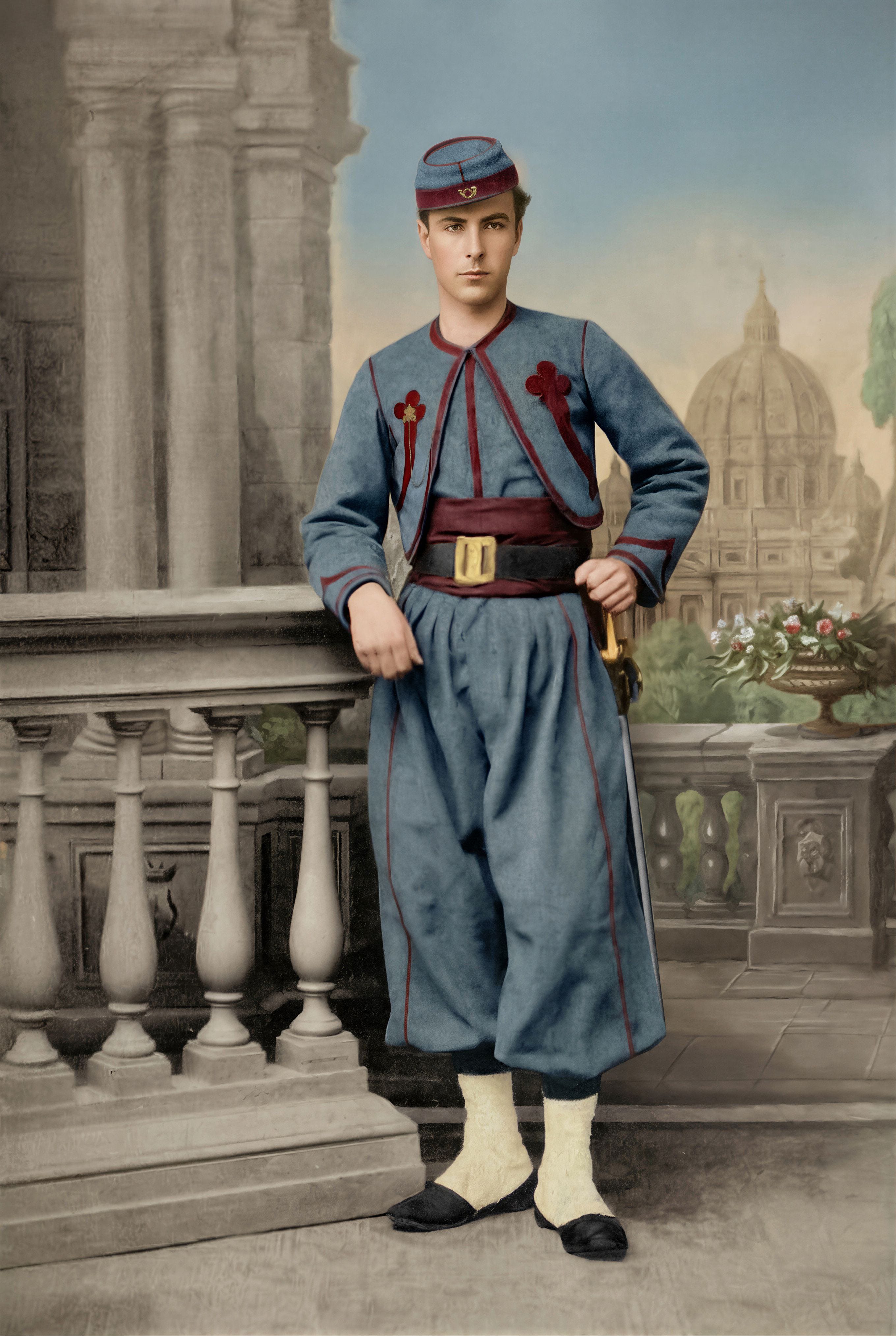
A colorized portrait of Julian Watts-Russell
On Saturday the 9th of this month, a tender ceremony took place in the Church of the English College: the solemn funeral rites of the young Giulio Watts Russell, of an illustrious English family, a Papal Zouave, killed in the cause of the Church near Mentana on the 3rd of November, aged seventeen years and ten months.
Five months earlier, together with his elder brother Wilfrid, he had generously enlisted among the Zouaves as a simple soldier. He fought gloriously with his brother at Nerola, then departed for Monte Rotondo, leaving Wilfrid behind in Rome, ill with fever from the hardships of the campaign. A handshake, a Pater, an Ave, and a Salve Regina murmured together — that was their farewell, at two in the morning, as Giulio, armed and pack on shoulder, was already falling into the ranks.
It was the first time they had been separated. Not twenty-four hours had passed before the generous Giulio had obtained what he most desired: to give his blood and his life Pro Petri Sede — for the See of Peter.
The day before, according to his custom, he had fortified himself with the Holy Sacraments. He fought with heroism and, as his companions attest, spoke little and prayed much. From the very start of the battle he lost his cap, carried off by a bullet; several times he ran great risk; and finally, near Mentana, he fell — a bullet that entered his right eye and wounded his brain. The shot was fired at close range by a Garibaldine soldier.
His body was set apart through the care of Mrs. Stone, who went with three Sisters of Charity onto the field. There was found upon him a handwritten devotional booklet; the last words written in Italian, which well express his pious, frank, and generous character, are these:
A Maxim for Giulio:
Anima mia, anima mia, Ama Dio e tira via
(My soul, my soul, be this thy song, love thy God and speed along)
There is also a tender prayer in French to the Most Blessed Virgin, asking her intercession for the conversion of those who, even amid their sins, have preserved a spark of devotion to her. Who knows but that the conversions of some wounded Garibaldines may not be owed to such prayers! The whole booklet is a jewel of devotion, revealing the fervent piety of the young Zouave.
He was loved by all for his innocent ways and the generosity of his heart. To understand the beauty of Giulio’s soul, it suffices to say this: not long before, having grown slightly heated with his brother over some dispute, Giulio broke it off saying: “Wilfrid, let us kneel down, make an act of contrition, and shake hands.” And so it was done — and so those brief amantium irae ended in holiness.
(Latin, from Terence: “lovers’ quarrels” — used here for brotherly disagreements.)
Well do those know how to be generous soldiers who know how to conquer themselves!
A French gentleman and a French priest brought the body from Mentana to Rome; it was embalsamated in the home of this gentleman, who had also had the privilege of taking charge of the body of the Zouave Guérin. Indeed it may be said that young Watts Russell is the Guérin of England.
The friend had placed upon the brow of the corpse, while it lay in state at his home, a crown of white roses; the Crucifix and a palm in his hands; the scapular of Mary around his neck. It was moving to see that handsome young man in his finest Zouave uniform, with a gentle smile — one almost supernatural — supple in every limb as if he slept. The wound in the eye and the bruising on the forehead seemed rather to add beauty to that face. Thus he remained exposed for more than a day, and many came to see what they called “that little Angel.”
The Zouave uniform Giulio had worn in the field, bloodied as it is, is kept for a better time, as a consolation for his father — a father well worthy of such a son.
On Friday evening the body was carried by hearse to the English College, where it was received in procession at the door by all the students and by the new Rector, Father O’Callaghan of the Oblates of St Charles in London. On Saturday morning the Office and Mass were sung. Present were Monsignor Talbot, Monsignor Stonor, English gentlemen and ladies, and several fellow Zouaves — a beautiful sight, holding their crowns and lit candles during the Mass and the funeral rites. Among them were two Zouaves, Carey and Collinridge: the first a friend of Giulio and his companion to the last in battle; the other, Carey’s cousin, and himself the brother of a brave man who, mortally wounded at Monte Libretti, had the honour of being the first among the English to die for so holy a cause.
The prevailing feeling was one of tender consolation and holy envy of the departed — and even Wilfrid, who had felt so keenly the loss of his brother, said in the end that the funeral had left upon him the impression of a festa — a celebration. The wonder and consolation of those present renewed itself when for the last time the body was uncovered to close it in its zinc coffin. That gentle smile — more beautiful than ever — and the suppleness of his whole body made it seem he slept in somno pacis — in the sleep of peace.
Toward evening he was brought to San Lorenzo, to a distinguished place, and his brother laid upon the sepulchre two wreaths of flowers gathered in the garden of the Pope, praying peace for the soul of his beloved Giulio, whom we already hope to be crowned and bearing a palm in heaven.
Upon the monument was placed this inscription:
Heic ad Martyrum cryptas dormit in pace
Julianus Watts Russell Michaelis F.
Anglus claro genere
Pro Petri Sede strenue dimicans
in acie ad Nomentum occubuit
III. Non. Novemb. an. MDCCCLXVII
an. n. XVII. mens. X.
Adolescens Christi miles
Vive in Deo.
Here, near the crypts of the Martyrs, sleeps in peace Julius Watts Russell, son of Michael, an Englishman of noble lineage, who, fighting bravely for the See of Peter, fell in battle at Mentana, on the 3rd of November, in the year 1867, aged 17 years and 10 months. A young soldier of Christ — Live in God.
Most esteemed Sir,
This morning I left at the printer’s for you the photograph of dear Giulio Watts Russell and a small image of St Maurice taken from his devotional booklet. Please accept this little gift, which Wilfrid sends in memory of Giulio. I must also add the thanks of Wilfrid and of his father for my brief article, which you were kind enough to include in the Divin Salvatore.
Mr. Watts Russell has already come to Rome, having learned of his son’s death. When I saw him I took his hand, saying: “I do not know whether I should first speak a word of condolence to the father, or of congratulation to the Christian.” And he, pressing my hand, after a moment of silence replied: “I am content.” And after a brief pause: “If I had ten children, I would willingly sacrifice them all to God for so holy a cause.”
I had also written to him at Saragossa and Barcelona, where he was making a devout pilgrimage with his daughter to the shrines of the Most Blessed Virgin; but the letters did not reach him in time. He learned of Giulio’s death in Marseille, reading a brief piece in L’Univers, taken from the Figaro, which stated that among the bravest of the Zouaves had died one Giulio Russell, aged twenty-one. The name was that of the younger son, the age that of the elder — it might have been either, or perhaps both. Having made the sacrifice in his heart, he came at once to Rome; and one of his first consolations was to receive immediately the article from the Divin Salvatore.
He was deeply grateful for the honours paid to the body transported from Mentana to Rome; but he added that had he been present, he would not have thought of removing his Giulio from the noble obscurity of burial at Mentana — which, before God, was the true field of his glory. He likewise declined the affectionate proposal to transport the body to England, feeling that if a place is to be chosen, no better could be found for Giulio than the Cemetery of Rome near the tombs of the Martyrs.
I must also add what I have since learned: that the good Giulio, at every rifle volley, would say an Ave to the Virgin, praying her to have mercy on the soul of whatever poor wounded man he might be sending into eternity. How much more will the Most Blessed Virgin have gathered to herself the soul of this beloved son!
Your most humble and devoted servant,
V.C., of the Company of Jesus.
Most esteemed Sir,
Allow me one final word of edification regarding my dear Zouave Giulio Watts Russell, now that his monument is being erected. A beautiful marble cross; at the base, a gilded laurel crown enclosing the monogram of Christ; and then the inscription on the marble pedestal — such is the simple monument of this soldier of Christ.
In the inscription has been placed his true baptismal name, Julianus, though he was commonly called Giulio not only in Italy but also in England and within his family, taking Giulio as a familiar form of Giuliano. The little monument stands in an excellent position, in the first row on the slope of the hill to the right of the central church of the cemetery, beside the monument of an old English General in the army of India, Mr. George Tylee, who, having come with his wife to Rome for Easter of 1865, died shortly thereafter of a violent fever — holily, in my hands — thanking God that He had led him to die in the Holy City, and that his remains might rest near the tombs of the Martyrs.
I had learned at the General’s deathbed a devout hymn of praise which he repeated to the very end, in honour of the Most Holy Trinity; and now, to my surprise, I have found it in Giulio’s devotional booklet — Giulio, who, without ever knowing the General, had learned it from a simple account I had given by letter to his father. Who would have believed that so soon I should have to place beside that brave General this young hero!
But there is another thing I had not noticed in Giulio’s booklet, far more remarkable. There is a long Protestation of devotion to the Most Blessed Virgin, which, though he there promises to recite only every Saturday, I am told he recited every day. In it he asks especially to be free from temptations at the moment of death, and expresses his desire to always carry this protestation with him as a pledge of his devotion to Mary — so that it might be found on him after death; indeed he desires to be buried with it. Now, since his death was instantaneous, it seems the devil had not even time to tempt him; and since he died fully clothed, he had the booklet with its protestation on him.
For the consolation of his father, I obtained permission to have the body disinterred and examined; and on that occasion Giulio’s sister copied out from the booklet that protestation, and his father with his own hand laid it upon the breast of this devout son. This occurred on Saturday the 23rd of November, twenty days after his death. It was surely no small consolation for the father, the sister, the brother, and a few intimate friends to see that body again — for as the father expressed it, no description had made him understand the extraordinary suppleness of that body, which seemed to have robbed death of one of its most terrible trophies.
There is another beautiful consolation for the father. His custom being to recite with his family at three in the afternoon a short devotional prayer in honour of the Agony of Jesus — on that very 3rd of November, with those words miserere animae agonizantis in egressu suo, not knowing it, he was commending in Saragossa the soul of his son who was dying on the field at Mentana at precisely that hour. Moreover, that very morning in the famous Shrine of the Virgin called del Pilar, he and his daughter had prayed specially at communion for Wilfrid and for Giulio.
(Latin: “Have mercy on the soul in its agony at its departure” — a liturgical prayer from a devotion to the Agony of Jesus.)
The greatest consolation of all is that Giulio made such a death after such a life. A few days before his death, returning from the exhausting campaign at Nerola, he was met on the street by the Countess de Redmond, who at once invited him to dine at her home. As it was a Friday, she told him that by a dispensation she had obtained, meat had been prepared — which seemed fitting for him in his state. The good Giulio replied that he could truly avail himself of the soldiers’ exemption in those days of such heavy labour; but that he preferred to keep to the common rule of the Church. And so without even tasting a spoonful of broth, he greatly enjoyed the meatless meal the lady had prepared for him.
Another day, the same lady, seeing him at Mass at San Carlo al Corso, approached to have a word with him; but she found him so absorbed in prayer that she stopped and did not dare to disturb that holy recollection. She herself told me that even in ordinary social intercourse, the sight of this young man so cheerful and composed filled her with devotion — and that the ease and joy that lit his face seemed to come not so much from the bloom of youth as from the innocence and contentment of his heart.
With this same sense of affectionate reverence speak of Giulio the Baroness Martini and the Countess of Montgelas, his aunts. The Chevalier Geneste, who knew Giulio from childhood and showed him great affection to the point of rendering him the last offices at the bier, recalls among so many things having heard from Giulio these dear words: “I cannot understand how men can find any pleasure in offending God.” Beautiful soul! He who, like you, finds all his pleasure in loving God — truly cannot understand it.
To this same Chevalier, one or two days before his departure for Mentana, Giulio said as if in jest that if he died, he should write to his father. The friend replied: Heaven forbid I should have to bring such dreadful news! “And why?” said Giulio. “Do you really think that Papa will be too grieved? On the contrary, he will thank God. Elena yes” — (his dear sister) — “will weep a little... but the Lord will console them.” And truly, tears for Giulio have been shed more of consolation than of sorrow.
The finest testimonies of affectionate esteem accompany him from earliest childhood to his death. Father Vasco of the Company of Jesus, who had him as a young boarder at the Convitto dei Nobili in Rome; Father Digby Beste, Oratorian of London, who often kept him occupied with innocent childish games in the garden of the Oratory; three students now at the English College in Rome who were his companions at Ushaw College in England; Mr. Arthur Marshall, his tutor at home; Professor Don Solfanelli, his teacher in Rome; Don Liberato Magistrato, for one year chaplain of the family in France; and Canon Don Luigi Forcioli, who as a friend of the family knew him closely in Ajaccio, and had my memorial notice reprinted by the hundreds in Corsica — translated into English, French, and German — all have only words of praise for the various stages of Giulio’s life.
Among the Zouaves, Giulio was one of the dearest. A young Zouave of his own age and intimate friend wrote that even before his holy death, Giulio was already half a saint (half-a-saint) — or as we would say in Italian, un Santarello. And another young Zouave said with innocent holy envy: “Well, Giulio certainly deserved to die — he was so good!”
It seems the Lord was thus preparing him for death, giving him at times what felt less like desire or hope than a presentiment. A friend recounts that Giulio, a few days before the battle, while seated on the edge of his bed tossing a lead bullet from one hand to the other, said: “What a fine thing it would be to send a present like this to Garibaldi!” — to which the friend replied: “But what if Garibaldi sent one to you?” — “All the better,” answered Giulio; “then I hope I would fly straight to paradise.”
The day before his departure for Mentana, the same friend heard him speak with holy cheerfulness of going to fight, as if going to a ball — or rather, to die for the Church. And his last farewell to some friends was this: “Goodbye — until we meet again in paradise.” He also said his last affectionate goodbyes to Mrs. Geneste’s two small children, saying he would pray for them in paradise, that the Lord might keep them always in their beautiful innocence. And as he departed, she from a little balcony tossed him two oranges. He caught them gracefully and said that was the last time — and returned her greeting with the words: “Until we meet again in Paradise” — and so went on his way along the street, rifle on shoulder, eating the oranges, while she watched him go with eyes full of tenderness.
It has been observed by many that as at Castel Fidardo, so now it seems God chose the most elect victims — for among the dead at Mentana are found not a few of the finest flower. It suffices to name just a few: Lieutenant Arthur Guillemin, called by his soldiers “their Guardian Angel”; Sub-Lieutenant Urbain de Quélen, called in praise of his humility “the Capuchin”; the brothers Sub-Lieutenant Emmanuel and Captain Adeodato Du Fournell; Marshal Carlo Count Bernardini; Captain De Veaux; Sergeant Rialland; Lieutenant Marquis De Quatrebarbes; Sub-Lieutenant Carlo Count D’Alcantara; and Sergeant Alfred Collinridge, who passed from the Seminary to the Zouaves in the hope of passing thence to heaven by a path akin to martyrdom — which he found at Monte Libretti. And those three heroic Dutchmen — Jong, Heycamp, and Crone.
The Holy Father himself, as soon as he learned the particulars of this death, expressed the feelings of his paternal heart in words of heartfelt sympathy, blessing the family.
I will end with the Evviva of the Inscription:
Adolescens Christi miles — Vive in Deo.
“A young soldier of Christ — Live in God.”
Your most humble and devoted servant,
V. Cardella, of the Company of Jesus.
Allow me not another letter, but only a postscript for the reprint. First I must add two fine testimonies from two of our Fathers.
Father Armellini writes to me of Giulio: “He was my penitent from childhood, when he spent two months at our Convitto dei Nobili, then again when he returned to Rome and continued his studies at home, and finally throughout his entire military life as a Papal Zouave. He frequented the sacraments with a piety and constancy that edified me singularly. I always admired in him a modesty and delicacy of conscience uncommon in young men of his temperament. He had the clearest insight into things of the soul and expressed himself with the greatest sincerity. He was deeply religious — far beyond his years — yet at the same time easy and frank, without any human respect. When he returned to Rome to enlist among the Zouaves, I marvelled to find him as pious as I had known him as a boy. The change of places and companions had produced no change whatever in his religious life. Before departing for Mentana he wished to go to the Gesù to make his confession, but was not permitted to cross the bridge; and he made his confession in Borgo with some priest. I cannot report the sentiments that accompanied the last hours of his life; but from what I knew of his conscience I am certain that that last day was for him an heroic act of religion, while from God’s side it was the greatest of gifts conferred upon that blessed soul: Raptus est ne malitia mutaret intellectum ejus.”
(Latin, Wisdom 4:11: “He was taken away, lest wickedness should alter his understanding.”)
And Father Blosi, who heard his confession several times when Father Armellini was occupied, adds: “I had the fortune of knowing him closely when he sometimes came to my confessional. Oh, what devotion, what exterior composure, what humility! Those present watched with eyes of delight as this little Angel threw himself on his knees before me, overcoming all human respect. What faith! What exactness! What compunction! I think that when at Mentana he gave up his beautiful soul to the Creator pro Petri sede, his Guardian Angel, whose likeness he bore, received his soul and presented it to the Divine Mother to whom he was so devoted.”
I myself knew him not as his confessor, but as a friend of the family. It was to me that he wrote when the two generous brothers thought of becoming Zouaves; and I replied coolly, throwing cold water on their ardour to put it to the test. Nevertheless, soon afterwards they arrived in Rome, and an hour after their arrival came to me. Then I received them with warm words and great rejoicing, and led them at once to the little chapels of St. Luigi Gonzaga and Blessed John Berchmans, where young Zouaves — especially from Belgium and Holland — often come to pray. They were enrolled immediately, and in their Zouave uniforms were presented to me by Count Redmond, who himself, even before Giulio, died holily — a victim of his charity during the cholera.
They at once accustomed themselves to the noble daily sacrifices of the laborious and humble military life of simple soldiers. Giulio told me laughing that he had quickly learned the manoeuvre of polishing his little boots and washing his gaiters; and one hot summer day we laughed at the joke that, while they had come to give their blood for the Pope, the fleas that abounded in the barracks were instead drawing his blood from him. But soon came the hour for greater sacrifices: for Wilfrid, the sacrifice of his health from the fevers of Nerola; and for Giulio, the sacrifice of his life at Mentana — a more perfect, more glorious, more fortunate sacrifice.
It seems he bore a happy presage of this in the name of the Holy Martyr given him at baptism, in a manner quite singular.
He was born at the Epiphany of 1850, in Florence, where the family was then living. His father sent the glad news by letter to a devout religious, to whose prayers he and his wife had commended the birth. The religious replied on the 11th of January, and though she must have supposed the child already baptised, she suggested three names — Gaspare, Michele, Giuliano — saying: “From these three, choose whichever you most prefer as the first, provided only that he be placed under their holy protection, which perhaps will one day obtain for him from heaven the qualities necessary to fight victoriously against the enemies of our holy Religion” — words which now take on a precise and definite meaning that could not naturally have been supposed at the time.
The letter was expected to arrive too late — yet it arrived in time, for the baptism had been deferred several days to await His Eminence Cardinal Piccolomini, who had made a promise — indeed a courteous insistence — to baptise the child himself. The Cardinal was at his villa near Siena, delayed by a mislaid letter and by the snows. The Archbishop and the Nuncio kindly offered to stand in for him; but Mr. Watts Russell — who had already waited several days, not for the pomp of the baptism, but simply for his promise — declined these honourable offers with modesty, and decided to take the child to the font without further delay. And it was precisely as he was leaving the house that the letter arrived in good time. Thus, instead of the names already settled upon, the child received as his first name Giuliano — which, as I said, was later shortened in the family to Giulio.
And in another letter of 22 February 1850, the religious added concerning the martyr St. Julian whose feast falls on the 9th of January: “Saint Julian, Martyr of Antioch, offers the precious example of a simple wisdom united with purity and courage — virtues so greatly to be desired in these sad times, and which I ardently wish for my little Giuliano... So it will be no wonder if in his day God grants him the grace, as to St. Julian, of drawing behind him thousands of generous souls in the practice of virtue, who like him may not fear even death in defence of our Holy Religion.”
So ends the truly Christian auspice at the birth of Giulio — and it finds so beautiful an echo in his death. Indeed, from various accounts I receive, it seems that the good odour of his young sacrifice, spreading wherever he was known, is gently drawing many souls to God — perhaps more than the good odour of his example in a longer life might have done.
For all of this, praise be to God, who — in the beautiful words of St. Mary Magdalene de’ Pazzi — in certain chosen souls does not merely take pleasure, but takes delight.
Your most humble and devoted servant,
V. Cardella, of the Company of Jesus.
The following three prayers were found in Giulio’s handwritten devotional booklet. The first is attributed to St. Germaine Cousin; the second is by an English Carmelite nun who died in the odour of sanctity two centuries prior; the third is a popular devotion from Spain. Giulio carried this booklet on his person at Mentana. They are translated here for the first time into English, from the Italian versions copied in Giulio’s hand.
1.
O Mary! obtain, I beseech You, for all those souls who, even amid their sins, have preserved in the depths of their heart the smallest spark of love, the faintest devotion toward You — oh, obtain that their chains may be broken, and that they may be preserved from eternal death. Amen.
2.
O most glorious and ever Immaculate Virgin Mary, Mother of my God, I protest that I wish always to be Your humble and devoted servant. I promise to revere You often, and to love You always, and to invoke You always; and from this moment I will rejoice to serve You until my last hour and at the moment of my death.
But oh, at that moment restrain for me the infernal spirits, who might then place evil images in my mind and lay dangerous snares for me; so that through Your intercession and protection, which can never fail those who seek it, I may one day and for ever adore the Majesty of God in His holy Court of heaven, beneath Your mantle and at Your feet.
Meanwhile I resolve — and I wish this resolve to be a promise to You — to ask You more than once a day for Your maternal blessing; and this will be my first act in the morning and my last at night. At the same time, when I can do so without being noticed, I will kiss the ground. I will also each day give a small alms to some poor person, or at least a spiritual alms to the holy souls in purgatory, in memory and honour of You, so that You, at my death, may give me the glad news of an eternal happy life at Your feet.
I will endeavour to carry this protestation with me in life and in death, so that it may be found upon me; and I desire also to be buried with it — (I desire also that it may be buried with me) — as a sign of defiance against all hell, and of the cordial trust which I have and shall always have in Your prayers and protection, O most holy Queen of heaven, Mother of my God, and my Mother.
Meanwhile, every Saturday I will read this protestation on my knees, to refresh often the memory of Your presence, and that as I rejoice to think of You, so too You may deign to take perpetual care of my poor soul.
3.
Blessed and praised be the Most Holy Trinity —
Father, Son, and Holy Spirit.Holy, Holy, Holy is the Lord God of hosts.
Full are the heavens and the earth of the majesty of Your glory.Glory to the Father.
Glory to the Son.
Glory to the Holy Spirit.I believe in the Most Holy Trinity.
I hope in the Most Holy Trinity.
I love the Most Holy Trinity.
I repent of having offended the Most Holy Trinity.
I desire to see the Most Holy Trinity.Amen.
Read the full story of Giulio Watts Russell
Check out England’s Last Crusader: Papal Zouave Giulio Watts-Russell — republished by Papal Zouave International, with a new introduction by Father Nicholas Schofield, author of Victorian Crusaders: British and Irish Volunteers in the Papal Army, 1860–70.
Get your copy here → https://amzn.to/4maeZpT
No posts
Comments
Nothing yet. Say the first thing.
Sign in to join the conversation.