
Happy Monday, Friends,
I hope this finds you well. This letter goes to you, wherever you are, experiencing your reality. Today I thought I would share a little bit of ours.
Of water and smoke
We don’t have air conditioning. I am not saying that to complain; it is a conscious choice, but rather to share with you the pulse of our day, this time of year—the way we manage the breath of a summer day in these mountains that keeps us (mostly) comfortable.
The narrow valleys and ridges that run both east to west and north to south make this range a region of micro-climates that are at times surprisingly different than one another. One notable winter our little valley, that runs north to south, had over 3 feet of snow pile up over the course of a day. The neighboring valleys that were oriented from west to east measured their snow in inches, never reaching a foot.
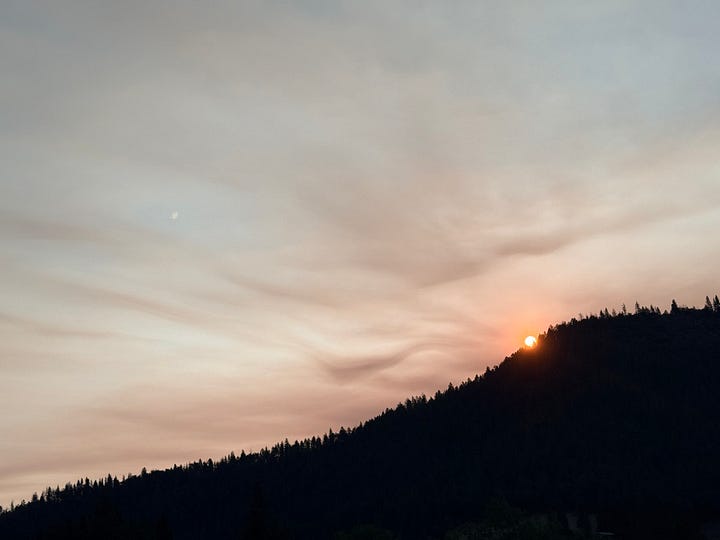
We live between two hills that meet, or are divided by, depending on your point of view, a cleft that water runs through. Water from sky and ground. There is a spring that begins in the middle of that small ravine and flows through a pond and on to the creek below. These hills, this spring, and our home all face east, which means the top of this ridge is where the sun sinks, earlier than sunset.
In the summer, this is the moment when the hot air stops rising off the dry hillside and asphalt of the road; instead, cool air comes rushing down that moist, tree-shaded gully, and rinses away the heat of the day. This is when we open the windows and turn on the attic fan and flush out the heat that slowly accumulated during the day.
In the morning, when the sun has come back around and rises across the valley, the sun’s rays make their way down the hill behind us until they are upon us. The heat begins to rise again. We close everything up. And despite a poorly insulated, early 1970s, small, ranch-style house, we stay comfortable enough until the sun passes and the spring-cooled mountain air can blow in relief. This is on repeat.
Sometimes we are fooled by the pleasant chill in the air and go on a walk down the road. We begin to sweat, and realize that it is this tiny micro-climate right here that makes our passive cooling system (can we call it a system?) all work out.
That is, until it is smoky and the air quality keeps us from opening up. The last four days we have been waking up to open up the windows, deep in the night, or before dawn, when there have been a few hours of clearer air. Thankfully, this time the offending fire is located to the east, and we have been out of the main assault of smoke. Neighboring communities have been less lucky.
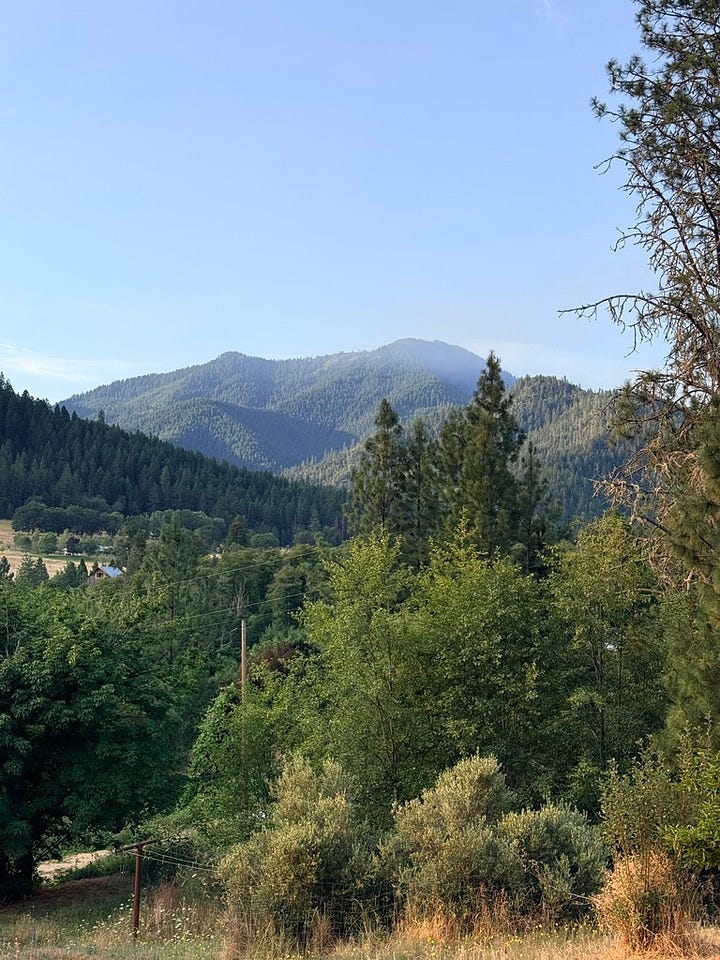
Water is life. That same spring was our source of water, gravity-fed; it filled pipes to our home, our orchards, our gardens, our livestock tanks, and what didn’t go into a pipe burbled on to the creek below us, watering willows on its way to fill small ponds in the otherwise dry bed to keep baby salmon and trout alive through the summer.
That has changed. The spring is still there but she trickles and we leave her to the wildlife and the fish. We had to turn to a solar-powered well at the top of the hill and tanks. I do realize that this well may also be the same ground water that feeds the spring. But we had to move to something, as the spring had begun to retreat more and more each year. And one summer afternoon it was dry. It came back the next morning, but it was a wake up call, we had to have a back up in place.
This year, everything is dryer, and not unlike the windows, I wake up in the morning to manage the careful watering of plants and garden so that things don’t run out. But there are many of us—myself and Christopher, and our son’s family. All of use hoses and water. We all have plants or pets we care for. All that to say when a hose is left on by accident or a pipe breaks and goes unnoticed the tanks slowly drain down until they are empty.
The well is solar-powered so it becomes a multi-week effort of turning this pipe off or on to get the 3 tank arrays filled again. Twice this week, there has been a mishap, plants have to wait for water and we have to wait for showers.
As I tried to get the right configuration of open and closed lines I had to trudge up and down the hill multiple times, while the day warmed, and dried burrs and grasses stuck to my legs. I laughed to myself, thinking of how many times a variation of this has played out with our non-standard (but delicious) water system. It wasn’t buckets from the pond, but that did happen, once a long time ago. This is my summer just as much as eating homegrown tomatoes, spitting cherry seeds off the deck, and fermenting food from the garden.

You may remember reading about Desi Cultures a few weeks ago. It started this morning with a wonderful and it is not too late to get a ticket, if you haven’t already. Everything is recorded.
The opening keynote by Dr. Dolly Kikon was beautiful and gave all of us a lot to think about. Dr. Kikon’s lens is through her indigenous Naga roots and anthropology, with her focus on resource extraction, militarization, development, human rights, migration, gender, and political economy. Her conversation was rich, touching all these points.
This post continues for supporting subscribers. More on Dr. Kikon’s work and Nagaland ferments. Plus resources and answering a reader’s question about Cyclospora and fermentation.
Comments
Nothing yet. Say the first thing.
Sign in to join the conversation.