
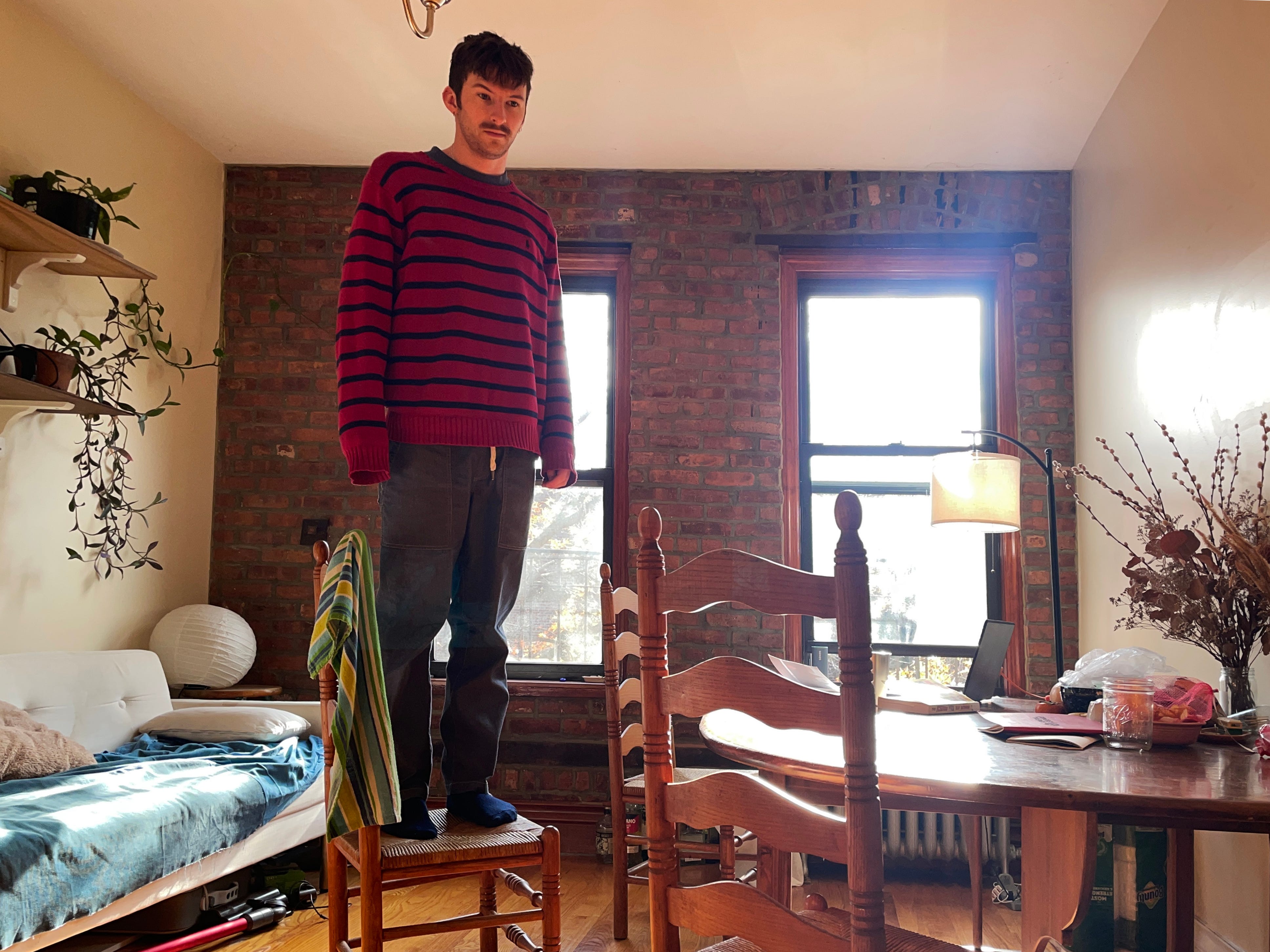
Arranged in front of me are two beautiful screens: a MacBook on the dining table and an iPad in my lap. Often there is a third screen, my phone, which makes a trifecta, since, in order to limit distractions, I’ve disabled iMessage on the two bigger devices. (I don’t even have location services activated on the MacBook or the iPad; both think I am in Tulsa, Oklahoma.)
When all three screens surround me, I feel comforted, even swathed, in an expansive and synchronous landscape. Reference material sits full-screen on the MacBook; my eyes dart from there to the iPad, then to an incoming text on the iPhone (I almost always respond immediately, terrified that otherwise I’ll forget about the message forever). The other day, after feeling a strange resistance on my MacBook’s trackpad, I literally lost my cursor, only to discover that it had floated contiguously, and I guess helpfully—though without my consent—over to the iPad. This feature is called Sidecar.
Such has been the professional setup in recent times. Though I once freelanced as a videographer, I’ve found managing and upgrading my own gear to be stressful, and, given the limited budgets of projects I’ve been hired for, that I’m typically overstretched, lugging around lights while my cross-body camera bag bumps against my hip, relying on the tiny monitor of a DSLR, really bummed when a favorite shot ends up out of focus. My new arrangement—sticking to editing and graphic design gigs—is much smoother: less room for error, high-performing tech bought cheaply, on installment plans sold by Apple with zero interest and at a cumulative price-point no different from the amount charged upfront.
Many freelancers set up shop in cafes, which are encumbered by any combination of bad music, really loud music, bad pastries, intentionally scarce seating, intentionally uncomfortable seating, or breathtakingly low temperatures. My roommates and I conversely order giant bags of whole-bean Peet’s coffee from Costco, and ever since Radio Bakery—the Tiktok sensation originally confined to Greenpoint—opened a Prospect Heights location, I’ve had country batard slices waiting in the freezer. Add an egg and cheddar and you’re approximating a $15 purchase in the real world.
I always start my day reading, and I also take breaks from labor by reading, and sometimes these periods of time merge into one long journey through words and numbers of varying importance. Because I know I have to get back to editing or animating, my aim is always to read one or two articles, but toggling between sites is a deeply absorbing compulsion, and it can happen so fast (I am drawn to speed) and articles by The Economist, accessed via a friend’s corporate credentials, are short, and that’s me cosplaying as a finance bro, which shouldn’t count toward my textual intake, so I then veer toward the London Review of Books, whose articles are too long, so I pivot to Vulture and The New Yorker, whose paywalls are fun to circumvent, then to Deadline, because they update their site so often (that’s me cosplaying as a film industry insider).
Then I check Oscar odds on GoldDerby, then the weather in San Francisco, Stinson Beach, Austin, Reno, Berlin, Chicago, Santa Barbara, Zurich, London, Melbourne, Savannah, the Washington Heights Wunderground station of New York City (I live in Brooklyn). Then I review my own music-listening statistics, because I can track play counts on Apple’s desktop Music app. I can also see the date I added a song and the date I last listened to it, and I now often picture this information while consuming music on the train, perhaps as a means of making a track more memorable, but less nobly because I am happy to be increasing the play count, to be making the numbers bigger. In this same way I am disappointed when on a given day no film joins the “millions club,” as the Box Office subreddit calls it—daily grosses exceeding a million dollars.
The Music app generally leads me back to digital media: Pitchfork album reviews (still no paywall there—alarmingly, for the publication’s staff) from the early 2000s until the present, which in tandem with my review of personal listening statistics actually do the most to compartmentalize my day. This is because I am an album-oriented listener, and I queue albums to accompany my labor. Sometimes the music has no words, like when I want to summon the feeling of endless dancing at a rave, to incite a propulsive strain of productivity. When the music has words, I am always singing. I am actually convinced that the amount I’ve been singing amounts to some kind of vocal training. I belt while I cook, I hone my falsetto on the toilet, I strain to reach that Janet Jackson tonality during my bursts of cleaning, which is like being in a Mad Men fever dream on MTV. Wiping down surfaces, vacuuming my room—these are all necessary acts, and household order starts to feel like my calling, until I realize I’m doing it as a small respite from whatever project needs completing.
I listen to album after album after album. I’ve become resentful toward editing that involves cutting audio, because I’m so reliant on continued melodic accompaniment, though eventually I do tire of music, yet I berate myself when I can’t naturally think of the next album I want to hear. I haven’t always been at a loss; until maybe a few years ago I could within minutes identify the sounds and mood I needed. It might be the infinitude of availability of music on streaming services that’s catching up to me.
I also get tired when I have been dancing to music, if the song in the air is “Ring Ring Ring” or “People” or “How to Stay with You.” Dancing usually follows a lunch break. I get myself into states where I think I’ve christened choreography that’s destined to go viral, and I spend five minutes recording a video of myself replicating this choreography on my iPad. Then I feel ashamed for wasting that time—also, the quality of the iPad’s camera is horrible—and I AirDrop the video to my iPhone then text it to my sister because I know she’ll find it endearing.
Throughout the day I receive social-media content from my friend Pierre. Pierre is my conduit to the truly online world, because his Twitter feed is perfectly curated, populated with heartrendingly funny people and videos. I could never make up for the time Pierre has spent cultivating this content ecosystem, which makes me really dependent on him. Meanwhile my self-constructed schedule allows me to go to the gym or to play tennis whenever I want, when those spaces are mercifully uncrowded. Inevitably I put off projects until a deadline is near, but this isn’t even a problem, because I know that once I’m in a flow state, I’ll knock the whole thing out from 4 p.m. to 4 a.m. More important than laboring efficiently is, for example, laboring aesthetically, which is especially possible in my apartment because it is full of the most gorgeous light you’ve ever seen. I follow the light like a cat, imagining when it hits me that time has stopped, and in some sense it does, because I myself cease, for just these few moments, to consider everything I’ll keep needing to do when the light disappears completely, or (for an hour) is hidden behind the hulking new condominium across the street.
Upon realizing that this environment is a bit dull, and then despairing (despairing is maybe too strong a word) that this dullness is insidious and perhaps impossible to escape, I remember a passage from The Idiot, the novel by Elif Batuman, whose protagonist Selin keeps thinking about “the uneven quality of time—the way it was almost always so empty, and then with no warning came a few days that felt so dense and alive and real that it seemed indisputable that that was what life was…But then time passed and unthinkably grew dead again, and it turned out that fullness had been an aberration and might never come back.” This quote puts me at such ease that I’m driven by a burst of motivation to execute one of my tasks.
I also know, in remembering the passage, that I’m counting backward from the experience of making Sparks, my first feature. It’s now been a year since production wrapped. What I sometimes struggle to comprehend is the manufactured nature of that experience. My producer Lola and I went onto set with the suspicion that being there might change the way we felt about our lives, that it might dizzyingly elevate our lives for as long as it lasted. And that’s not what Selin is describing, which is instead the way the heights of life are suddenly foisted upon you, in the unassuming depths of tedium. To be fair, I couldn’t have predicted how right it felt to be on set, the vibration—not tension, because I wasn’t stressed in any sense that was familiar or precedented—that made me certain I was enacting and fulfilling a deep sense of purpose. In the year 2025, when events can be minutely planned, when spontaneity is evasive, I wonder what the circumstances would have to be for spasmodic, bracing life to feel totally surprising, not at all accounted for or enabled by choices. But it is probably precisely this circumstance that is hard to imagine while working, three screens before my eyes, from home.
And in fact the intensity of this bafflement peaked several months ago, egged on by the summer, by the high temperatures exaggerating the mindlessness of standing over an already-hot stove waiting for the water to boil for my lunch. Now, at the end of November, every corner of my apartment glows like it’s full of purpose, like there’s anticipation seeping out of the walls. All day, without leaving the apartment, I feel like I’ve just come home. It is hard to believe that before last week, I hadn’t considered ascending one extra flight of stairs to my building’s roof, which no other resident is interested in either, apparently, even though it’s quiet and spacious up there.
One afternoon I brought a notebook, my laptop and a novel and a patio chair which my old roommate Mabel left behind, and I set the chair to face the sun, for what would probably be the last day for a while on which I could wear only a t-shirt. The breeze made me feel like I was close to a beach—and really, in South Brooklyn, I am—and I closed my eyes for five minutes and again, in the light, time landed like it was stopping, and then I wrote this piece.
Fergstack will not run next week due to Thanksgiving.
From last Thursday: iso: my own western
….wherein I think about adapting a Western and revisit Bend of the River, Anthony Mann and James Stewart’s spellbinding addition to the genre.
From November 6: Why don’t I want to write about New York?
From October 16: How to dance on the big screen. considering the ideal pop-cultural platform for inspired choreography.
No posts
Comments
Nothing yet. Say the first thing.
Sign in to join the conversation.