
Soon after we wrapped production on Sparks, my first feature, I started fantasizing about how the arc of my filmography might develop, and, modeling the possibilities on the careers of filmmakers I admired, I figured that sooner or later I should adapt a novel.
I predicted this adaptation would not occur until after I’d proven no fewer than three times that I could formulate an original story with my own characters and plot beats, formulaically in the worst-case scenario, but nevertheless absent the guiding light of source material. Though this prediction was thoughtless (meaning I did not question it at first), and though it arises amid an epidemic of authorial intent among young filmmakers, I realized upon reflection that I am in fact concerned I’ll need as long as the production of two more features to discover the material I’ll want to adapt.
The desire I developed around the time I was thinking about adaptation was to make a Western, since I couldn’t get enough of and afterward craved the desert landscapes where we shot Sparks, and since, for reasons I’ll explain below, high Western form seems so unassailable. My first course of action was thus to search for a Western story—a novel—worth adapting.
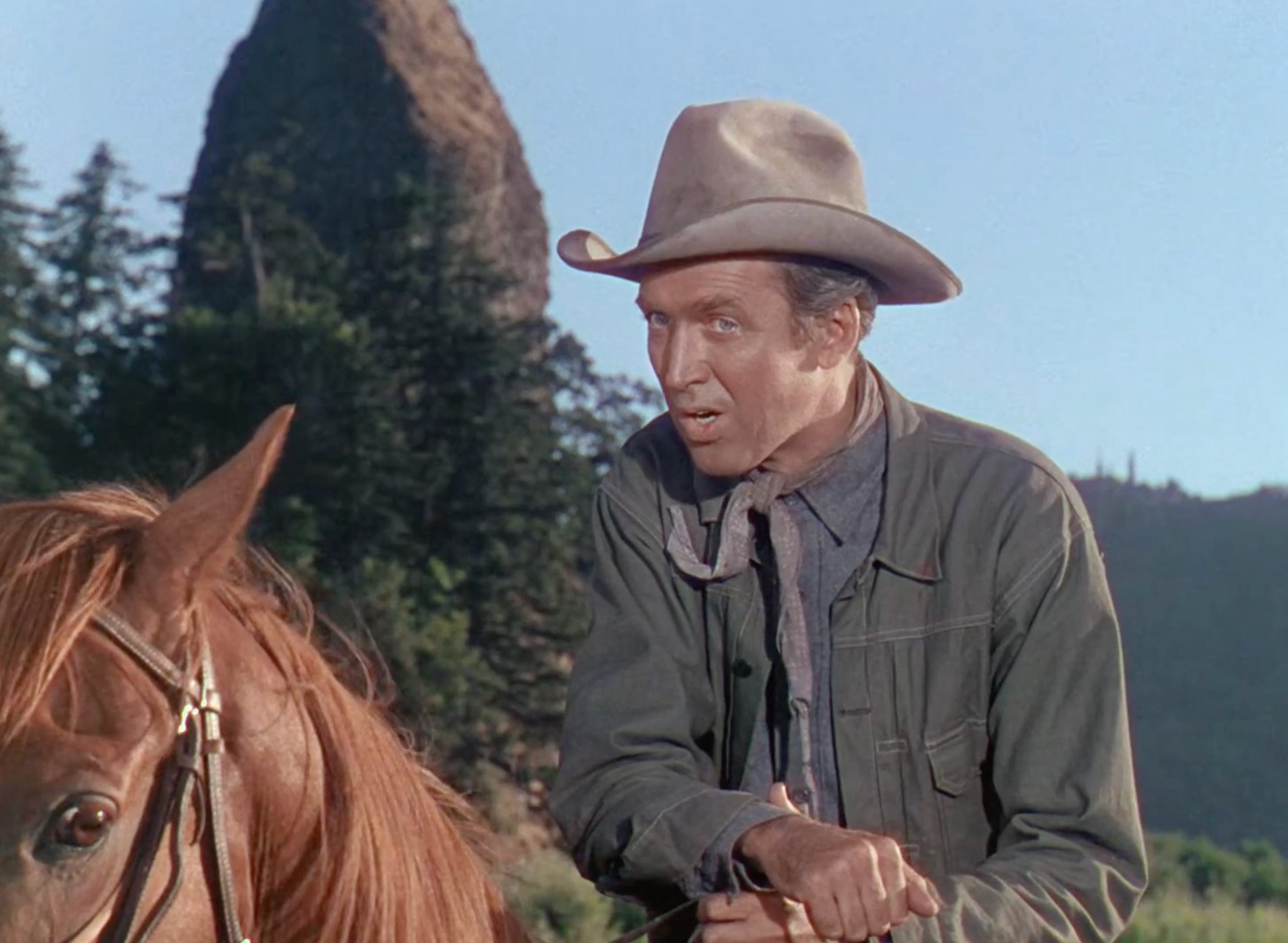
This search was narrowed after a MoMA screening of Anthony Mann’s Bend of the River, which stars James Stewart, that happened almost a year ago, as part of the museum’s annual film preservation showcase. I was in thrall to the iterative tautness of the central relationship in the film: two cowboys with equally checkered pasts whose undulating camaraderie—and ongoing exchange of live-saving maneuvers—inhibits the assignment of a villain label to the more opportunistic of the pair.
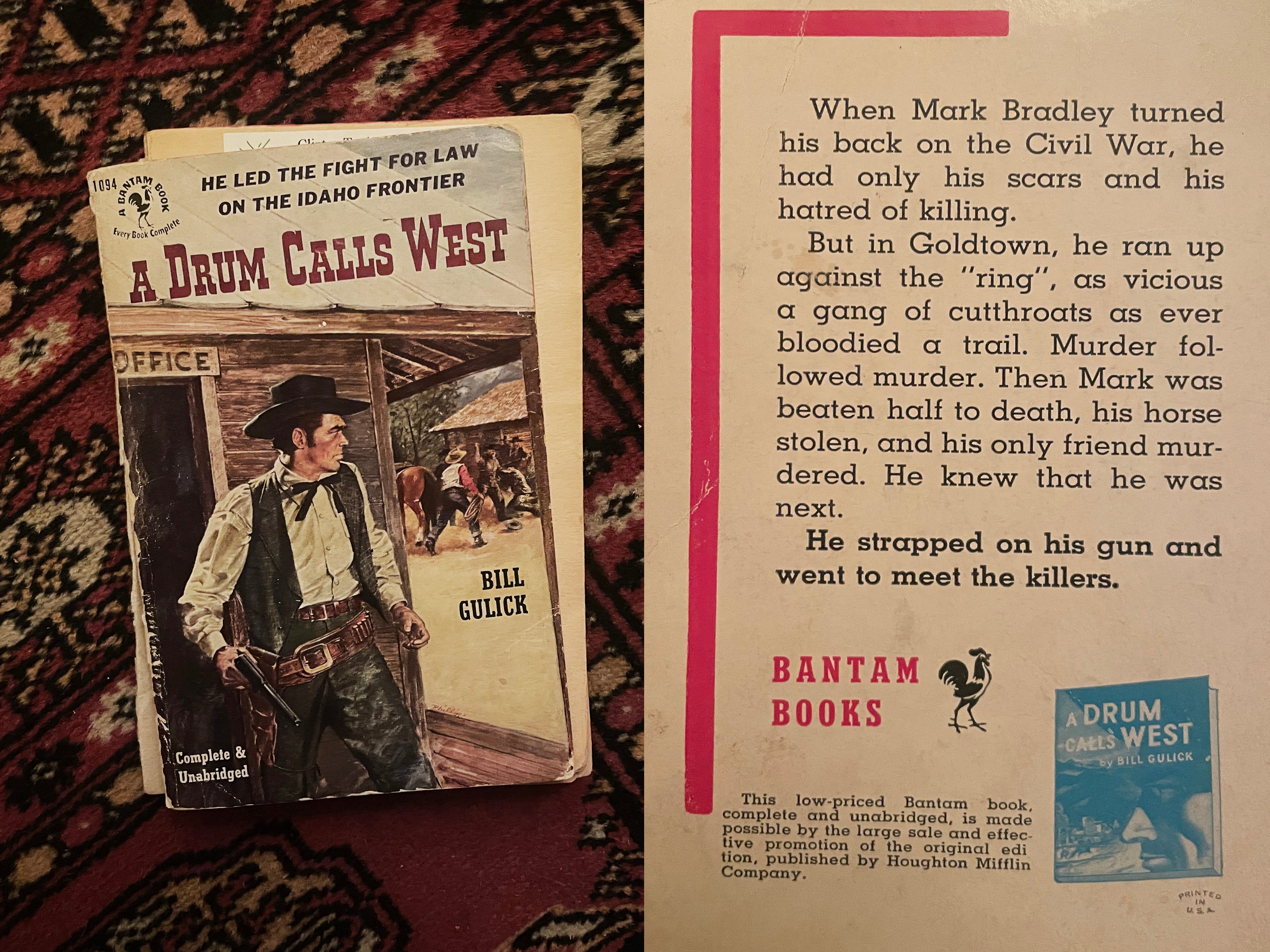
Bend of the River is based on a novel called Bend of the Snake by Bill Gulick, who has an obituary in the Yakima Herald-Republic because he was a resident of Walla Walla, Washington, but little else in the way of a public biography. Why not adapt a Gulick book, I thought, as Mann and the screenwriter Devin Borden had done? In February I ordered a fragile paperback copy of Gulick’s novel A Drum Calls West, published the same year that Bend of the River was released. This edition, by the “low-priced” publisher Bantam Books, is prefaced with a hooky one-page excerpt from a climactic scene, and includes a gravely yet goofily described “cast of characters,” led by Mark Bradley, who “had enough of bloodshed, but death rode his trail.”
The task may now be to read the Mann picture’s novel of origin, because it seems possible that Mann and Borden were responsible for conjuring the nuance and complexity which defines Bend of the River; it is completely missing from A Drum Calls West. The stock Western characters are present, but not archetypally undermined or allowed to be unpredictable; Bradley sets out to homestead in Goldtown, where his estranged lover, Amy, has taken refuge, the reason for her retreat from established society being that her father, Judge Crittenden, is a staunch Confederate still in denial about losing the Civil War. The Judge cut ties between his daughter and Bradley, a Union soldier, so Amy initially refuses to see him after she hears he’s in town.
Bradley, like Wyatt Earp in John Ford’s My Darling Clementine, finds the lawlessness of Goldtown an obstacle to living peacefully. The villain fomenting the lawlessness is the unsubtlest kind, at least to the reader, because from the time Bradley hears about the “Ring,” a criminal gang with secret members who kill the first friend Bradley makes in Goldtown (yes, a gold miner), it’s clear the Ring has a powerful and conniving leader with access to resources. That this leader, Preston Stone, is masquerading as a benevolent merchant merely brings about impatience, a sense of being strung along, as Bradley starts an investigative newspaper to unmask Preston’s evil. There are fun showdowns, like when Preston’s cronies start to turn on him, but too much repetition, as with Gulick’s treatises on the saving liberalist graces of a free press. Why should an unblemished hero like Bradley hold our attention? He’s a man who doesn’t possess past regrets, only lost love, and no reason to savor wide open plains as a means of relief, of starting over.
The landscape descriptions in A Drum Calls West are a little tempting, though—vivid and eager, stuffed with enough simulation of fact to feel like history. And these descriptions beg the question of whether Gulick’s books were in some sense fodder-in-waiting for scripts that major Hollywood studios could produce. Since the book is not worth adapting, however, I figured I would try to absorb and internalize the structure of the adaptations themselves. I’m not saying I would remake a Mann-Stewart feature, but perhaps instead collect plot twists and personalities before undertaking a re-assemblage, instead of privileging literary roots which turn out to be rotten.
Because it followed a year after Bend of the River, and to freshen up the recency of the activity in this post, I watched The Naked Spur last week: that’s Mann and Stewart’s third Western collaboration (the first is Winchester ‘73, which I haven’t seen). The conceit in The Naked Spur is as rich as you should expect from these “reinvented” Westerns, as MoMA calls them. Stewart plays Howard Kemp, an Eastener on the hunt for Ben Vandergroat, who’s wanted for murder in Abilene, Kansas. Though Kent sets out to source only small favors from a wannabe prospector and a discharged cavalryman, once they learn of the bounty on Ben’s head, they demand to be cut in on a deal.
The group also includes Lina (Janet Leigh), the daughter of a slain friend of Ben’s, whom he’s taken under his wing, though not without uncomfortable sexual intent. The group’s dynamic is endlessly giving, because Ben is wanted “dead or alive,” and, if returned to Abilene alive, he will be hanged anyway. The cavalryman and the prospector argue on several occasions that Kent ought to shoot Ben, especially after Ben proves his own willingness to kill in order to escape his captors. Lina repeatedly points to the hypocrisy, or I suppose the convolution, of Kent’s conviction that death at the hands of the state somehow absolves him of wrongdoing, even though it will be Kent who delivered Ben to the state. Lina also, more fustily but still compellingly, has her own inner conflict: the obligation to remain at Ben’s side butting up against her attraction to Kent. While taking shelter in an Indiana Jones-pilled cave, Ben means to cause a rockslide that will cut him off from the rest of the group, and give him time to find another exit from the cave. But Ben needs Kent distracted while he kicks at the cave wall, which Lina can do, by pretending to flirt with the bounty hunter, only it’s not performed flirting but honest and wistfully smitten interrogation. Of course we see a basic version of this setup all the time—false and real intents meshing, a big lie providing an excuse for the truth not to matter—but rarely in the context of this (Kent’s) higher-level moral confusion.
In the long run, the foils to Kent’s ego and purpose are equitably provided by the ensemble cast, meaning electric, singular rapport has too little time to develop in any of his relationships. And though I couldn’t place this dissatisfaction at first, I decided about halfway through the film that the landscapes in which Mann conducted principal photography, which emit the tame atmosphere of, say, Indian Rock in Berkeley, are nowhere near as transporting as the snow-capped Oregon mountains of Bend of the River.
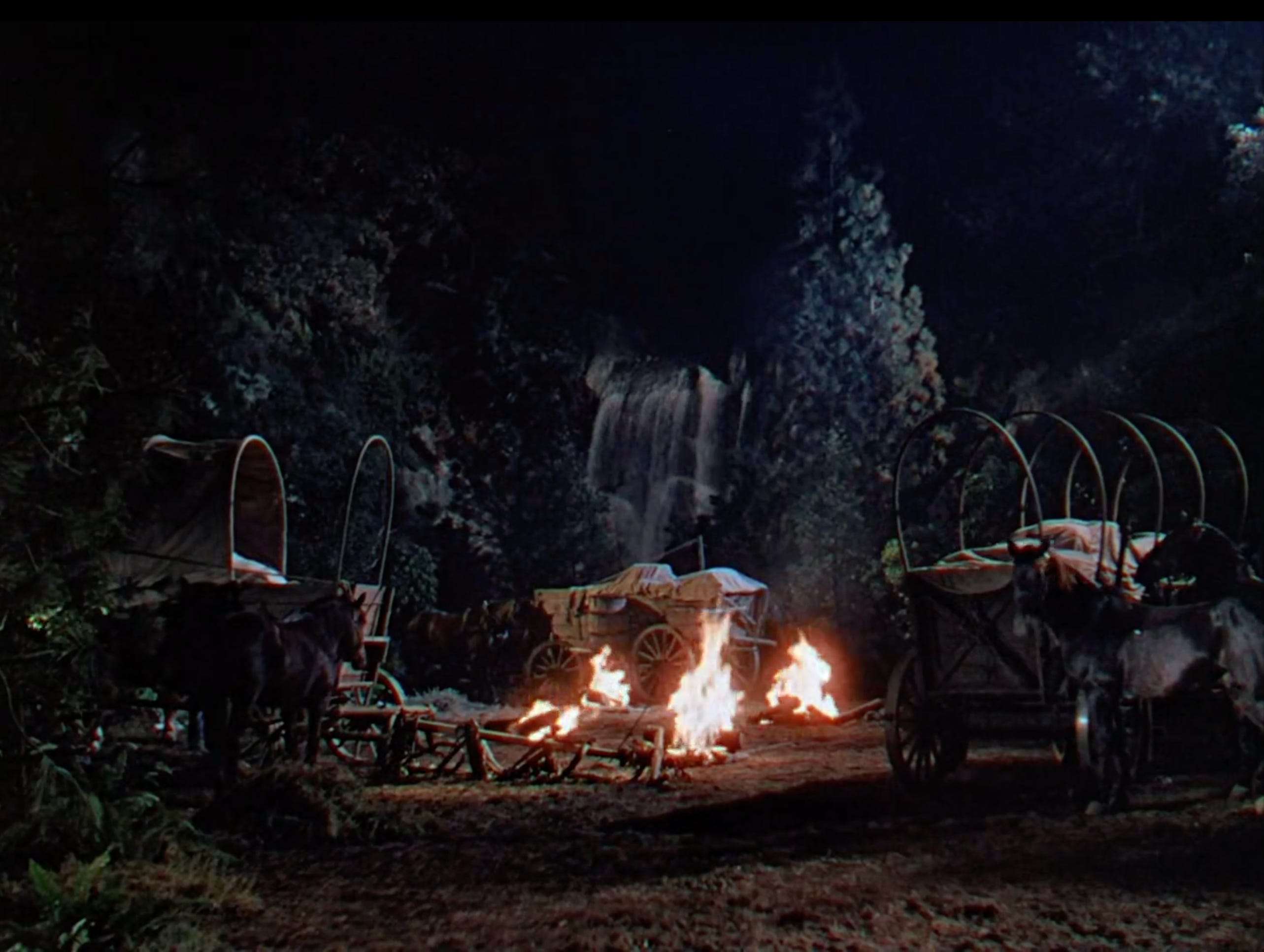
I then hesitated to return to a film that I saw all the way back in January, but there’s too much that’s good in Bend of the River not to want, after assessing a few alternatives, to make this the beacon for imitation and reproduction. The film’s beauty is of course a big part of its irresistibility: it starts out in dense forest as a lush Western, as opposed to the arid ones that Ford made, before spanning sandy beaches, a bustling frontier-town set (which looks like it was built on location!), and, most strikingly, snow-speckled foothills. But the film also does (I think) what few Westerns do: it shoots night scenes on elaborately build soundstages. The Naked Spur goes the more conventional, less expensive route: shooting day-for-night exteriors, where the frame is too blue and you can sometimes see perfectly formed clouds in the sky. Conversely, I’m not sure that the Bend of the River production design team would welcome my compliments, as the aim with their sets was probably verisimilitude, but each time dusk fell in this film I felt like I was slipping into a dream. There’s a bite-sized waterfall against which the main characters at one point set up camp, and a shot where Arthur Kennedy crawls across verdant, fern-laden soil, trying not to be spotted by Indians. The camera tracks backward, almost acting to envelop him in the wilderness, and with the same wonder and tactile attention more popularly associated with the Avatar movies. The mountain that dominates the skyline during the day is painted in the dark, which inevitably brings that skyline closer to the action and renders the mountain watchful and intimate.
Anyway: the film opens in the company of Stewart’s Glyn McLyntock, who’s leading a caravan of farmers hoping to plow a valley near Portland. McLyntock’s charm, the reserved and unfussy kind, is soon offset by Emerson Cole’s, which is far looser, more roguish. McLyntock finds Cole (Arthur Kennedy) while charting the caravan’s route; Cole is literally about to hanged by fur traders for allegedly stealing a horse (he later insists to McLyntock that no such theft took place). McLyntock stops the hanging and brings Cole back to the caravan with him. In an early back-and-forth, Cole asks McLyntock his name, and his eyes widen when he hears it, because the name is familiar. I shuddered with pleasure at the prospect of expressing a past using only two words and a glance.
It’s not long before Cole does his own saving. Indians attack the caravan the night of his arrival, and McLyntock and Cole go after them, with McLyntock in front. An Indian lunges to pounce on him with a knife, but Cole tosses his own knife square into the Indian’s back. This act erases Cole’s debt to McLyntock, but more importantly, even texturally, it elevates the cowboys’ shared ability and dexterity, which, if not for some choice dispositions, could perhaps be interchangeable. Cole and McLyntock are both animated, rejuvenated by the simple pleasure of having a lot in common. But Cole signals, with his mutable plans for the future and with Arthur Kennedy’s de facto expressive move—to smile cheekily—that he doesn’t like being reined in by staunch moral ideas.
Later, the crux of the drama is tied to the delivery of food to the caravan’s settlement—but food, in scarce supply in Portland, has been marked up exponentially due to a sudden gold rush, which has also caused an influx of new residents. Cole, who parted with the settlers to go to California, has been roped into a job as a pit boss in the Portland casino where Tom Hendricks, the man who sold the caravan the goods they still haven’t received, does his accounting.
McLyntock demands that Hendricks give him the goods the settlers have bought, and Hendricks, who wants more money for the goods, tries to shoot McLyntock, but Cole saves him again. Now the debt is McLyntock’s, and the urgent subsequent aim—rescuing the settlers from starvation—has been overlaid with the outcome of the cowboys’ swashbuckling friendship.
What McLyntock and Cole did in the East, it turns out, was work as “raiders” on “the Missouri border,” and that phrase is literally the extent of the history offered, which is awesome, because the characters in the film who hear the phrase recognize a famous and dangerous pastime which, if it involved you, can never be overcome reputationally. It’s easy to see how Cole’s perspective, that the settlers won’t shake a dismissive, even hateful view of a man who used to kill and steal, is preferable to McLyntock’s—that redemption can be achieved through virtuous action. After all, Jeremy Baile, the settlement’s leader, says over and over again, before Cole commits any kind of betrayal, that he doesn’t believe men like Cole can change (McLyntock has until this point managed to shield his own border-raiding past from Jeremy).
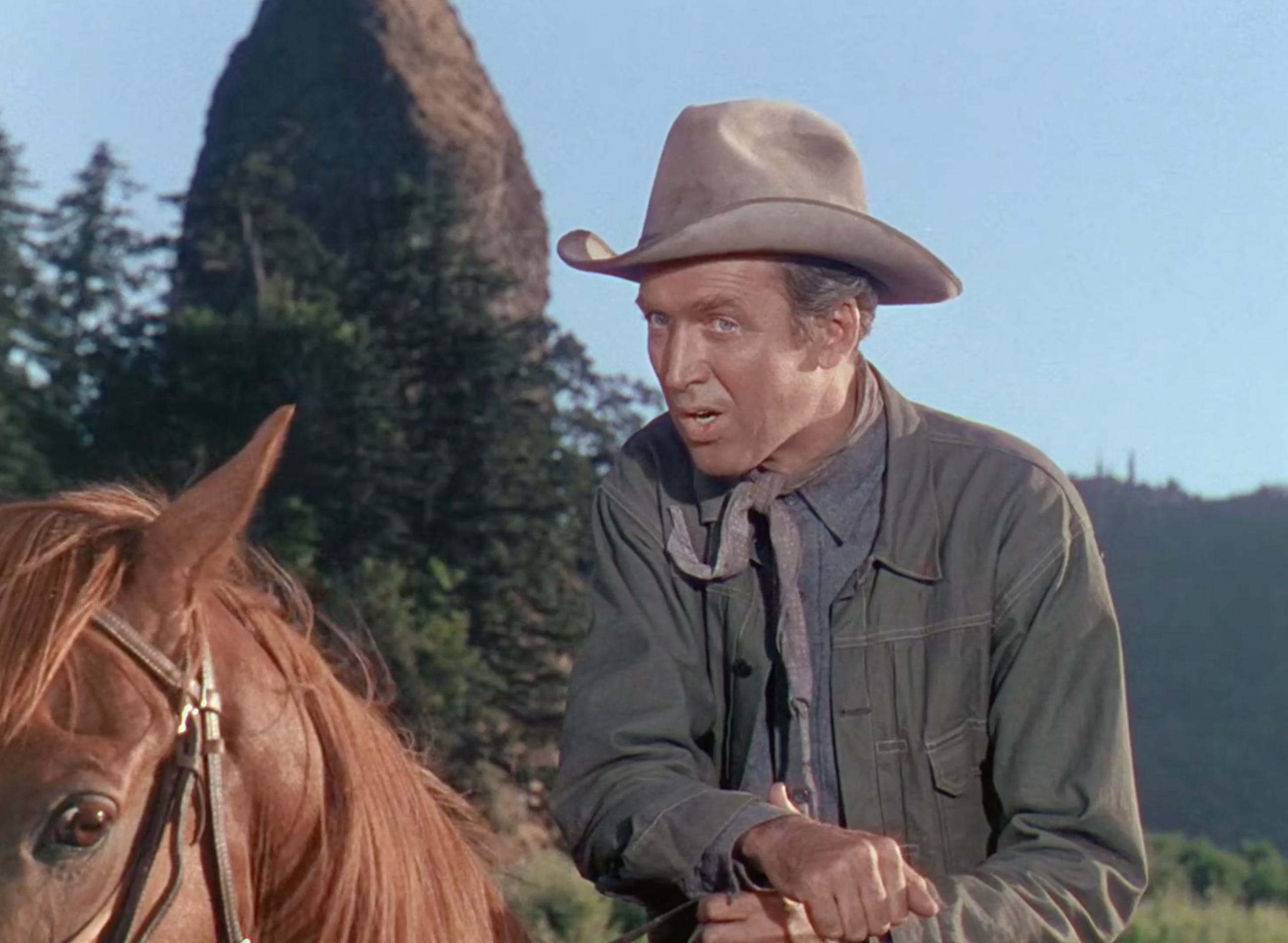
The tenuousness of getting supplies to the settlement, once they’re forcibly taken from Hendricks, is constant, throbbing enough that we need our belief in Cole and McLyntock’s auras to be reinforced. Stewart does this reinforcing with one of the best line deliveries I’ve witnessed in my life. After hired hands balk at continuing on to the settlement, they accuse McLyntock of extortion. One of them exclaims that “the law won’t let you get away with this!” But Stewart assumes an impenetrable and also chiding stoicism, even a darkness. “What law?” he asks, his head bent forward, his mouth made circular, pointing up the right side of his face. Mann cuts away before Stewart chooses to change expressions.
Cole’s eventual double-crossing does the reinforcing too. It is captured by a series of shots so deliberate and bracing in their composition, amid scenery so breathtaking, that the scene lands both with the sense of danger intended by its narrative position and with a stunning, high-altitude sense of possibility, of neutral potential. McLyntock’s laborers have been itching to overtake their boss since miners from a nearby gold camp made a lucrative offer of $100,000 for the settlement’s goods. Cole perhaps registers how McLyntock, being outnumbered, might also be overpowered, and decides to take the lead on this new journey. But Cole hasn’t previously rolled over to temptation, so long as it’s been moderate ($100,000 is quite a dumbfounding number, isn’t it?) He has just been playing the odds, has been looking, casual and unbothered, for advantages. The only marginal sacrifice in securing this particular advantage is committing more violence than usual.
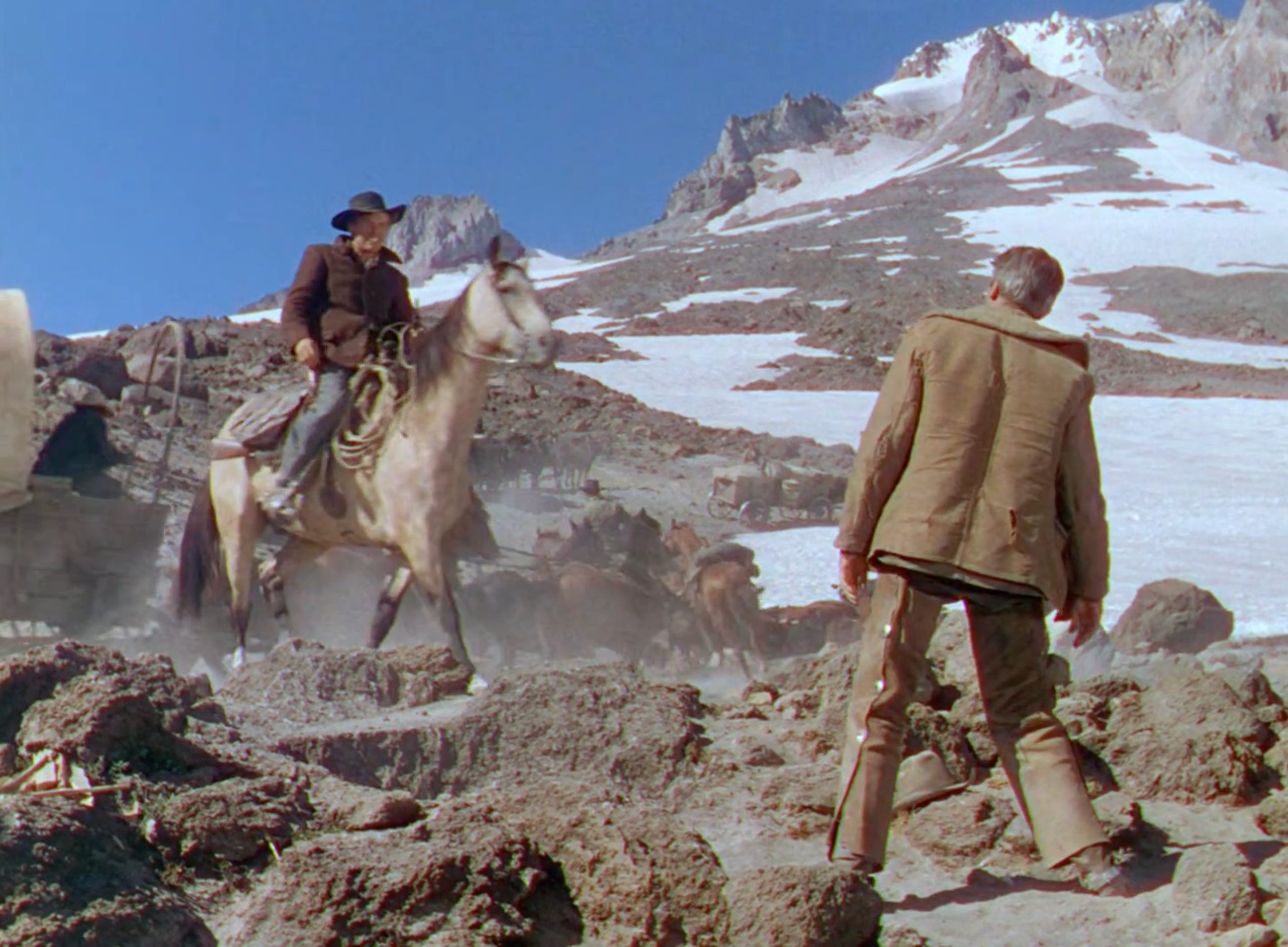
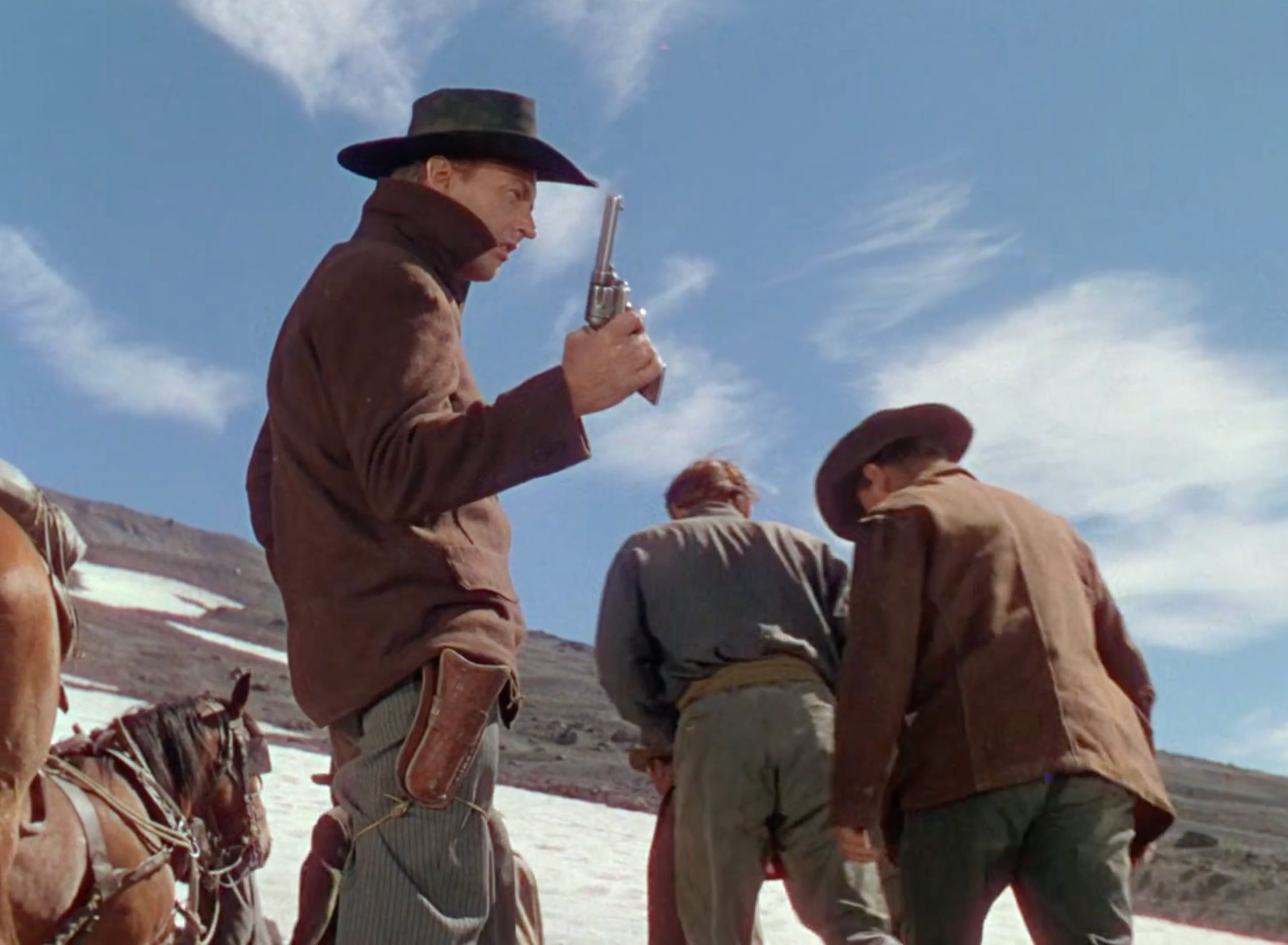
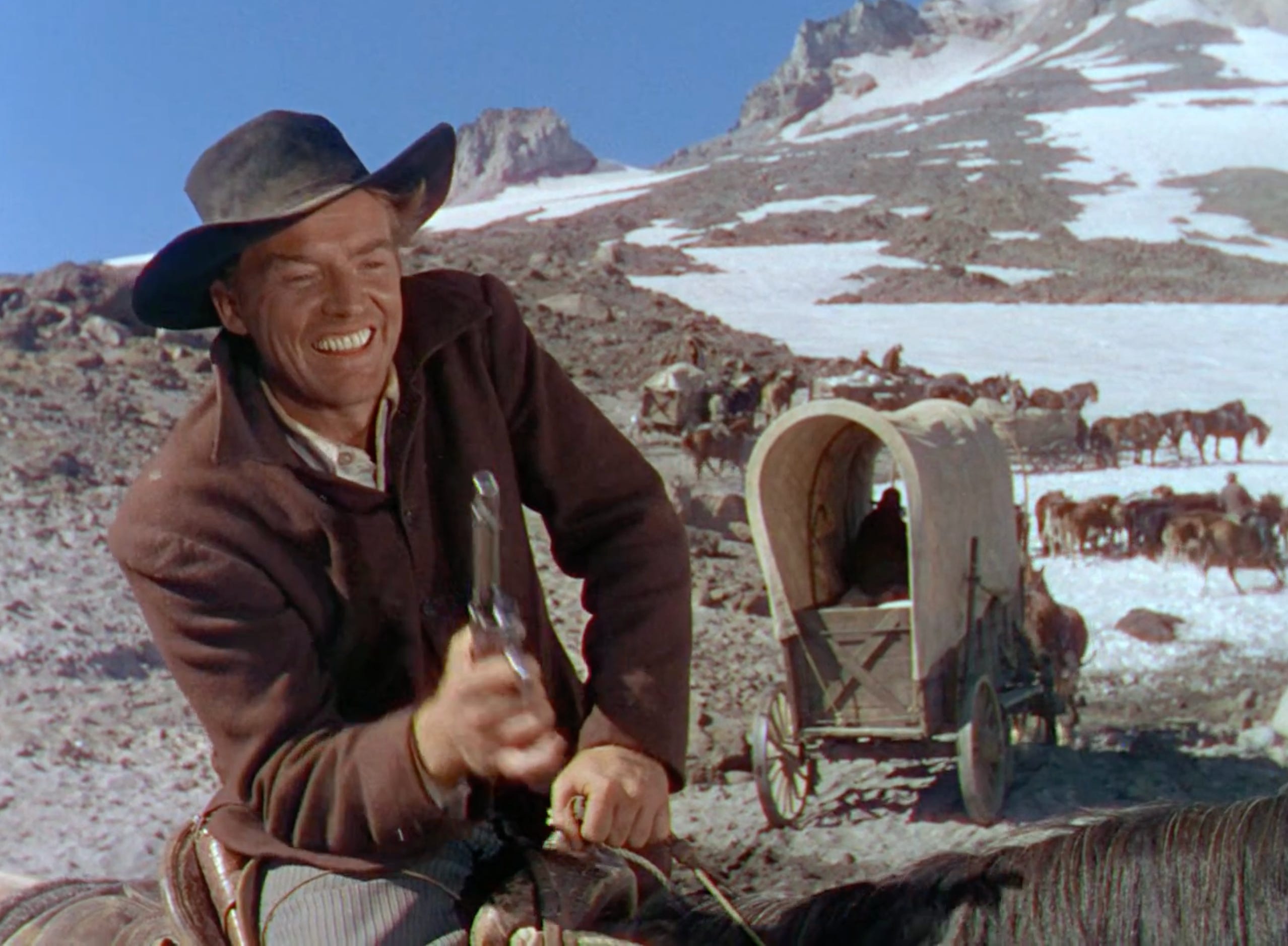
Perhaps I’m being generous. It’s true that Cole wanted to kill all of Hendricks’s men, after he and McLyntock ambushed the entourage, and McLyntock stopped him. But Cole’s only real miscalculation, or indeed his only decision which reminds the viewer of the insufficient space for two cowboys who possess his and McLyntock’s powers, is thinking that his overtaking McLyntock will prove a permanent development. But when McLyntock again gains the upper hand, Cole isn’t easily felled, and not by gunshot. No, these peaks of masculinity we’re witnessing demand a fistfight, which happens when Cole knocks McLyntock out of a covered wagon and into a rushing river. The sounds of physical contact are almost drowned out by the rapids, and the sun’s glare is so hot that it turns our opponents into silhouettes.
What, at bottom, do I want that’s in this structure which Bend of the River contains, which culminates in brutal physical contact? I already mentioned the essence of it: the past summed up with a glance, with a recognized name, a reputation that’s a hair too mysterious to be infamous. I want that economy of meaning, and also those densely layered tensions built from protagonists who are survivors, who are uncommonly able, swaggering, who can go the distance with some combination of clear effort and sufficient good fortune. I want to replicate the pretense to brawl in water, which is having no other recourse, which is having the duty to kill. I want the airtight array of chess pieces, whose paths are plain for the eye to see and yet still not one path could be called a foregone conclusion. A survey of the bare essentials, the narrative equivalent of the first stage of that canonical Western homestead-building: the beams alone.
Which, if I’m being absolutist, Bend of the River can’t claim to possess in the extreme. It’s undercut in a few scenes, which go some way toward muddling the film’s perspective on the characters whose moralities it works so hard to gradate.
There’s this moment where Jeremy thanks the captain who helps the settlers transport goods upriver in his steamboat (that’s how they get ahead of Hendricks, who pursues the group from Portland). No payment is necessary to the captain, because, claims the captain, this is a case of essentially good folks helping other good folks. Jeremy’s clan has come to plant apple trees, you know. But what about McLyntock basically entrapping those Portland layabouts in order to get the food to the settlement? Isn’t Jeremy turning a blind eye to forced labor, or is he ignorant of McLyntock’s methods, and if so, is naïveté more excusable than outright cunning?
But asking these questions is like avoiding the fact that I’ve strayed a bit far from my initial incitement. What I’m describing—my parsing through this film which is based on a book whose author is, in the single instance I observed, not at all convincing—that’s admiration…and really the early consideration of borrowing or stealing the whole or part of a set of ingeniously constructed cinematic rules. If I’m in need of a Western I didn’t create from pieces, then look at the examples of pieces I have to guide me! The least I can do, the next thing I should do, which is indicative of the nascence of this process—and I did promise to give myself the duration of production on two more features, before finding the right source—is jot down a list. I need not limit its use to one genre.
No posts
Comments
Nothing yet. Say the first thing.
Sign in to join the conversation.